If you have ever clicked “Buy” or “Sell” on your trading platform only to notice that your trade opened at a completely different price than what you expected, you have experienced slippage.
Slippage is one of the most misunderstood and frequently overlooked costs of trading currencies. While many beginners focus entirely on broker spreads and commissions, professional traders know that managing slippage is what actually protects a trading edge over the long haul.
This comprehensive guide breaks down exactly what slippage is, why it occurs, how to measure it, and—most importantly—the concrete steps you can take to keep it from eating into your profits.
Interactive Forex Slippage Cost Calculator
Calculate the real hidden financial drag that execution delays and order slip inflict on your account equity.
1.5 Pips
0.0 (Perfect Fill)10.0 (Extreme Gap)
Total Hidden Transaction Drag Cost
-$15.00
Calculated assuming USD base cross-currency liquidation (1 Pip equivalent = $10.00 per Standard Lot).
Calculating risk analysis profile…
1. Defining Slippage in Forex Trading
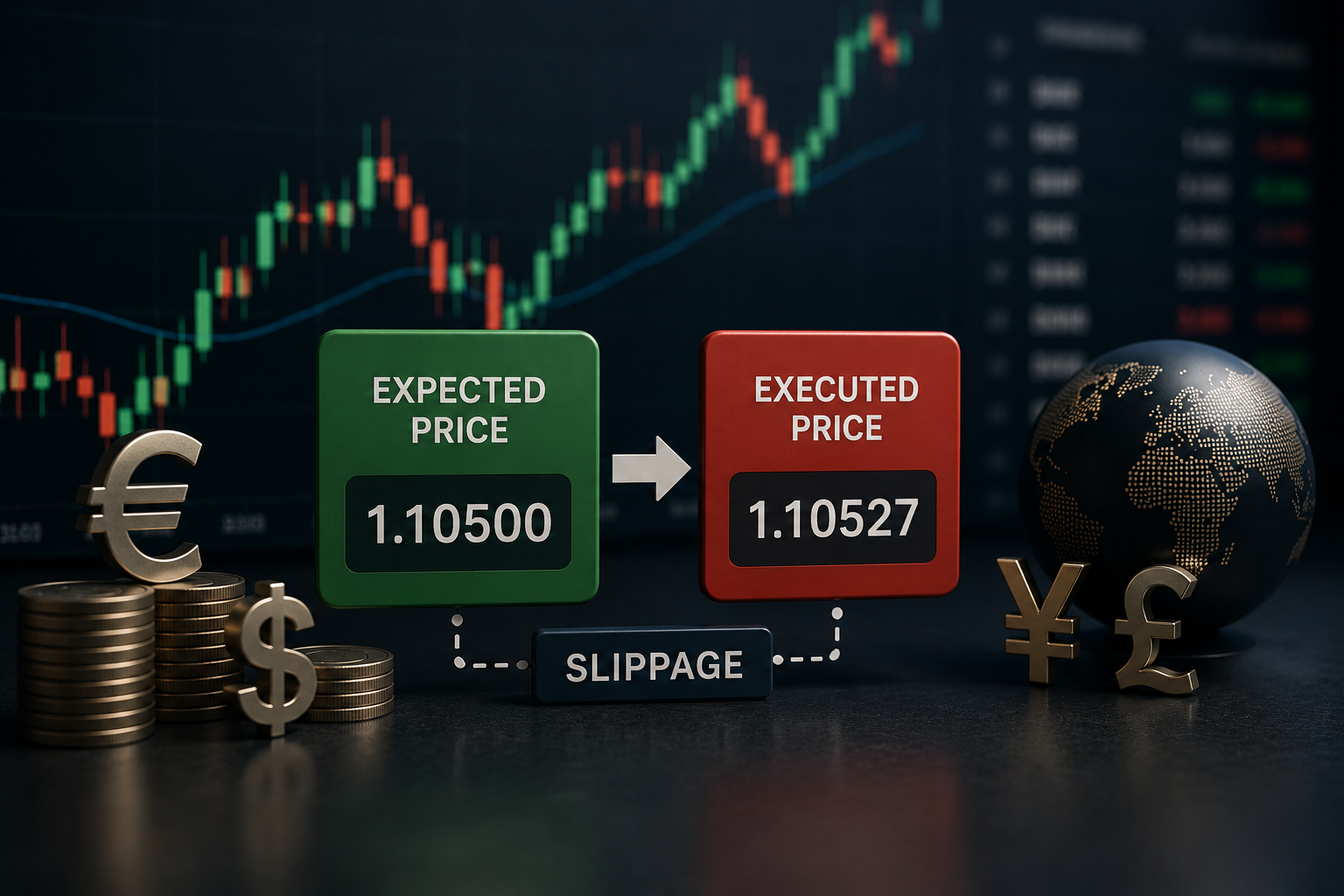
In the foreign exchange (Forex) market, slippage is the difference between the requested price of a trade and the actual price at which that trade is executed by your broker.
When you submit a market order, you are not locking in a static price. Instead, you are instructing your broker to fill your position immediately at the best available price provided by global liquidity providers (like major banks and financial institutions). Because the currency markets move in milliseconds, the price can change during the brief window it takes for your order to travel from your computer to the broker’s execution engine.
As shown in the diagram above, when a market moves or gaps rapidly, your execution price can detach heavily from your intended entry level. Slippage is measured in pips (Percentage in Point), which represent the fourth decimal place in most major currency pairs (e.g., 0.0001).
2. The Two Faces of Slippage: Negative vs. Positive
Slippage is not always a bad thing. Depending on how the market moves during your order’s transmission phase, slippage can work against you or in your favor.
Negative Slippage
This occurs when your trade executes at a worse price than expected, instantly putting your position at a larger initial deficit.
For a Buy (Long) Order: The filled price is higher than requested.
For a Sell (Short) Order: The filled price is lower than requested.
Positive Slippage (Price Improvement)
This occurs when market liquidity shifts favorably while your order is processing, netting you a better price than expected.
For a Buy (Long) Order: The filled price is lower than requested.
For a Sell (Short) Order: The filled price is higher than requested.
The table below illustrates exactly how these two types manifest across different trade setups:
Order Type
Requested Price
Executed Price
Resulting Slippage Type
Impact on the Trader
Buy Market
1.0850
1.0853
Negative
Costs 3 pips more to enter
Buy Market
1.0850
1.0847
Positive
Saves 3 pips on entry
Sell Market
1.3210
1.3206
Negative
Sells for 4 pips less
Sell Market
1.3210
1.3214
Positive
Sells for 4 pips more
Broker Note: Transparent ECN (Electronic Communication Network) and STP (Straight-Through Processing) brokers pass both positive and negative slippage onto the trader. If your broker only hands you negative slippage while pocketing the positive price improvements, it is time to look for a new provider.
3. The Structural Causes of Slippage
Slippage is not an error, nor is it a sign of a “scam” broker; it is a fundamental mechanic of an open electronic marketplace. It is primarily driven by three core variables:
A. High Market Volatility
When high-impact macroeconomic data drops, the market reacts with extreme speed. Prices do not move smoothly from 1.0850 to 1.0860; they jump or “gap” instantaneously. If no market participants are willing to sell to you at 1.0850, your order jumps to the first available seller higher up the ladder.
B. Low Market Liquidity
Liquidity represents the volume of available buy and sell orders waiting in the market’s order book. If you place a large trade in a pair with thin liquidity (like an exotic currency pair), there may not be enough matching orders at your exact price to fill your entire position. The broker has to fill the remainder of your trade at subsequent, less favorable prices.
C. Latency (Execution Speed)
In institutional circles, order processing is known as order latency—the total round-trip time it takes for an order to be transmitted, processed by a matching engine, and confirmed.
Even if you have an ultrafast internet connection, if your broker takes 150 milliseconds to route your order to their liquidity providers, the market has ample time to shift out of your favor.
4. When Does Slippage Peak? (High-Risk Windows)
Slippage probability is not uniform throughout the day. It peaks sharply during specific market environments:
Major Economic Announcements: Releases like the US Non-Farm Payrolls (NFP), Consumer Price Index (CPI) inflation data, and Central Bank interest rate decisions cause liquidity providers to pull their orders to avoid risk. This thins out the order book precisely when retail activity spikes.
The Sunday Market Open: Since retail Forex markets close over the weekend, any major geopolitical event occurring on Saturday or Sunday will cause the market to “gap open” on Sunday evening. Your stop-losses or entry orders sitting inside that gap will fill at the opening price, completely bypassing your intended targets.
The Late New York / Asian Session Transition: Between 5:00 PM and 7:00 PM EST, global banking volume dries up significantly. With fewer institutions providing active quotes, spreads widen, and even small market orders can experience minor slippage.
5. Order Types and Their Slippage Profiles
The specific order type you choose dictates how your broker handles price versus execution certainty.
Market Orders
Market orders prioritize execution certainty over price certainty. The broker is instructed to get you into the market immediately, regardless of what the final price turns out to be.
Slippage Risk: High.
Stop Orders (Stop-Entries & Stop-Losses)
A stop order is a latent instruction that converts into a standard market order the exact millisecond a predetermined price level is touched. Because it turns into a market order, it is fully exposed to slippage.
Slippage Risk: High (particularly dangerous for standard stop-losses during news events).
Limit Orders (Limit-Entries & Take-Profits)
Limit orders prioritize price certainty over execution certainty. You are instructing the broker to only fill your order at your specified price or better. If that price is not available, the trade simply does not execute.
Slippage Risk: Zero negative slippage. It can only experience positive slippage.
6. Real-World Case Study: The Cost of Latency
Let’s look at how small delays can impact your bottom line. Suppose you are trading a fast-moving EUR/USD market during an active London session. You click to buy 5 lots ($500,000 face value) at 1.0920.
The table below breaks down how different infrastructure latency profiles alter your execution costs:
Infrastructure Setup
Average Latency
Execution Price
Slippage Incurred
Financial Impact ($)
Co-located VPS
2 ms
1.0920
0.0 pips
$0.00 (Perfect Fill)
Standard Home Fiber
45 ms
1.0921
-0.1 pips
-$5.00
Lagging/Wi-Fi Connection
180 ms
1.0924
-0.4 pips
-$20.00
High-Volatility News Delay
400 ms
1.0938
-1.8 pips
-$90.00
Over hundreds of trades a year, absorbing an extra 0.5 to 1.5 pips of negative slippage per trade due to poor infrastructure can transform a structurally profitable trading strategy into a losing one.
7. Professional Strategies to Minimize Slippage
While you can never eliminate slippage entirely in a decentralized market, you can significantly mitigate its impact using the following four strategies:
Strategy 1: Transition to Limit Orders
If your trading style allows it, replace market entry orders with limit orders. By using limit orders, you ensure you never chase a market or enter at a disadvantageous price. If the market gaps past your entry level, you miss the trade, but your capital remains entirely protected.
Most professional trading platforms (like MetaTrader 4, MetaTrader 5, or cTrader) allow you to specify a Maximum Deviation or slippage tolerance level within your order panel.
For example, if you set your slippage tolerance to 2 pips, your platform will automatically cancel or reject the order if the broker cannot find a liquidity fill within 2 pips of your requested price.
Strategy 3: Deploy a Trading VPS (Virtual Private Server)
If you utilize automated trading systems, Expert Advisors (EAs), or rely heavily on rapid execution, host your trading platform on a specialized Forex VPS. Ensure the VPS data center is physically located in the same hub as your broker’s execution servers (typically London LD4, New York NY4, or Tokyo TY3). This slashes round-trip latency down to 1–3 milliseconds.
Certain retail brokers offer Guaranteed Stop-Loss Orders. Unlike a standard stop-loss, a GSLO guarantees that your trade will be closed at your exact requested price, even if the market gaps heavily during a news release or weekend open.
Note: Brokers typically charge a small premium or wider spread for this service, acting essentially as an insurance policy against extreme negative slippage.
Summary Checklist for Everyday Traders
To keep your slippage costs to an absolute minimum, incorporate this operational checklist into your routine:
Trade High-Liquidity Hours: Focus the bulk of your trading volume within the London and New York session overlap (8:00 AM – 12:00 PM EST) when market depth is thickest.
Check the Economic Calendar Daily: Step away from market orders at least 15 minutes prior to and after high-impact red-folder news events (CPI, NFP, Interest Rate decisions).
Stick to Major Pairs: Keep your risk tightly controlled by focusing on majors (EUR/USD, USD/JPY, GBP/USD) rather than highly volatile exotic pairs which naturally suffer from wide spreads and erratic liquidity.
Audit Your Execution Quality: Periodically download your trade execution logs and verify if your broker is giving you a fair balance of positive price improvements alongside negative slippage.