The rapid expansion of the digital asset economy has turned cryptocurrencies into a multi-trillion-dollar asset class. However, this decentralized freedom brings a critical responsibility: you are your own bank.
Unlike traditional banking apps, where a lost password can be reset with a quick call to customer support, losing access to your crypto wallet or falling victim to a smart contract hack can instantly permanently erase your digital wealth.
To secure your tokens, you must master the fundamental infrastructure of crypto custody, which is divided into two primary environments: Hot Wallets (Software Storage) and Cold Wallets (Hardware Storage).
Choosing between these two models requires a trade-off between convenience and security. This comprehensive guide breaks down the underlying engineering of both wallet architectures, analyzes their vulnerability profiles, and provides an actionable blueprint to help you implement a secure digital storage system.
Crypto Custody Security Analyzer
Assess your digital storage patterns to identify critical security gaps.
To truly understand wallet security, we must clarify a common misconception: crypto wallets do not actually store cryptocurrency.
All tokens exist entirely as data entries on a decentralized public blockchain ledger. Instead, a crypto wallet stores your private key a 256-bit alphanumeric password that grants cryptographic permission to sign transactions and transfer ownership of those blockchain entries.
What is a Hot Wallet?
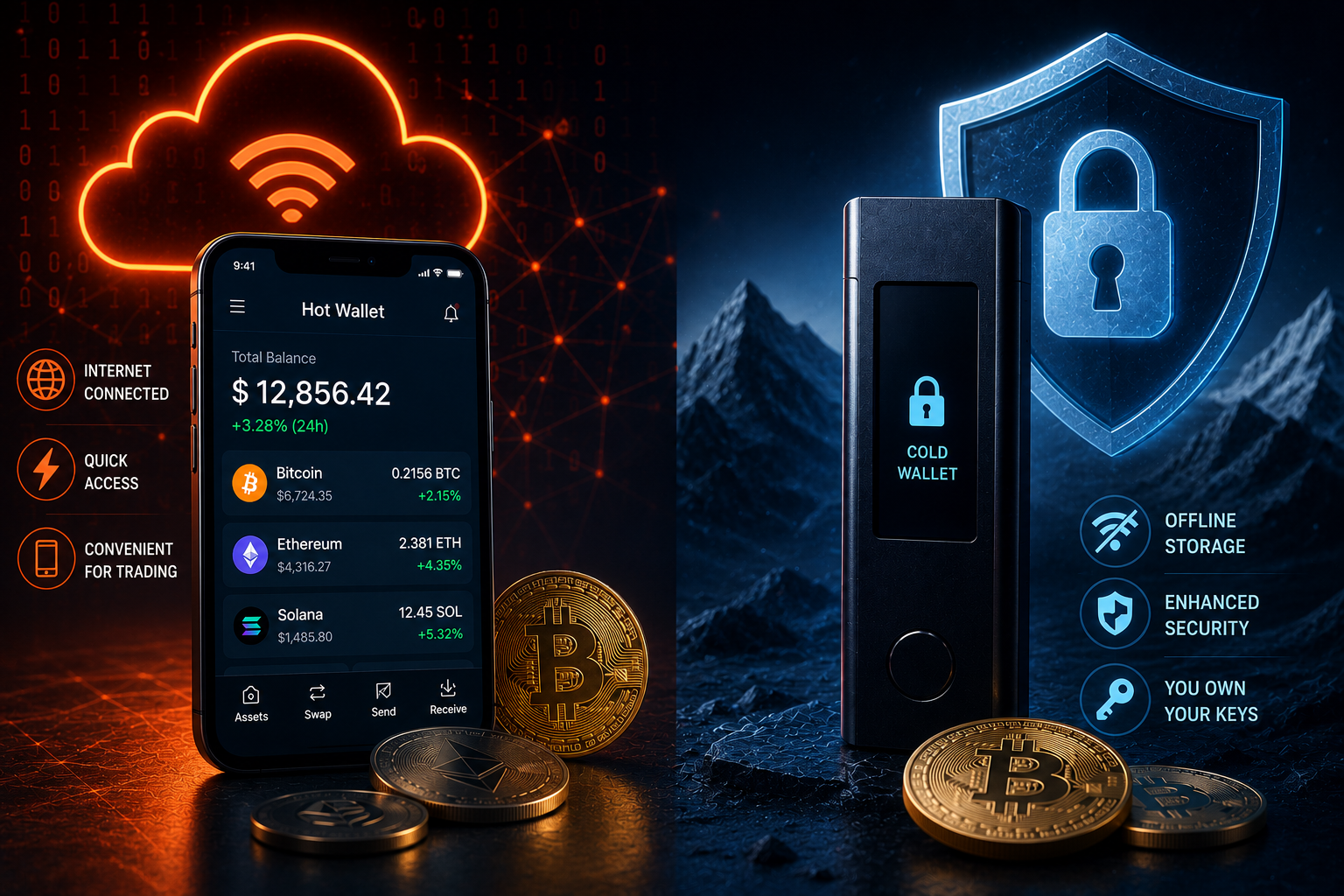
A hot wallet is a software application whose private keys are generated and stored on a device directly connected to the internet (such as a smartphone, laptop, or web browser extension).
Because they maintain a continuous connection to the web, hot wallets offer zero friction when interacting with Decentralized Finance (DeFi) protocols, Non-Fungible Token (NFT) marketplaces, and centralized exchanges. However, this constant connection leaves them vulnerable to digital attack vectors.
What is a Cold Wallet?
A cold wallet is a physical electronic device designed to isolate your private keys completely from the internet and local network environments.
When you setup a cold wallet, the master cryptographic seed phrase is generated completely offline within a secure hardware component. When executing a transaction, the hot interface constructs the data payload online, transfers it via USB or Bluetooth to the physical device, and the device signs the transaction internally before sending it back. Your private key never leaves the physical hardware.
2. Structural Comparison Matrix
To clarify how these storage environments function in day-to-day operations, let’s examine their core structural profiles side by side:
To pick the right setup for your needs, you need to look at how malicious actors exploit each architecture.
How Hot Wallets Are Exploited
Because hot wallets run directly on internet-enabled operating systems (like Windows, macOS, iOS, or Android), they share the same security flaws as those platforms:
Malware and Keyloggers: If you accidentally download a malicious file, spyware can record your screen or track keyboard strokes to steal your seed phrase as you type it.
Malicious Smart Contract Approvals: This is the most common hack in web3. A phisher creates a replica of a popular DeFi platform. When you click “Connect Wallet,” you unknowingly sign a transaction granting the smart contract full permission to drain all tokens from your address. Because the wallet is hot, the exploitation executes instantly.
The Cold Wallet Defense System
Cold wallets counter these digital attack vectors using dedicated security hardware called a Secure Element (SE) the same military-grade chip architecture used in credit cards and passports.
If your computer is infected with a massive Trojan virus, a cold wallet remains protected. Even if a virus alters the transaction data on your computer screen to display a fake destination address, the physical cold wallet screen displays the true blockchain destination directly from its secure hardware. Unless you physically click the manual verification buttons on the device, no capital can leave your account.
4. The Mathematical Realities of Recovery Phrases
Whether you deploy a software or hardware wallet, both systems rely on a BIP-39 Recovery Phrase (typically a sequence of 12 or 24 random dictionary words). This phrase serves as the unencrypted human-readable root from which all your public addresses and private keys are calculated.
The mathematical probability of a hacker randomly guessing or brute-forcing a 24-word seed phrase is $1.15 \times 10^{77}$ combinations a number so vast that even all the supercomputers on Earth running for billions of years could not guess it.
Therefore, the primary security threat is not mathematical; it is human behavioral error. If you write down your seed phrase and save it as a digital screenshot on iCloud, or type it into a text file on Google Drive, you have effectively turned your cold wallet back into a hot wallet, leaving it exposed to web-based cloud server breaches.
5. Step-by-Step Security Blueprint: The Core Wallet Lifecycle
The safest approach to crypto asset management is to use a hybrid custody system that balances operational speed with institutional security.
1.Establish Your Core Financial Cold Vault: Wealth Segregation.
Purchase a hardware wallet directly from an official manufacturer (never buy from third-party resellers like Amazon, as they can be physically tampered with before shipping). Initialize the device completely offline, and write your 24-word seed phrase onto a physical metal plate. Store this plate in a fireproof home safe. Use this address strictly as a vault for assets you plan to hold long term.
2.Deploy an Isolated Hot Wallet for Daily Actions: Operational Buffering.
Install a reputable software browser wallet or mobile app on your clean daily device. This software wallet acts as your checking account. Only fund it with the exact amount of capital you need for near-term trades, NFT mints, or web3 transactions.
When interacting with new web3 applications, use your hot wallet as a security buffer. Never link your master cold storage vault directly to experimental DeFi protocols. Once a month, use a revoke tool (like Revoke.cash) to cancel any open token spending permissions given to web3 protocols.
4.Execute Profits Back to Offline Safety: Secure Offramps.
Once you complete your active trading cycle or take profits on a short-term trend, transfer your surplus digital capital off your hot browser app and send it back to the public address of your offline hardware vault.
Final Summary: Balancing Security and Access
When it comes to securing cryptocurrency, there is no one-size-fits-all solution. Instead, the focus should be on portfolio segregation.
Hot wallets serve as your day-to-day web3 checking account. They offer the fluid access needed to run DeFi swaps, interact with micro-dapps, and manage small trading positions on the fly.
Cold wallets act as your secure savings vault. They offer the isolation required to shield your generational wealth from the growing threat of web-based attacks and smart contract phishers.
By keeping your daily transactional assets separate from your core long-term capital, keeping your seed phrases completely off digital devices, and verifying transactions on physical hardware screens, you build a bulletproof security system designed to safeguard your wealth for years to come.