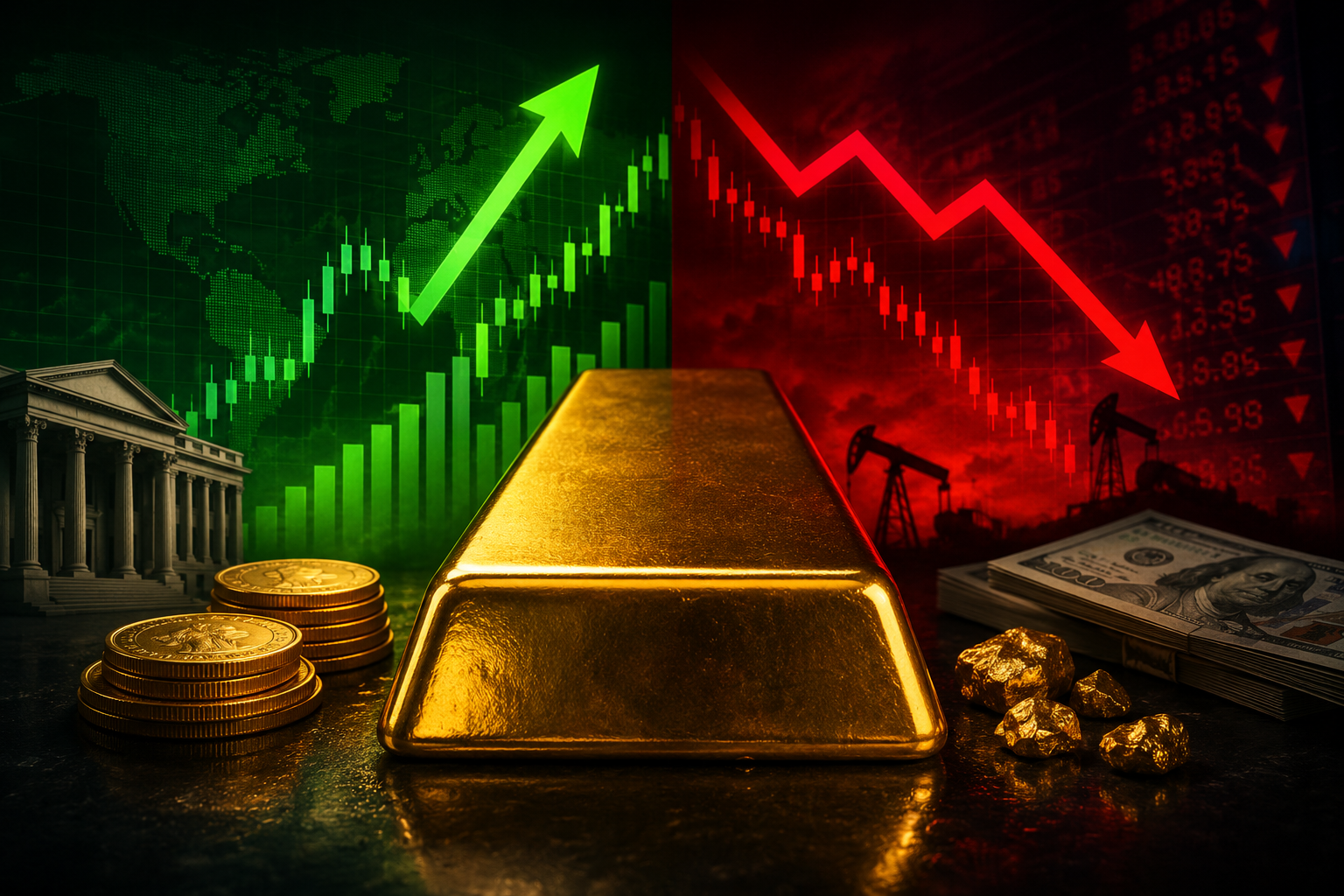
For thousands of years, gold has served as the ultimate store of value, a universal currency, and a financial refuge during times of chaos. But if you watch the financial markets, you will notice that gold prices are constantly in motion surging to historic, record-breaking highs, only to experience sharp, sudden corrections a few months later.
Unlike oil, copper, or wheat, gold is rarely “consumed” by industrial processes. Nearly all the gold ever mined still exists today in vaults, jewelry boxes, and electronics. Because its physical supply is remarkably stable, the price of gold is almost entirely driven by investor psychology, macroeconomic forces, and central bank policy.
Whether you are a retail investor, a gold-bug, or a macro trader, understanding what drives gold prices higher or lower is essential for navigating the markets. This comprehensive guide breaks down the core structural mechanisms that dictate the value of gold, backed by modern market data and economic frameworks.
Gold Scrap & Melt Value Calculator
Calculate the live melt value of your gold jewelry, coins, and bullion.
Est. Live Gold Spot Price:
$4,330.00 / oz
Estimated Melt Value
$810.37
Fine Gold Content: 5.83 grams
Value per gram: $81.04
*Disclaimer: Values are calculations based on structural gold purity melt weights and do not account for refinery fees, dealer premiums, or gemstone weights. Check with a licensed assayer before buying or selling.
1. The Core Macroeconomic Drivers of Gold
Gold operates at the intersection of currency, debt, and inflation. While day-to-day fluctuations can be noisy, long-term trends are dictated by four massive macroeconomic pillars.
Pillar A: The Opportunity Cost & Real Interest Rates
The single most critical concept to understand about gold pricing is opportunity cost. Gold is a non-yielding asset; it pays no dividend, yields no interest, and doesn’t generate quarterly earnings. If you hold a bar of gold, your yield is exactly 0%.
Because of this, gold acts like a mirror to global interest rates specifically real interest rates.
When Real Rates Are High/Rising: If a regular US government bond pays a high interest rate after adjusting for inflation, holding gold carries a steep penalty. Investors dump gold to buy yield-bearing assets, driving gold prices lower.
When Real Rates Are Low/Negative: If interest rates are low or failing to keep pace with runaway inflation, cash and bonds actively lose purchasing power. Under these conditions, a 0% yield on gold looks incredibly attractive. Capital floods into bullion, driving gold prices higher.
Pillar B: The Inverse US Dollar Relationship
Gold is priced globally in US Dollars (USD). This creates a structural, inverse relationship between the greenback and the precious metal.
When the US Dollar Index (DXY) strengthens due to aggressive Federal Reserve monetary policy or strong domestic economic growth, gold becomes more expensive for international buyers using foreign currencies. This curbs global demand and forces the nominal price down. Conversely, when the US dollar weakens or its long-term outlook is questioned due to ballooning structural deficits, gold becomes cheaper globally, triggering an influx of buying pressure.
Pillar C: Inflation and Fiat Purchasing Power
Gold is the traditional antidote to fiat currency debasement. When central banks expand their balance sheets and print money rapidly, the supply of fiat currency grows exponentially, while the supply of gold grows by only about 1.5% to 2% per year through mining.
Historically, during periods of high structural inflation such as the stagflation era of the late 1970s or the post-pandemic supply shocks investors pile into gold to preserve their purchasing power.
2. Supply vs. Demand: The Structural Flow of Gold
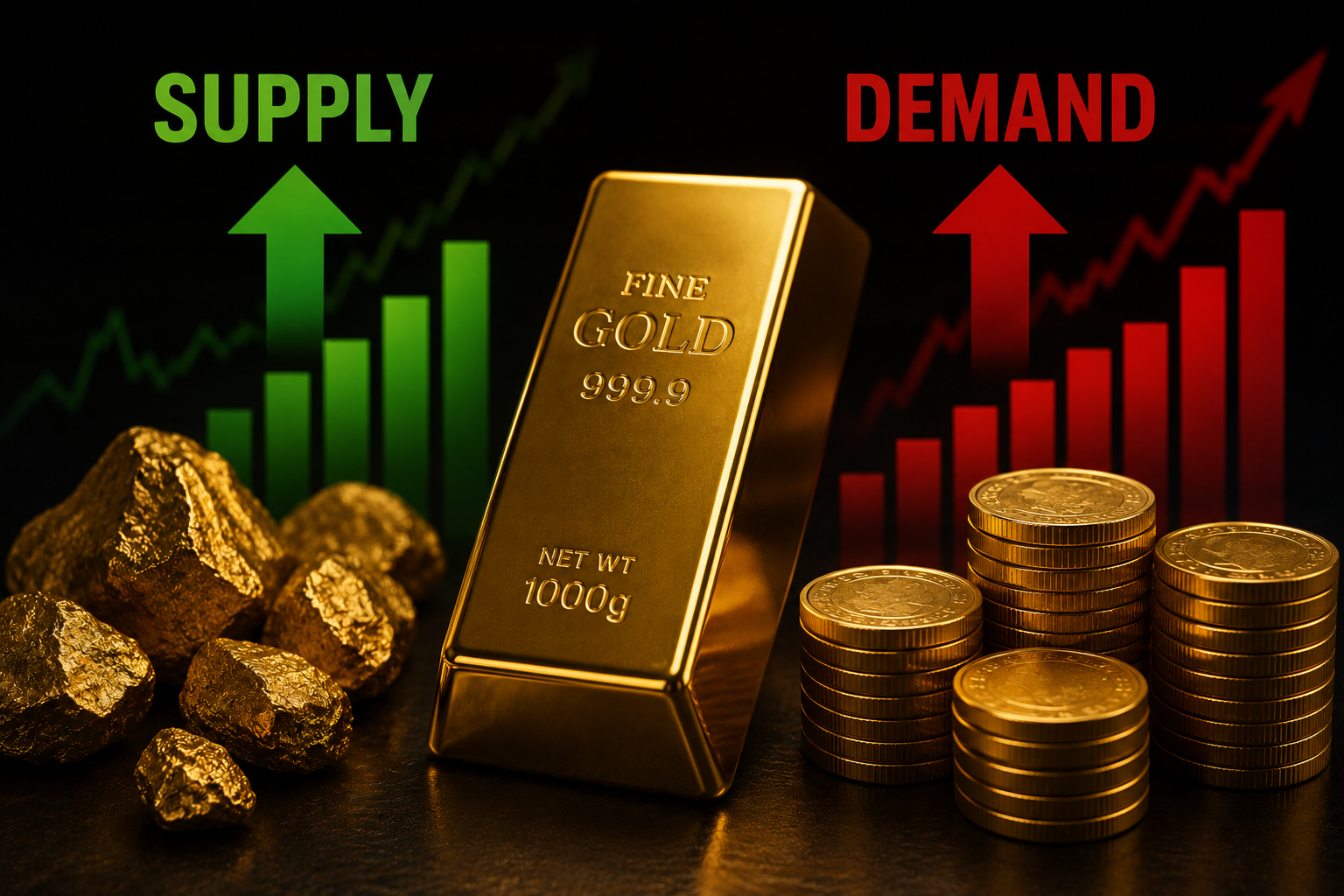
To visualize how the gold market distributes its physical and financial assets, we must look at the balance between where gold comes from and who is buying it.
The Composition of Global Gold Demand
The traditional view of gold is that it is primarily a decorative luxury. However, modern financial dynamics have shifted the equilibrium. High physical prices have triggered a structural pivot: retail consumers are shifting away from jewelry in favor of pure investment vehicles like bullion bars and coins.
Demand Sector
Historical Focus
Modern Market Dynamics
Physical Investment
Bars, sovereign coins, retail hoarding
Now rivals or exceeds jewelry demand during bull cycles. Led by massive retail retail adoption in China and India.
Institutional demand remains far above pre-2022 historical averages as nations seek alternative tier-1 reserve assets.
Technology & Industry
Electronics, semiconductors, medical tools
Small, highly stable baseline of demand (roughly 5-7%), heavily reliant on global high-tech manufacturing health.
The Supply Side: Rigid and Predictable
While demand is highly volatile and psychological, gold supply is notoriously rigid. Increasing mining output is a slow, multi-year capital-intensive process involving exploration, environmental permitting, and massive infrastructure development.
Furthermore, the average All-In Sustaining Cost (AISC) for gold mining has faced persistent upward pressure due to inflation, higher royalties, and declining ore grades globally. Even when prices hit historic highs, supply cannot simply double overnight; it scales marginally, meaning demand surges almost entirely dictate price spikes.
3. Institutional Catalysts: Central Banks and ETFs
While retail investors buy physical coins, the true institutional heavyweights that move billions of dollars in the gold market are Central Banks and Exchange-Traded Funds (ETFs).
Central Bank Accumulation and De-Dollarization
Central banks are among the largest holders of gold on earth. Following Western sanctions and the freezing of foreign exchange reserves in recent geopolitical conflicts, central banks particularly in emerging markets embarked on a massive structural diversification campaign.
Nations are actively rotating out of Western government debt and into physical gold to insulate their reserves from geopolitical and counterparty risk. When central banks buy gold, they take it off the open market and lock it away in deep storage vaults, permanently constricting the circulating supply and putting a hard floor under global prices.
ETF and Futures Inflows
Gold ETFs (like GLD or IAU) allow institutional managers and retail brokerages to buy exposure to gold without taking physical delivery of bars.
The Momentum Multiplier: During macroeconomic expansions or high-yield environments, ETF outflows act as a liquid drag on prices.
The Bull Influx: When institutional sentiment flips bullish due to market volatility or corporate earnings compression, billions of dollars rush into gold ETFs within days. The funds must back these shares by purchasing physical bullion on the spot market, creating a massive upward spiral in price momentum.
4. The Fear Index: Geopolitics and Systemic Risk
Gold is often called the “crisis commodity.” Unlike fiat currencies, equities, or corporate bonds, gold cannot go bankrupt, default, or be inflated out of existence by political decree.
Geopolitical Shocks
When military conflicts ignite, trade wars accelerate, or sweeping international tariffs are announced, international market dynamics change instantly. Capital flees vulnerable international equities and flows directly into safe-haven liquid assets. Gold prices react rapidly to headlines of geopolitical escalations, pricing in a “risk premium” that reflects systemic instability.
Sovereign Debt Concerns and Equity Volatility
When major economies face ballooning debt-to-GDP ratios, or when stock markets reach stretched, highly unstable valuations, institutional investors look for portfolio hedges. Gold possesses a low-to-negative correlation with equities during major market corrections, making it an essential diversification asset for modern portfolios.
5. Summary Matrix: What Drives Gold Higher vs. Lower?
To give you a quick, actionable reference point for analyzing market conditions, use this structural cheat sheet to evaluate the primary forces acting on gold prices:
Economic Indicator
Direct Impact on Gold
Structural Market Mechanism
Rising Real Interest Rates
Lowers Price
Yield-bearing bonds become highly attractive; the opportunity cost of holding non-yielding gold rises.
Falling Real Interest Rates
Raises Price
Cash and fixed income lose purchasing power; capital flees to gold to preserve absolute wealth.
Strengthening US Dollar (DXY)
Lowers Price
Gold becomes more expensive for international buyers holding non-USD currencies, dampening global demand.
Weakening US Dollar (DXY)
Raises Price
Bullion becomes cheaper on the international stage, encouraging widespread institutional and foreign buying.
Sovereign De-Dollarization
Raises Price
Central banks aggressively buy physical bullion to diversify their reserve tier away from fiat debt instruments.
Geopolitical Escalation
Raises Price
Capital seeks absolute safety away from banking systems, inflating the global “safe-haven risk premium.”
Stretched Stock Valuations
Neutral to Bullish
Triggers portfolio rebalancing as institutional managers look to hedge against potential equity market drawdowns.
Surging Mine Production
Neutral to Bearish
Marginally increases global supply, though usually offset or easily absorbed by physical investment cycles.
The Bottom Line
Gold is far more than a glittering ornament it is a complex financial instrument that behaves like an international currency without a central bank. Its price is determined by a continuous tug-of-war between interest rates, the strength of the US dollar, central bank accumulation strategies, and the overall level of global anxiety.
When confidence in the global monetary system, fiat currencies, and political stability falls, gold thrives. When the economy is booming, interest rates are high, and peace prevails, gold takes a backseat to growth-oriented assets. By tracking these structural macroeconomic indicators, you can look past short-term market noise and clearly identify the long-term structural trends moving the gold market.