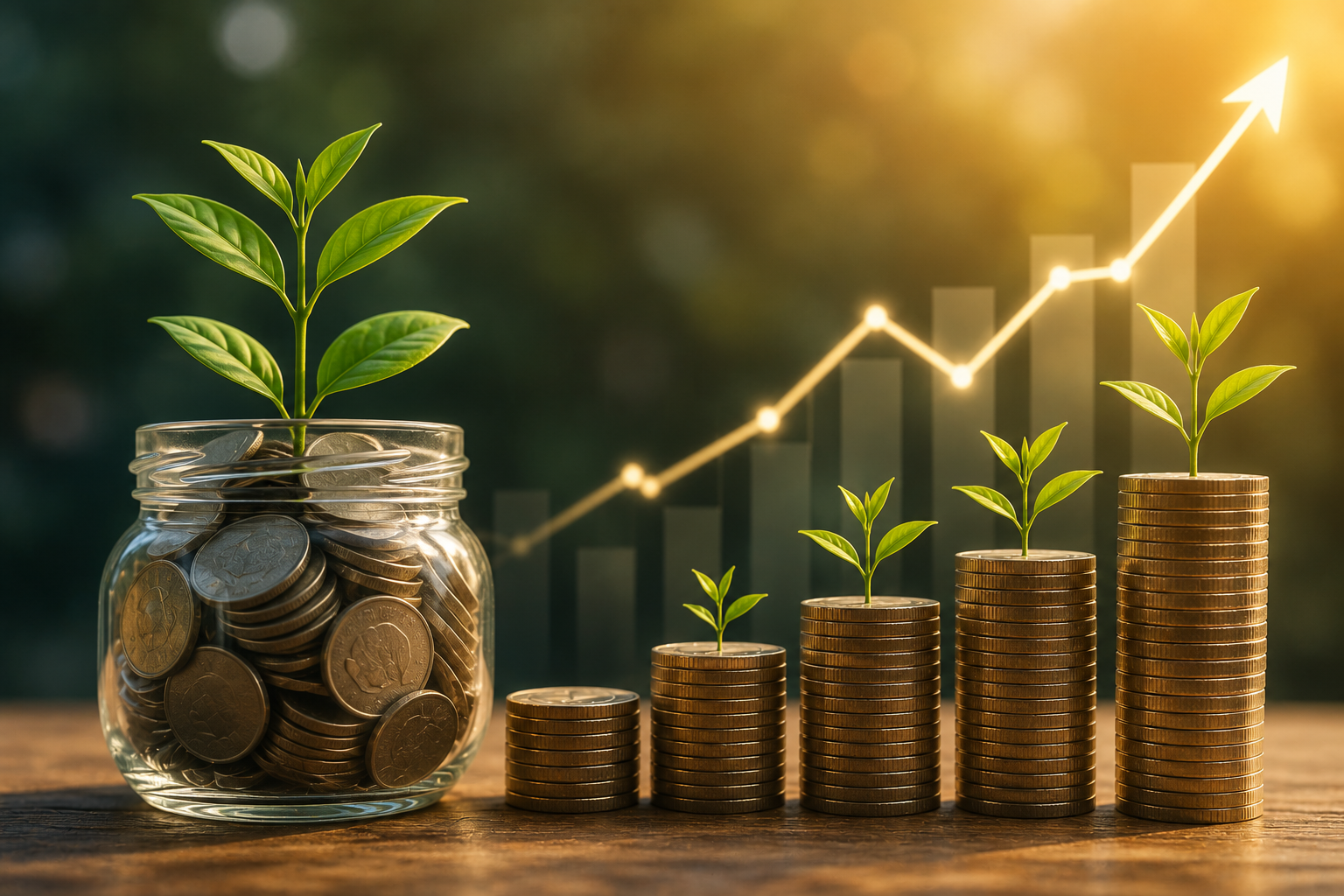
Imagine planting a single seed in your backyard. Over time, that seed grows into a tree. That tree then drops its own seeds, which grow into more trees, which eventually drop their own seeds. What started as a solitary plant quietly transforms into a massive, self-sustaining forest.
In the financial world, compound interest is that forest.
Often referred to as the eighth wonder of the world, compound interest is the foundational mechanism behind almost every self-made fortune. It is not a get-rich-quick scheme or a complex trading strategy reserved for Wall Street professionals. Instead, it is a mathematical reality available to anyone who understands how to leverage time and consistency.
This comprehensive guide will break down what compound interest is, how it works, why it is essential for building wealth, and how you can deploy it in today’s shifting financial environment.
Interactive Compound Interest Calculator
Adjust the sliders below to see how time, interest rates, and regular contributions drastically change your long-term wealth trajectory.
Estimated Future Balance$0.00
Total Principal Invested$0.00
Total Interest Accrued$0.00
Understanding the Basics: What Is Compound Interest?
To fully appreciate the mechanics of compounding, it helps to contrast it with its simpler sibling: simple interest.
Simple Interest: You earn interest only on your original investment, known as the principal. The amount of interest you make stays identical every single period.
Compound Interest: You earn interest on your original principal plus any interest that has already been added to your account. In other words, you are earning interest on your interest.
Historically, this concept has deep roots. Financial systems have utilized compound interest since ancient civilizations to systematically grow assets and determine long-term value. Today, it remains the ultimate wealth-building accelerator.
The Compound Interest Formula
For those who like to see the underlying machinery, the mathematical formula used to calculate compound interest is:
A = P \left(1 + \frac{r}{n}\right)^{nt}
Where:
A = the future value of the investment or loan, including interest
P = the principal investment amount (the initial sum of money)
r = the annual interest rate (decimal)
n = the number of times that interest is compounded per year
t = the number of years the money is invested for
The true magic of this equation lies in the exponent (nt). Because time (t) sits in the exponent position, the growth of your money is not linear; it is exponential.
Simple vs. Compound Interest: A Visual and Tabular Comparison
Let us look at a practical example to see how this plays out in real life.
Suppose you invest $10,000 at a 10% annual interest rate for 30 years. The table below illustrates the stark difference between simple interest and compound interest over various intervals.
Wealth Accumulation Over Time ($10,000 Initial Investment at 10% APR)
Year
Total Wealth (Simple Interest)
Total Wealth (Compound Interest)
The Compounding Difference
0
$10,000
$10,000
$0
5
$15,000
$16,105
$1,105
10
$20,000
$25,937
$5,937
15
$25,000
$41,772
$16,772
20
$30,000
$67,275
$37,275
25
$35,000
$108,347
$73,347
30
$40,000
$174,494
$134,494
As you can see, during the first five years, the difference between simple and compound interest is relatively minor. However, by year 30, the simple interest account has grown to $40,000, while the compound interest account has exploded to $174,494. This massive gap is the result of your money pulling its own weight over decades.
How Compound Interest Builds Wealth: The Three Key Pillars
Compounding does not happen overnight. It relies on a specific set of variables that work together to maximize your returns. If you want to use this mechanism to achieve true financial independence, you must focus on three core components.
1. The Critical Element of Time
Time is the single most powerful variable in the compound interest equation. Because the growth is exponential, the real explosive acceleration happens in the later years of an investment journey.
Consider two friends, Alex and Taylor:
Alex starts investing at age 20. He invests $300 a month at an 8% annual return. He stops contributing entirely after 10 years (at age 30) and just lets the money sit. In total, he contributed $36,000.
Taylor waits until age 30 to start. She invests the exact same $300 a month at the same 8% return, but she continues to contribute every single month for 35 years until she reaches age 65. In total, she contributed $126,000.
Who ends up with more money at age 65?
Remarkably, Alex wins. Even though he contributed for only 10 years, his money had an extra decade to compound in the background. Alex finishes with roughly $540,000, while Taylor finishes with around $450,000. This highlights a critical rule of personal finance: starting early matters more than saving large sums later in life.
2. Frequency of Compounding
The frequency with which your interest is calculated and added back to the principal matters. Interest can compound on various schedules:
Annually (1 time per year)
Quarterly (4 times per year)
Monthly (12 times per year)
Daily (365 times per year)
The more frequently your interest compounds, the faster your wealth accumulates. While the difference between monthly and daily compounding on a small balance may seem like pocket change, across a massive portfolio over 40 years, it equates to thousands of extra dollars.
3. The Rate of Return (Yield)
Your interest rate or investment return dictates the slope of your growth curve. A higher rate of return means your money multiplies faster. However, higher returns always come with increased risk. Striking a healthy balance through diversified investments, like index funds or exchange-traded funds (ETFs), is generally the safest way to maintain a strong long-term yield.
Current Economic Outlook: Compounding in Today’s Financial Climate
Understanding compound interest is particularly vital right now. Global economies are experiencing significant shifts that directly impact how everyday people save and invest.
Recent insights from international organizations highlight both opportunities and challenges for modern investors:
Elevated Interest Rates and Yields: Central bank monetary policies globally have kept interest rates relatively high to combat sticky inflation trends. For savers, this means that high-yield savings accounts (HYSAs) and certificates of deposit (CDs) are offering some of the best guaranteed returns seen in decades. It is an ideal environment to let short-term cash compound safely.
The Threat of Inflation: Compounding can also work against you if your cash is sitting under a mattress. With ongoing global fiscal pressures and economic reallocations, inflation acts like negative compound interest. If inflation is at 3% and your bank account pays only 0.5%, your purchasing power is actively compounding downward.
The Literacy Gap: Recent global financial literacy studies confirm that a solid grasp of foundational concepts like diversification and compound interest directly correlates with smarter investor choices and long-term asset building. Individuals who actively educate themselves are much more likely to make aggressive, productive choices with their portfolios rather than letting fear stall their wealth creation.
To counteract modern economic headwinds, relying solely on traditional savings accounts is rarely enough. Investors must look toward the stock market, real estate, and other compounding assets to outpace the rising cost of living.
The Double-Edged Sword: When Compounding Works Against You
While compound interest is an incredible asset for savers and investors, it can be equally devastating when you are the borrower.
When you carry consumer debt, such as high-interest credit card balances, compounding flips into reverse. Credit card companies typically compound your interest daily. If you carry a balance of $5,000 at a 22% annual percentage rate (APR), you aren’t just paying interest on the items you bought; you are paying interest on yesterday’s interest.
Debt can quickly spiral out of control because the math working against you is identical to the math that builds wealth for an investor. This is why personal finance experts universally recommend paying off toxic, high-interest debt before aggressively building a long-term investment portfolio.
Practical Ways to Harness the Power of Compound Interest
Knowing how compounding works is only half the battle. To actually use it to build wealth, you must implement specific, actionable habits into your financial life.
1. Pay Yourself First
The concept of “paying yourself first” is a cornerstone of wealth generation. Instead of budgeting by spending your income on bills and entertainment and then saving whatever is left over, you flip the script. As soon as you receive a paycheck, immediately route a designated percentage (such as 10% or 20%) into your savings and investment accounts. Treat your future self like your most important monthly bill.
2. Automate Your Contributions
Human beings are prone to emotion, procrastination, and impulse spending. The easiest way to protect your wealth from your own bad habits is automation. Set up automatic transfers from your checking account to your investment account to occur the day after every payday. This ensures consistent, disciplined investing without requiring daily willpower.
3. Reinvest Your Dividends
When you invest in stocks or mutual funds, companies often pay out a portion of their profits to you in the form of dividends. If you take those dividends and spend them on groceries or gadgets, you cut your compounding tree down before it can fully mature.
Instead, enroll your accounts in a Dividend Reinvestment Plan (DRIP). A DRIP automatically uses your dividend payouts to purchase more shares of that investment. This ensures that your portfolio growth remains uninterrupted and fully exponential.
Step-by-Step Blueprint: Your Compounding Action Plan
If you want to start building an exponential money machine today, follow this simple blueprint:
Crush your debt: Prioritize paying off any debt carrying an interest rate higher than 7% to stop negative compounding in its tracks.
Establish an emergency fund: Park three to six months worth of living expenses in a high-yield savings account so you never have to raid your long-term investments during a crisis.
Grab free money: If your employer offers a retirement account match (like a 401k match), contribute enough to get the full amount. This is an instant, 100% return on your investment.
Open a brokerage or retirement account: Set up an account with a reputable, low-fee custodian and select broad-market index funds that historical trends show grow over time.
Automate and ignore: Let the system run automatically. Avoid the temptation to constantly check your balance or panic during temporary market downturns.
Summary: Patience Is Your Ultimate Leverage
The greatest challenge of compound interest isn’t the mathematics; it’s the psychology. In a modern society addicted to instant gratification, waiting decades for an investment portfolio to mature requires an immense amount of discipline.
During the first few years of your investing journey, the progress will feel slow. You might feel like your sacrifices aren’t yielding results. But if you maintain consistency, pay yourself first, and respect the element of time, you will eventually reach the tipping point where your accumulated interest earns more money each month than your actual job.
Start planting your financial seeds today, protect them from debt, and give them the time they need to grow. Your future financial security depends on it.