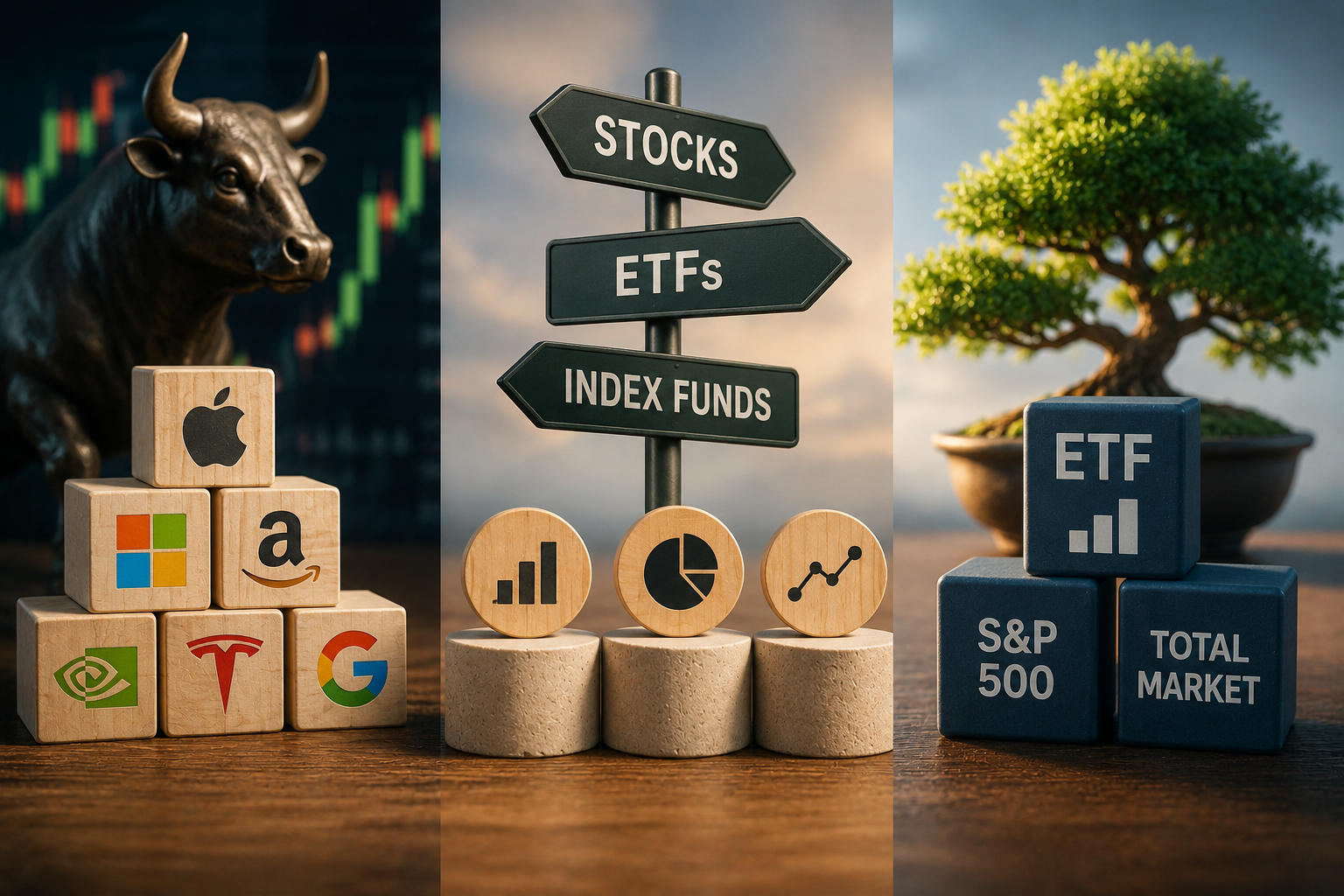
Building a modern investment portfolio can feel overwhelming. The financial world is packed with competing advice, acronyms, and flashing market screens. If you want to put your money to work in the stock market, you will quickly find yourself facing a fundamental choice: should you buy individual stocks, exchange traded funds (ETFs), or index funds?
The path you choose will directly dictate your portfolio’s risk level, the amount of time you spend managing your money, and your long term investment returns.
This deep dive guide will break down the precise definitions of these three vehicles, weigh their pros and cons, analyze recent market shifts, and help you select the exact strategy that matches your wealth building goals.
Interactive Portfolio Visualizer
Select an investing style to see an optimized allocation strategy matching your goals.
Portfolio Breakdown
Index Funds: 80%
Core/Sector ETFs: 20%
Individual Stocks: 0%
The Set-and-Forget Strategy
Designed for hands-off investors looking for low-cost, steady compounding. Capital is concentrated entirely into major broad-market funds like S&P 500 options to capture complete economic trends.
Strategic Match: Which Path Matches Your Financial DNA?
To clarify your selection, let us compare how these assets fit different profiles across the modern investment landscape.
If Your Primary Goal Is…
The Ideal Vehicle Is…
Key Tactical Justification
Maximizing long term savings with zero daily maintenance
Broad Index Funds or Core ETFs
Automating index fund contributions ensures steady compounding based on global economic growth without requiring constant oversight.
Gaining targeted exposure to a hot industry or specialized trend
Sector Specific or Thematic ETFs
Vehicles tracking specialized hardware or clean energy allow you to invest in a macro trend while avoiding the risk of a single business model failing.
Outperforming the market and enjoying deep balance sheet research
Individual Stocks
Concentrating your capital into deeply researched, competitively protected companies provides the only legitimate pathway to outperforming the market average.
Defining the Contenders: Individual Stocks, ETFs, and Index Funds
Before comparing these assets, we need to strip away the financial jargon and look at exactly what you are purchasing with each vehicle.
1. Individual Stocks (Direct Ownership)
A stock represents a fractional ownership share in a single specific corporation. When you buy shares of a single company, your financial outcome is bound entirely to that business. If the company crushes its earnings, expands its market share, and innovates, your investment can skyrocket. Conversely, if the company suffers a major regulatory setback, structural disruption, or poor leadership, you can lose your entire investment.
Investing in individual stocks gives you absolute control, but it places the burden of research, monitoring, and diversification squarely on your shoulders.
2. Index Funds (The Broad Basket)
An index fund is a pooled investment vehicle designed to track a specific, pre existing market index. The most famous example is the S&P 500, which tracks the performance of roughly 500 of the largest publicly traded corporations in the United States.
When you buy a single share of an S&P 500 index fund, your money is automatically spread across all 500 companies. You do not need to choose individual winners or losers. Instead, you are betting on the growth of the broader economy. Index funds are famous for their passive management style, which keeps operating fees incredibly low.
3. ETFs: Exchange Traded Funds (The Modern Wrapper)
An Exchange Traded Fund is highly similar to an index fund because it holds a diversified basket of underlying securities. However, the critical difference lies in how it is bought and sold. While traditional index funds settle prices just once a day after the market closes, ETFs trade actively on public stock exchanges throughout the day, exactly like individual stocks.
This means ETF prices fluctuate second by second during market hours, giving investors massive flexibility, intra day liquidity, and access to unique, targeted strategies.
The Core Structural Differences
Understanding how these assets operate mechanically is essential for efficient portfolio design. Let us compare them across four critical areas.
Liquidity and Trading Mechanics
Individual stocks and ETFs share identical trading mechanics. You can place market orders, limit orders, or stop losses at 10:30 AM or 2:15 PM and receive an instantaneous execution price.
Traditional index funds operate on a delayed timeline. When you submit an order to buy or sell an index fund, your transaction is held until the market closes at 4:00 PM Eastern Time. The fund manager calculates the Net Asset Value (NAV) of the fund’s total assets, and your trade executes at that single closing price.
Expense Ratios and Fees
Owning individual stocks carries zero ongoing management fees, as you own the underlying equity directly.
Because ETFs and index funds require a financial institution to manage the basket of holdings, they charge an annual fee known as an expense ratio. This fee is a tiny percentage deducted automatically from your returns. For basic passive index funds and core ETFs, these fees are near zero, often ranging from 0.03% to 0.10% per year. However, specialized, thematic, or actively managed ETFs can carry significantly higher expense ratios that eat into your long term gains.
Minimum Investment Thresholds
Modern brokerages have largely eliminated the barriers to stock and ETF investing by offering fractional shares, allowing you to start investing with as little as $1 to $5.
Traditional index funds, particularly those managed by firms like Vanguard or Fidelity, frequently require fixed minimum initial investments, sometimes ranging from $1,000 to $3,000 to open a position.
Diversification and Risk Allocation
If you put $10,000 into one individual stock, your portfolio concentration risk is 100%. If that company fails, your money vanishes.
If you put that same $10,000 into a broad market index fund or ETF, your capital is instantly diversified across hundreds or thousands of global enterprises. This diversification protects your portfolio from the collapse of any single business entity.
The Pros and Cons of Individual Stock Investing
The Advantages
Uncapped Upside Potential: The ultimate draw of stock picking is the chance to outpace the market. While an index fund might yield a steady 8% to 10% annualized return, finding an early stage market leader can return hundreds or thousands of percent over a decade.
Granular Control over Values and Taxes: You decide exactly which businesses earn your financial support. Furthermore, you control when to trigger capital gains or harvest capital losses for tax optimization.
The Disadvantages
High Vulnerability to Volatility: Individual stocks experience massive price swings driven by quarterly earnings reports, product recalls, or shifting executive leadership.
Extensive Time Requirements: To pick stocks successfully, you must commit to analyzing balance sheets, evaluating competitive advantages, listening to corporate earnings calls, and staying on top of industry developments.
The Pros and Cons of ETFs and Index Funds
The Advantages
Instant, Reliable Diversification: You capture the collective returns of an entire sector, country, or global index in a single transaction.
True Passive Management: They require zero daily maintenance. You can set up automated monthly contributions and let compounding do the heavy lifting over decades.
Structural Tax Efficiency: ETFs utilize a unique creation and redemption mechanism that allows them to trade underlying shares via in kind transfers, drastically minimizing the capital gains distributions passed on to everyday investors.
The Disadvantages
No Opportunity to Beat the Market: By design, a passive index fund aims to copy the market, meaning you will never achieve market beating, legendary alpha returns.
Exposure to Underperforming Companies: When you buy a broad market index, you are buying the bad companies alongside the elite performers.
Current Trends in Portfolio Construction
The dynamic between individual stocks and fund vehicles is shifting due to changing macroeconomic forces and massive institutional asset flows.
A comprehensive market review by State Street Global Advisors highlighted a historic shift in how investors deploy capital. Global inflows into ETFs have surged, accelerating toward the multi trillion dollar mark. This massive scale is completely changing the landscape, with ETFs evolving from basic passive tracking tools into the structural backbone of modern wealth management.
According to data compiled by ETF Database, retail and institutional investors are increasingly favoring low cost, giant core funds to anchor their wealth. For instance, the Vanguard S&P 500 ETF (VOO) recently crossed a historic milestone, surpassing $1 trillion in assets under management. This massive concentration highlights a growing desire among investors for broad, low cost equity exposure as their core holding.
However, the nature of these inflows reveals a highly tactical approach to today’s market. Rather than buying blindly, investors are using specialized funds to navigate a unique economic environment. Two major trends stand out:
The Resurgence of International Diversification: Worried about valuation spikes and concentration risk in U.S. large cap tech indices, investors are moving substantial assets into global funds like the Vanguard Total International Stock ETF (VXUS) and emerging market vehicles to catch lower valuations worldwide.
Targeted Artificial Intelligence Infrastructure: Instead of chasing individual, volatile software stocks, investors are piling capital into specialized hardware, semiconductor, and computer memory ETFs to gain diversified exposure to the entire AI physical infrastructure loop.
This structural trend highlights why broad index products remain the gold standard for core asset allocation. They allow you to ride major economic waves without taking on the extreme risk of picking an individual company that might falter under heavy competition.
Crafting the Perfect Hybrid Strategy: The Core and Satellite Model
You do not have to choose just one path. The most successful investors frequently deploy a framework known as the Core and Satellite Strategy to get the best of both worlds.
Building the Core (70% to 80% of Wealth)
The vast foundation of your portfolio is placed into low cost, highly diversified instruments like S&P 500 ETFs, total stock market index funds, or international equity funds. This capital acts as your steady wealth builder, mirroring the resilient long term upward trend of global markets.
Launching Satellites (10% to 30% of Wealth)
The remaining, smaller portion of your capital is reserved for selective, tactical allocations. This is where you can buy individual stocks you thoroughly research, make concentrated sector bets via specialized ETFs, or explore innovative themes.
This hybrid structure ensures that even if one of your individual stock selections underperforms, your fundamental retirement security remains perfectly safe, anchored by your diversified index holdings. By establishing this clear division, you protect your capital from emotional decision making while maintaining the freedom to explore unique market opportunities.
For a deeper look into how professional fund managers analyze equity allocations and thematic fund flows, you can check out the educational resources and analysis provided by the Financial Industry Regulatory Authority at FINRA Investors Insights.