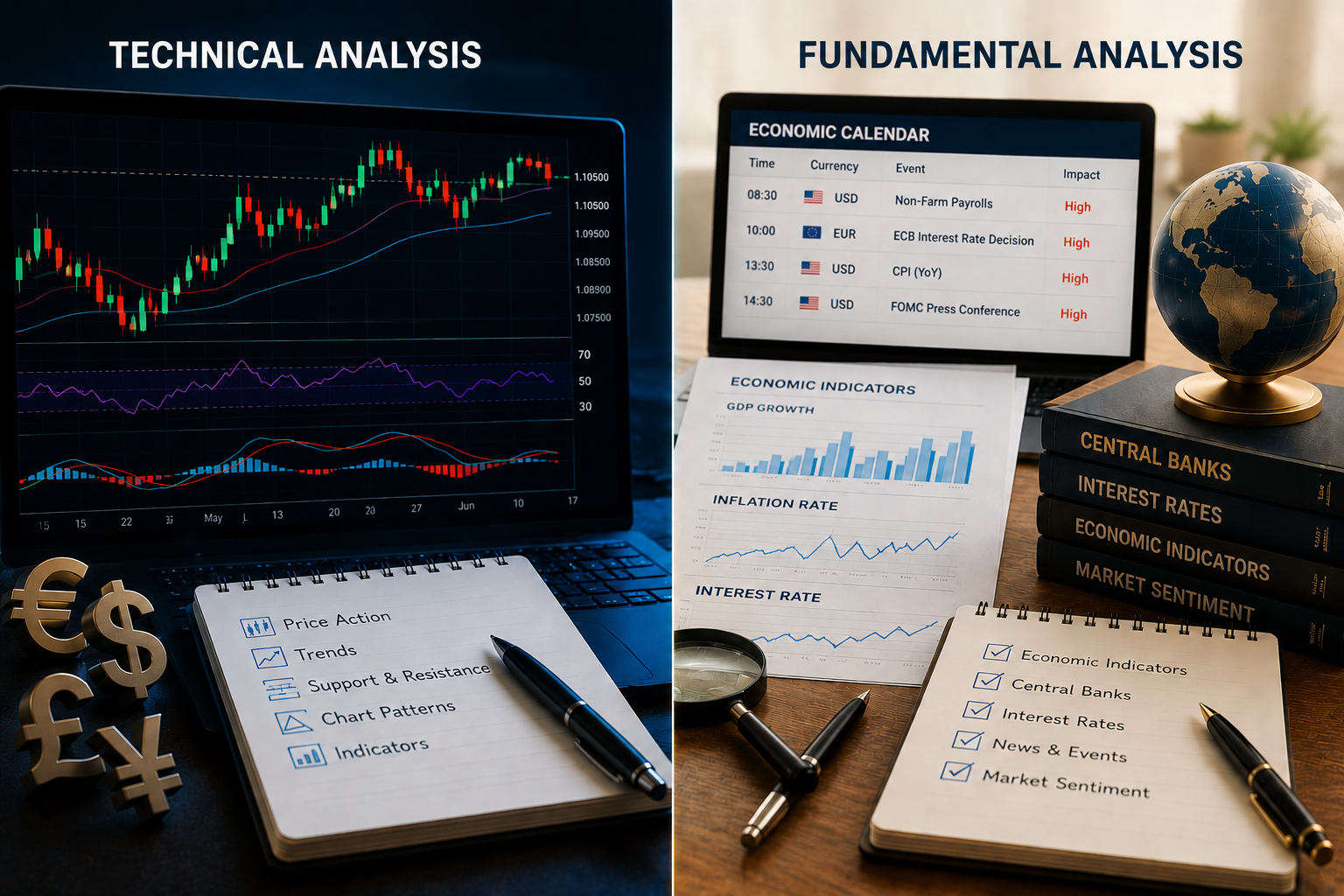
Fundamental analysis is the cornerstone of long-term currency trading. While technical analysis focuses on price charts and historical patterns, fundamental analysis examines the underlying economic, social, and political forces that drive a nation’s currency valuation.
In the foreign exchange market, you are not trading a static financial asset. You are trading the economic health of entire nations against one another. According to the Bank for International Settlements (BIS) latest Triennial Central Bank Survey, global foreign exchange turnover has reached an astonishing 9.5 trillion USD per day on average, showing a 27% increase over previous reporting cycles. This unprecedented level of market activity is overwhelmingly driven by macro portfolio rebalancing, monetary policy shifts, and sudden structural trade shocks.
Macroeconomic Divergence & Trend Predictor
Map macroeconomic discrepancies between two sovereign states to project long-term structural currency cycles.
Sovereign Profile Inputs
Base Economy Growth+1.5%
Quote Economy Growth+1.5%
Base Inflation Level2.0%
Quote Inflation Level2.0%
Base Central Bank
Quote Central Bank
Projected Macro Directional Bias
?
Structural Consolidation
System Divergence Strength: 0%
Fundamental Alignment
Macro forces currently remain balanced. No clear economic divergence exists to motivate multi-asset portfolio rebalancing across capital accounts.
The Core Concept: Intrinsic Value and Exchange Rates
The primary objective of a fundamental analyst is to determine a currency's intrinsic value based on macroeconomic data. If your analysis suggests a currency is worth more than its current market quote, it is undervalued, presenting a clear buying opportunity. If the market quote is higher than your calculated intrinsic value, the currency is overvalued, presenting a selling opportunity.
Unlike domestic equity markets where a stock is valued based on company earnings reports, forex pairs require a comparative analysis. You must constantly weigh the economic metrics of the base currency against the quote currency (e.g., assessing the economic momentum of the Eurozone relative to the United States in the EUR/USD pair).
The Three Pillars of Forex Fundamental Analysis
The macro ecosystem can be categorized into three pillars: Monetary Policy, Economic Indicators, and Geopolitical Risk Sentiment.
1. Monetary Policy and Central Bank Mechanics
Central banks are the most powerful participants in the forex market structure. They manage a nation's monetary stability using interest rates, open market operations, and quantitative measures.
The Federal Reserve (Fed): Controls the US Dollar (USD).
The European Central Bank (ECB): Controls the Euro (EUR).
The Bank of Japan (BoJ): Controls the Japanese Yen (JPY).
The Bank of England (BoE): Controls the Great British Pound (GBP).
When a central bank adopts a hawkish stance, it signals an intention to raise interest rates to combat inflation. Higher interest rates offer foreign investors a greater return on capital denominated in that currency, stimulating capital inflows and driving up the currency's exchange value.
Conversely, a dovish stance indicates an intention to lower interest rates or expand liquidity to stimulate an underperforming economy. Lower interest rates compress investment yields, triggering capital outflows as multi-asset managers move funds toward higher-yielding sovereign bonds elsewhere.
2. Primary Economic Indicators
Economic indicators are periodic statistical releases that reveal the health of an economy. Market participants monitor these releases via an economic calendar to assess whether a nation is expanding or contracting.
Gross Domestic Product (GDP): The broadest measure of overall economic output and productivity. Consistently positive GDP growth signals a robust economy, boosting currency demand.
Consumer Price Index (CPI): The primary gauge for measuring inflation. If CPI prints significantly higher than a central bank's target rate (typically 2%), it forces policymakers to consider hawkish interest rate adjustments.
Employment Metrics: Reports like the US Non-Farm Payrolls (NFP) or national unemployment rates. Strong employment figures indicate a resilient labor market, increasing consumer spending power and giving central banks the confidence to tighten policy without risking an immediate recession.
3. Geopolitical Risk Sentiment and Capital Flight
Money moves toward safety and stability. Political crises, sudden changes in trade agreements, and military conflicts disrupt global commerce, forcing capital out of vulnerable regions. During periods of global panic, the market transitions into a risk-off phase, where capital flees emerging market assets and seeks shelter in established safe-haven currencies like the US Dollar, the Swiss Franc (CHF), and the Japanese Yen.
Market Share and Asset Allocation Trends
The distribution of daily capital turnover illustrates the global dominance of specific macro currencies and derivatives used by institutional desks to hedge against fundamental policy shocks.
Global Currency Matrix
The table below details the daily average turnover share for the most heavily traded currencies in the macro landscape, emphasizing the unparalleled position of the US Dollar in international settlements.
Currency
Daily Average Turnover (Billions USD)
Share of Global Market %
US Dollar (USD)
8,550
90.0%
Euro (EUR)
2,714
28.5%
Japanese Yen (JPY)
1,608
16.9%
Great British Pound (GBP)
967
10.2%
Note: Individual currency percentages sum to 200% because every transaction requires two separate currencies to form a pair.
Financial Instrument Distribution
The global forex market uses diverse financial instruments beyond spot transactions to manage structural exposure to interest rate differentials and trade shocks.
Foreign exchange swaps lead global volume at 42% of total turnover, as institutions continuously roll over financing balances. Spot transactions follow at 35%. Notably, currency options have expanded to a 7% market share, reflecting a sharp increase in corporate demand for protection against unexpected macroeconomic policy adjustments.
The Global Trading Session Architecture
Because forex is a decentralized, over-the-counter network, it operates 24 hours a day, five days a week across shifting regional hubs. The United Kingdom and the United States remain the primary focal points of institutional volume, commanding nearly 60% of daily turnover. Meanwhile, Asian financial hubs like Singapore have achieved an 11.8% market share, acting as critical conduits for capital flow during eastern trading hours.
The London and New York session overlap (13:00 to 17:00 UTC) represents the peak liquidity window of the trading day. Major economic data releases from the United States regularly drop during the opening hour of this overlap, creating intense order execution, contracting broker spreads, and driving primary directional trends.
Current Macro Drivers: Trade Wars, Tariff Shocks, and Safe-Haven Flights
The global macro landscape has experienced heightened volatility due to major structural changes in international trade policy. When governments shift toward protective trade measures, the fundamental assumptions underlying exchange rates can change rapidly.
The Impact of Reciprocal Tariff Announcements
A clear example of macro fundamental forces occurred following major US reciprocal tariff announcements. These policy declarations introduced systemic trade risk, sparking concerns over global corporate supply chains and downstream economic output.
The announcement triggered an uncharacteristic breakdown of typical cross-asset correlations, causing significant exchange rate movements. In a flight to safety, the US Dollar depreciated sharply against the Japanese Yen, driving the USD/JPY pair down from the upper 149 level to the lower 143 level in just a few trading sessions. Concurrently, global fund managers who were caught underhedged due to prior monetary policy tightening scrambled to rebalance portfolios, driving spot and options volume to record highs.
Regional Vulnerabilities and Capital Flight
Geopolitical friction in the Middle East highlights how quickly market sentiment can pivot between risk-on and risk-off profiles. While major currency pairs manage these liquidity shocks efficiently due to their extensive institutional backing, emerging market pairs face greater structural vulnerability.
Empirical studies examining cumulative average abnormal returns show that emerging economies heavily dependent on global trade, such as Mexico (MXN) and India (INR), suffer deep and prolonged currency depreciation following unexpected tariff adjustments. In contrast, integrated economies like Canada (CAD) show minimal abnormal currency variance, demonstrating that structural economic integration can shield a currency from external trade shocks.
Step-by-Step Fundamental Execution Strategy
Integrating fundamental analysis into a practical trading strategy requires filtering economic calendar noise to focus exclusively on institutional order drivers.
Scan your economic calendar at the start of each week. Filter out minor data points and pinpoint critical events like Central Bank rate decisions, CPI inflation prints, and key employment data. Identify the consensus forecast and the previous reading for each asset.
2.Determine the Global Risk Profile: Sentiment Mapping.
Evaluate current global market sentiment. Is the broader market in a Risk-On phase (buying equities and emerging market currencies) or a Risk-Off phase (buying bonds, gold, USD, and JPY)? Cross-reference this sentiment with current geopolitical headlines and trade policy announcements.
3.Measure the Macro Data Discrepancy: Deviation Analysis.
When an economic indicator is released, do not just look at whether the number is positive or negative. Measure its deviation from the consensus forecast. A significant variance between the forecasted data and the actual print is what triggers institutional portfolio rebalancing and explosive price momentum.
4.Align with Institutional Capital Flows: Execution & Risk Control.
If a major data print aligns with the central bank's broader policy direction (e.g., higher CPI printing in an already hawkish environment), execute your trade in the direction of that fundamental momentum. Place your stop-loss order beyond structural technical levels to protect your position against initial slippage and spread widening.
Conclusion and Advanced Resources
Fundamental analysis provides the structural context needed to understand why currency trends form, while technical analysis helps identify optimal price entry points. By shifting your approach away from isolated chart patterns and viewing the forex market as a decentralized macroeconomic system responding to interest rate differentials, inflation data, and geopolitical trade shocks, you can better align your trading with institutional capital flows.
To deepen your understanding of global capital flows, you can access the Bank for International Settlements to monitor triennial liquidity reports, or consult the Federal Reserve Economic Data to track real-time macroeconomic indicators driving global currency valuations.