If you are navigating the digital asset space, you have likely heard the terms coin and token used interchangeably. News reports, social media threads, and even some trading platforms frequently clump them together under the generic umbrella of cryptocurrency.
However, using these terms as synonyms is a major technical mistake. In blockchain architecture, coins and tokens represent completely different asset classes, serve distinct economic purposes, and run on separate structural layers. Understanding this distinction is vital for anyone analyzing market utilities or building an investment portfolio.
This guide breaks down the core structural differences between crypto coins and tokens, explores their real-world use cases, examines current market trends, and outlines how to classify these digital assets.
1. The Core Architectural Division
The fundamental difference between a crypto coin and a crypto token comes down to blockchain ownership.
What is a Crypto Coin?
A crypto coin is the native asset of an independent, self-sufficient Layer 1 blockchain protocol. Coins are built directly into the base layer of the ledger architecture. They serve as the primary medium of exchange for that specific network and are used to pay transaction fees (gas fees) to network validators or miners.
New coins enter circulation programmatically as rewards given to node operators for securing the network through consensus mechanisms like Proof of Work (PoW) or Proof of Stake (PoS).
What is a Crypto Token?
A crypto token is a digital asset built on top of an existing Layer 1 blockchain infrastructure using smart contracts. Tokens do not have their own native, independent ledgers. Instead, they rely entirely on the security, validation nodes, and underlying protocol rules of the host blockchain.
While a coin tracks simple balance changes across a ledger, a token is highly programmable, allowing it to represent complex utility rules, digital identities, or fractionalized real-world assets.
[SYSTEM]: CRYPTO ASSET ARCHITECTURE CLASSIFIER
Scan underlying structural protocol traits to run automated Coin vs Token logic diagnostics.
// INPUT PARAMETERS
Standalone Blockchain NetworkAsset runs on independent protocol infrastructure
Native Gas Fee AssetUsed directly to reward base ledger validators
Smart Contract Sub-Layer BoundHosted as an app balance inside another chain
>> DIAGNOSTIC OUTFLOW SCREEN <<
LAYER 1 CRYPTO COIN
Network Independence: 100%
[ANALYSIS REPORT] :
Asset possesses structural base autonomy. It acts as the underlying foundational infrastructure fuel for transaction validation blocks.
2. Structural Head-to-Head Comparison
To better visualize how these digital assets diverge, review this comprehensive structural matrix:
Feature
Crypto Coin (Layer 1 Native)
Crypto Token (Smart Contract Layer)
Blockchain Dependence
Independent; runs on its own standalone network.
Dependent; sits on top of a pre-existing host network.
Primary Utility
Fueling gas fees, network consensus, store of value.
Processed directly by base-layer network validators.
Executed via smart contracts running on the host chain.
Supply Creation
Minted gradually via block rewards (PoW or PoS).
Often minted all at once by project smart contracts.
Transaction Fee Payment
Paid using the coin itself (e.g., ETH for Ethereum).
Requires the host network coin to execute transfers.
Key Examples
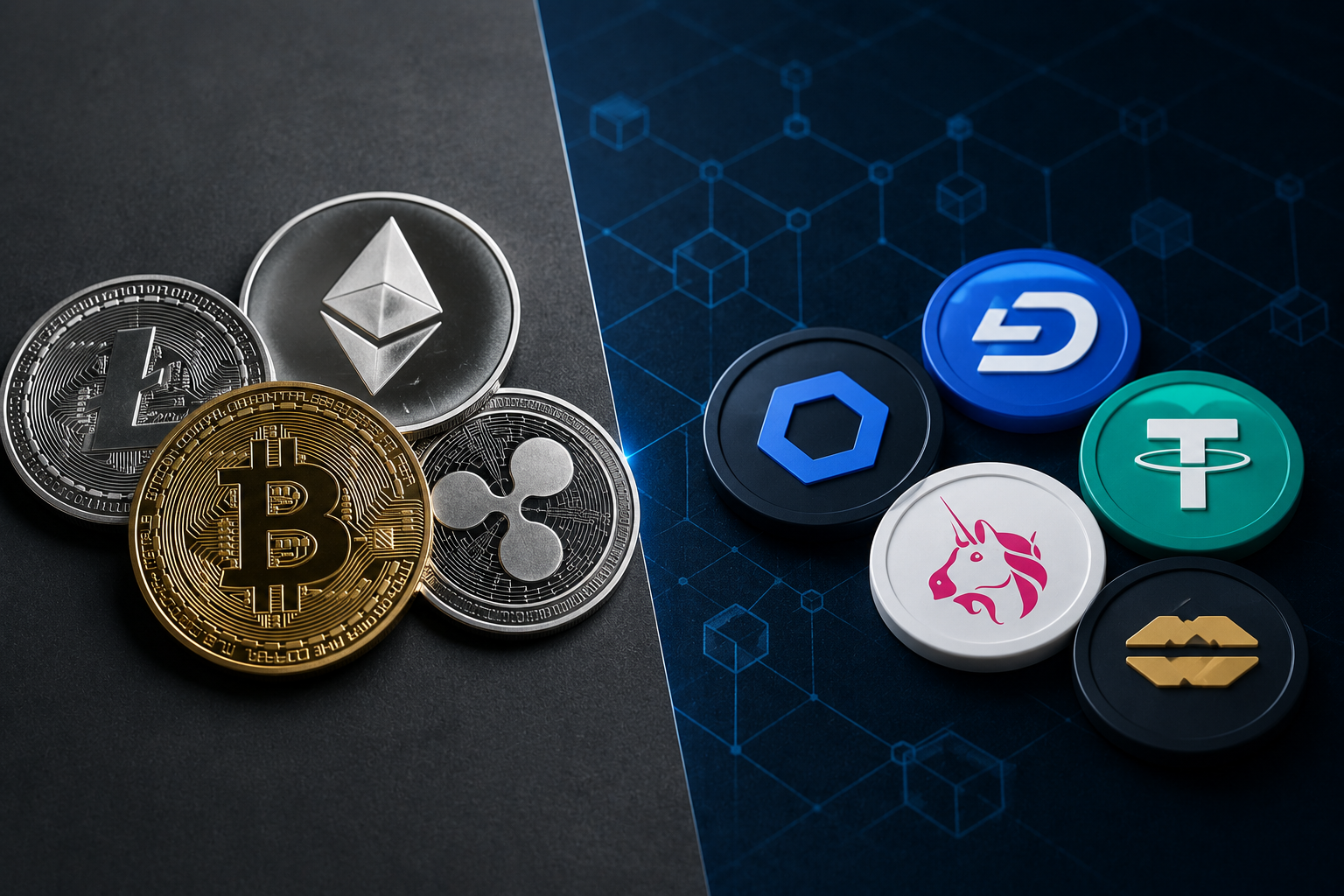
Bitcoin (BTC), Ethereum (ETH), Solana (SOL).
Tether (USDT), Chainlink (LINK), Uniswap (UNI).
3. Deep Dive into Crypto Coins: The Layer 1 Foundations
Because coins are tied to the bedrock layer of a blockchain, their market value and security scale directly with the adoption of the underlying network.
Gas and Network Infrastructure Coins
On programmable smart contract networks, coins function as the economic fuel required to execute code. For example, every time a user swaps assets or interacts with an application on the Ethereum network, they must pay gas fees using Ether (ETH).
Similarly, the Solana network requires Solana (SOL) to process high-speed transactions, and the Avalanche network uses AVAX to power its customizable enterprise subnets.
Sovereign Payment and Store of Value Coins
Some coins are designed primarily to operate as alternative digital currencies or decentralized stores of value. Bitcoin (BTC) is the prime example. It does not power a complex ecosystem of decentralized applications; instead, its network focuses on secure, trustless wealth transfers.
With a hard supply cap of 21 million units, Bitcoin derives its value from programmatic scarcity, decentralized consensus, and deep liquidity across global order books.
4. Deep Dive into Crypto Tokens: Programmable Utility
Tokens do not focus on network consensus. Instead, developers program tokens using specific network standards to perform unique tasks within decentralized applications (dApps).
On the Ethereum network, the most common blueprint for a fungible token is the ERC-20 standard. This standard ensures that tokens remain compatible with various Web3 wallets, decentralized exchanges, and decentralized finance (DeFi) lending pools. On the Solana blockchain, the SPL standard serves an identical purpose.
Tokens generally fall into five distinct functional categories:
Stablecoins: Digital assets pegged 1:1 to a reference fiat currency, such as the US dollar. Tether (USDT) and USD Coin (USDC) are tokens built across multiple host chains, allowing users to hold stable purchasing power on-chain.
Governance Tokens: Assets that grant holders voting rights within a Decentralized Autonomous Organization (DAO). Holding tokens like Uniswap (UNI) or Maker (MKR) allows users to vote on protocol upgrades, fee structures, and treasury allocations.
Utility Tokens: Tokens that function like digital keys or in-ecosystem tickets to unlock specific services. For example, Chainlink (LINK) is a utility token used to pay node operators for importing secure, off-chain data feeds into smart contracts.
Security Tokens: Digital certificates representing fractional ownership of an external, real-world asset, such as company shares, real estate, or bonds. These tokens fall under traditional regulatory compliance frameworks.
Non-Fungible Tokens (NFTs): Unique, non-interchangeable tokens (often using the ERC-721 standard) that verify ownership of distinct digital or physical items, such as digital artwork, gaming assets, or tokenized identity credentials.
5. Current Market Landscape: Layer 2 Scaling and Institutional Tokenization
The relationship between coins and tokens continues to shift due to technological upgrades and institutional adoption.
The Rise of Layer 2 Ecosystems
As Layer 1 networks like Ethereum face high congestion and volatile gas fees, the market has expanded into Layer 2 (L2) scaling solutions. Networks like Arbitrum (ARB), Optimism (OP), Mantle (MNT), and ZKsync (ZK) process transactions in batches off-chain before settling them securely back onto the Ethereum Layer 1 mainnet.
This structural evolution has introduced a fascinating economic dynamic: while these L2 protocols rely on their own native governance tokens (like ARB or OP) to coordinate community decisions, the underlying transaction fees are still settled using the Layer 1 coin (ETH).
Recent network upgrades, such as the introduction of data blobs, have lowered these L2 data costs close to zero, moving speculative retail activity toward high-speed Layer 2 token ecosystems.
Traditional Finance and Real-World Asset Tokenization
Traditional financial institutions are actively embracing tokenization to bring legacy assets on-chain. According to digital economy insights from the World Economic Forum, asset tokenization is reshaping modern capital markets by moving entire funds, corporate bonds, carbon credits, and real estate assets into fractionalized blockchain tokens.
Major institutional players like BlackRock have noted that tokenization expands the world of investable assets, offering increased market liquidity, transparency, and operational efficiency. Furthermore, banking institutions are integrating public blockchains by deploying localized deposit tokens, such as JPM Coin, to facilitate real-time cross-border payments and corporate liquidity management.
6. Token Migration: When a Token Becomes a Coin
The distinction between coins and tokens is not always permanent. A crypto asset can start its lifecycle as a token and later transition into a standalone coin. This architectural evolution is known as a mainnet migration or a token swap.
During the early fundraising and development stages, many crypto projects launch their asset as an ERC-20 token on the Ethereum network. This approach allows developers to leverage Ethereum’s established security and wallet infrastructure without building a blockchain from scratch.
Once the project’s proprietary blockchain is fully coded, tested, and secure, the development team executes a mainnet swap. The original tokens are burned (permanently destroyed), and investors receive equivalent native coins on the newly launched independent blockchain. Notable networks like Binance Coin (BNB), TRON (TRX), and Solana (SOL) originally began their lifecycles as ERC-20 tokens before migrating to independent Layer 1 coin architectures.
Summary Diagnostic Checklist
When evaluating an asset on tracking platforms like CoinMarketCap or CoinGecko, use this quick checklist to identify its structural class:
Does the asset run on its own branded network explorer, or do transactions show up on a host explorer like Etherscan?
Are you required to hold a different cryptocurrency in your wallet to cover network transaction fees?
Was the asset distributed via a smart contract minting function?
Does the asset represent a voting right or a fractional piece of an application’s revenue?
Has the project published a roadmap outlining a planned mainnet migration from a temporary host?
By categorizing digital assets correctly, you can better analyze project whitepapers, evaluate network gas dependencies, and protect your portfolio from fundamental market misconceptions.