The digital asset market offers unprecedented financial freedom, but its decentralized nature makes it a prime playground for advanced financial fraud. According to the groundbreaking Chainalysis 2026 Crypto Crime Report, an estimated 17 billion dollars was stolen via crypto scams and fraud in recent cycles. Malicious actors continuously upgrade their toolkits, replacing simple phishing emails with artificial intelligence deepfakes, advanced smart contract exploits, and systemic industrial-scale fraud syndicates.
For any web3 participant, learning how to audit a project before deploying capital is no longer optional. It is the core requirement for financial survival. This comprehensive guide breaks down the structural mechanics of modern crypto scams, provides technical blueprints to spot developer rug pulls, and details the exact defensive strategies needed to keep your capital safe.
1. The Anatomy of a Rug Pull
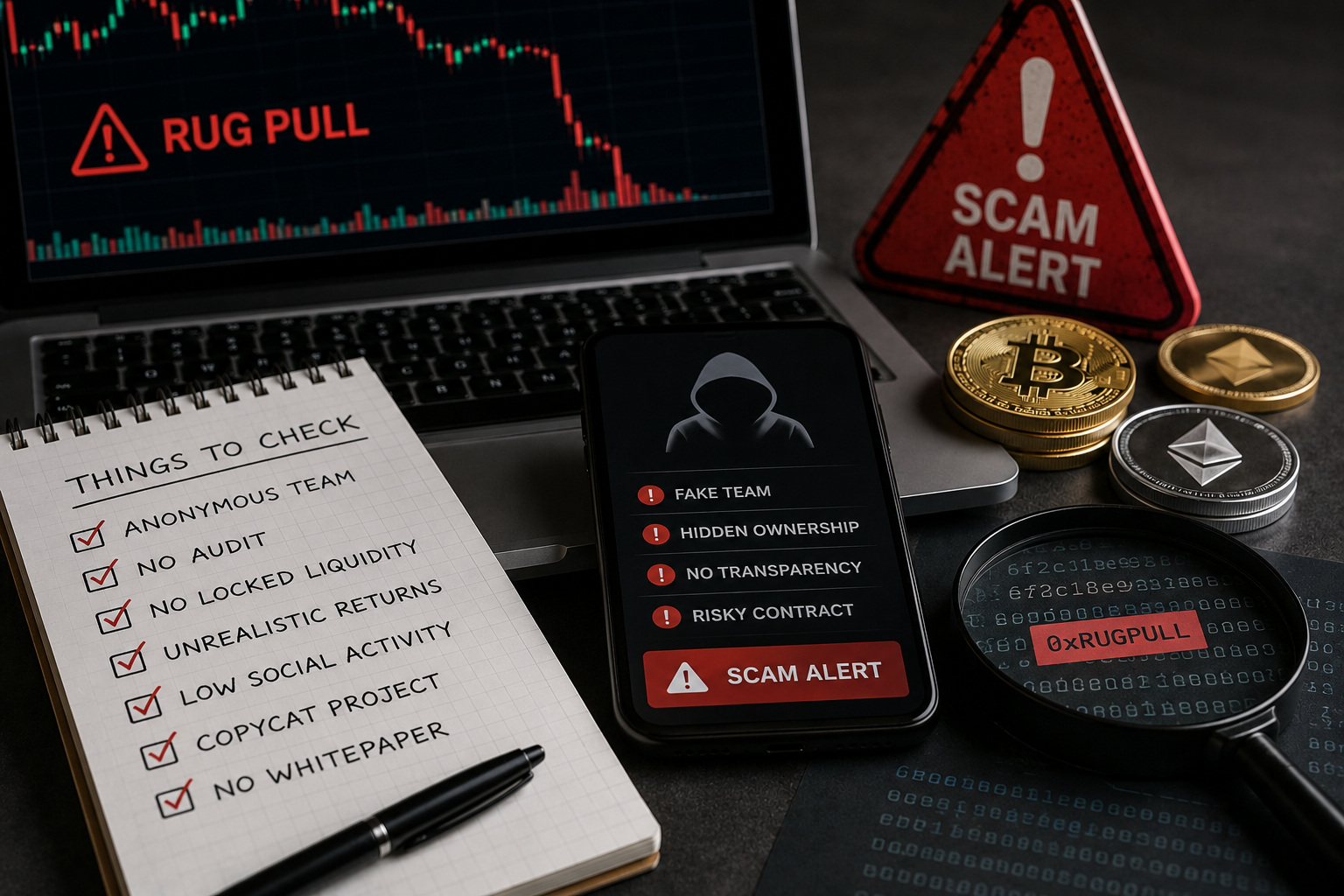
A rug pull is a specific type of cryptocurrency scam where developers launch a new project, pump up the token price through marketing or artificial hype, and then abruptly drain the locked liquidity pool or abandon the ecosystem entirely. This actions render the asset worthless to regular retail investors.
To effectively protect your portfolio, you must recognize that rug pulls fall into three distinct architectural categories.
Hard Rug Pulls (Malicious Code)
A hard rug pull occurs when developers purposefully insert backdoor vulnerabilities directly into the token’s smart contract code before deployment. These technical traps allow the creators to execute catastrophic fraud with a single transaction.
The Honeypot Trap: The smart contract contains specific code modifying access controls, allowing only authorized developer wallets to sell the asset. Retail buyers can purchase the token but face error messages whenever they attempt to swap it back for stablecoins.
Hidden Minting Functions: The contract looks clean on the surface, but includes a hidden function allowing owners to mint millions of new tokens out of thin air. Creators execute this function to create infinite supply and dump the excess assets onto the public liquidity pool.
Soft Rug Pulls (Strategic Abandonment)
Soft rug pulls operate in a legal gray area, relying on behavioral manipulation rather than direct code exploitation.
The Ghost Team Escape: Developers stop updating the project github repositories, delete social media profiles, and claim market conditions have forced them to stall development.
Slow Insiders Dumping: Instead of pulling all capital out in a single block, creators slowly siphon money from the treasury or split their holdings across hundreds of burner wallets to sell down token value over months, hiding their exit strategy from basic on-chain tracking tools.
Liquidity Theft
This is the most common execution mechanism in Decentralized Finance (DeFi). To trade a token on a decentralized exchange like Uniswap or Raydium, a liquidity pool containing equal values of two tokens (e.g., the new token and USDC) must exist. The project creator funds this pool initially. In a liquidity theft scenario, the developer simply revokes the pool access or withdraws their creator shares, stripping away the entire underlying pool backing. Investors are left holding a token that literally cannot be traded for any real-world value.
[SYSTEM]: RUG PULL RISKMETER V2.6
Run an automated vulnerability scan by flagging known malicious on-chain and behavioral traits.
// FLAG IDENTIFIED RED FLAGS:
[DIAGNOSTIC RADAR MONITOR]
SECURE ENVIRONMENT
Calculated Threat Level: 0%
[LIVE ANALYSIS LOGS]:
System indicators nominal. The protocol code exhibits clear security characteristics aligning with baseline secure asset criteria. Continue monitoring deployer wallets.
2. On-Chain Security Indicators
Evaluating a project requires moving past marketing presentations and examining raw blockchain data. The following table highlights the critical on-chain security metrics you must audit before interacting with any new smart contract.
Security Metric
Safe Project Benchmark
High-Risk Danger Zone
On-Chain Verification Tool
Liquidity Lock Duration
100% of initial liquidity locked via third-party smart contracts (e.g., Uncx Network) for minimum 12 months.
Liquidity is unlocked, held entirely in the deployer wallet, or locked for less than 30 days.
Etherscan, Solscan, DEXTools
Top 10 Holder Concentration
Combined top ten non-exchange wallets hold less than 15% of the total circulating supply.
A single insider wallet holds more than 10% of supply, or top 10 wallets control over 50%.
Bubblemaps, Token Sniffer
Smart Contract Audit Status
Verified code audited by reputable security firms (e.g., CertiK, OpenZeppelin) with zero unresolved critical bugs.
Completely unverified source code on the block explorer, or missing external security reviews.
GitHub, RugCheck
Developer Minting Rights
Minting function is permanently renounced or secured via an institutional multi-signature wallet.
Active minting function accessible by a single, un-renounced deployer private key.
Etherscan Contract Read Tab
3. The 2026 Crypto Scam Landscape: Current News and Case Studies
The methodologies used by global cybercriminals are evolving rapidly. Scammers have transitioned from basic text-based traps to industrial operations utilizing cutting-edge technologies.
AI-Enabled Impersonation and Deepfakes
Data from modern cyberintelligence reports reveals that AI-enabled scams extract up to 4.5 times more capital per victim than traditional phishing text campaigns. Fraud syndicates utilize sophisticated generative video models to create deepfakes of high-profile industry figures. These fake broadcasts are streamed via hijacked high-subscriber accounts to push fraudulent giveaway web platforms.
Furthermore, generative AI allows scammers to host automated text chats, simultaneously building artificial relationships with hundreds of retail investors on platforms like Telegram and X without human resource constraints.
The Southeast Asia Scam Center Crackdown
In response to the unprecedented expansion of transnational organized crime, global law enforcement has launched aggressive counter-operations. In mid-2026, the U.S. Department of Justice announced the results of "Disruption Week," a sweeping operation coordinated by the Scam Center Strike Force alongside international agencies including the Royal Thai Police and the UK National Crime Agency.
This historic enforcement initiative successfully dismantled cyber-fraud networks operating from entrenched tactical compounds in Southeast Asia. The joint operation resulted in:
The coordinated takedown of over 1.4 million social media accounts and fraudulent groups.
The disruption of thousands of rogue internet connectivity kits used to coordinate infrastructure access.
The immediate freezing of over 3.8 million dollars in illicit stablecoins and crypto assets before they could be laundered through privacy protocols.
These targeted compounds are infamous for running industrial-scale "pig butchering" rings. In these long-term financial traps, human trafficking victims are forced by criminal syndicates to cultivate romantic or professional trust with western citizens over months, eventually leading to coordinated theft via fake trading applications.
The Meteora M3M3 Legal Precedent
The transition from legacy DeFi hacks to aggressive memecoin-related market manipulation was highlighted by the landmark Meteora M3M3 civil enforcement action. In this high-profile case, corporate insiders were accused of manipulating a Solana-based token infrastructure for personal enrichment.
According to legal filings, the group utilized automated internal wallet loops to simulate vast market demand, artificially driving up token values. Once public retail investors poured funds into the project, the inner circle dumped their coordinated allocations, causing an immediate crash that cost public participants over 69 million dollars. This case highlights how malicious actors exploit low-fee, high-speed networks to execute rapid pump-and-dump mechanics.
4. Universal Red Flags Checklist
To systematically vet any cryptocurrency asset before purchasing, memorize this seven-point technical warning checklist. If a project triggers more than two of these flags, do not interact with the protocol.
Guaranteed Returns or Yield Fixed Targets: Any platform promising fixed daily returns (e.g., 1% daily compounding) or mathematically impossible stablecoin yields is running a Ponzi model. Real market yields fluctuate based on organic transaction demands.
Anonymous Team with Clouded Track Records: While privacy is valued in crypto, teams that hide their names while holding direct admin keys to token treasuries present extreme security risks. Look for verified professional histories or backing from reputable venture capital funds.
Plagiarized Whitepapers and Documentation: Fraudulent initiatives frequently copy technical text from established platforms like Ethereum or Uniswap, adding buzzwords like AI-powered automated quantum arbitrage yield filters to create a false sense of security. Always paste whitepaper sections into search engines to check for plagiarism.
The "Honeypot" Sell Errors on Test Swaps: Always execute a test trade by buying an extremely small amount of a new token ($5 or less) and attempting to sell it immediately. If the purchase goes through but the sell transaction fails with an unreadable code error, you are likely interacting with a malicious honeypot contract.
Urgency Tactics and Artificially Forced Scarcity: Social media alerts shouting "Presale closes in 10 minutes, buy now or lose your seat!" are psychological tricks designed to bypass your logical analytical frameworks.
Paid Social Media Influencer Inundation: If a project relies completely on lifestyle influencers, TikTok accounts, or paid celebrity endorsements rather than building open-source code architecture and utility frameworks, the asset is built purely for exit liquidity generation.
Unverified Smart Contracts on Block Explorers: Legitimate teams publish their raw code on public block explorers to enable public code analysis. An unverified contract tab means developers are hiding the internal mechanisms governing token transfers.
5. Advanced Defensive Framework: Tools and Best Practices
To safeguard digital assets from wallet drainers and smart contract vulnerabilities, investors must implement institutional-grade security habits.
Deploying On-Chain Scanners
Before sending any transactions, utilize specialized analytics engines to inspect token code. Platforms like RugCheck and Sol Sniffer analyze the token contract instantly, looking for hidden mint functions, freeze authorities, and dangerous ownership concentrations. For Ethereum Virtual Machine (EVM) ecosystems, tools like DEXTools or Token Sniffer give automated safety scores based on historical developer activity data.
Smart Contract Spending Revocation
When interacting with DeFi platforms, you sign a digital permission allowing that specific smart contract to spend tokens inside your wallet. If that platform is later compromised, hackers can drain your wallet through those open allowances.
Make it a weekly habit to connect to official verification portals such as the Etherscan Token Approval Tool or Revoke.cash. These tools let you completely delete old contract access permissions, isolating your funds from future external network breaches.
The Sandbox Wallet Architecture
Never connect your primary long-term savings wallet to unverified web3 dApps or new token launchpads. Implement a strict tiered wallet system:
The Cold Vault: A hardware wallet (e.g., Ledger, Trezor) that never interacts with smart contracts. It is used exclusively to receive and hold core long-term assets.
The Sandbox Hot Wallet: A software browser extension wallet containing only nominal capital. Use this wallet to mint new assets, trade memecoins, and connect to experimental web applications. If the hot wallet interacts with a hidden contract drainer, your maximum exposure is limited to that small balance.
6. What to Do If You Have Been Scammed
If you realize you have interacted with a malicious smart contract or sent funds to a fraudulent platform, you must act within minutes to protect remaining balances and preserve evidentiary logs.
Step 1: Immediate Asset Isolation
If your wallet has been compromised via a stolen seed phrase or an active wallet drainer, assume the entire wallet is permanently compromised. Immediately open a clean, newly generated wallet on a separate physical device and transfer all uncompromised assets, NFTs, and liquidity positions to the new address. Do not waste time trying to revoke permissions on a wallet where private keys have been leaked.
Step 2: Preserve Digital Evidence
Do not delete browser histories, communication logs, or application files. Take clear screenshots of:
The scam website URL and associated hosting metadata.
Telegram user IDs, Discord conversations, and X profile handles.
All transaction hashes (TxID) showing the movement of assets from your wallet to the destination exploit addresses.
Step 3: File Formal Law Enforcement Reports
Submit your compiled evidentiary briefs to official cybercrime reporting agencies. These records are vital for global monitoring networks to build tracking databases against criminal cash-out endpoints:
Use open explorers to watch the destination wallets holding your stolen crypto. Setup automated tracking alerts via services like MistTrack or Etherscan. The moment the criminal attempts to route those funds into a centralized cryptocurrency exchange, contact that exchange's compliance and legal division with your police report reference number to request an administrative lock on those specific accounts.
7. Educational Resources and Technical Verifications
To expand your technical analysis capabilities and stay updated on systemic web3 vulnerabilities, add these official portals to your regular educational tracking list:
Global Cyber Defense Advisories: Monitor structural warnings regarding active phishing vectors by tracking updates directly on the CISA National Cyber Awareness System.
On-Chain Forensics: Read public threat analysis overviews provided by tracking security networks via the Chainalysis Resource Matrix to understand how modern capital laundering channels operate.