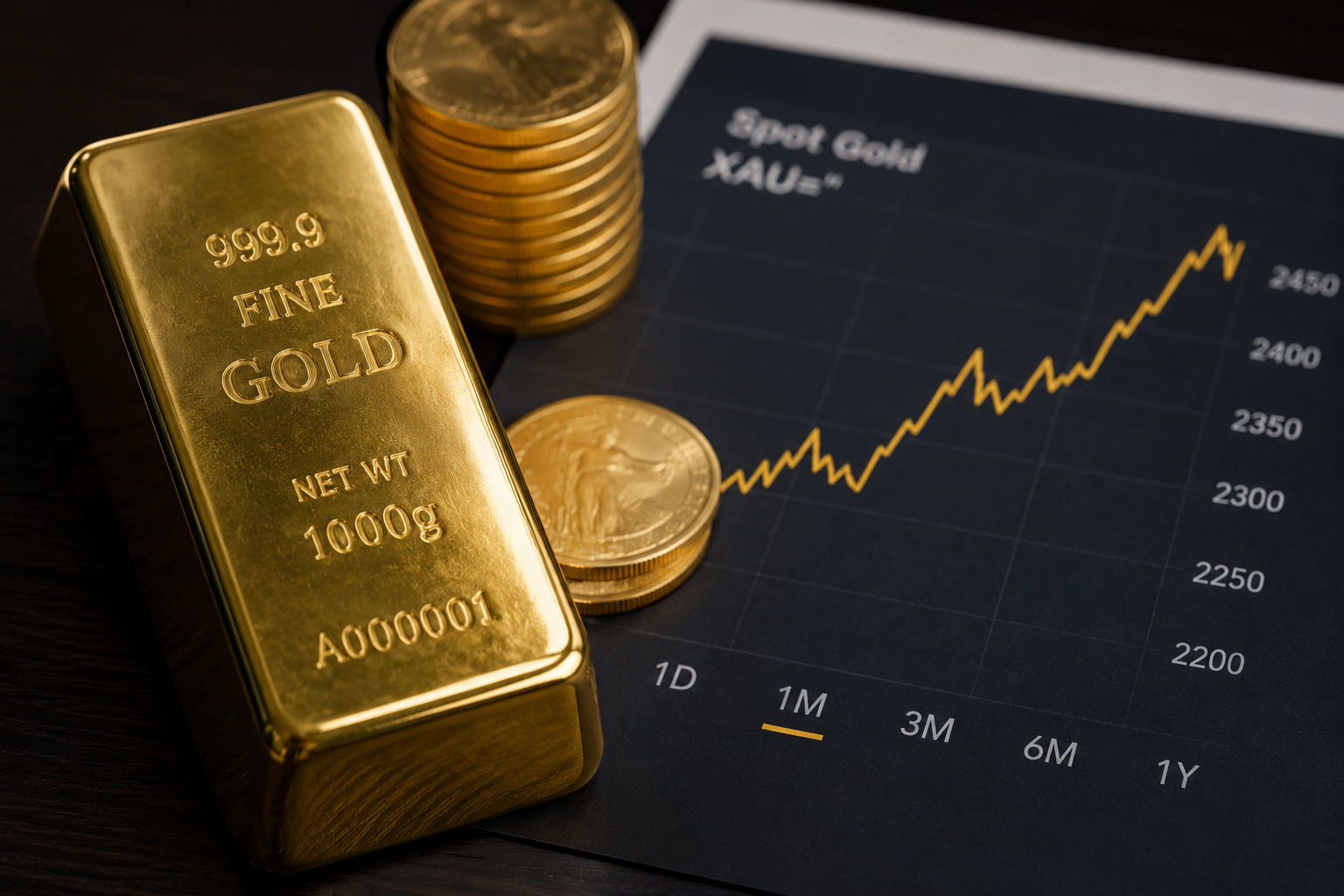
For thousands of years, gold has stood as the ultimate symbol of wealth, power, and financial security. While ancient civilizations traded physical coins and bars, modern financial markets allow investors to trade gold instantly without ever touching the physical metal. This system revolves around spot gold.
If you want to protect your wealth, hedge against inflation, or trade market volatility, understanding spot gold is essential. This guide breaks down what spot gold is, how its pricing mechanism works, the factors driving its value, and how you can participate in this global market.
What Is Spot Gold?
Spot gold refers to the purchase or sale of gold for immediate delivery and payment. The term spot originates from the phrase on the spot, meaning the transaction occurs right now at the current market price rather than at a specified date in the future.
When you look up the price of gold on a financial news website, you are viewing the spot gold price. This price represents the baseline value of one troy ounce of unrefined gold in investment-grade form. It serves as the underlying benchmark for the entire jewelry, bullion, and derivative banking industry worldwide.
Spot Gold Position Calculator
Calculate position value and theoretical profit or loss
$
$
Total Position Value:$23,500.00
Estimated Profit:+$500.00
Calculations use standard market conventions for retail spot gold (XAU/USD).
How Does Spot Gold Trading Work?
Spot gold trading does not take place on a single centralized physical stock exchange floor. Instead, it is traded over-the-counter (OTC), meaning transactions occur electronically directly between two parties via a vast global network of banks, brokerages, and financial institutions.
The Mechanics of the Trade
The Unit of Measurement: Gold is universally priced and traded in troy ounces (often abbreviated as oz or t oz). One troy ounce equals exactly 31.1034768 grams, which is slightly heavier than a standard kitchen ounce (28.34 grams).
The Currency Benchmark: Spot gold is quoted internationally in US Dollars per troy ounce. The universal financial ticker symbol for spot gold is XAU/USD. XAU represents the chemical symbol for gold (Au) combined with the letter X, which denotes an international precious metal asset class under standard trading nomenclature.
The Settlement Protocol: Although spot trades reflect immediate transactions, the standard technical settlement window follows a T+2 protocol. This means ownership documentation and cash balances clear within two business days of the execution date. For retail traders using electronic brokers, this settlement occurs instantly behind the scenes.
The Bid-Ask Spread
When trading spot gold, you will always encounter two distinct prices quoted by your broker or platform:
The Bid Price: The highest price a buyer is currently willing to pay for spot gold. This is the price you receive when you sell gold to the market.
The Ask (Offer) Price: The lowest price a seller is currently willing to accept for spot gold. This is the price you pay when you buy gold from the market.
The small difference between these two figures is known as the spread. The spread represents the transaction cost paid to the broker or liquidity provider for facilitating the electronic trade.
Spot Gold vs. Gold Futures: Understanding the Key Differences
Many new investors confuse spot gold with gold futures. While both financial instruments allow you to gain exposure to the price movements of precious metals, they operate on completely different structural frameworks.
Feature
Spot Gold (XAU/USD)
Gold Futures Contracts
Delivery Time
Immediate (Settles within two business days)
Specified future date (e.g., 3, 6, or 12 months out)
Pricing Model
Current real-time market value
Future expected price plus storage and interest costs
Contract Sizes
Highly flexible (trade fractions of an ounce via CFDs)
Rigid, standardized sizes (e.g., 100 troy ounces per contract)
Expiration Dates
None. You can hold a spot position indefinitely
Fixed expiration dates requiring rollover or physical delivery
Trading Venue
Over-The-Counter (OTC) electronic networks
Regulated commodity exchanges (e.g., COMEX)
Spot gold is ideal for short-term day traders or long-term investors who want straightforward exposure to the present value of gold without managing contract expiration deadlines. Futures contracts are preferred by institutional hedgers and large commercial firms looking to lock in prices for physical inventory delivery months in advance.
How Is the Spot Gold Price Determined?
The price of spot gold updates second-by-second during global market hours. It is driven by the fluid forces of supply and demand across institutional networks, but it relies on an ancient institutional anchor known as the London Gold Fix to set global benchmarks.
The London Gold Fix
The London Gold Fixing is a twice-daily bidding process conducted by the London Bullion Market Association (LBMA). Occurring at 10:30 AM and 3:00 PM London time, a select panel of major international clearing banks meets electronically to match buy and sell orders from institutional clients.
The price that matches large institutional supply with demand becomes the official LBMA Gold Price. This fixed benchmark is used by mining corporations, central banks, and jewelry manufacturers to price long-term contracts, while retail spot markets fluctuate around it throughout the trading day.
Core Economic Drivers of Spot Gold Prices
Gold behaves differently than traditional assets like equities or bonds. Because it yields zero dividend payments and carries no corporate earnings reports, its value is dictated by macroeconomic stability, systemic risk, and central banking policies.
1. Geopolitical Instability and Safe-Haven Demand
When wars, trade disputes, or political crises erupt, investors flee risky assets like stocks and purchase gold. This phenomenon is known as safe-haven asset allocation. Because gold is a physical asset with no counterparty risk, it cannot go bankrupt or default on its obligations, making it highly resilient during international conflict.
2. Inflation and Currency Depreciation
When central banks print money or expand liquidity, the purchasing power of fiat paper currencies declines. Gold serves as a direct hedge against inflation because its finite supply prevents it from being artificially devalued by government policy. When consumer prices rise, the nominal value of gold tends to adjust upward to maintain its real purchasing power.
3. Real Interest Rates and Opportunity Cost
The opportunity cost of holding gold is measured by the return you give up by not investing in yield-bearing assets like government bonds.
High Interest Rates: When real interest rates are high, investors prefer to hold bonds to earn guaranteed yields. This creates an opportunity cost drag that pushes spot gold prices down.
Low Interest Rates: When central banks cut rates to zero or real yields turn negative due to high inflation, the opportunity cost of holding gold drops to zero, making precious metals highly attractive.
4. US Dollar Strength
Because spot gold is priced globally in US Dollars (XAU/USD), its price shares an inverse relationship with the dollar index (DXY). When the US dollar weakens, it takes more dollars to purchase the same troy ounce of gold, driving the spot price higher. Conversely, a strengthening dollar makes gold more expensive for foreign buyers using weaker local currencies, which can suppress global demand.
5. Central Bank Reserve Diversification
Central banks are among the largest institutional holders of gold. In recent years, a strong structural shift toward de-dollarization has emerged among emerging economies like China, Russia, India, and Turkey. To insulate their financial systems from unilateral foreign sanctions and currency risks, central banks have aggressively bought thousands of tonnes of physical gold, establishing a massive baseline demand layer under the spot market.
Market Dynamics: Analyzing Key Gold Milestones
To understand how spot gold responds to crises and macroeconomic shifts, it is useful to trace historical and recent market data. The timeline below illustrates how major macroeconomic developments have triggered price surges in the spot market.
The Ukraine Conflict Shock
March 2022
Following the escalation of tensions in Eastern Europe, global commodity markets experienced severe disruptions. Investors sought shelter from unfolding sanctions, pushing spot gold past the $2,050 per troy ounce threshold.
Middle East Escalations
October 2024
Renewed conflict in the Middle East introduced a structural geopolitical premium into the precious metals complex. Institutional hedging and consumer anxiety pushed baseline gold valuations up to $2,420 per ounce.
The Great Parity Shift
December 2025
For the first time since 1996, official global central bank gold reserves reached near parity with total foreign-held US Treasury securities, with gold assets hitting a valuation of $3.909 trillion.
Historical Safe-Haven Surge
January 2026
A sharp escalation of financial sanctions and geopolitical stress in the Middle East led to a rapid bifurcation of safe-haven flows. Intense de-dollarization pressures and macroeconomic panic drove spot gold to an unprecedented nominal high of $5,318 per troy ounce before the market entered a period of volatile consolidation.
Ways to Invest in Spot Gold
If you want to add spot gold to your investment portfolio, you can choose from several pathways depending on your risk tolerance, capital availability, and investment strategy.
1. Physical Gold Bullion
The most direct way to own gold is by purchasing investment-grade physical bullion in the form of bars or government-minted coins (such as the American Gold Eagle or Canadian Gold Maple Leaf).
Pros: Total ownership control with zero counterparty risk or digital vulnerability.
Cons: You must pay a retail markup premium over the raw spot price, handle storage logistics, and secure insurance coverage.
2. Gold Exchange-Traded Funds (ETFs)
Gold ETFs trade on stock exchanges like standard equities. Each share represents a fractional ownership stake in an institutional vault of physical gold managed by a custodian trust.
Pros: Highly liquid, easy to trade within traditional brokerage accounts, and eliminates physical storage and security hassles (Rathi, 2026).
Cons: You do not own the underlying physical metal, and you must pay an annual management fee (expense ratio) that slowly reduces your position value over time.
3. Contracts for Difference (CFDs) and Retail Spot Trading
For short-term speculators, brokers offer retail spot gold accounts via Contracts for Difference (CFDs). This allows you to trade the real-time movements of the XAU/USD pair using leverage without ever intending to take delivery of physical bars.
Pros: Ability to go long (profit from rising prices) or short (profit from falling prices) 23 hours a day with minimal capital requirements.
Cons: Leveraged trading magnifies both profits and losses, making it a high-risk strategy if market volatility spikes unexpectedly.
Step-by-Step Guide to Trading Spot Gold Online
If you decide to actively trade or invest in spot gold electronically, following a structured process helps manage operational risks.
1.Select a Regulated Broker
Choose a brokerage firm that offers spot gold trading (XAU/USD). Ensure the platform is regulated by a reputable financial authority such as the FCA, ASIC, or CFTC to protect your funds against counterparty insolvency.
2.Open and Verify Your Account
Complete the registration process and fulfill your broker's Know Your Customer (KYC) compliance mandates by uploading a valid government ID and proof of address.
3.Fund Your Trading Capital
Deposit capital into your account using a bank transfer, credit card, or supported digital payment system. Ensure you only invest capital that matches your designated risk threshold.
4.Analyze Market Conditions
Utilize technical analysis (charts, support and resistance levels, moving averages) alongside fundamental analysis (Federal Reserve interest rate choices, global inflation trends) to identify optimal market entries.
5.Set Risk Controls and Execute
Open your order window on the platform. Define your trade size and implement strict risk management protocols, including a stop-loss order to cap your potential downside and a take-profit target to lock in gains. Click buy or sell to execute your spot position.
Summary of Pros and Cons of Spot Gold
Before allocating capital to spot gold, carefully weigh its advantages against its structural limitations.
Crucial Market Note: While spot gold is highly reliable for preserving capital over long horizons, short-term volatility can be intense during periods of geopolitical uncertainty, making disciplined position sizing vital.
Advantages
High Liquidity: Traded globally around the clock, allowing you to convert your asset into cash almost instantly at transparent prices.
No Expiration Obstacles: Unlike futures, spot positions do not expire, sparing you the friction of constant contract roll-overs.
Proven Crisis Protection: Demonstrates a reliable long-term track record of maintaining real purchasing power when fiat currencies depreciate or equity markets experience systemic crashes.
Disadvantages
No Yield Generation: Gold does not generate interest, dividends, or cash flow. Your financial returns depend entirely on price appreciation.
Incurred Holding Costs: If you buy physical bullion, you face ongoing storage and security costs. If you hold leveraged spot positions overnight, brokers charge interest fees known as swaps.
Exposure to Currency Risk: Because gold is dollar-denominated, domestic fluctuations in your home currency can impact your net investment returns even if the raw price of gold stays flat.