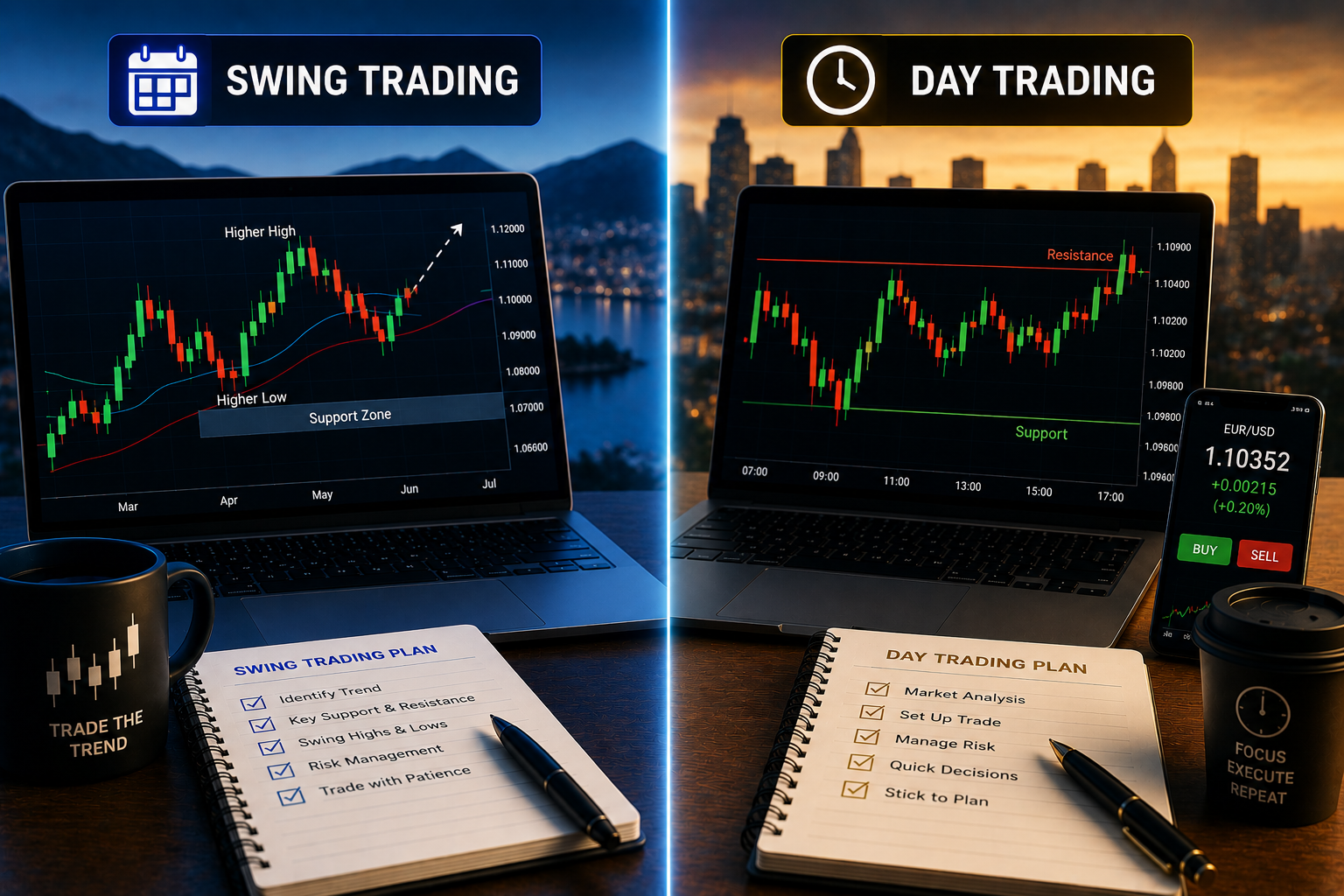
In the global foreign exchange (Forex) market, where daily trading volumes exceed $7.5 trillion, retail traders have two primary paths to capture profits: Day Trading and Swing Trading.
While both strategies aim to exploit short-term price inefficiencies, they operate on completely different time horizons, require vastly different capital commitments, and demand entirely separate psychological profiles. Choosing the wrong methodology for your lifestyle is one of the most common reasons retail traders lose money.
This comprehensive strategic guide breaks down the core structural differences between Day Trading and Swing Trading, analyzes their mathematical cost structures, and provides an actionable blueprint to help you determine which system fits your capital baseline and risk tolerance.
Forex Lifestyle & Strategy Matcher
Analyze your daily availability and psychological preferences to find your ideal trading style.
Select options above to see your customized strategic breakdown.
1. Core Mechanics & Time Horizons
What is Forex Day Trading?
Day trading is an intensive execution style where all currency positions are opened and closed within the exact same trading session. A day trader’s absolute rule is never hold a position overnight. Day traders operate on lower-timeframe charts (typically the 1-minute, 5-minute, and 15-minute intervals), trying to extract small, frequent profits from intraday momentum spikes, news releases, or institutional order-flow imbalances.
What is Forex Swing Trading?
Swing trading is a slower, structural methodology focused on capturing medium-term price “swings” that develop over several days or weeks. Swing traders typically analyze higher-timeframe charts (such as the 4-hour, daily, and weekly intervals). They are not interested in minor intraday price noise; instead, they want to capture the core body of a multi-day trend driven by structural support/resistance shifts or changing macroeconomic fundamentals.
2. Head-to-Head Comparison Matrix
Before analyzing the specific mathematics of both approaches, let’s review how Day Trading and Swing Trading stack up across key operating parameters:
Operational Dimension
Day Trading
Swing Trading
Chart Timeframes
1-minute, 5-minute, 15-minute
4-hour, Daily, Weekly
Trade Frequency
3 to 10+ trades per day
2 to 5 trades per week
Average Hold Time
Minutes to hours
2 to 10+ days
Overnight Risk
Zero (All positions flat by cash close)
Significant (Exposed to market gaps)
Primary Fee Type
Spreads, volume commissions, slippage
Spreads, overnight financing (Swap rates)
Screen Time Required
High (4 to 8+ hours of active focus daily)
Low (30 to 60 minutes of daily maintenance)
Psychological Friction
High stress, rapid choice fatigue
Medium stress, requires prolonged patience
3. The Mathematics of Trading Fees: Spreads vs. Swaps
A critical, overlooked difference between these two strategies is how transaction costs impact your edge.
The Day Trader’s Tax: Commisions and Slippage
Because day traders execute a high volume of transactions, their primary financial hurdle is the cumulative friction of spreads, broker commissions, and execution slippage.
Consider a day trader executing 100 round-trip trades per month on a standard 1-lot EUR/USD position with an average spread/commission cost of $8 per trade. This trader faces a $800 monthly transaction hurdle before generating any gross profit. If their execution platform suffers from micro-second latencies or slippage during high-volatility news events, these friction costs can easily double, dragging down their net profitability.
The Swing Trader’s Tax: Overnight Swap Rates
Because swing traders execute far fewer positions, standard transaction friction is a negligible percentage of their portfolio. Instead, their primary financial hurdle is the overnight swap fee (financing charge).
When you hold a Forex position past 5:00 PM EST, your broker automatically charges or credits an interest rate differential based on the two currencies involved.
If you are shorting a high-yield currency while longing a low-yield currency, these daily swap deductions compound every night your trade remains open, eating away at your profit target. Conversely, strategic swing traders can use positive swap dynamics (Carry Trading) to generate passive interest income while waiting for their price target to hit.
4. Risk Profiles & Capital Efficiency
Intraday Volatility vs. Macro Structural Gaps
Day Trading Risk: The primary danger here is execution speed and sudden leverage wipeouts. Because day traders utilize tight stop-losses (often 5 to 15 pips), a sudden high-impact economic news flash can trigger severe slippage, blowing past a stop-loss and invalidating their risk parameters in seconds.
Swing Trading Risk: The primary danger here is the weekend market gap. Because the global currency market pauses over the weekend while real-world events continue, major geopolitical developments or emergency central bank announcements can cause the market to reopen hundreds of pips away from Friday’s close. This gap can easily bypass a guaranteed stop-loss order, exposing the account to unexpected drawdowns.
Capital Requirements & Margin Management
In many equity markets, strict regulations like the US Pattern Day Trader (PDT) rule mandate a minimum of $25,000 to actively day trade. While the decentralized Forex market does not enforce global PDT mandates, starting capital dictates your risk parameters:
Day trading allows you to leverage smaller target moves because your tight stop-losses allow for larger contractual lot sizes while keeping your total account risk under 1%.
Swing trading requires wider stop-losses (often 50 to 150 pips) to withstand normal daily volatility. To keep your risk at 1% per trade with a 100-pip stop-loss, you must scale down your position sizing, meaning smaller accounts require more patience to experience meaningful compounding growth.
5. Step-by-Step Execution Frameworks
To see how these methodologies contrast in the live market, look at the stark structural differences between their practical setups:
Day Trading Framework: The 5-Minute Intraday Reversal
Day trading relies heavily on rapid technical pattern confirmations relative to institutional volume.
1.Identify the Session High/Low Liquidity Pools: Contextual Setup.
During the London/New York session overlap, monitor the extreme highs and lows established during the quieter Asian session. Look for institutional buy or sell stops resting just outside these boundaries.
2.Wait for a Liquidity Sweep and Candlestick Reversal: Execution Trigger.
Watch the 5-minute chart as price pierces the Asian session high. Look for an immediate rejection, marked by a long upper wick (Pin Bar) accompanied by a spike in intraday volume.
3.Set a Tight Intraday Stop-Loss: Risk Initialization.
Place a tight protective stop-loss exactly 2 pips above the wick of the rejection candle. Your target is the opposing session value area or VWAP (Volume Weighted Average Price).
4.Exit Complete Exposure Prior to London Close: Position Liquidation.
Liquidate the entire position when your target hits or when the session liquidity begins to dry up. Under no circumstances let the trade run past the daily cash settlement window.
Swing Trading Framework: The Daily Structural Retracement
Swing trading blends higher-timeframe technical structures with a clear macroeconomic directional bias.
1.Identify the Central Bank Policy Trend: Macro Baseline.
Analyze the economic landscape to find a clear monetary divergence—for example, a currency with an ultra-hawkish central bank (raising interest rates) paired against a currency with a dovish central bank (cutting rates).
2.Locate Key Daily Support and Demand Zones: Technical Mapping.
Open the Daily/4-Hour chart. Map out major historical structural support levels where buyers previously stepped in to drive a multi-week rally.
3.Wait for a Slower Multi-Day Pullback: Execution Trigger.
Allow the currency pair to pull back into your identified daily support zone over several sessions. Look for a bullish candlestick confirmation pattern (such as a Daily Morning Star) to signal that sellers are exhausted.
4.Deploy Wide Structural Stops and Trailing Targets: Risk Management.
Place your stop-loss safely below the entire daily swing low structure (typically 80 to 120 pips away). Leave the trade open over multiple sessions, using a trailing stop to capture a multi-week trend toward major overhead resistance.
Final Takeaway: Match Your Strategy to Your Life
Choosing between Day Trading and Swing Trading is not a question of which strategy is universally more profitable. Instead, it is about identifying which strategy aligns with your lifestyle parameters.
If you have a busy career, want lower daily stress, and prefer long-term macro trends, Swing Trading provides a sustainable, methodical environment to build wealth over time.
If you have full daily availability, thrive under fast-paced execution demands, and want to completely eliminate overnight risk, Day Trading provides an intensive path to compound short-term returns.
The most successful market participants do not force their lives into a mismatched trading style. Instead, they pick the strategy that fits their daily routine, protect their capital with disciplined risk management, and let their statistical edge play out over time.