In the foreign exchange (Forex) market, multi-trillion-dollar liquidity pools shift second by second. To extract consistent profits from these relentless price movements, a trader must answer one basic question: How do you predict where a currency pair will move next?
To solve this puzzle, the trading world has split into two major schools of thought: Technical Analysis (TA) and Fundamental Analysis (FA).
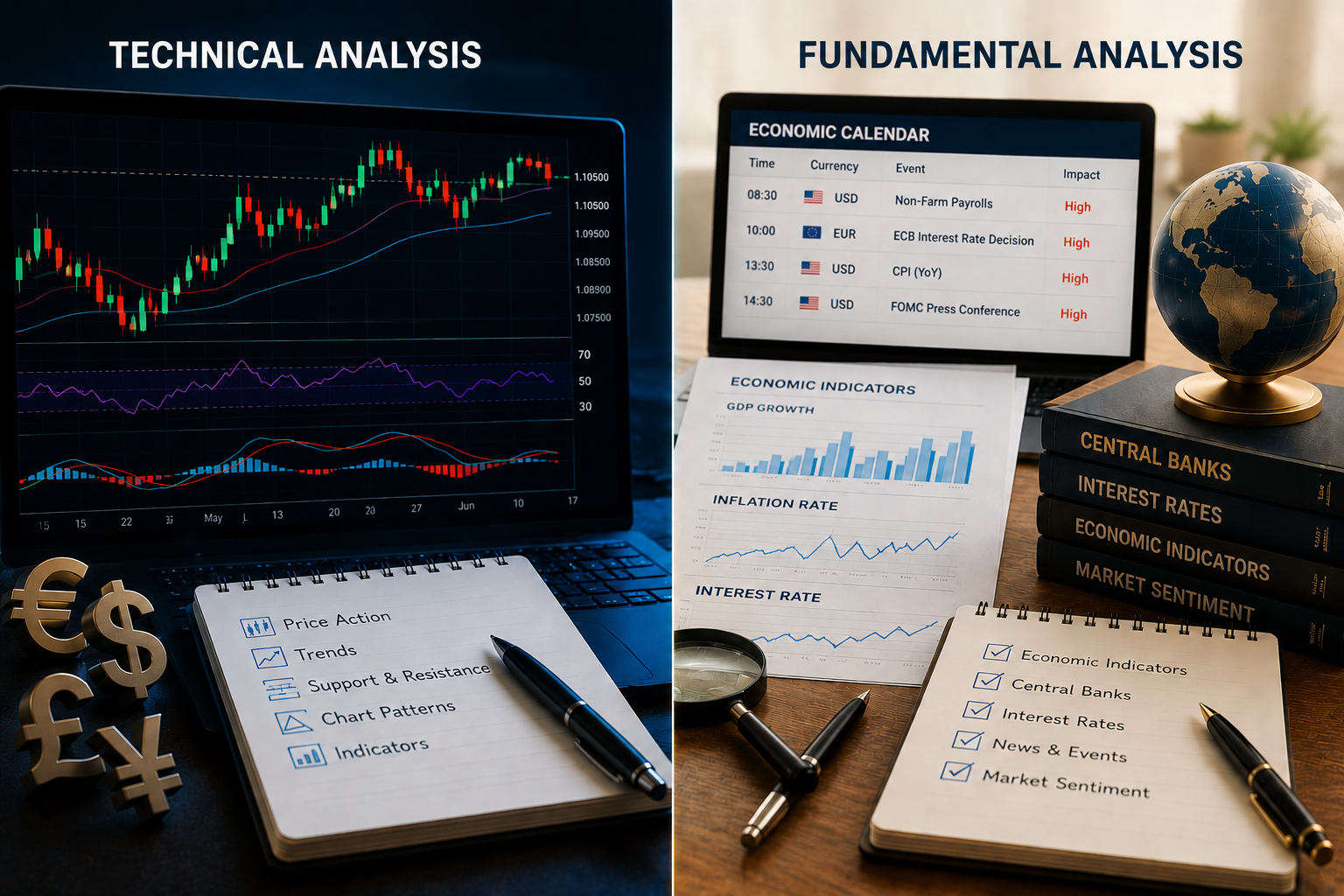
Technical analysis looks at price charts, tracking historical patterns, mathematical indicators, and human behavioral psychology.
Fundamental analysis looks beneath the charts, evaluating economic health, central bank monetary policies, interest rates, and geopolitical shifts.
Some traders treat these methodologies like rival sports teams, strictly choosing one and ignoring the other. However, institutional fund managers view them as two halves of a complete trading system. This comprehensive guide breaks down the core mechanics of both approaches, compares their strengths and weaknesses, and outlines a modern strategy for combining them into an all-weather trading system.
Forex Analytical Style Assessment Tool
Select your primary trading preferences to discover your ideal analytical framework balance.
Recommended System Allocation Mix50% Technical / 50% Fundamental
System Blueprint: Loading customized profile configurations…
1. Defining the Core Ideologies
What is Technical Analysis?
Technical analysis operates on a core premise: all known market variables are already factored into the price chart. Technical analysts argue that trying to calculate real-time global economic data is inefficient because big institutions have already processed that data and bought or sold accordingly.
Instead of studying why a price is changing, technical traders study how the price is reacting. They look for recurring geometric shapes (like Head and Shoulders or Double Bottoms) and use mathematical overlays (like Moving Averages or Fibonacci retracements) to spot structural imbalances between buyers and sellers.
What is Fundamental Analysis?
Fundamental analysis is the study of macroeconomic cause and effect. A currency is not just a digital ticker symbol; it is a direct share of stock in a specific nation’s economy.
Fundamental analysts believe that capital naturally flows toward countries with strong economic growth, high interest rates, and stable political systems. When a central bank changes its economic policy, it alters the intrinsic value of its currency. Fundamental traders look for a mismatch between this intrinsic economic value and the current market exchange rate, positioning themselves for long-term corrections.
2. Core Toolsets: How to Apply Each Framework
The practical day-to-day application of these two schools requires completely different analytical dashboards.
The Technical Analyst’s Toolset
Price Action & Candlesticks: Reading individual sessions (like Pin Bars or Engulfing patterns) to gauge short-term shift changes between bulls and bears.
Support & Resistance: Identifying historical price levels where buying or selling pressure has historically paused a trend.
Technical Indicators: Deploying mathematical algorithms categorized into trend-following metrics (e.g., Exponential Moving Averages) and momentum oscillators (e.g., Relative Strength Index or RSI).
Chart Patterns: Spotting geometric formations that reveal market consolidation and breakouts, such as triangles, flags, and wedges.
The Fundamental Analyst’s Toolset
Central Bank Monetary Policy: Monitoring interest rate decisions and forward guidance from major institutions like the Federal Reserve (Fed) or the European Central Bank (ECB).
Economic Indicators: Analyzing regular data releases such as Gross Domestic Product (GDP), Consumer Price Index (CPI) inflation metrics, and employment data (like the US Non-Farm Payrolls).
Interest Rate Differentials: Tracking the gap between the interest rates of two different nations. Capital consistently flows toward the currency offering the higher yield, creating strong, long-term trends.
Geopolitical Stability: Assessing how trade wars, elections, sanctions, and military conflicts alter international capital allocations.
3. Side-by-Side Comparison Matrix
To clarify how these methodologies operate in real-world scenarios, let’s review their key structural parameters side by side:
Analytical Parameter
Technical Analysis (TA)
Fundamental Analysis (FA)
Primary Data Source
Historic price charts, volume, and indicator metrics
Economic reports, central bank policy statements, and news
Analytical Time Horizon
Short to medium term (Minutes, Hours, Days)
Medium to long term (Weeks, Months, Years)
Core Objective
Pinpoint exact market entries, exits, and risk parameters
Determine a currency pair’s intrinsic value and macro trend
Primary Limitation
Can produce false signals during volatile market news
Exact timing of macro trends is often highly unpredictable
Common Style Fit
Scalpers, Day Traders, and Swing Traders
Position Traders, Macro Fund Managers, and Investors
4. The Time Horizon Factor: Where Each System Shines
Neither analysis type is inherently superior. Instead, their effectiveness depends heavily on your chosen trading time horizon.
The Short-Term Domain (Minutes to Hours)
If you are a short-term day trader or scalper holding trades for minutes or hours, technical analysis is your primary tool. Over short horizons, macroeconomic fundamentals change slowly. A country’s GDP growth does not shift at 10:15 AM on a Tuesday. Instead, short-term price movements are driven by institutional order flow, order-book liquidity gaps, and automated trading algorithms reacting to support and resistance levels.
The Long-Term Domain (Months to Years)
If you are a position trader holding currency positions for months, fundamental analysis takes priority. Over long horizons, short-term chart patterns become minor noise. Long-term trends are shaped by macroeconomics specifically, which central bank is raising interest rates to fight inflation and which is cutting rates to stimulate a slowing economy.
5. Case Study: The 2022 USD/JPY Macro Divergence
The Fundamental Catalyst
Throughout the post-pandemic recovery, inflation spiked globally. The US Federal Reserve responded aggressively by initiating a massive cycle of interest rate hikes. Meanwhile, the Bank of Japan (BOJ) maintained its ultra-loose, near-zero interest rate policy to combat local deflation.
Fundamental analysts saw a widening interest rate differential. Capital naturally moved out of low-yielding Yen assets and into higher-yielding US Dollar assets, fueling a multi-month macro bull trend.
The Technical Execution
While fundamental analysis correctly predicted the long-term upward direction, it did not provide precise entry levels. That is where technical traders stepped in.
By analyzing daily and weekly charts, technical traders spotted clear continuation chart patterns such as ascending triangles and bullish flags alongside bounces off the 50-day Moving Average.
The Fundamentals provided the directional bias (Buy).
The Technicals provided the exact execution map (Where to entry and place stop-losses).
6. How to Build an Integrated “Blended” Trading System
The most resilient portfolios do not rely on a single analysis type. Instead, they use a blended approach that treats fundamental analysis as a compass and technical analysis as a microscope.
Here is a step-by-step roadmap to combining both styles into an all-weather trading routine:
1.Establish the Macro Baseline Bias via Fundamentals: Directional Filter.
Begin your week by checking the macroeconomic landscape. Review recent central bank policy statements and identify which currencies have strong economic tailwinds (raising rates) and which have headwinds (cutting rates). This establishes your directional bias you will only look to buy the strong currency and sell the weak one.
2.Audit the Economic Calendar for Near-Term Traps: Risk Management.
Before checking your charts, check the daily economic calendar. Note the exact times for high-impact data releases like CPI, GDP, or NFP. If your technical setup flashes a buy signal right before a major news event, cancel or pause the entry. High-impact news can easily invalidate technical structures in seconds.
Once you have your directional bias and know when to avoid the news, open your charts. Map out key long-term support and resistance levels, supply and demand zones, or structural trendlines that match your fundamental thesis.
4.Trigger Entries Using Candlestick Confirmations: Trade Execution.
Wait patiently for the price to pull back into your identified technical zones. When the market prints a bullish confirmation signal (like an engulfing candlestick or an RSI divergence) inside a fundamentally backed buy zone, execute the trade with a clear stop-loss.
Final Takeaway: Combine the Compasses
Choosing between technical and fundamental analysis is a false dilemma. Technical analysis helps you navigate the immediate human psychology on the charts, while fundamental analysis keeps you aligned with global economic realities.
Instead of relying on a single approach, professional traders use both. By using macro fundamentals to confirm what direction to trade and technical tools to determine where to execute, you build a balanced framework designed to protect your capital and adapt to any market condition.