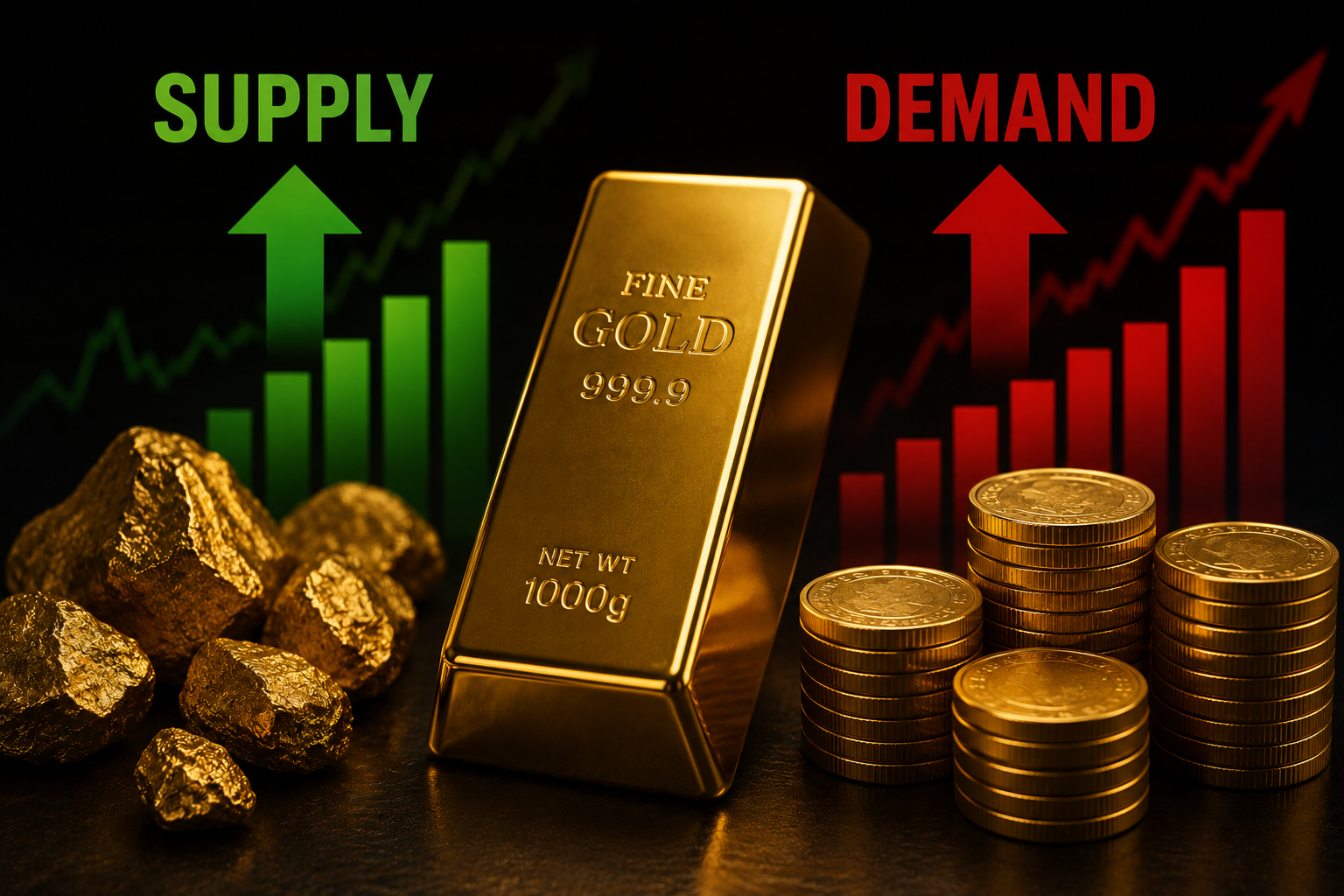
For thousands of years, gold has held a unique position in global economics. Unlike fiat currencies, which can be printed in unlimited quantities by central banks, gold is a finite physical asset. Because it cannot be artificially devalued, its price is dictated by the pure forces of microeconomics: supply and demand.
Understanding how these dual forces interact is essential for any investor looking to build a balanced portfolio or hedge against inflation. This comprehensive analysis breaks down the mechanics of the gold supply chain, the shifting dynamics of global gold demand, and the structural factors that establish its real time value.
The Economics of Price Discovery in the Gold Market
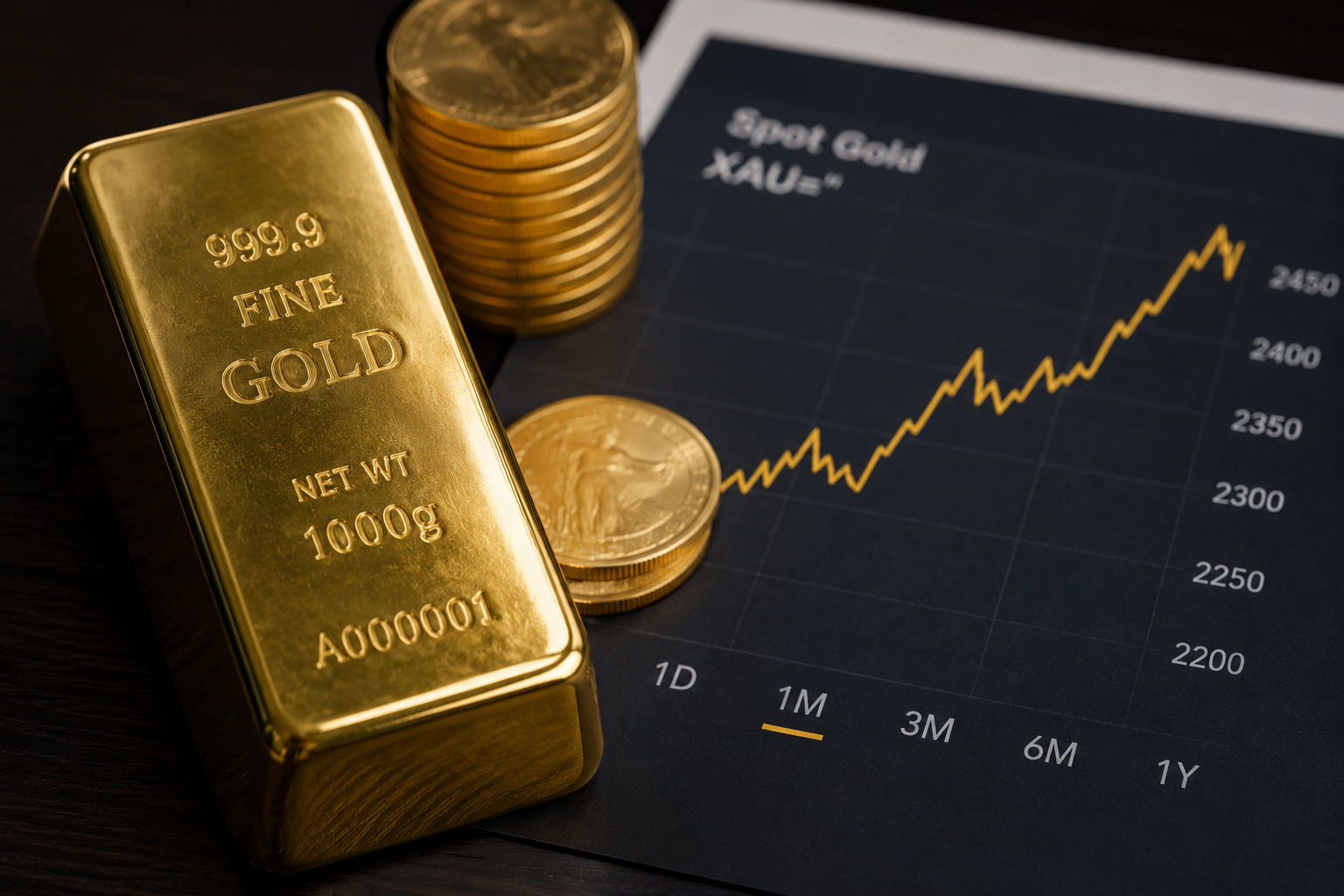
Price discovery is the process by which the market determines the spot price of an asset based on real time buy and sell orders. In the gold market, this process operates around the clock across a decentralized over the counter network of international bullion banks, brokerages, and electronic trading systems.
While global trading screen prices change second by second, the market relies on the London Bullion Market Association Gold Price to establish global institutional contracts. This process matches large buy and sell orders twice daily to establish a baseline market clearing price.
When global uncertainty increases or real interest rates decline, a surge of buy orders hits the market. Because the physical supply of gold cannot expand quickly, the spot price must adjust upward to clear the market, balancing the immediate demands of buyers with the available inventories of sellers.
Gold Market Supply & Demand Simulator
Adjust market forces to see live impacts on supply-demand deficits and theoretical pricing
850 t
Baseline (0%)
Normal Production
Simulated Demand5,002 t
Simulated Supply5,002 t
Market Equilibrium:Balanced
Theoretical Spot Target (USD / oz):$4,300.00
Disclaimer: This models real-world macroeconomic relationships using structural price elasticities. Actual spot gold trends vary based on real-time continuous OTC volume data.
The Supply Side: Where Does Global Gold Originate?
The total annual supply of gold is remarkably steady compared to other agricultural or industrial commodities. New gold enters the market from two primary pipelines: mining production and scrap recycling.
According to data compiled by the World Gold Council, the total annual supply of gold hovers around 5,000 tonnes. The breakdown between these sources reveals the structural inelasticity of the gold supply.
1. Primary Mine Production
Mine production forms the foundation of the gold supply, contributing roughly 70% to 75% of total annual volume. Gold mining is a capital intensive, multi year process involving exploration, environmental permitting, facility construction, and extraction.
Because it takes an average of 10 to 15 years to bring a new mine from discovery to commercial production, mining companies cannot instantly increase output when gold prices surge. This structural delay means that short term price spikes have an incredibly muted impact on primary mining supply. Long term industry statistics show that global mine production struggles to expand by more than 1% to 2% annually, even during multi year bull markets.
2. Recycled Scrap Gold
The remaining 25% to 30% of global supply comes from recycled gold, primarily consisting of melted jewelry, old coins, and discarded industrial electronics. Unlike mine production, recycled gold is highly responsive to price movements.
When the spot price of gold hits historic highs, consumer liquidations increase as individuals sell old jewelry to cash in on high market rates. However, recent market analysis indicates that even when gold achieves record nominal values, recycling pools can be constrained by holders choosing to retain their physical gold as a strategic safe haven asset.
Annual Gold Supply Distribution
The table below illustrates the recent distribution of the global gold supply chain, highlighting the balance between mining and secondary recovery methods.
Supply Component
Annual Volume (Tonnes)
Percentage of Total Supply
Characteristics
Mine Production
3,672
73.4%
Highly inelastic; requires years of capital investment.
Recycled Gold (Scrap)
1,404
28.1%
Highly elastic; fluctuates rapidly based on current spot prices.
Net Producer Hedging
-74
-1.5%
Mining companies buying back or restructuring forward contracts.
Total Global Supply
5,002
100.0%
Sets the absolute baseline for global physical market availability.
The Demand Side: Who Is Buying Gold?
While the supply side remains constrained by physical and logistical limits, the demand side is highly dynamic. Gold demand is divided into four distinct economic sectors, each responding to different market incentives.
1. Jewelry and Consumer Fabrication
Historically, the jewelry sector has been the largest consumer of physical gold, often accounting for half of global demand. This sector is dominated by emerging consumer markets, specifically China and India, where gold jewelry is deeply woven into cultural traditions, weddings, and generational wealth transfers.
Jewelry demand behaves like traditional consumer goods: it is price sensitive. When spot gold prices climb rapidly, jewelry demand tends to drop significantly as retail buyers experience sticker shock. Fabricators often respond by using lighter weights, altering purity carats, or substituting alternative precious metals to keep retail products affordable.
2. Private Investment (Bars, Coins, and ETFs)
Investment demand includes institutional and retail purchases of physical gold bars and coins, alongside capital flows into gold backed Exchange Traded Funds (ETFs).
Investment demand is driven by macroeconomic sentiment:
Safe Haven Allocations: During periods of high inflation, currency depreciation, or banking crises, capital flows rapidly into gold to protect wealth.
The Momentum Effect: Unlike jewelry, investment demand often rises as prices increase. Retail and institutional investors buy into the market out of fear of missing out, creating a self reinforcing demand spiral that accelerates upward price trends.
3. Central Bank Official Reserves
Central banks maintain massive physical gold reserves to back national currencies, manage institutional sovereign risk, and diversify foreign exchange portfolios.
Over the last several years, central banks have engaged in sustained, historic gold accumulation programs, pushing global purchase levels toward 1,000 tonnes annually. This structural shift is heavily driven by de-dollarization policies among emerging economies.
By converting paper fiat reserves into physical bullion, sovereign states insulate their financial frameworks from unilateral currency interventions and foreign asset freezes. This continuous institutional buying creates a solid price floor under the global spot market.
4. Industrial and Technological Applications
Gold is an exceptional conductor of electricity and is highly resistant to corrosion. Consequently, it is utilized across the technology sector in microchips, printed circuit boards, automotive safety components, and precision telecommunications hardware.
While industrial demand is steady, it accounts for less than 10% of total global consumption. Because industrial fabricators use tiny quantities per device, their purchasing patterns are less sensitive to short term spot price volatility, though economic recessions can dampen overall industrial volume.
Macroeconomic Forces Transforming Supply and Demand Dynamics
The supply and demand equilibrium of gold does not exist in a vacuum. It is constantly reshaped by shifting macroeconomic variables, which turn safe haven demand levers on or off.
The Real Interest Rate Matrix
The opportunity cost of holding a non yielding asset like physical gold is directly tied to real interest rates (nominal interest rates minus the inflation rate).
Positive Real Yields: When government bonds offer high yields that clear the rate of inflation, investors prefer to hold interest-bearing debt instruments. This drops investment demand for gold and exerts downward pressure on prices.
Negative Real Yields: When inflation outpaces central bank interest rates, cash and bonds lose purchasing power over time. In this environment, the opportunity cost of holding gold disappears, driving a rapid rotation of capital into precious metals.
Recent Institutional Market Shifts
The composition of the gold market has undergone a significant structural shift. Recent financial analysis shows that physical investment demand has officially surpassed jewelry fabrication as the largest source of global gold consumption.
This historic transition means the gold market has become much more sensitive to broader financial trends, including shifts in investor risk appetites, institutional inflation expectations, and changes in Federal Reserve interest rate guidance.
Timeline of Major Supply and Demand Milestones
The timeline below traces the recent structural transformations that have reshaped the global gold market.
The Institutional De-Dollarization Surge
Late 2022
Central banks worldwide accelerated physical reserve accumulation programs to safeguard capital against unilateral financial sanctions, driving annual sovereign demand past the historic 1,000-tonne baseline.
The Central Bank Reserve Parity Shift
Mid 2025
According to official European Central Bank assessments, gold reserves rose to represent 27% of global official asset allocations, eclipsing US Treasury instruments (which fell to 22%) as the largest aggregate component of international sovereign reserves.
Historic Price Inversion Peak
January 2026
Driven by intense safe-haven investment demand and structural geopolitical risks in the Middle East, spot gold prices hit an unprecedented nominal record high of $5,318 per ounce. This price peak triggered a major consumer rotation from retail jewelry into bars and coins.
Primary Demand Rebalancing
June 2026
Market data confirmed that physical retail investment and institutional ETF inflows officially consolidated their position as gold’s primary demand category, overtaking traditional jewelry fabrication on an annualized basis.
Evaluating the Pros and Cons of Gold Market Liquidity
Before dedicating investment capital to the precious metals sector, it is helpful to analyze how supply and demand inelasticity impacts portfolio performance.
Key Takeaway for Investors: Because physical gold supply cannot expand quickly to meet unexpected demand spikes, entering the market during safe-haven surges requires careful risk management and a long-term investment horizon.
Advantages
Hard Asset Protection: Gold’s rigid, physical supply prevents the currency dilution that naturally impacts fiat paper systems.
Counter-Cyclical Returns: Investment demand typically spikes when traditional equity and real estate markets face severe systemic shocks, providing vital diversification.
Constant Liquidity Infrastructure: The deep, global over-the-counter institutional trading network ensures that physical gold can be liquidated into cash 23 hours a day at transparent global rates.
Disadvantages
Opportunity Cost Drag: Because gold generates no active yield, dividend, or corporate cash flow, it can underperform traditional assets during sustained economic expansions.
Retail Premium Friction: Small-scale retail purchasers looking to acquire physical bars and coins must pay broker premiums over raw spot rates, increasing entry costs.
Short-Term Price Volatility: Speculative derivatives and institutional rebalancing trends can trigger dramatic short-term price drops, even while long-term supply-demand fundamentals remain tight.