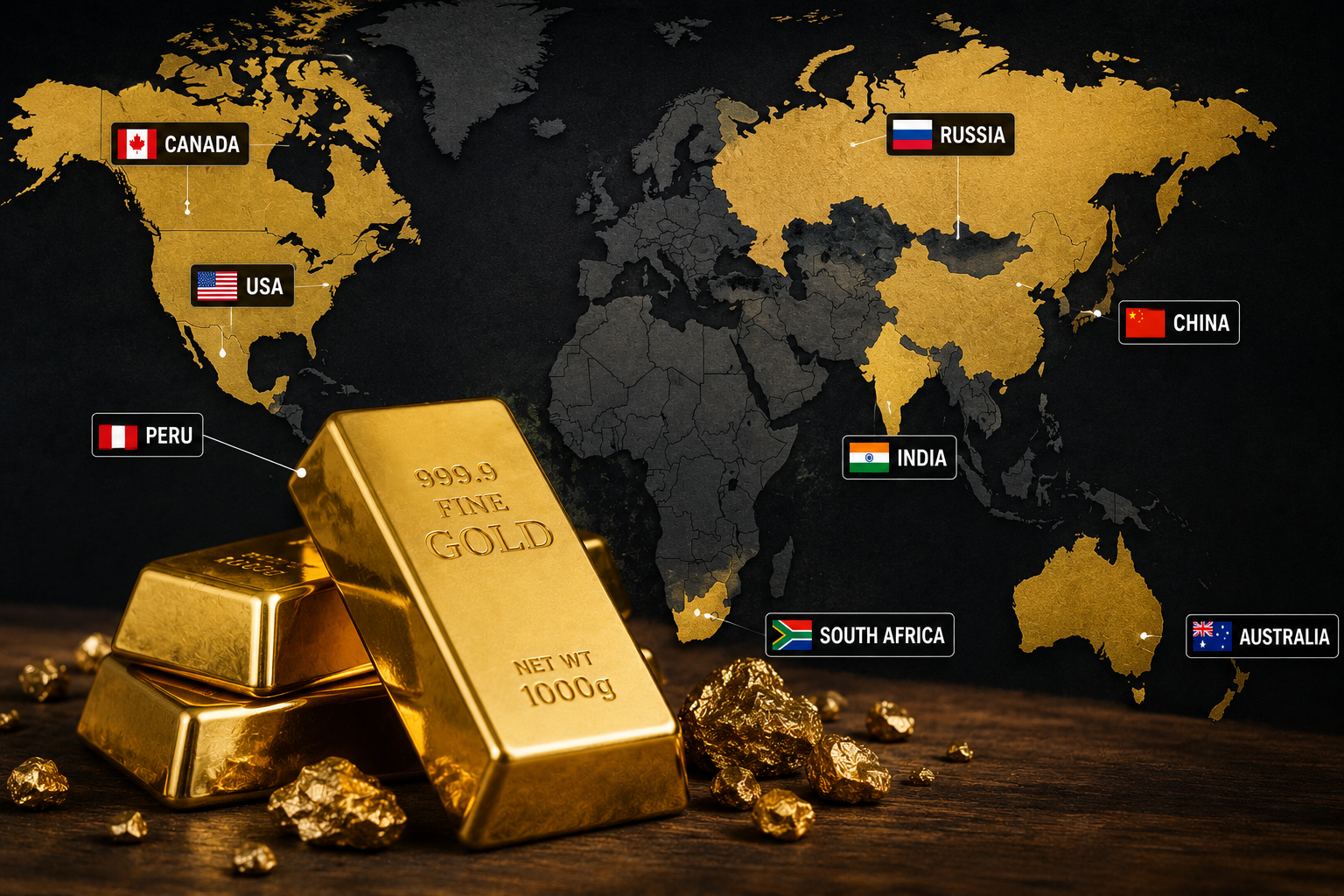
The global gold mining industry is experiencing an unprecedented era of structural transformation. Physical gold demand shattered historical data in late 2025 by exceeding 5,000 tonnes for the first time, pushing spot gold prices to historic highs near 5,600 USD per ounce in early 2026.
While the yellow metal remains a ultimate safe haven asset, the physical extraction of gold is heavily concentrated within a select group of nations. Mining operations are currently grappling with deep geopolitical risks, structural changes in mine grades, and escalating environmental stewardship regulations.
This comprehensive analysis breaks down the leading gold producing countries, evaluates the top performing operations globally, and explores the market dynamics shaping supply.
Global Gold Production & Margin Simulator
Explore leading producers and simulate how changing extraction costs impact mine margins
+0%
Annual Mine Output380 Tonnes
Global Market Share11.4%
Simulated Profit Margin72.3%
China Mining Infrastructure
Dominates production via major state-integrated groups like Zijin Mining and Shandong Gold. Output is heavily preserved for domestic sovereign bank reserve accumulation.
Relative Share of Global Supply11.4%
Calculations assume a standard benchmark market spot gold valuation of $5,300 per troy ounce. Margins shift based on local base All-In Sustaining Costs (AISC).
Global Gold Production: The Official Leaderboard
Global mine output reached a record 3,672 tonnes. The supply landscape is highly consolidated, with the top five nations controlling over 40% of the entire global output.
The following dataset showcases the official distribution of gold production based on compiled figures from the U.S. Geological Survey (USGS) and the World Gold Council.
Table 1: Top 10 Gold Producing Nations
Rank
Country
Annual Production (Metric Tonnes)
Global Market Share (%)
Key Mining Regions
1
China
380
11.4%
Shandong, Henan, Shaanxi
2
Russia
310
9.3%
Krasnoyarsk, Amur, Magadan
3
Australia
290
8.7%
Western Australia, Queensland
4
Canada
200
6.0%
Ontario, Quebec, Nunavut
5
United States
160
4.8%
Nevada, Alaska, Colorado
6
Ghana
140
4.2%
Ashanti Belt, Western Region
7
Mexico
140
4.2%
Sonora, Zacatecas, Guerrero
8
Indonesia
110
3.3%
Papua, East Kalimantan
9
Peru
100
3.0%
Cajamarca, La Libertad
10
Uzbekistan
90
2.7%
Kyzylkum Desert
Deep Dive: The Top 5 Gold Producing Nations
1. China (380 Tonnes)
China continues its long standing reign as the world leader in physical gold production. Unlike western jurisdictions where production is dominated by a few publicly traded mega corporations, the Chinese market relies on a highly integrated mix of state owned enterprises and decentralized artisanal operations.
Major corporate players like Zijin Mining and Shandong Gold Group drive large scale industrial output, while smaller networks span the mineral rich provinces of Shandong, Henan, and Shaanxi.
Current Dynamic: The Chinese central bank (PBOC) has engaged in structural purchasing strategies, systematically absorbing significant portions of domestic production directly into national reserves. This has effectively insulated a portion of global supply from the open market.
Operational Headwinds: The Chinese mining sector is facing aggressive regulatory tightening focused on mandatory water recycling and land reclamation programs, which has capped further exponential growth in domestic output.
2. Russia (310 Tonnes)
Russia holds the second spot globally, extracting immense volumes from its prolific eastern and Siberian deposit belts. The country possesses some of the largest unmined reserves in the world, positioned across complex geographic terrains.
Current Dynamic: International trade sanctions have entirely reshaped how Russian gold enters the global economy. Instead of routing through traditional European hubs like London, Russian domestic producers, led by Polyus and Polymetal, have permanently redirected physical bullion flows toward alternative processing hubs in the Middle East and Asia.
Operational Headwinds: Supply chain restrictions on heavy machinery and precision extraction technology have forced Russian operations to rapidly scale up domestic equipment alternatives, increasing local processing and capital expenditure costs.
3. Australia (290 Tonnes)
Australia remains an absolute powerhouse of stable mining infrastructure, centered heavily within Western Australia. The country operates under high investment security and boasts excellent geology.
Current Dynamic: Australian production is heavily anchored by ultra deep open pits and extensive underground systems. The nation is at the forefront of automated hauling and precision drilling technologies designed to extract value from lowering ore grades.
Operational Headwinds: Mines frequently intersect with pastoral lands and strict ecological corridors. This requires significant, ongoing spending on progressive rehabilitation, where landscapes must be continually restored alongside active extraction cycles.
4. Canada (200 Tonnes)
Canada has established itself as one of the most attractive investment jurisdictions globally, leveraging deep deposits across the Canadian Shield, Quebec, and Nunavut.
Current Dynamic: Output is expanding due to a wave of newly commissioned projects and brownfield expansions. Operations like Agnico Eagle’s Detour Lake have provided highly resilient output volumes.
Operational Headwinds: High energy costs in remote northern territories have accelerated an industry wide shift toward micro hydro grids and large scale solar configurations to offset heavy reliance on diesel fuel.
5. United States (160 Tonnes)
The United States rounds out the top five, driven almost entirely by the tier one asset landscape of Nevada.
Current Dynamic: The US gold landscape is defined by massive corporate consolidation, most notably represented by Nevada Gold Mines, a joint venture operated by Barrick Gold and Newmont Corporation.
Operational Headwinds: Environmental permitting timelines in the US are among the lengthiest in the world, creating extended multi year lags between initial discovery and actual commercial production.
Market Dynamics: The World’s Top Performing Gold Mines
Evaluating national production numbers tells only part of the story. Global supply is fundamentally dictated by a small group of highly consolidated mega mines. When a single site experiences disruption, it alters international supply metrics.
Table 2: Elite Mining Complexes Globally
Asset Name
Primary Country
Controlling Operator(s)
Annual Output (Koz)
Mine Structure
Nevada Gold Mines
United States
Barrick Gold / Newmont
2,595
Integrated Open Pit / Underground
Muruntau
Uzbekistan
Navoi Mining & Metallurgy
1,708
Massive Open Pit
Olimpiada
Russia
Polyus
1,357
Open Pit
Kazzinc Consolidated
Kazakhstan
Glencore / State
947
Poly metallic Complex
Grasberg
Indonesia
Freeport McMoRan / PT Inalum
937
Deep Block Cave Underground
Critical Market Shift: The 2025/2026 data highlights a major structural change at Indonesia’s iconic Grasberg complex. Long ranked as a top three asset globally, a catastrophic mudslide in late 2025 slashed production by roughly 50%. This allowed Kazakhstan’s Kazzinc complex to leapfrog into the top four positions, proving how fragile physical gold supply lines can be.
Key Industry Drivers and Risk Factors
To properly project future gold supply, miners and investors monitor macro trends that alter mine profitability.
1. Equity Divergence and the Leveraged Reverse Effect
A fascinating anomaly occurred throughout 2025 and early 2026. While physical gold bullion set nominal records, major gold mining equities experienced swift corrections ranging from 20% to 40%.
This divergence is rooted in All In Sustaining Costs (AISC). Rising expenditures for specialized mining labor, chemical reagents, heavy vehicle fleets, and grid electricity compressed operating margins for high cost producers. When gold prices trimmed slightly from all time highs, the structural leverage of mining equities worked in reverse, driving down stock valuations despite record physical output.
2. Geopolitical and Legal Friction
Sovereign and corporate asset risk is intensifying. A clear example is unfolding at the world’s largest producing gold asset: Nevada Gold Mines.
Newmont filed a formal notice of default against its joint venture partner Barrick Gold, alleging that resources were improperly diverted away from the joint venture toward Barrick’s wholly owned Fourmile development project. When the world’s most productive asset operates under active legal contention between its parent entities, global baseline supply uncertainty increases.
3. Permitting and Program Extensions
Informal and artisanal mining sectors heavily influence total output numbers in developing economies. In Peru, the government extended its REINFO temporary permit program through the end of 2026. Estimates indicate that nearly 40% of the gold moving through Latin American export channels originates from unpermitted or informal operations, causing persistent tension between corporate mine operators and regional regulators.
The Outlook for Global Gold Supply
Data models compiled by Metals Focus suggest that global mined gold production is steadily moving toward a cyclical plateau. The industry is encountering a severe scarcity of tier one asset discoveries, despite substantial global exploratory spending over the past decade.
Because an industrial gold project requires an average timeline of seven to over ten years to transition from initial drill hole validation to commercial production, near term supply shifts will depend on optimizing existing operations rather than building new mega complexes.
As central banks maintain elevated purchase profiles to diversify reserve assets, the structural concentration of gold production ensures that the nations controlling physical supply will continue to hold immense macroeconomic leverage.