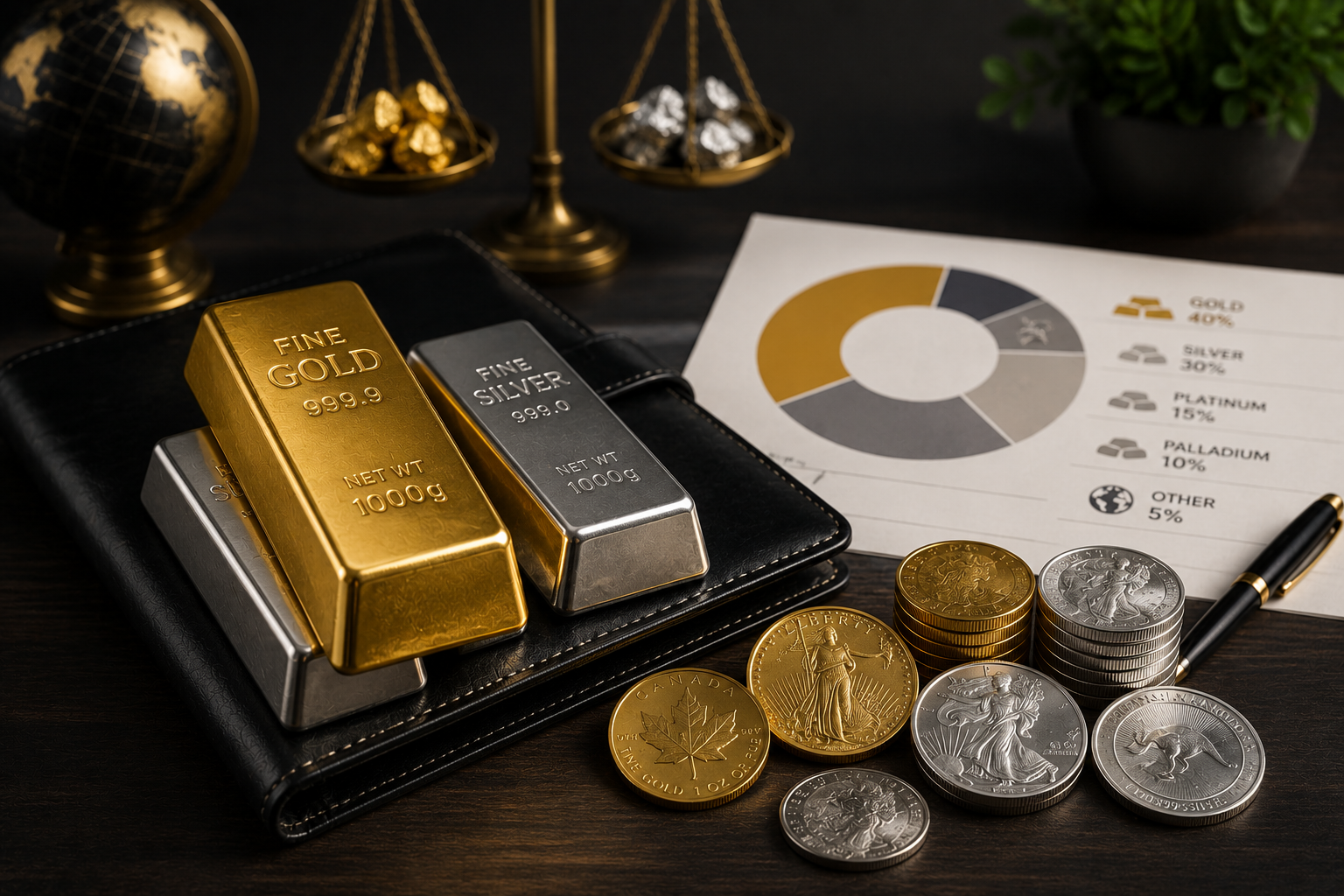
For centuries, precious metals have served as the ultimate financial insurance policy. When fiat currencies falter, stock markets experience late-cycle corrections, and geopolitical tensions escalate, physical assets like gold and silver consistently step into the spotlight.
Building a precious metals portfolio isn’t about wild speculation; it’s about wealth preservation, systemic risk mitigation, and structural diversification.
The precious metals landscape has undergone a massive secular shift. Gold has broken past historic boundaries to trade well above $4,500 per ounce, while silver has experienced explosive price-discovery phases, whipsawing between $70 and $112 per ounce due to intense green energy and artificial intelligence (AI) industrial demand.
If you want to protect your capital from currency debasement and soaring global debt, this comprehensive, step-by-step framework will show you exactly how to design, execute, and manage a resilient precious metals portfolio.
Precious Metals Asset Allocator
Set your total investment capital and balance your portfolio risk profile. Ensure your total allocations sum to 100%.
$
Gold Allocation (Anchor)70%
Silver Allocation (Growth)20%
Platinum Allocation (Industrial)10%
Allocation Balance Lock: Adjusting allocations to maintain exactly 100% total distribution.
Portfolio Blueprint Summary
Gold ($XAU)1.63 oz
$7,000.00
Silver ($XAG)29.41 oz
$2,000.00
Platinum ($XPT)0.56 oz
$1,000.00
Total Balanced:100%
Est. G/S Ratio:63.4:1
1. Step-by-Step Asset Allocation Blueprint
Building a portfolio requires a methodical approach to balancing safety, liquidity, and growth. Follow this structural sequence to establish your allocation securely:
1.Determine Your Total Portfolio Allocation: Target: 5% to 15% of net worth.
Evaluate your overall financial net worth. Financial planners generally recommend allocating 5% to 10% of a standard portfolio to precious metals for pure wealth preservation, or up to 15% if you expect high systemic inflation or market drawdowns. Never over-leverage your liquid cash into illiquid physical metals.
2.Select Your Core Metals Mix: Balance stability and growth.
Divide your precious metals capital across different assets based on your risk tolerance. A reliable baseline allocation for a balanced portfolio is 70% Gold (for absolute downside protection and central bank alignment) and 30% Silver (for industrial upside and economic beta).
3.Choose Your Direct Investment Vehicles: Physical vs. Paper vs. Equities.
Decide how you want to hold the metals. Allocate at least half of your metals capital to physical bullion (sovereign coins or bars) held in secure storage to eliminate counterparty risk. Allocate the remaining half to Exchange-Traded Funds (ETFs) for instant liquidity, or mining equities to gain operational leverage.
For physical allocations, secure your storage before making major purchases. Avoid storing large amounts at home unless you have a high-grade, hidden, bolted safe. Use third-party, fully insured, segregated and allocated private vault depositories in politically stable jurisdictions.
2. Allocating the Four Core Precious Metals
Each precious metal responds differently to economic cycles. To optimize your asset allocation, you need to understand what drives value within each tier.
Gold (XAU): The Monetary Anchor
Gold is the ultimate tier-1 reserve asset with zero sovereign counterparty risk. According to J.P. Morgan Global Research, global central banks purchased over 1,000 tonnes of gold annually for three consecutive years, with demand projected to average a highly elevated 585 tonnes per quarter. Global debt exceeding 120% of GDP makes gold an essential anchor for any defensive portfolio.
Silver (XAG): The High-Beta Growth Engine
Silver behaves like gold on steroids. It is a monetary asset, but more than 50% of its annual demand comes from industrial applications. Driven by solar photovoltaics, electric vehicle electronics, and the massive expansion of AI data centers, silver entered its sixth consecutive year of structural supply deficits. This dual nature makes silver volatile, but it offers immense upside during commodity bull runs.
Platinum (XPT) & Palladium (XPD): The Industrial Cyclicals
These sister metals are dominated by the automotive sector, specifically catalytic converters for emissions control. Platinum is increasingly tied to the emerging hydrogen fuel cell economy, while palladium remains sensitive to traditional internal combustion and hybrid auto production. These should be limited to small, tactical allocations within aggressive portfolios.
3. Physical Bullion vs. Paper vs. Mining Stocks
A resilient portfolio utilizes multiple investment vehicles to balance safety, liquidity, and upside potential.
Asset Type
Examples
Primary Advantage
Major Disadvantage
Target Allocation
Physical Bullion
American Eagles, Maple Leafs, 10oz Bars
Zero counterparty risk; true private wealth preservation.
Pro Tip on Streaming Companies: If you want equity exposure without high mining risks (such as labor strikes or energy cost inflation), look at precious metal streaming and royalty companies. These firms provide upfront capital to miners in exchange for the right to buy future metal production at fixed, heavily discounted prices, ensuring predictable profit margins.
4. Modern Portfolio Mechanics: Rebalancing with the Gold-to-Silver Ratio
To maximize long-term returns without adding external capital, you can dynamically rebalance your portfolio using the Gold-to-Silver Ratio. This ratio measures how many ounces of silver are required to purchase a single ounce of gold.
\text{Gold-to-Silver Ratio} = \frac{\text{Spot Price of Gold}}{\text{Spot Price of Silver}}
Historically, this ratio acts as an excellent mean-reverting indicator for identifying structural mispricings between the two companion metals:
When the Ratio is Stretched High (Above 80:1 – 85:1): Silver is historically cheap relative to gold. An investor should over-allocate new capital to silver or rotate a portion of their gold holdings into silver.
When the Ratio Compresses Low (Below 50:1 – 55:1): Silver has become expensive relative to gold. An investor should harvest profits from their silver gains and rotate capital back into stable gold.
By systematically executing this rotation, you can steadily increase the total ounces of precious metals in your vault over time.
5. Avoiding Common Pitfalls: A Guide for Retail Buyers
The retail precious metals industry can be difficult to navigate for beginners. Avoid these common traps to keep your portfolio efficient:
Paying Absurd Premiums for Modern Numismatics: Commission-driven dealers often push “rare,” “graded,” or “limited edition” proof coins at 50% to 100% markups over the metal’s actual melt value. Stick to high-liquidity, low-premium sovereign bullion coins or institutional bars.
Ignoring the Bid-Ask Spread: Every time you buy or sell physical metal, the dealer takes a cut. Ensure you know the “bid” (the price they pay to buy it back from you) before paying the “ask” (the retail purchase price).
Failing to Track Total Cost of Carry: If your vault storage fees, insurance, and transport costs exceed 1% to 1.5% of your asset value annually, your portfolio’s wealth-preservation benefits will slowly erode over the long run.
Summary Portfolio Checklist
Before deploying your hard-earned capital into the precious metals market, ensure you have checked every item on this operational checklist:
Portfolio Cap Confirmed: Ensure your total precious metals exposure does not exceed 15% of your overall investable net worth.
Premium Verification: Confirm that the dealer’s markup on physical gold is under 4% to 5%, and under 12% to 15% for physical silver coins.
Storage Autonomy: Verify that your chosen private vault depository uses fully segregated, allocated accounts with regular third-party audits.
Tax Framework Optimization: Consult with your accountant to see if holding metals within a specialized retirement account (like a precious metals IRA) provides a more capital-efficient structure.
By treating precious metals as a strategic asset class rather than a speculative trade, you can build a secure framework that protects your purchasing power across any economic environment.