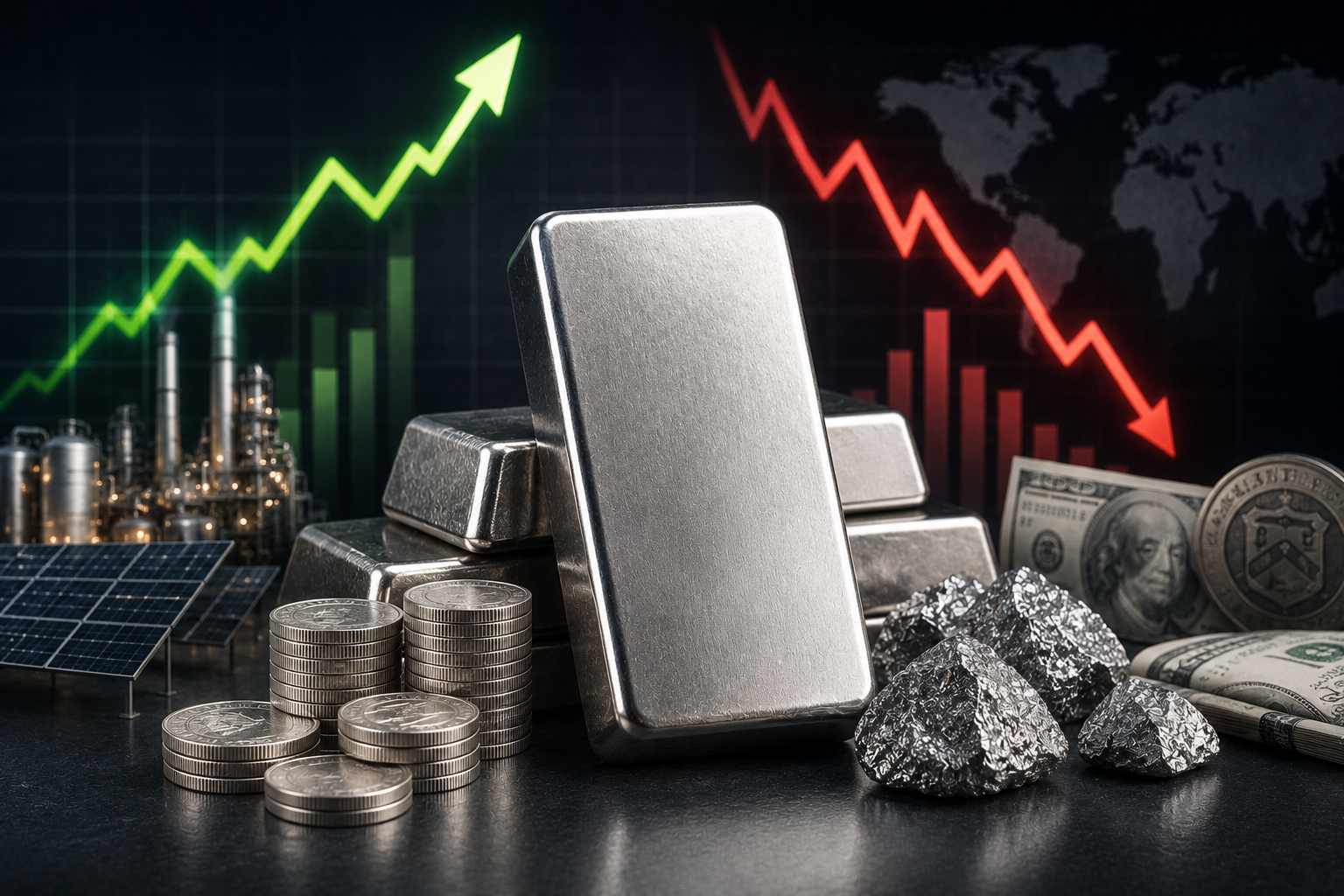
For thousands of years, silver has straddled two worlds. It is simultaneously a cherished monetary store of value and an irreplaceable industrial commodity. Because it wears both hats, the silver market is notoriously volatile, experiencing dramatic price swings that trap uneducated retail buyers while providing massive opportunities for seasoned investors.
If you have ever wondered why silver prices suddenly skyrocket or plunge without warning, you are in the right place.
This comprehensive guide breaks down the core structural drivers of the silver market. We will look at macroeconomic variables, supply constraints, emerging industrial technologies, and how the current economic landscape shapes the value of this precious metal.
Silver Price Sentiment Simulator
Adjust the macroeconomic sliders below to see how shifts in monetary policy and green energy demand impact the estimated price of silver.
A weaker dollar makes silver cheaper for global buyers.
+12%
Accelerating solar and AI hardware infrastructure boosts structural demand.
SIMULATED SILVER PRICE
$30.00
Baseline Price
MARKET SENTIMENT
NEUTRAL
*Simulated projections are for educational purposes based on historical core matrix correlations and do not constitute formal financial advice.
1. The Dual Nature of Silver: Money vs. Industry
To understand why silver prices move, you must first understand its split personality. Unlike gold, which is primarily held by central banks and jewelry collectors as a safe-haven asset, silver’s value is driven almost equally by investment demand and practical industrial applications.
When the global economy booms, industrial demand for silver surges, pulling prices upward. Conversely, during periods of extreme financial crises or intense inflationary pressure, investors pile into physical silver as a secure alternative asset, driving the price up via speculative buying. This unique intersection creates highly complex market dynamics.
2. Macroeconomic Drivers: The Forces That Move the Needle
Silver operates within the global financial architecture. Several major macroeconomic variables act as massive gravity wells, constantly pulling silver prices higher or pushing them lower.
Interest Rates and Central Bank Policies
Precious metals do not pay a dividend or yield interest. Therefore, silver is highly sensitive to the monetary policies implemented by the U.S. Federal Reserve and other global central banks.
When Interest Rates Rise: Yield-bearing assets like U.S. Treasury bonds become highly attractive. The opportunity cost of holding physical silver increases, which typically causes investors to rotate capital out of precious metals and into fixed-income securities.
When Interest Rates Fall: The opportunity cost of holding an unproductive asset disappears. As interest rates plunge, capital flows back toward real, physical assets, fueling aggressive rallies in silver and gold prices.
The U.S. Dollar Index (DXY)
Global commodities, including silver, are universally priced in U.S. dollars (USD$). Consequently, there is an inverse relationship between the strength of the dollar and the price of silver. When the U.S. dollar is strong, silver becomes more expensive for international buyers purchasing with weaker local currencies, dampening demand. When the dollar weakens, silver effectively becomes cheaper worldwide, inviting a flood of cross-border purchasing power.
Inflation and Currency Devaluation
When fiat currencies lose their purchasing power due to expansionary monetary policy or supply-chain shocks, investors turn to tangible assets. Silver serves as an accessible inflationary hedge, preserving wealth when paper money is actively depreciating.
3. Industrial Demand: The Green Energy Engine
Silver possesses the highest electrical and thermal conductivity of any element on Earth. It cannot be easily or cheaply substituted in high-performance electronics, making it foundational to modern technology and green energy infrastructure.
Industrial Sector
Primary Use Case
Market Impact
Solar Photovoltaic (PV)
Silver paste is screen-printed onto solar cells to conduct generated electricity.
Rapidly expanding global capacity acts as a structural floor for long-term industrial demand.
Electronics & 5G
Printed circuit boards, electrical switches, and multi-layer ceramic capacitors.
Highly cyclical; demand tracks directly with global consumer technology spending.
Automotive & EVs
Battery management systems, wire harnesses, and structural electronic relays.
Electric vehicles require up to 2x more silver per vehicle than traditional internal combustion engines.
Artificial Intelligence
Specialized data center infrastructure, advanced semiconductors, and power grids.
The aggressive global transition toward renewable energy has fundamentally transformed silver's underlying fundamentals. Year-over-year growth in global solar installations has absorbed huge chunks of annual mine supply, making silver incredibly vulnerable to supply deficits.
4. Supply Dynamics: Why Silver Cannot Simply Be Turned On
The supply side of the silver equation is highly inelastic, meaning that even if the price doubles tomorrow, miners cannot instantly ramp up production to meet demand.
Crucially, nearly three-quarters of all silver mine supply is produced as a byproduct of mining other base metals like copper, zinc, lead, and gold. If global industrial activity slows down and copper prices fall, base-metal miners may cut production or close down operations entirely. This inadvertently chokes off the global supply of byproduct silver, regardless of how high the standalone demand for silver happens to be.
Furthermore, setting up a new primary silver mine takes an average of 10 to 15 years from initial exploration and environmental permitting to commercial production. This massive structural delay keeps the market highly vulnerable to sudden structural deficits.
5. Market Speculation and the Gold-to-Silver Ratio
Because the total physical silver market size is a tiny fraction of the global gold or equity markets, relatively minor shifts in investment capital can trigger explosive, parabolic price movements.
The Gold-to-Silver Ratio Explained
The Gold-to-Silver Ratio measures how many ounces of silver it takes to buy one single ounce of gold. Historically, this metric has served as an excellent indicator for identifying structural mispricings between the two companion metals.
\text{Gold-to-Silver Ratio} = \frac{\text{Price of Gold per Ounce}}{\text{Price of Silver per Ounce}}
High Ratio (e.g., Above 85:1): Indicates that silver is historically undervalued relative to gold. Value investors often interpret this as a strong buy signal for silver, expecting it to outperform gold during the next major precious metals bull market.
Low Ratio (e.g., Below 50:1): Suggests that silver has become overvalued or overextended relative to gold, often indicating that a cyclical market peak may be approaching.
6. Real-Time Analysis: The Economic Landscape
The precious metals market reflects broader macro anxieties and late-cycle stresses. Analysts highlight several critical factors directly steering price discovery:
The AI Infrastructure Boom: The massive, capital-intensive expansion of worldwide data centers and advanced computing grids is creating an unexpected structural demand layer for high-purity electrical contacts, heavily utilizing silver and copper components.
Late-Cycle Financial Fragility: Tightening liquidity conditions, structural debt burdens, and volatility radiating from global sovereign bond markets have renewed investor interest in physical, non-rehypothecated real assets.
Deepening Structural Deficits: The Silver Institute continually tracks widening structural deficits, where total global demand (industrial + investment) consistently outstrips aggregate mine output and recycling supply. These deep multi-year deficits place immense pressure on commercial vault inventories.
Summary Checklist for Silver Investors
Before making an entry or exit decision in the silver market, check these core indicators:
Federal Reserve Direction: Is the Fed cutting interest rates (bullish) or hiking/holding them higher for longer (bearish)?
Dollar Index (DXY): Is the greenback weakening against other major global currencies (bullish for silver)?
Industrial Growth & Photovoltaics: Are global solar, automotive, and semiconductor manufacturing sectors actively expanding?
The Gold-to-Silver Ratio: Is the ratio stretched historically high, signaling an undervalued entry point?
By systematically tracking these moving parts, you can strip away the emotional noise of daily market fluctuations and position yourself intelligently alongside long-term macroeconomic and industrial trends.