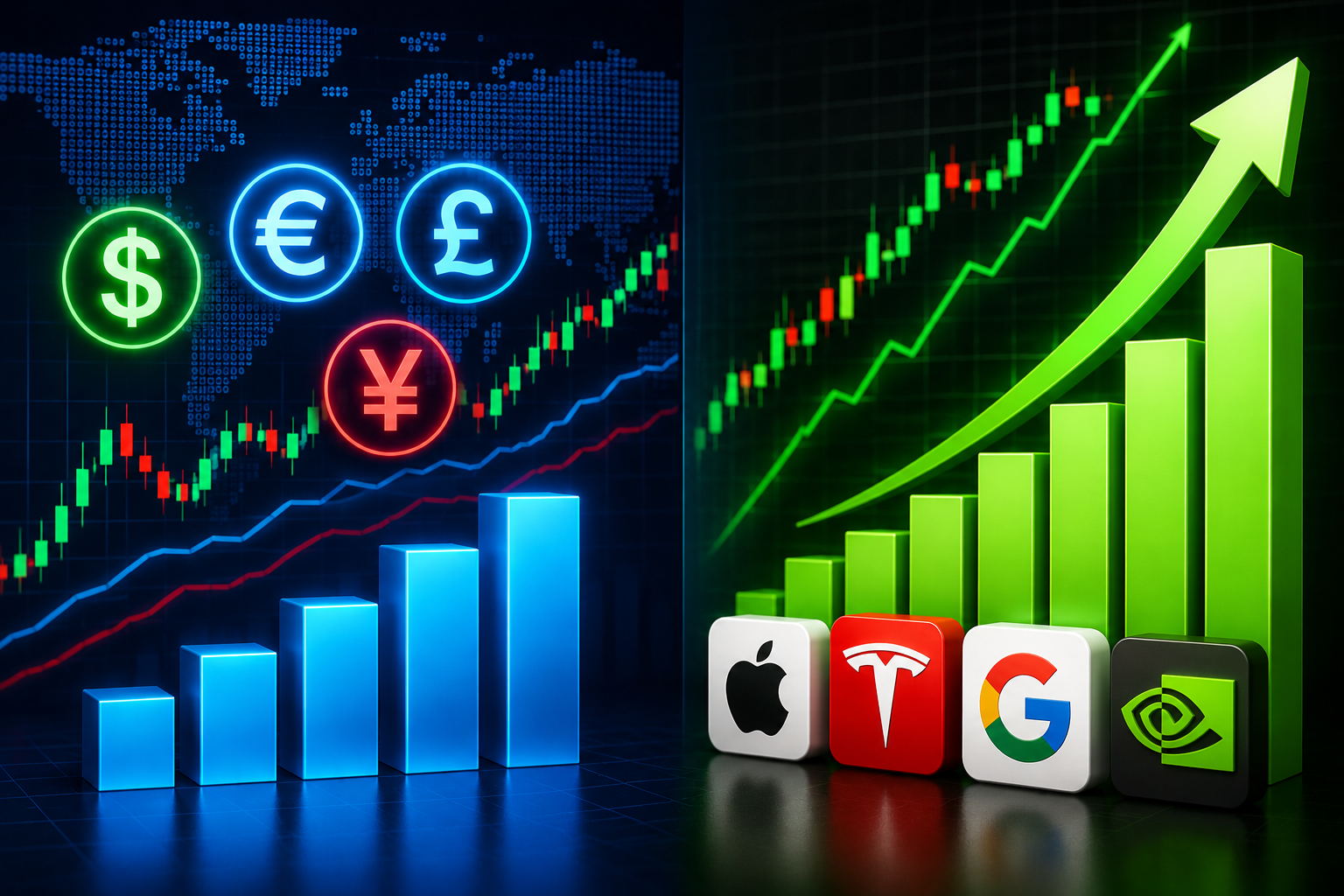
A detailed, honest comparison for US beginners in 2026 – covering trading hours, costs, regulation, leverage, risk, and which market actually gives you the best shot at learning to trade profitably.
Every new trader faces this question eventually. Forex and stocks are both legitimate markets with real profit potential, but they operate very differently, attract different personalities, and reward different skills. This guide does not declare a universal winner because there is none. What it does is give you every meaningful data point so you can make the right choice for your specific goals, schedule, and risk tolerance.
Before going deep on each category, here is the high-level comparison every beginner needs to see first.
Feature
Forex
Stocks (US)
Market size (daily volume)
$7.5 trillion per day
$400 billion per day (NYSE + NASDAQ)
Trading hours
24 hours a day, 5 days a week
9:30 AM to 4:00 PM ET (weekdays only)
Minimum to start
$0 to $100 (micro accounts)
$0 (fractional shares) or $25,000 (day trading)
Max US leverage
50:1 (major pairs)
2:1 (standard margin), 4:1 intraday
Number of instruments
~70 to 80 currency pairs
8,000+ individual stocks, plus ETFs
Regulator
CFTC and NFA
SEC and FINRA
Profit in falling markets
Yes (short selling built-in)
Yes, but more complex (short selling, puts)
Dividends/ownership
No
Yes (dividends, voting rights, equity ownership)
Primary tax treatment
Section 988 or Section 1256
Capital gains (short and long term)
Market Size and Liquidity
The forex market is by a significant distance the largest financial market on earth. With approximately $7.5 trillion in daily trading volume, it dwarfs the US stock market, the US bond market, and all global commodity markets combined. To put that in perspective, the entire New York Stock Exchange processes roughly $20 billion in trades on an average day. The forex market handles that in minutes.
What does this mean for you as a beginner? Liquidity. In forex, especially on major pairs like EUR/USD or USD/JPY, there is always a buyer and always a seller. You will almost never be stuck in a position because you cannot find someone to trade with. Your order fills instantly, at or very close to the price you see on your screen.
The stock market is also highly liquid for large-cap names like Apple, Microsoft, or Amazon. However, if you venture into small-cap or micro-cap stocks, liquidity thins dramatically. Bid-ask spreads widen. Orders slip. Getting in and out of a position at the price you want becomes genuinely difficult.
Forex
$7.5 trillion daily volume
Instant execution on major pairs
No single entity can corner the market
Uniform liquidity around the clock during sessions
Stocks
$400 billion daily (US exchanges)
Excellent liquidity on large-cap stocks
Poor liquidity on small/micro caps
Liquidity concentrated in market hours only
Advantage: Forex for consistent, around-the-clock liquidity. Stocks win on large-cap individual names but lose badly on smaller companies.
Trading Hours Compared
This is one of the most practically important differences for American beginners, and it is often underestimated.
Stock Market Hours
US stock markets — the NYSE and NASDAQ — are open from 9:30 AM to 4:00 PM Eastern Time, Monday through Friday, excluding federal holidays. Pre-market trading (4:00 AM to 9:30 AM ET) and after-hours trading (4:00 PM to 8:00 PM ET) exist but come with significantly wider spreads, lower volume, and higher risk of price manipulation by institutional players.
If you work a standard 9-to-5 job, the stock market is open while you are working. Your options are to trade pre-market, take time during lunch, or trade after hours — none of which are ideal conditions for beginners.
Forex Market Hours
The forex market operates 24 hours a day from Sunday evening to Friday evening. For US traders, the most active window is the London-New York overlap from 8:00 AM to 12:00 PM ET, which is also the window of tightest spreads and highest volatility. But trades can be placed at 11 PM, 3 AM, or any other time.
This flexibility is a genuine structural advantage for anyone who works a conventional schedule. You can trade before work, during lunch, after dinner, or on weekends for analysis without market pressure.
Scenario
Forex
Stocks
9-to-5 worker in the US
Can trade evenings, early mornings, or weekends
Very difficult — market closes at 4 PM ET
Night owl or shift worker
Asian and London sessions available late night / early AM
Extremely limited after-hours volume
Weekend researcher
Can review charts freely; market closed but no pressure
Same — no weekend trading on US exchanges
Retiree or full-time trader
Full flexibility across all sessions
Standard market hours work well
Advantage: Forex for anyone with a day job or non-traditional schedule. Stocks require you to be available during a specific six-and-a-half-hour window on weekdays.
How Much Capital You Need to Start
Capital requirements are arguably the single biggest practical difference between these two markets for American beginners, and the gap between them is enormous.
Starting Capital for Stocks
Technically, you can buy fractional shares of US stocks with as little as $1 through brokers like Fidelity, Schwab, or Robinhood. Long-term investing, which is different from active trading, genuinely works at this level.
However, if you want to day trade stocks in the US, federal FINRA regulations require you to maintain a minimum account balance of $25,000 if you make more than three day trades in any rolling five-day period. This is the Pattern Day Trader (PDT) rule, and it is a hard regulatory floor with no workarounds for US residents using US-regulated brokers.
Swing trading stocks (holding positions for days or weeks) avoids the PDT rule, but you still need enough capital to buy meaningful share quantities. Buying 1 share of a $400 stock to “learn” the market is not really the same experience as active trading.
Starting Capital for Forex
The PDT rule does not apply to the spot forex market. You can day trade forex as frequently as you like with any account balance. US-regulated forex brokers offer micro accounts with deposits starting at $50 to $100, and the fractional lot sizing available on platforms like OANDA means you can trade with any account size.
Realistically, $500 to $2,500 is a workable starting range for forex beginners who want to trade with real discipline. For stocks, the equivalent active-trading experience costs $25,000 minimum to avoid the PDT restriction.
The PDT Rule matters enormously: If you have less than $25,000 to invest and want to actively day trade, the stock market effectively bars you from doing it legally and freely in the US. Forex has no such restriction. This single regulatory difference pushes a large portion of undercapitalized beginners toward forex.
Advantage: Forex for beginners with limited capital. Stocks win only for long-term investors or those with $25,000 or more who want to day trade equities.
Leverage: Power and Danger
Leverage amplifies your market exposure beyond your actual cash balance. Both markets offer leverage, but the amounts differ substantially, and so do the risks.
Forex Leverage in the US
Under CFTC and NFA regulations, US retail forex traders can access up to 50:1 leverage on major currency pairs and 20:1 on exotic pairs. This means a $1,000 account can control $50,000 in currency. A 1% move in the currency pair would produce a $500 gain or loss on that position, which is 50% of the account. At maximum leverage, even small market movements produce outsized results.
Stock Market Leverage in the US
US stock traders using standard margin accounts can access up to 2:1 leverage for overnight positions and up to 4:1 intraday leverage under Regulation T and FINRA rules. This is substantially lower than forex leverage. A $10,000 stock account at 2:1 margin controls $20,000 in equity. A 10% stock move produces a $2,000 gain or loss, which is 20% of the account.
Account Size
Forex (50:1 max)
Stocks Overnight (2:1)
Stocks Intraday (4:1)
$1,000
Controls $50,000
Controls $2,000
Controls $4,000
$5,000
Controls $250,000
Controls $10,000
Controls $20,000
$25,000
Controls $1,250,000
Controls $50,000
Controls $100,000
For beginners, high leverage is a double-edged sword: It accelerates profits when you are right and accelerates losses when you are wrong. Professional forex traders routinely use only 5:1 to 10:1 effective leverage, far below the 50:1 maximum. The availability of high leverage does not mean you should use it. Beginners who trade at or near maximum leverage are the primary reason why the majority of retail forex traders lose money.
Advantage: Stocks for beginners, paradoxically. Lower maximum leverage means slower account blow-ups and more time to learn from mistakes.
Transaction Costs and Fees
The cost of trading is one of the most overlooked factors by beginners, and it directly affects how much capital you need and how quickly you need to become profitable.
Forex Trading Costs
Forex brokers primarily make money through the spread, which is the difference between the buy and sell price. On EUR/USD at a major US broker, a typical spread is 0.5 to 1.5 pips. At 1 pip on a mini lot, that is $1 cost per trade in and out. Some brokers also charge a flat commission per lot on ECN-style accounts, typically $3 to $5 per standard lot round trip.
Holding positions overnight incurs a swap fee based on the interest rate differential between the two currencies. This can be a credit or a debit depending on the direction of your trade and which currencies are involved.
Stock Trading Costs
The US stock brokerage industry underwent a revolution in 2019 when major brokers including Fidelity, Schwab, TD Ameritrade, and Robinhood eliminated per-trade commissions. Most US retail stock traders now pay $0 in commissions per trade on listed US equities.
However, there are still costs. The bid-ask spread exists in stocks too, though it is typically very tight on large-cap names. Margin interest charges apply if you use leverage. And payment for order flow practices at some zero-commission brokers mean your order may not receive the best possible price, which is a hidden cost.
Cost Type
Forex
Stocks
Commission per trade
$0 to $5 (varies by broker/account type)
$0 at most major US brokers
Spread
0.5 to 2+ pips (varies by pair and time)
$0.01 to $0.10 on large-cap stocks
Overnight hold cost
Swap fee (can be credit or debit)
Margin interest (typically 5% to 12% annually)
Data/platform fees
$0 to $150/month (advanced tools)
$0 to $150/month (advanced tools)
Inactivity fees
Some brokers charge ($10 to $25/month)
Rare at major US brokers
Advantage: Stocks on commissions, thanks to the zero-commission revolution. Forex has a slight edge in overnight holding costs for traders who carry positions for weeks (swap rates can be lower than margin interest), but this is pair and direction dependent.
Volatility and Price Movement
Volatility is what creates trading opportunities. Without price movement, there are no profits. But too much volatility in the wrong direction destroys accounts fast. Understanding how each market moves is essential.
Forex Volatility
Major forex pairs like EUR/USD typically move between 50 and 120 pips per day under normal conditions. At 1 pip per $1 on a mini lot, that is $50 to $120 of daily price movement. Volatility in forex is heavily session-dependent — the London-New York overlap produces the sharpest moves, while Asian hours tend to be calmer.
Forex volatility can spike dramatically around major economic releases: US Non-Farm Payrolls, Federal Reserve interest rate decisions, CPI reports, and geopolitical events. Currency pairs can move 100 to 200 pips in seconds after a surprise announcement. This is both the thrill and the danger of forex trading.
Stock Volatility
Individual stocks can be far more volatile than currency pairs. A company reporting earnings can gap up or down 20%, 30%, or even 50% overnight. This is impossible in the forex market where no currency pair moves that dramatically in a single day under normal conditions.
However, major stock indices like the S&P 500 are considerably less volatile than individual stocks and somewhat comparable to major forex pairs on a day-to-day basis. Index ETFs like SPY or QQQ typically move 0.5% to 1.5% on an average trading day.
For beginners, moderate and predictable volatility is generally better than extreme swings. Major forex pairs offer more consistent, session-driven volatility patterns that are easier to anticipate than earnings-season stock gaps that can happen without warning overnight.
Advantage: Forex for predictability. Stocks win for raw volatility potential, which cuts both ways for beginners.
US Regulation and Investor Protections
The regulatory environment protecting American traders differs significantly between forex and stocks. This matters enormously for your money’s safety.
Stock Market Regulation
US stocks are regulated by the Securities and Exchange Commission (SEC) and broker conduct is overseen by FINRA. Your brokerage account is protected by SIPC (Securities Investor Protection Corporation) insurance, which covers up to $500,000 in securities (including $250,000 in cash) if your broker goes bankrupt. This is a powerful and well-established protection mechanism.
US stock brokers are also required to maintain strict capital requirements, report customer accounts regularly, and comply with decades of consumer protection legislation. The regulatory framework around equities is among the most developed in the world.
Forex Market Regulation
US forex brokers must be registered with the CFTC and be NFA members. The NFA enforces strict capital requirements on its members and runs a public database (nfa.futures.org) where you can verify any broker’s registration. US forex brokers are also required to maintain negative balance protection for retail clients, meaning you generally cannot lose more than you deposit.
However, there is no SIPC equivalent for forex accounts. If your US-regulated forex broker goes bankrupt, your recourse is through the NFA’s complaint process and whatever assets remain in the broker’s segregated customer accounts. This is a weaker protection than the SIPC guarantee stock traders enjoy.
Critical warning for US traders: Hundreds of offshore forex brokers actively solicit US traders despite being unregistered with the CFTC and NFA. Trading with these brokers is technically illegal for US residents and provides zero regulatory protection. Always verify your broker at nfa.futures.org before sending any money. If you cannot find a broker in the NFA database, do not fund an account with them.
Advantage: Stocks on regulatory protection. The SEC/FINRA/SIPC framework is more comprehensive and better established than the CFTC/NFA framework for retail forex traders.
Learning Curve for Beginners
Both markets have genuine complexity, but they demand different types of knowledge. Here is an honest assessment of what each market requires you to learn.
What Forex Requires You to Learn
Forex trading is primarily a technical analysis discipline. Successful retail forex traders spend most of their study time on chart reading, price action patterns, support and resistance levels, trend identification, and economic calendar interpretation. Fundamental analysis matters — particularly central bank policy and macroeconomic data — but it is simpler than stock fundamental analysis because you are comparing two entire economies rather than dissecting individual company financials.
The forex market also demands you understand session timing, correlation between pairs, the impact of leverage on position sizing, and how spreads affect your trading costs. There is a significant body of knowledge required, but it is reasonably well-bounded.
What Stock Trading Requires You to Learn
Stock trading introduces an additional layer of complexity: company-specific fundamental analysis. To trade stocks intelligently, you eventually need to understand earnings reports, price-to-earnings ratios, revenue growth, profit margins, debt levels, sector dynamics, and competitive moats. This is a genuinely large body of knowledge that takes years to develop well.
Stock traders also need to understand options (increasingly important for hedging and income strategies), sector rotation, index composition, ETF mechanics, and the impact of macroeconomic factors on individual industries. The knowledge surface area is significantly larger than forex.
That said, long-term stock investing, as opposed to active trading, is arguably simpler than any form of active trading. Buying and holding low-cost index ETFs like VOO or VTI requires almost no ongoing analysis and has historically outperformed most active traders over long time horizons.
Skill Area
Forex Requirement
Stocks Requirement
Technical analysis
Very high — core skill
High for active traders, low for investors
Fundamental analysis
Moderate (macro level)
High (company level) for active trading
Risk and position sizing
Critical (leverage amplifies everything)
Important but lower leverage softens errors
Session timing knowledge
Essential
Simple (9:30 AM to 4:00 PM ET)
Platform complexity
Moderate (MetaTrader or broker platform)
Low to moderate (ThinkorSwim, Fidelity, etc.)
Number of instruments to track
8 to 12 major and minor pairs (manageable)
8,000+ stocks (overwhelming without a filter)
Advantage: Forex for the focused, bounded nature of its learning curve. Stock active trading ultimately requires more knowledge. Long-term stock investing, however, is the simplest path of all.
Tax Treatment in the United States
Taxes are not exciting, but the difference in how the IRS treats forex versus stock profits can meaningfully affect your net returns. This is worth understanding before you choose a market.
Stock Tax Treatment
US stock profits are taxed under standard capital gains rules:
Positions held for one year or less are taxed as short-term capital gains at ordinary income rates (10% to 37%).
Positions held for more than one year qualify for long-term capital gains rates (0%, 15%, or 20% depending on income).
For active day traders in stocks, virtually all gains are short-term and taxed at ordinary income rates. Long-term capital gains treatment requires genuine patience, not day trading behavior.
Forex Tax Treatment
Forex traders in the US have two primary options under IRS rules:
Section 988 is the default treatment. All forex gains and losses are treated as ordinary income, taxed at your marginal income tax rate (up to 37%). Losses can be fully deducted against ordinary income, which is advantageous if you have a losing year.
Section 1256 treatment, which must be elected before the tax year begins, applies a 60/40 rule: 60% of gains are taxed at long-term capital gains rates and 40% at short-term rates. For traders in high income brackets, this blended rate can be meaningfully lower than straight ordinary income tax. However, loss carryback rules under Section 1256 are also different, and this election requires careful planning with a tax professional.
The Section 1256 election can produce a materially better tax outcome for profitable forex traders in higher income brackets. However, it must be documented and elected before January 1 of the tax year. Do not assume you can elect it retroactively. Always work with a CPA who has experience with forex trading taxation before making this decision.
Tax Category
Forex (Section 988)
Forex (Section 1256)
Stocks (Active Trading)
Tax rate on gains
Ordinary income (up to 37%)
Blended ~26.8% (top bracket)
Short-term: up to 37%
Loss deductibility
Fully deductible vs. ordinary income
Capital loss rules apply
Capital loss rules apply ($3,000/year cap vs. ordinary income)
Recordkeeping burden
Moderate
Moderate, plus annual election required
Broker 1099 simplifies most reporting
Advantage: Stocks for long-term investors who hold over a year and qualify for 0% or 15% long-term capital gains rates. For active traders, forex under Section 1256 can actually be more tax-efficient than short-term stock trading, depending on income level.
Category-by-Category Scorecard
Here is how each market scores across every category covered in this guide.
Liquidity
Forex Wins
Trading Hours
Forex Wins
Starting Capital
Forex Wins
Leverage Safety
Stocks Win
Commission Costs
Stocks Win
Volatility Pattern
Forex Wins
US Regulation
Stocks Win
Learning Focus
Forex Wins
Tax Treatment
Draw
Forex wins six categories, stocks win three, and tax treatment is a draw dependent on individual circumstances. But this scorecard is only meaningful in the context of who you are and what you are trying to accomplish.
Who Should Choose Forex, Who Should Choose Stocks
The scorecard above is not a verdict. Both markets have produced consistent, professional-level traders. The right market for you depends on your personal situation. Here are the honest profiles for each.
Choose Forex If You…
Work a 9-to-5 and cannot trade during market hours
Have less than $25,000 and want to actively day trade
Prefer technical analysis over company research
Want to focus on a small number of instruments (8 to 12 pairs)
Are comfortable with leverage and understand position sizing
Want 24-hour flexibility in when you trade
Are drawn to macroeconomic themes (interest rates, central banks)
Choose Stocks If You…
Can be available during market hours (9:30 AM to 4:00 PM ET)
Have $25,000 or more for active day trading (or are long-term investing)
Want to own real equity in companies you believe in
Are interested in fundamental analysis and earnings research
Want SIPC protection on your account balance
Prefer lower leverage and slower-moving risk
Are interested in dividends and long-term wealth building
There is a third option worth naming: you do not have to choose permanently. Many traders start with forex to build technical analysis skills on a small account, then later add stocks or ETF swing trading as their capital grows. The skills transfer. Chart reading is chart reading regardless of what asset is displayed.
Frequently Asked Questions
Is forex harder than stocks for beginners?
Active forex trading and active stock trading are comparably difficult at the beginner level. Forex is simpler in terms of the number of instruments to track and the type of analysis required, but the availability of high leverage makes mistakes more expensive. Long-term stock investing, which is a different activity from active trading, is considerably simpler than either form of active trading.
Can you make more money in forex or stocks?
Neither market has an inherent profit ceiling. Both have produced billionaires and also wiped out the majority of retail participants. Earnings potential in both markets is primarily determined by your starting capital, your skill level, and your risk management. The market you choose matters less than the discipline and education you bring to it.
Is forex riskier than stocks?
For most beginners, yes, forex carries higher practical risk because of leverage. A currency pair moving 1% in the wrong direction with 50:1 leverage produces a 50% account loss. The same 1% move in a stock with no leverage produces a 1% account loss. The underlying price movements are actually more predictable in forex, but leverage transforms those movements into much larger account swings. Use low effective leverage and forex risk becomes comparable to stock trading.
Do professional traders prefer forex or stocks?
Professional traders exist in both markets at very high levels. Institutional forex traders at banks and hedge funds manage the largest positions in the world. Meanwhile, professional stock fund managers at firms like Fidelity and Vanguard manage trillions in equity assets. There is no consensus “better” market at the professional level. Professionals simply specialize in whichever market best suits their edge and institutional context.
Can I trade both forex and stocks at the same time?
Yes. Many retail traders hold both a stock brokerage account and a forex trading account simultaneously. Some brokers, including TD Ameritrade’s thinkorswim platform and Interactive Brokers, offer access to both markets through a single account. There is no rule against diversifying across both markets, and many traders find the two complement each other well in terms of session timing and asset correlation.
Which is better for long-term wealth building: forex or stocks?
Stocks, without question, for long-term wealth building. Stock ownership includes equity in companies that grow, pay dividends, and participate in economic expansion over time. Currency pairs have no intrinsic growth component; EUR/USD in 20 years could be anywhere. Long-term, passive stock market investing through index funds has historically produced average annual returns of 7% to 10% before inflation. No comparable long-term passive strategy exists in the forex market.
The Final Verdict
If forced to make a single recommendation for the average US beginner who works a regular job, has limited starting capital, and wants to learn active trading: start with forex. The 24-hour access, lower capital requirements, absence of the PDT rule, and focused learning curve make it the more accessible entry point for most Americans.
If you are a long-term investor with patience, no interest in day trading, and a desire to own real pieces of great American businesses: start with stocks. Buy diversified index funds, hold them for decades, and let compounding do the heavy lifting.
And if you are serious about becoming a genuine market professional: learn both. The technical skills you build in forex transfer directly to chart analysis in stocks. The fundamental discipline you develop studying company earnings sharpens your macro forex thinking. The markets are not rivals. They are complementary classrooms.
Bottom Line Recommendations
Beginner with a day job and under $5,000: Start with forex on a demo account, then transition to a real micro account.
Beginner with $25,000+ who is available during market hours: Stock day trading is a valid option, but the PDT rule demands that capital be deployed carefully.
Long-term wealth builder with any budget: US index fund investing through a tax-advantaged account (Roth IRA, 401k) is the simplest and most historically reliable wealth building strategy available to Americans.
Aspiring professional trader: Build skills in both markets. The more markets you understand, the more adaptable your edge becomes.
Key Takeaways
Forex is the larger market by volume and offers 24-hour access — a major advantage for working Americans.
The $25,000 PDT rule for stock day trading does not apply to forex, making forex more accessible for undercapitalized beginners.
Stock leverage is lower (2:1 to 4:1), making stock accounts slower to blow up — an underrated safety feature for beginners.
Stock brokerage accounts carry SIPC insurance; forex accounts do not have an equivalent federal guarantee.
Zero-commission stock trading gives stocks a cost advantage; forex competes through tight spreads on major pairs.
For long-term wealth building, US stock index investing has no forex equivalent.
Forex under Section 1256 can be more tax-efficient for high-income active traders than short-term stock trading.
Always verify your forex broker at nfa.futures.org. Never trade with an unregistered offshore broker as a US resident.