Crypto Staking 2026: Risks, Rewards and Best Coins to Stake
Quick Summary
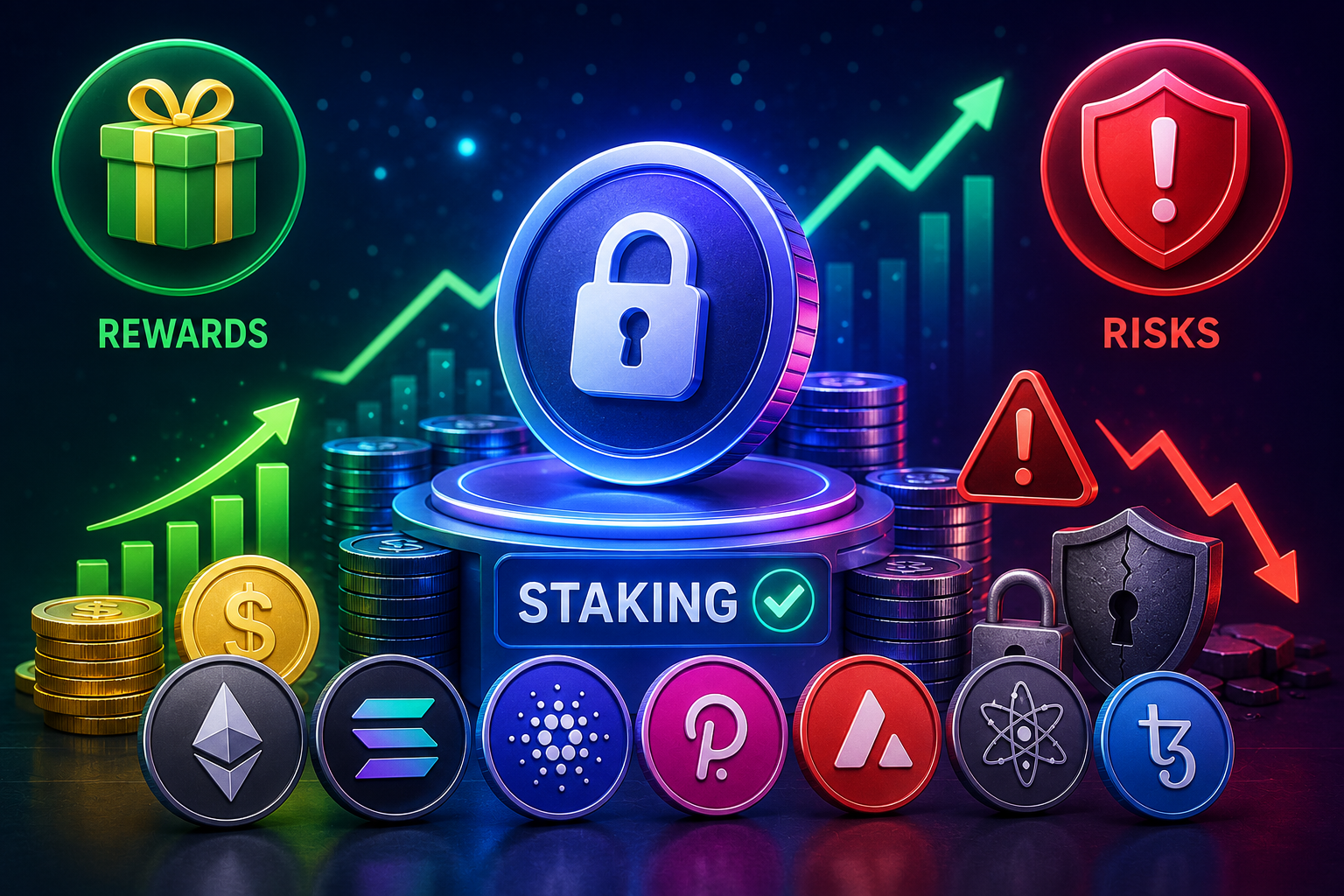
Crypto staking lets you earn passive income by locking coins to help secure a proof-of-stake blockchain. APY ranges from roughly 3% for Ethereum to over 15% for Cosmos in 2026.
Liquid staking now accounts for more than $58 billion in total value locked across protocols, giving investors flexibility without full lock-up periods.
Key risks include slashing (validator penalties), smart contract exploits, token price volatility, and liquidity lock-ups that vary by chain from zero to 28 days.
The IRS treats staking rewards as ordinary income at fair market value upon receipt. Form 1099-DA is now required from exchanges for 2025 transactions filed in 2026.
Top coins for staking in 2026 include Ethereum (3 to 3.5% APY), Solana (6 to 7% APY), Cardano (4 to 8% APY), Cosmos (14 to 20% APY), and Polkadot (around 14% APY).
Exchange staking is easiest but most expensive: Coinbase charges 25 to 35% commission on rewards. Self-custody staking keeps the full rate but requires more setup.
What Is Crypto Staking?
Crypto staking is the process of locking up cryptocurrency tokens to participate in the operation and security of a proof-of-stake blockchain network. In exchange for committing your tokens, the network rewards you with newly minted coins and a share of transaction fees. These payouts are called staking rewards, and they function similarly to earning interest on a savings deposit, with one critical difference: the value of the underlying asset can change dramatically.
Staking is not available for every cryptocurrency. Bitcoin, for example, uses proof-of-work and relies on energy-intensive mining rather than staked capital. The coins discussed in this guide all use proof-of-stake or a close variant of it, meaning the right to propose and confirm new blocks is tied to how many tokens a participant has committed to the network.
The appeal is real. At a time when high-yield savings accounts offer 4 to 5% in the U.S., being able to earn 6 to 7% annually on Solana or up to 14% on Cosmos looks attractive on paper. The catch is that those yields are denominated in the staked coin itself, so a 10% annual reward means nothing if the coin drops 40% in dollar terms. Understanding this distinction is the single most important concept for any staker to internalize before committing funds.
How Proof-of-Stake Works
In a proof-of-stake network, validators are the nodes responsible for proposing and confirming new blocks of transactions. To become a validator, a participant must lock up a minimum amount of the network’s native token as collateral. This collateral is called the stake, and it is the economic deterrent that prevents validators from acting dishonestly. If a validator tries to double-sign a block or otherwise misbehave, the network can destroy a portion of their staked tokens through a process called slashing.
Most investors are not running full validator nodes. Instead, they delegate their tokens to existing validators. In this arrangement, a token holder points their coins toward a trusted validator and receives a proportional share of that validator’s rewards, minus a commission fee. The token holder retains ownership of the coins throughout this process but accepts some exposure to their chosen validator’s behavior.
Key Terms Defined
APR is the simple annual reward rate without compounding. APY compounds rewards over the year and will always be slightly higher. Unbonding period is the waiting time after you request to unstake before your tokens are accessible again. Slashing is the network penalty that destroys a portion of a misbehaving validator’s stake. Liquid staking issues you a derivative token representing your staked position, which you can trade or use in DeFi while still earning rewards.
Best Coins to Stake in 2026
The following profiles cover the most widely staked cryptocurrencies ranked by a combination of network maturity, staking accessibility, liquidity, and realistic yield after accounting for inflation and fees. APY figures reflect current network conditions as of mid-2026 and will fluctuate with participation rates and network activity.
Ethereum (ETH)
Current APY
3.0 – 3.5%
Liquid staking rate
Min solo stake: 32 ETH
Unbonding: 1 to 5 days
Risk level: Low to Medium
Liquid option: Yes (Lido, Rocket Pool)
2026 Highlights
Ethereum’s Pectra upgrade enabled validator consolidation and automated reward compounding, making large-scale staking more efficient for institutional participants.
Over 30% of all staked ETH now flows through liquid staking protocols, with Lido holding the largest share at roughly 32% of the market.
Ethereum is the standard starting point for stakers who want the most extensively documented and widely supported staking ecosystem. The trade-off is yield: at 3 to 3.5% APY through liquid staking protocols, it is among the lowest nominal returns in this list. However, ETH’s large market cap and deep liquidity mean price volatility is comparatively lower than smaller-cap alternatives, and stETH from Lido is accepted as collateral on more DeFi lending platforms than any other liquid staking token.
Solo staking requires 32 ETH (worth roughly $80,000 to $100,000 depending on market conditions) and technical knowledge to run a validator node. For most investors, liquid staking through Lido or Rocket Pool is the practical route. Rocket Pool allows validator participation with 16 ETH and takes a more decentralized approach to validator selection, which matters for investors who are concerned about Lido’s outsized influence over Ethereum’s validator set.
Solana (SOL)
Current APY
5.5 – 7%
Native and liquid staking
Min stake: No minimum for delegation
Unbonding: 1 to 2 epochs (~2 to 5 days)
Risk level: Low to Medium
Liquid option: Yes (Jito, Marinade)
2026 Highlights
As of early June 2026, roughly 67.7% of eligible SOL supply is staked across approximately 430 million SOL worth close to $28 billion, one of the highest participation rates of any major proof-of-stake network.
Over $3.3 billion in SOL is liquid-staked across Jito, Marinade, and other protocols earning 6 to 7% APY while remaining liquid.
Solana has become one of the most popular staking destinations in 2026, offering meaningfully higher yields than Ethereum with a comparable level of network maturity. Jito, the leading liquid staking protocol on Solana, adds MEV (maximal extractable value) revenue sharing on top of the base staking yield, which consistently pushes its JitoSOL APY above the 5.5% base delegation rate. Slashing events are rare on Solana but not impossible, and delegators should understand they carry indirect exposure to their chosen validator’s behavior.
Cardano (ADA)
Current APY
4 – 8%
Staking pool delegation
Min stake: No minimum
Unbonding: None (liquid at all times)
Risk level: Low
Liquid option: Varies by platform
Why It Stands Out
Cardano staking has no lock-up period whatsoever. ADA remains spendable and transferable at all times while earning rewards. Approximately 60% of the entire ADA supply is staked.
No slashing mechanism exists on Cardano, making it one of the lowest-risk staking environments for conservative investors.
Cardano’s staking model is unique among major networks in that it imposes no unbonding period and no slashing penalty. Staked ADA never leaves your wallet; you delegate only your staking rights, not custody of the coins. For investors who want passive income without any liquidity risk from lock-up periods, ADA’s 4 to 8% APY with zero lock-up and zero slashing represents a genuinely differentiated profile. The trade-off is that Cardano’s ecosystem is smaller than Ethereum or Solana, meaning DeFi opportunities for staked ADA are more limited.
Cosmos (ATOM)
Current APY
14 – 20%
Varies by provider and fees
Min stake: No minimum for delegation
Unbonding: 21 days
Risk level: Medium to High
Slashing: Yes (double sign and downtime)
Important Caveats
The high nominal APY on Cosmos does not mean high real returns. ATOM has a meaningful inflation rate, which means a significant portion of the staking yield is offset by token supply dilution.
Kraken lists bonded ATOM rewards above 20% APY, while other providers show lower rates depending on fees and terms. Verify current rates before committing.
Cosmos offers some of the highest nominal staking yields in the large-cap space, but investors need to account for two structural factors before treating these numbers as face value. First, ATOM has a relatively high inflation rate, meaning the supply of tokens grows to fund staking rewards, diluting the real purchasing power of those rewards. Second, the 21-day unbonding period is one of the longest among major chains. If ATOM’s price falls significantly during that window, you cannot act until the unbonding completes. For investors who hold ATOM long-term and have conviction in the Cosmos ecosystem, staking makes strong sense. For those primarily chasing yield, the combination of inflation and illiquidity makes this a more complex trade-off than the headline rate suggests.
Polkadot (DOT)
Polkadot uses a Nominated Proof-of-Stake system where token holders back validators and earn rewards for helping secure the chain. Current APY sits around 12 to 14%, with a 28-day unbonding period, one of the longest in this guide. DOT staking rewards exposure to Polkadot’s interoperability and multi-chain infrastructure thesis alongside yield. The 2026 case for DOT staking is described by analysts as yield plus ecosystem exposure, particularly for users who understand the nomination process and are comfortable with the extended lock-up.
Avalanche (AVAX)
Avalanche offers roughly 7 to 9% APY through staking, with a minimum validator requirement and a lock-up period of 2 weeks to 1 year depending on your setup. AVAX’s Subnets allow developers to create specialized blockchains, and staking supports the Primary Network consensus. Delegation to existing validators is accessible with no technical setup required, but the minimum delegation amount is higher than on most competing chains. Avalanche sits in the medium-risk tier, with slashing possible for validator misbehavior and unbonding periods that eliminate tactical flexibility.
APY Comparison: Best Staking Coins 2026
Nominal Staking APY by Network (Mid-2026 Estimates)
Tezos (XTZ) — delegatorsUp to 16%
Cosmos (ATOM)14 to 20%
Polkadot (DOT)12 to 14%
Avalanche (AVAX)7 to 9%
Solana (SOL)5.5 to 7%
Cardano (ADA)4 to 8%
NEAR Protocol~4.6%
Ethereum (ETH) liquid staking3.0 to 3.5%
Rates are approximate mid-2026 figures and fluctuate with network participation, validator commissions, and tokenomics. Higher nominal APY does not indicate higher real returns. Always verify current rates on StakingRewards.com or individual protocol dashboards before staking.
Staking Lock-up Periods by Network
Polkadot (DOT)28 days
Cosmos (ATOM)21 days
Avalanche (AVAX)2 to 14+ days
Ethereum (ETH)1 to 5 days
Solana (SOL)2 to 5 days
Cardano (ADA)None (always liquid)
Lock-up periods apply to native staking. Liquid staking protocols allow faster exits via secondary markets but introduce additional smart contract and de-pegging risk.
Full Comparison Table
Coin
APY Range
Unbonding
Slashing
Min. Stake
Risk
ETH
3.0 to 3.5%
1 to 5 days
Yes
32 ETH (solo) / None (liquid)
Low
SOL
5.5 to 7%
2 to 5 days
Rare
None
Low
ADA
4 to 8%
None
No
None
Very Low
ATOM
14 to 20%
21 days
Yes
None
Medium
DOT
12 to 14%
28 days
Yes
Minimum varies
Medium
AVAX
7 to 9%
2 to 14+ days
Yes
25 AVAX (delegation)
Medium
XTZ
Up to 16%
Minimal
No
None
Low
NEAR
~4.6%
~4 epochs
Yes
None
Low
Liquid Staking Explained
Liquid staking has become one of the most significant structural shifts in crypto markets over the past two years. Instead of locking coins with a native validator and waiting out an unbonding period, liquid staking protocols accept your tokens, stake them on your behalf with a validator set, and issue you a derivative token in return. That derivative token, such as stETH from Lido or JitoSOL from Jito, represents your staked position including accruing rewards, and it can be traded, used as collateral in lending protocols, or deployed in DeFi strategies while your underlying stake keeps earning.
The market has grown substantially. As of April 2026, over $58 billion flows through liquid staking protocols, with an additional $19.63 billion in restaking. Ethereum’s Pectra upgrade improved validator consolidation and automated compounding mechanics, increasing the efficiency of large-scale staking operations. On the Bitcoin side, a notable 2026 development is the expansion of liquid staking into the Bitcoin network through the Babylon shared-security protocol, with Lombard Finance’s LBTC token having crossed $1.5 billion in total value locked.
Liquid Staking Market Share by Protocol (Approximate, 2026)
Lido Finance (stETH) — ~32%
Jito (JitoSOL) — ~20%
Ether.fi (eETH/weETH) — ~12%
Rocket Pool (rETH) — ~13%
Marinade (mSOL) — ~8%
Other protocols — ~15%
Approximate market share based on TVL data from DeFiLlama and Coincub, April to June 2026. Lido’s dominance has prompted ongoing discussion about validator concentration risk on Ethereum.
Liquid Staking vs. Native Staking: Key Differences
Factor
Native Staking
Liquid Staking
Custody
Tokens locked with validator
Tokens pooled in smart contract
Liquidity
Locked during unbonding period
LST tradeable on secondary markets
DeFi use
Not possible while staked
LST usable as collateral or in LP pools
Smart contract risk
Minimal
Significant (code vulnerabilities)
De-pegging risk
None
LST can trade below underlying value
APY
Base network rate
Base rate plus protocol fees (may be higher or lower)
Staking Risks: A Detailed Breakdown
Staking is not a risk-free activity. Every method of earning yield on crypto assets carries a distinct set of risks that vary in probability and severity. The following chart scores the five primary risk categories by severity across the three most common staking approaches.
Risk Profile by Staking Method (5 dots = highest risk)
Price Volatility: The Risk That Overrides Everything Else
Every risk discussed above is secondary to the most important risk in crypto staking: the underlying token’s price. Staking rewards are denominated in the coin being staked. If you earn a 10% APY on Cosmos but ATOM falls 40% in dollar terms during the year, your net return is negative 30% in USD. No amount of APY optimization matters if you choose the wrong asset at the wrong time.
This is why many experienced stakers argue that you should only stake assets you would hold regardless of staking rewards. If you are comfortable holding Ethereum or Solana for multiple years as a long-term investment, staking adds incremental yield on top of that conviction. If you are buying an asset primarily to earn the stated APY, you are taking on full speculative risk while potentially being unable to exit during a market downturn because your tokens are locked in an unbonding period.
Slashing: What U.S. Investors Often Miss
Slashing is the network-enforced penalty that destroys a portion of a validator’s staked tokens for misbehavior such as double-signing a block. When you delegate your coins to a validator, you are indirectly exposed to their slashing risk. If your validator is slashed, your staked balance decreases proportionally. On Ethereum, Lido distributes slashing losses across the entire stETH pool so no single delegator bears disproportionate loss. On Rocket Pool, slashing is isolated to the individual minipool operator. On Cardano, slashing does not exist at all. Always verify the slashing design of your chosen network and protocol before staking.
Exchange Staking vs. Self-Custody Staking
For U.S. investors, the choice between staking through a centralized exchange and staking through a self-custody wallet has material financial implications, primarily because of how exchanges price their services.
Platform
Staking Commission
ETH Effective APY
Best For
Coinbase
25 to 35%
~2.3 to 2.6%
Beginners wanting simplicity and institutional trust
Kraken
~15%
~2.9%
Flexible choices, transparent performance
Binance.US
10 to 20%
~2.8 to 3.1%
Coin variety seekers
Crypto.com
Varies by product
Up to ~18% on select assets
Mobile-first users; read terms carefully
Lido (self-custody)
10% of rewards
~3.0 to 3.2%
ETH holders wanting competitive rate and DeFi access
Jito (self-custody)
Small protocol fee
~6.5 to 7%
SOL holders wanting liquid staking with MEV rewards
The fee differential is significant. If Ethereum’s base staking rate is 3.5%, Coinbase’s 25 to 35% commission brings your take-home yield to roughly 2.3 to 2.6%. The same coin staked through Lido earns approximately 3 to 3.2% after Lido’s 10% commission. Over years of compounding, this gap adds up considerably. The trade-off is that exchange staking is far simpler, handles validator selection automatically, and does not require managing wallet software or private keys.
Recommendation for U.S. Beginners
Start with a small amount on a reputable exchange like Coinbase or Kraken to understand how staking rewards accrue and how taxes are reported. Once comfortable with the mechanics, consider moving to a self-custody liquid staking option like Jito for Solana or Lido for Ethereum to improve your net yield. Never stake more than you can afford to have locked for the duration of the unbonding period.
IRS Tax Rules for Crypto Staking in 2026
The tax treatment of staking rewards in the United States has become significantly more structured in 2026, and investors who have been informally treating staking income as unreported or deferred revenue are now exposed to real penalties. Here is what every U.S. staker needs to know.
Staking Rewards Are Ordinary Income
Under IRS Revenue Ruling 2023-14 and confirmed by the Tax Court’s June 4, 2026 decision in Paschall v. Commissioner, staking rewards are taxable as ordinary income at their fair market value at the moment you gain control over the tokens. This means the U.S. dollar value of any staking reward received on a given day is added to your gross income for that year, even if you do not sell the tokens. Report this income on Form 1040 Schedule 1 as Other Income.
Form 1099-DA Is Now Live
Starting with 2025 transactions filed in 2026, the IRS introduced Form 1099-DA, requiring covered digital asset brokers including most centralized exchanges to report your crypto sales to the IRS. One important nuance: staking rewards do not appear on Form 1099-DA, because that form covers proceeds from broker transactions. The absence of a 1099 does not mean the income is not taxable. Staking rewards must be self-reported regardless of whether you receive any form from your exchange.
Capital Gains Layer: What Happens When You Sell Staking Rewards
When you eventually sell, exchange, or spend tokens you received as staking rewards, a second tax event occurs. The cost basis for those tokens is their fair market value at the time you received them as income. If the token appreciates after receipt, you owe capital gains tax on that appreciation. If it depreciates, you may claim a capital loss. Tokens held for more than one year qualify for long-term capital gains rates of 0%, 15%, or 20% depending on income level.
Example Tax Calculation
You stake $5,000 worth of ETH and receive 0.05 ETH in staking rewards when ETH is priced at $3,000. You report $150 as ordinary income in the year received. Six months later, ETH is at $4,000. You sell that 0.05 ETH for $200. You now owe short-term capital gains tax on the $50 gain ($200 proceeds minus $150 cost basis). Total tax events: two. Total reportable income: $150 ordinary + $50 short-term capital gain.
Per-Wallet Cost Basis Tracking Is Now Mandatory
Under IRS Revenue Procedure 2024-28, the universal method of pooling all your crypto across wallets into one combined cost basis is no longer permitted. Each wallet or exchange account is now its own cost-basis bucket. If you have crypto spread across Coinbase, Kraken, and a hardware wallet, each location requires separate tracking. Starting with 2026 transactions reported in 2027, covered brokers will also begin reporting cost basis to the IRS, not just gross proceeds.
Proposed Legislation That Could Change Things
On June 9, 2026, the House Ways and Means Committee introduced the Tax Clarity for Mining and Staking Act, which would allow validators to elect to defer tax on staking rewards until the tokens are sold rather than paying tax at the time of receipt. Separately, the Digital Asset PARITY Act, reintroduced on March 26, 2026 by Congressmen Horsford and Miller, addresses de minimis exemptions for small crypto transactions and clarification of staking income treatment. Neither bill is law as of this writing, but the legislative direction indicates Congress is actively working to reduce compliance complexity for crypto investors.
Tax Situation
Form to Use
Tax Type
Received staking rewards
Schedule 1, Line 8 (Other Income)
Ordinary income tax
Sold staking reward tokens (less than 1 year held)
Form 8949 + Schedule D
Short-term capital gains (ordinary rates)
Sold staking reward tokens (over 1 year held)
Form 8949 + Schedule D
Long-term capital gains (0%, 15%, or 20%)
Staking as a business / validator node
Schedule C
Ordinary income + self-employment tax (15.3%)
Exchange reports your crypto sales
Form 1099-DA (from broker)
Cross-reference with own records
How to Start Staking: Step by Step
Choose Your Coin Based on Risk Tolerance
For conservative investors or beginners, Cardano or Ethereum are the most sensible starting points. ADA has no lock-up period and no slashing risk. ETH has the most mature tooling and documentation. For investors comfortable with medium risk who want higher yield, Solana offers a strong balance of APY, ecosystem depth, and staking flexibility. Save high-yield chains like Cosmos for a later stage when you fully understand inflation-adjusted returns.
Decide Between Exchange Staking and Self-Custody
If you are new to crypto, starting on Coinbase or Kraken is acceptable while you learn the mechanics. If you already manage your own wallet and understand private key security, move to self-custody staking via a protocol like Lido, Jito, or native delegation through Phantom (for Solana) or Daedalus (for Cardano) to retain more of your yield.
Research and Select Your Validator
For native delegation, validator selection matters. Look for validators with high uptime history (above 99%), transparent operations, and a commission rate you find acceptable. On Ethereum, review Rocket Pool’s node operator registry or Lido’s validator set. On Solana, use Phantom’s staking interface or StakingRewards.com to compare. Do not stake with a validator charging zero commission without understanding their business model.
Start With an Amount You Can Afford to Lock
Assume the full unbonding period applies from the moment you stake. Do not stake funds you may need liquid within the next 21 to 28 days if you choose Cosmos or Polkadot. For chains with shorter or no unbonding (Cardano, Ethereum liquid staking), the liquidity constraint is much lower, but smart contract risks remain for liquid staking protocols.
Set Up Tax Tracking From Day One
Use a crypto tax software tool such as Koinly, CoinTracker, or TaxBit from your first day of staking. Every reward event creates a taxable income record. The fair market value of each reward at receipt is your cost basis for future capital gains calculations. Trying to reconstruct this retroactively from blockchain data is time-consuming and error-prone. Per-wallet basis tracking is now mandatory under IRS rules, so track each wallet separately.
Monitor and Rebalance Periodically
Staking APY rates change with network participation rates. As more tokens are staked on a network, rewards are spread across more participants, compressing individual yields. Check your rates against the current network averages every quarter. Restaking from a high-fee exchange validator to a lower-fee self-custody option can improve your net returns meaningfully over time without changing your underlying coin exposure.
Frequently Asked Questions
Is crypto staking worth it in 2026?
Staking can be worth it if you plan to hold a proof-of-stake token long-term regardless of price movements, since rewards offset inflation and provide additional passive income. However, if the token price drops significantly while you earn staking APY, your net USD return can still be negative. The answer depends entirely on which asset you stake, your time horizon, and whether you would hold the coin anyway.
How much can I realistically earn from staking?
With $10,000 staked in Solana at 6.5% APY, you would receive approximately $650 worth of SOL per year before taxes. In Ethereum at 3.25% APY, approximately $325 per year. In Cosmos at 15% nominal APY, approximately $1,500 before accounting for inflation effects on ATOM’s dollar value. All figures assume the coin’s price holds steady, which is not guaranteed.
Can I stake Bitcoin?
Bitcoin itself uses proof-of-work and cannot be staked natively. However, as of 2026, protocols like Babylon allow BTC holders to earn a small yield of approximately 0.04 to 0.57% APR by providing security to external proof-of-stake chains using Bitcoin timelocks, without moving BTC off the Bitcoin network. Lombard Finance issues LBTC as a liquid derivative of this position and has crossed $1.5 billion in total value locked.
What is the safest way to stake crypto?
The safest approach for most individual investors is native delegation through a non-custodial hardware wallet such as Ledger, choosing a reputable validator with a strong uptime history, on a network without slashing (Cardano) or with well-distributed slashing risk (Ethereum via Lido). This approach minimizes smart contract risk, counterparty risk from exchanges, and liquidation risk from using liquid staking tokens as collateral.
Do I have to report staking rewards on my taxes even if my exchange doesn’t send me a form?
Yes. The IRS requires all staking rewards to be reported as ordinary income at fair market value upon receipt, regardless of whether you receive a Form 1099-DA or any other form from your exchange. Staking rewards specifically do not appear on Form 1099-DA, which covers proceeds from broker transactions. You are responsible for self-reporting this income on Schedule 1 of your Form 1040.
What is liquid restaking and is it worth the risk?
Liquid restaking extends your staked ETH’s economic security to additional external protocols called Actively Validated Services through platforms like EigenLayer. You earn extra yield from each AVS but accept additional slashing conditions beyond standard validator penalties. As of early 2026, EigenLayer had over $11 billion in restaked ETH. Liquid restaking tokens like eETH from Ether.fi wrap this position. The yield increment above standard liquid staking is modest relative to the significant increase in risk complexity, including smart contract risk, AVS slashing, and longer exit windows of 3 to 10 days.
Which coin has the best staking rewards for beginners?
Cardano (ADA) is often recommended for beginners because of three features that are unique among major coins: no minimum stake requirement, no lock-up period whatsoever, and no slashing mechanism. Your ADA stays in your wallet and earns 4 to 8% APY without any of the liquidity risk or validator penalty exposure that affects other networks. Solana through an exchange or simple wallet staking interface is a reasonable second choice for beginners comfortable with a short unbonding window in exchange for higher yield.
Disclaimer: This article is for informational and educational purposes only and does not constitute financial, investment, tax, or legal advice. Cryptocurrency investments involve significant risk including the possible loss of principal. APY rates cited reflect approximate mid-2026 network conditions and fluctuate continuously. Tax laws are subject to change; consult a qualified CPA or tax attorney for advice specific to your situation. MoneyMarked does not endorse any specific cryptocurrency, exchange, or staking platform.