A clear explanation of the term every economist is using in 2026, where it comes from, how it differs from a hard landing or no landing at all, and what each outcome would mean for jobs, prices, and your portfolio.
Updated June 202615 min readEconomy Explainer
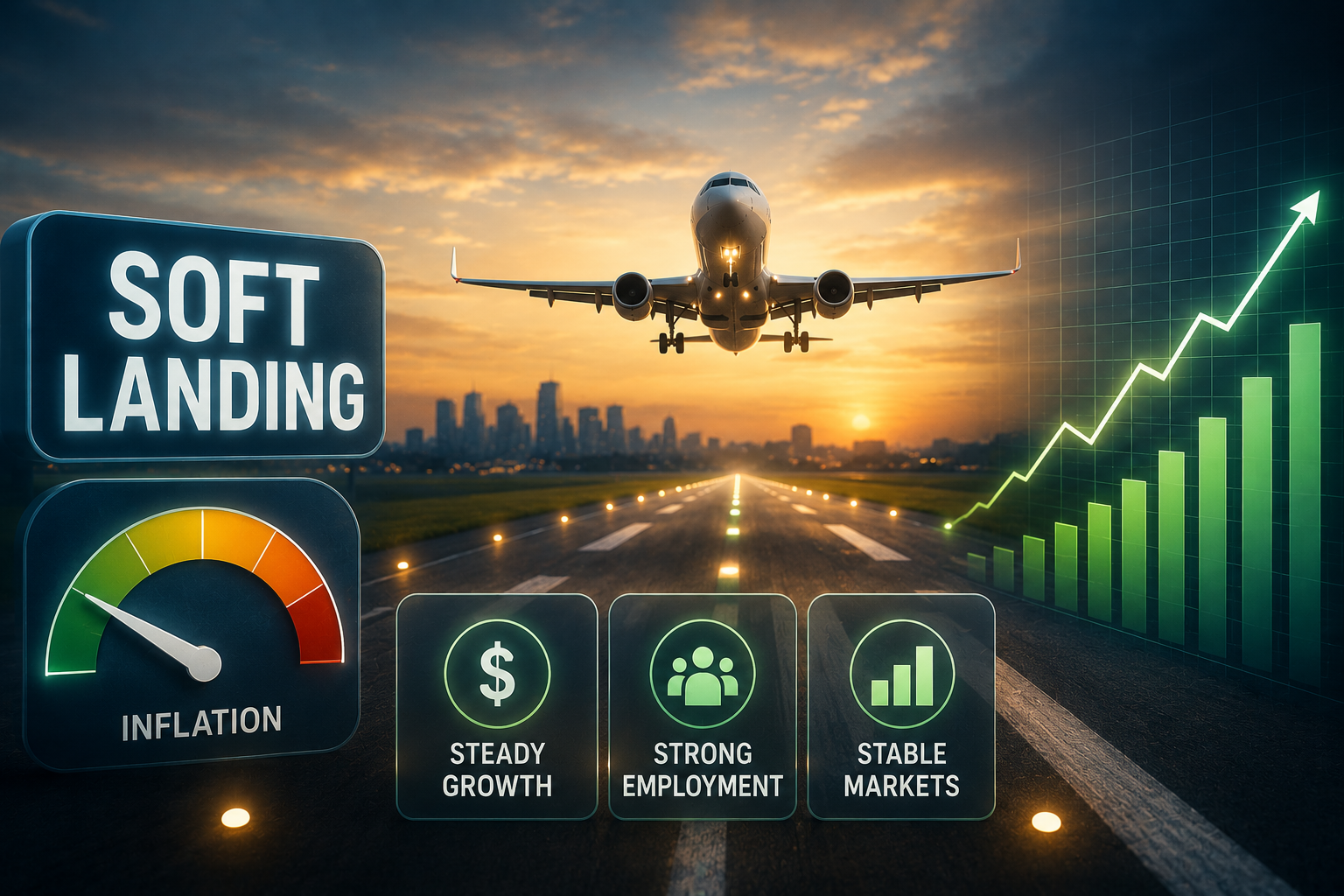
An aviation metaphor for monetary policy
A soft landing is what happens when the Federal Reserve slows an overheated economy enough to cool inflation, without slowing it so much that it tips into recession. The image is deliberate: like a pilot easing a plane down onto the runway, the Fed is trying to bring growth gently back to earth rather than stalling it in midair.
Not financial advice. This article explains a widely used economic term and summarizes current forecasts as of June 2026. It is educational content, not a prediction or a personalized recommendation. Confirm current data and speak with a licensed financial advisor before making investment decisions.
What a Soft Landing Means, Simply
A soft landing is when a central bank raises interest rates to fight inflation, then manages to bring inflation back down to its target without causing a recession or a large jump in unemployment. Economists at Northeastern University describe it as using monetary policy to reduce inflation without tipping the economy into a downturn, while preserving as much of the labor market as possible.
The phrase borrows directly from aviation. Just as a pilot wants a plane to descend smoothly and touch down without a jolt, the Federal Reserve wants economic growth to slow from an unsustainable, inflationary pace down to a steady, sustainable one, without stalling the engine altogether. Achieving it requires precise timing: raise rates too little and inflation stays elevated; raise them too much, or hold them too high for too long, and the economy tips into recession instead.
2%The Fed’s long-run inflation target
4.3%Unemployment rate, May 2026
1994-95The Fed’s last widely credited soft landing
3.50-3.75%Federal funds rate, June 2026
We may not have stuck the landing yet. We may be on the runway.
Soft Landing vs Hard Landing vs No Landing
Economists generally describe three possible outcomes when a central bank tightens policy to fight inflation. Each has a distinct effect on jobs, prices, and asset prices.
Soft landing
Growth slows just enough to relieve inflation while staying positive. Unemployment rises modestly, if at all, and the economy avoids a formal recession. This is the scenario central banks aim for and the one most forecasters treat as their base case for 2026, though with growing caveats.
Hard landing
The economy tips into recession: GDP contracts, unemployment rises sharply, and corporate earnings fall. This is the outcome the Fed is explicitly trying to avoid, and the one most associated with past tightening cycles, including the lead-up to the 2007-2009 financial crisis, when the Fed cut rates from 5.25 percent in September 2007 to zero by December 2008 as the economy fell into the Great Recession.
No landing
A scenario discussed more in this cycle than in past ones: growth and inflation both stay stronger than expected, meaning the economy never really slows down at all. That sounds positive, but it means inflation pressure persists and the Fed may need to keep rates higher for longer, or even raise them again, delaying the eventual landing rather than avoiding it.
Has the Fed Ever Pulled One Off Before
History suggests a true soft landing is rare. The most widely cited example is 1994-95, when the Federal Reserve doubled the federal funds rate to 6 percent and succeeded in slowing growth without sending the economy into recession. It was not painless: the tighter credit conditions contributed to severe losses in the bond market and to the 1994 bankruptcy of Orange County, California, a reminder that even a successful soft landing can carry real collateral damage in specific corners of the financial system.
More recently, the Fed has been given credit by many economists for steering the post-pandemic economy to something close to a soft landing in 2024 and early 2025. After raising rates from near zero in March 2022 to a peak of 5.25 to 5.50 percent by July 2023, the fastest tightening cycle since 1982, inflation cooled meaningfully without a recession materializing, even as the labor market gradually softened.
1994-95: The textbook soft landing
The Fed raised rates aggressively to head off inflation before it took hold, slowing growth without a recession, though at the cost of a sharp bond market selloff.
2004-2007: A landing that came in hard
Gradual rate hikes were followed by a housing market collapse and the 2007-2009 Great Recession, a reminder that tightening cycles can look stable for years before conditions turn.
2022-2023: The fastest hikes since 1982
The Fed raised its benchmark rate eleven times between March 2022 and July 2023 to fight the highest inflation since the early 1980s, reaching 5.25 to 5.50 percent.
2024-2025: A landing many economists credited the Fed with achieving
Inflation cooled substantially and the labor market softened gradually rather than collapsing, leading many forecasters to describe the period as a successful, if imperfect, soft landing.
2026: The landing gets reassessed
A fresh round of tariff and energy-driven inflation, plus a cooling but not collapsing labor market, has economists debating whether the plane is still descending smoothly or circling for another approach.
Where the 2026 Soft Landing Stands Now
As of mid-2026, most economists describe the United States as still attempting a soft landing rather than having definitively achieved or failed one. J.P. Morgan Asset Management’s outlook frames 2026 as a year of contrasts: strong growth in the first half supported by personal income tax refunds boosting consumer demand, followed by a moderation to an estimated 1.0 to 1.5 percent GDP growth in the second half as fiscal support fades and job growth slows. Barring an outside shock, that outlook still expects the economy to avoid a formal recession, though it flags softer earnings growth as a consequence of softer economic growth.
Other analysis published in 2026 strikes a more cautious tone. One research note observed that the soft landing consensus had assumed more margin for error than the economy currently has, pointing to an energy-driven inflation shock that has left central bankers with a harder balancing act: ease too quickly into rising energy prices and risk signaling that renewed inflation will be tolerated; hold rates too tight for too long and risk turning an external energy shock into a broader credit and income shock. Federal Reserve officials have publicly acknowledged the difficulty of distinguishing a temporary price shock from the start of a more durable inflation problem.
The labor market is the swing factor
Several 2026 analyses identify the labor market as the most significant risk to the soft landing narrative. Unemployment has stayed relatively low, near 4.3 to 4.4 percent, but the bigger concern is what economists call a “low-hire, no-fire” environment: monthly payroll growth slowed sharply through 2025, averaging far fewer new jobs per month than in prior years, even though outright layoffs have remained historically rare. A labor market that quietly stops adding jobs can still technically avoid recession while feeling much weaker to workers trying to find one.
The Signals Economists Are Watching
Core inflation trend. Whether core PCE inflation continues declining toward the Fed’s 2 percent target, or whether tariff and energy effects keep it elevated for longer than expected.
Monthly payroll growth. Not just the unemployment rate, but whether the pace of new hiring stabilizes or continues to slow toward zero.
Consumer spending resilience. Whether household spending, the largest component of GDP, holds up as one-time fiscal support fades later in the year.
Energy prices. Whether elevated oil and gas prices tied to geopolitical conflict prove temporary or feed into a broader, more durable inflation problem.
Fed communication. How the Federal Reserve, under new leadership in 2026, signals its tolerance for above-target inflation versus a softening labor market, since that tone tends to move markets as much as the rate decisions themselves.
What a Soft Landing Means for Markets
Historically, a successfully achieved soft landing has been bullish for stocks. Analysis of prior cycles has shown that when the economy avoids a recession after a tightening cycle, equity markets have tended to see meaningful gains, with some historical comparisons pointing to potential index gains in the range of 10 to 20 percent in the period following a confirmed soft landing.
The logic is straightforward. A soft landing implies corporate earnings keep growing rather than contracting, since recessions are what typically force broad earnings declines. It also implies the Fed has more room to cut rates gradually rather than urgently, which tends to support valuations without the kind of emergency easing that signals serious economic damage. Fixed income markets benefit too: falling inflation supports bond prices, and a stable economy reduces the credit risk premium investors demand from corporate borrowers.
The risk for 2026 specifically is that markets, and Wall Street strategists, may already be pricing in a soft landing as close to certain. Equity valuations have been historically elevated, and earnings growth expectations for 2026 are aggressive by historical standards. That combination means a soft landing outcome may already be reflected in current prices, while a hard landing, or even a “no landing” outcome that forces the Fed to hold rates higher for longer than expected, would represent a larger surprise to markets than it would in a cycle where expectations were more cautious to begin with.
What a Hard Landing Would Mean Instead
If the economy tips into a hard landing instead, the effects would be felt broadly and quickly. Unemployment would likely rise meaningfully rather than gradually, corporate earnings would contract, and equity markets would typically see a sharper, more sustained decline than the periodic pullbacks that occur even during expansions. Credit spreads would widen as investors demand more compensation for default risk, and the Fed would likely respond with faster, larger rate cuts than in a soft landing scenario, similar to the emergency cuts seen in 2007 and 2008, though the depth of any future downturn is impossible to predict in advance.
Soft landing versus hard landing: typical effects
Indicator
Soft Landing
Hard Landing
GDP growth
Slows but stays positive
Contracts for two or more quarters
Unemployment
Rises modestly
Rises sharply
Corporate earnings
Growth slows, stays positive
Broad declines
Stock market
Typically supportive, gains continue
Sharper, more sustained declines
Fed policy response
Gradual, measured rate cuts
Faster, larger emergency cuts
Credit spreads
Stable to modestly wider
Widen sharply
What It Means for Your Wallet
In a soft landing, job security tends to hold up reasonably well even as new hiring slows, but real wage gains may stay modest if inflation remains above target for longer.
Savers benefit either way in the short run, since elevated rates have kept yields on savings accounts and CDs attractive, though those yields would likely fall faster in a hard landing as the Fed cuts aggressively.
Borrowers should expect mortgage and loan rates to stay roughly where they are in a soft landing scenario, since the Fed has limited room to cut quickly while inflation runs above target.
Investors with a long time horizon are generally advised, in both scenarios, to avoid making large portfolio changes based on a single month’s data, since the soft landing narrative has shifted multiple times within a single year before.
Frequently Asked Questions
Is the U.S. economy currently in a soft landing in 2026?
Most economists describe the economy as still in the process of attempting a soft landing rather than having definitively achieved one. Growth has held up, unemployment remains historically low, but inflation has not yet returned to the Fed’s 2 percent target, partly due to tariff and energy-related price pressure, which keeps the outcome unresolved.
What is a “no landing” scenario?
A no landing scenario is when growth and inflation both stay stronger than expected, meaning the economy never meaningfully slows. While that can sound positive, it typically means inflation pressure persists, which can force the Fed to keep rates higher for longer or even raise them again, delaying rather than avoiding an eventual slowdown.
How long does it typically take to know if a soft landing succeeded?
Often a year or more. The 1994-95 episode is widely cited as a successful soft landing only in hindsight, and even the 2024-2025 period was still being debated and reassessed well into 2026 as new inflation and labor market data arrived.
Should I change my investments based on soft landing predictions?
This article is educational and not a recommendation to buy, sell, or hold any investment. Soft landing forecasts have shifted multiple times within recent cycles as new data arrived, so any investment decisions should be based on your own time horizon, risk tolerance, and a conversation with a licensed financial advisor rather than a single macroeconomic narrative.
The Bottom Line
A soft landing is the scenario where a central bank successfully cools inflation without crashing the economy: growth slows, but stays positive; unemployment ticks up, but does not spike; and the expansion continues on steadier footing. It is the outcome the Federal Reserve has been aiming for since 2022, and one many economists credited it with largely achieving through 2024 and 2025. As of mid-2026, that landing is being reassessed in real time, as tariff and energy-driven inflation complicate the descent and a cooling labor market raises the stakes of getting the timing right. Whether the plane lands smoothly, stalls, or stays in the air longer than expected will depend on data that is still arriving every month, which is exactly why the term keeps showing up in financial headlines.