When navigating the precious metals market, gold and silver naturally command the spotlight. However, sophisticated investors look to the Platinum Group Metals (PGMs) specifically platinum and palladium for unique combinations of industrial demand, absolute scarcity, and intense price volatility.
While they share a similar silvery-white finish, these sibling metals possess entirely different chemical properties, geographical distributions, and demand drivers. At various points in market history, palladium has traded at nearly double the price of platinum; at other times, platinum commands a massive premium.
This comprehensive, data-driven guide breaks down the critical structural and macroeconomic differences between platinum vs. palladium, giving you the clarity needed to optimize your portfolio or make smart industrial purchasing decisions.
Platinum vs. Palladium Value Calculator
Instantly compare the physical weights and values of PGM assets.
Platinum Spot
$1,964.00 / oz
Palladium Spot
$1,390.00 / oz
Platinum Result
$1,964.00
Physical Volume: ~1.45 cm³
Dense & heavy asset profile.
Platinum Premium: +$574.00 per ounce over Palladium
*Disclaimer: Calculated estimates use baseline configurations. Volumes correspond to fine bullion weights. Verify with market spot operators prior to settling trades.
1. Elemental & Physical Characteristics
On a physical level, platinum and palladium are part of the same six-element family on the periodic table (alongside rhodium, ruthenium, iridium, and osmium). Despite their visual similarities, their underlying physical structures are distinct.
Density, Weight, and Melting Points
Platinum is a heavy, dense element. It is roughly twice as dense as silver and significantly heavier than palladium. This density makes platinum incredibly durable, resistant to tarnishing, and capable of maintaining its structural integrity under extreme conditions.
Palladium, by contrast, has the lowest density and the lowest melting point of all the platinum group metals. Because it is lighter and more malleable, it is highly prized for precise industrial manufacturing applications.
Physical Property
Platinum (Pt)
Palladium (Pd)
Atomic Number
78
46
Density (g/cm³)
21.45
12.02
Melting Point
$1,768C $3,214F
$1,555C $2,831F
Hardness (Mohs Scale)
4.0 – 4.5
4.75
Primary Appearance
Bright, silvery-white
Silvery-white, slightly darker tint
2. Supply Dynamics: Geographical Monopolies
The South African Monopoly on Platinum
South Africa dominates global platinum mining, controlling between 70% and 75% of the world’s annual supply. The vast majority of this production occurs within the singular geological formation known as the Bushveld Igneous Complex.
Because of this intense concentration, the global platinum price is uniquely sensitive to South African systemic factors:
Grid Stability: Ongoing electrical power outages from state utility providers limit mining depth and refining capabilities.
Labor Disputes: Widespread, localized union strikes can halt three-quarters of the world’s supply instantly.
The Russian Factor in Palladium
Palladium supply is split into a duopoly, primarily balanced between Russia and South Africa (roughly 40% each). Russia’s production is spearheaded by a single major corporate conglomerate operating out of the massive Norilsk nickel deposits in Arctic Siberia.
Because palladium is extracted as a byproduct of regional copper and nickel mining, its supply cannot scale independently based on demand. International geopolitical actions, trade restrictions, and export tariffs target Russian trade pipelines, creating extreme volatility in the spot palladium market.
3. Industrial Demand Drivers: The Automotive Battleground
While retail consumers recognize these metals from rings and bullion bars, the automotive sector consumes over 80% of all annual PGM output. Both metals serve as catalysts in vehicle exhaust systems to transform harmful emissions into less hazardous gases. However, they cannot be substituted interchangeably without engineering adjustments.
Catalytic Converter Specialization
Palladium in Gasoline Systems: Palladium is highly efficient at processing emissions generated by high-temperature gasoline internal combustion engines. This made it the dominant catalyst during the multi-year boom in consumer gasoline sedans and SUVs.
Platinum in Diesel and Hydrogen Systems: Platinum excels in lower-temperature environments, making it the industry standard for heavy-duty diesel engines. Crucially, platinum is also the essential element required for Hydrogen Fuel Cell Vehicles (FCVs) and green hydrogen electrolyzers, positioning it as a long-term alternative energy asset.
The Substitution Cycle
Because auto manufacturers are highly price-sensitive, they alter engineering configurations when price spreads widen too far. When palladium spiked past $3,000/oz several years ago, automotive engineering shifted back toward cheaper platinum setups. As these production adjustments finalize, the underlying market deficits rotate dynamically.
4. Financial & Investment Profiles
For precious metals investors, platinum and palladium behave very differently compared to a pure safe-haven asset like gold.
Liquidity and Volatility
Because both PGM markets are exceptionally small relative to global gold flows, institutional inflows or minor supply hiccups generate oversized percentage moves. Palladium, historically driven by sudden supply panics, exhibits sharp spike-and-crash price cycles. Platinum behaves more like an institutional value play, fluctuating alongside global manufacturing indices and macroeconomic health.
5. Summary Comparison Matrix
Market Metric
Platinum
Palladium
Primary Market Driver
Heavy-duty diesel, Hydrogen tech, Jewelry
Passenger gasoline vehicles, Hybrid vehicles
Geographic Vulnerability
Power grid and labor infrastructure (South Africa)
Geopolitical trade barriers and export curbs (Russia)
Jewelry Suitability
Hypoallergenic, naturally white, requires no plating
Less common, lightweight alternative, darker silver hue
Long-Term Energy Play
Strong alignment with the emerging Hydrogen economy
Highly exposed to Battery Electric Vehicle ($\text{BEV}$) adoption
Historical Price Behavior
Cyclical, correlated with global capital expenditure
Highly explosive, prone to extreme short squeezes
6. Investment Strategy: Choosing Between Pt and Pd
Because of their unique industrial dynamics, deciding to allocate capital toward either platinum or palladium depends entirely on your macroeconomic thesis.
The Value Case for Platinum
Platinum is widely considered the long-term asymmetric value play.
The Hydrogen Macro: If you believe the global energy transition will increasingly lean on green hydrogen infrastructures (electrolyzers and heavy-duty Fuel Cell Vehicles), platinum holds a generational demand edge that cannot easily be engineered away.
Deep Structural Deficits: Industry institutions like the World Platinum Investment Council consistently project significant multi-ton supply deficits, meaning demand is outpacing what South Africa’s fragile power grid can reliably pull out of the earth.
The Momentum Case for Palladium
Palladium serves as a high-volatility trading vehicle.
Supply Crises: Because its primary nodes are locked deep within Arctic Russia, any shift in international trade sanctions, global tariffs, or localized nickel-byproduct extraction output can send the physical palladium market into a parabolic short squeeze.
Cyclical Exhaust Rebounds: Despite long-term electric vehicle adoption curves, consumer preference for hybrid internal combustion vehicles means near-term demand for high-efficiency gasoline catalysts remains remarkably sticky.
7. Direct Buying Options: Physical Bullion Comparison
If you choose to store physical bullion in a vault or home safe rather than trading paper ETFs, you’ll immediately encounter notable structural variations in retail availability.
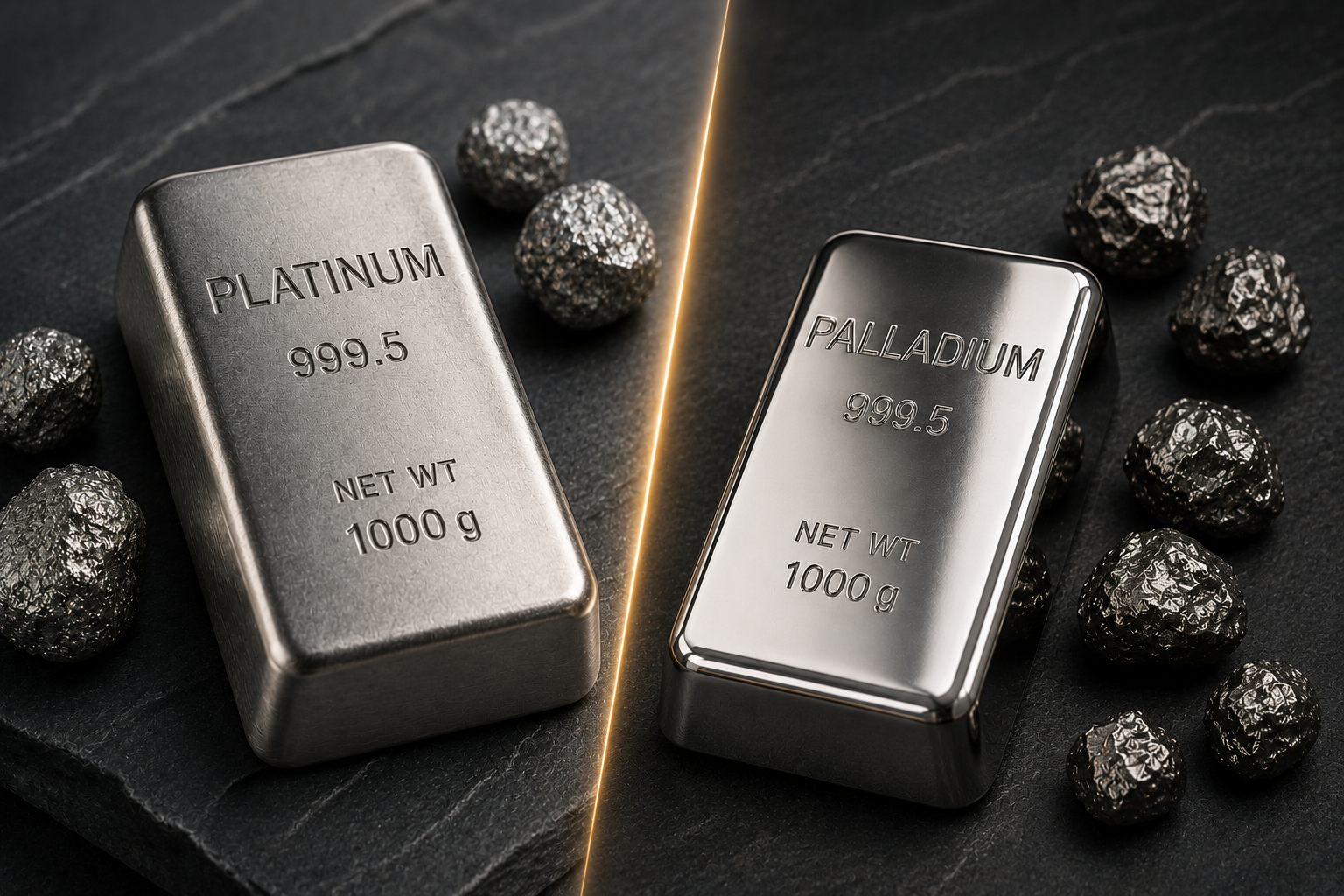
Physical Footprint: Because platinum ($21.45\text{ g/cm}^3$) is vastly more dense than palladium ($12.02\text{ g/cm}^3$), a 10-ounce stack of platinum bars takes up almost half the physical drawer space of an identical weight of palladium.
Premium Markups: Because the platinum retail market is far more liquid and enjoys consistent institutional backing, coin and bar premiums are generally much tighter over spot price ($3% – $6%). Palladium retail products are highly scarce; expect wider bid-ask spreads and higher dealer markups ($7% – $12%).