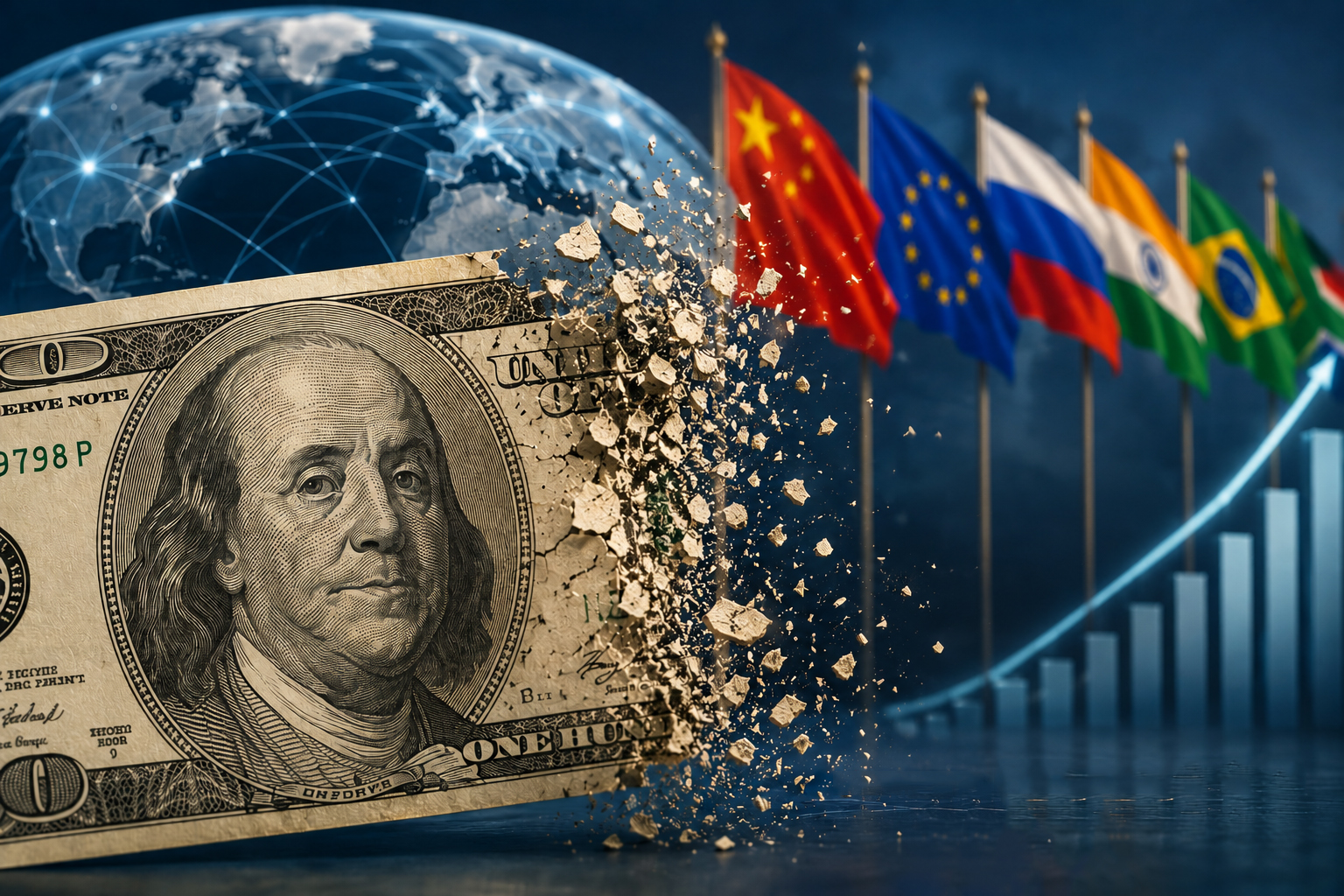
For decades, the United States Dollar (USD) has reigned supreme as the undisputed anchor of global finance. It prices the world’s commodities, settles cross-border corporate contracts, and populates the balance sheets of central banks from Tokyo to Frankfurt.
Recently, the global economic narrative has shifted. Headlines scream about “de-dollarization”, alternative trading blocs like the BRICS (Brazil, Russia, India, China, and South Africa) are actively pushing local currency settlements, and weaponized financial sanctions have left many nations wary of their reliance on the greenback.
Is the US dollar truly losing its global power, or are we witnessing normal structural shifts in an evolving global economy?
To answer this, we must unpack current macroeconomic data, track shifting central bank reserves, analyze real-time threats, and separate political rhetoric from cold, hard financial reality.
The Current State of Global Reserves
The most direct way to evaluate a currency’s global hegemony is to look at what central banks hold to protect their economies against structural shocks. The International Monetary Fund (IMF) tracks this through its Currency Composition of Official Foreign Exchange Reserves (COFER) database.
The data reveals a steady, multi-decade structural decline in the dollar’s dominance, though it remains far ahead of its competitors.
Cross-Border Trade & Margin Impact Simulator
Simulate how trade corridor friction shifts, regional tariff adjustments, and currency drag squeeze transaction margins
5%
0%
Simulated Net Margin18.0%
Adjusted Profit Yield$1,800,000
Total Capital Loss$0
!
Critical Margin Alert: Policy adjustments have compressed cross-border returns below the 10% structural safety viability threshold.
US Market to Eurozone Corridor Matrix
Operates with high liquidity using deep infrastructure pools via SWIFT channels. Retains stable base processing margins unless high counter-tariffs are enacted.
Dynamic engine initialized to $10,000,000 baseline cargo blocks. Values recalculate tracking live cross-border operational cost scenarios.
Allocation of Global Foreign Exchange Reserves
According to the latest IMF COFER reports, the US dollar's share of allocated global foreign exchange reserves has dipped below the 57% threshold. For context, the dollar held roughly 70% of global reserves in 2000 and around 66% in 2015.
Currency Asset Type
2000 Share
2015 Share
Current Share (IMF COFER)
Structural Trend
US Dollar (USD)
70.0%
66.0%
56.8%
Gradual Decline
Euro (EUR)
18.0%
19.5%
20.3%
Stable Holding
Japanese Yen (JPY)
6.0%
4.1%
5.2%
Minor Fluctuations
Pound Sterling (GBP)
3.0%
4.8%
4.9%
Flat Neutral
Chinese Renminbi (RMB)
0.0%
1.1%
1.9%
Slow, Minimal Growth
Nontraditional & Other
3.0%
4.5%
10.9%
Rapid Acceleration
This table highlights a vital nuance: the dollar is not losing its share directly to its primary competitors like the Euro or the British Pound. Instead, central banks are diversifying into nontraditional reserve assets—including the Australian Dollar, Canadian Dollar, Swiss Franc, and unallocated alternative pools.
Why Is the US Dollar Experiencing Structural Pressure?
The steady migration away from a unipolar, dollar-dominated ecosystem is driven by a mix of geopolitics, monetary policy, and structural economic shifts.
1. The Weaponization of SWIFT and Dollar Assets
A massive catalyst for modern de-dollarization was the freezing of roughly $300 billion in Russian central bank foreign reserves by Western nations following the escalation of regional conflicts. This move demonstrated that holding dollar assets inside the SWIFT (Society for Worldwide Interbank Financial Telecommunication) ecosystem exposes sovereign states to availability risk.
Nations across the Global South realized that if their foreign policy diverges from Washington's goals, their sovereign wealth could be frozen overnight. Consequently, countries like China, India, Saudi Arabia, and ASEAN members are establishing alternative payment networks to bypass Western infrastructure.
2. Rising US National Debt and Macroeconomic Policy Volatility
The economic health of a fiat reserve currency relies entirely on global confidence in the issuing nation's fiscal discipline. The US national debt has surged past critical thresholds, creating structural concerns among foreign buyers of US Treasuries.
Compounding this issue is ongoing policy volatility. Sharp escalations in reciprocal import tariffs and unpredictable trade policies have triggered periods of elevated currency volatility. When the US imposes unilateral tariffs, it forces trading partners to find alternative cross-border billing arrangements to shelter their local supply chains.
3. The Renaissance of Physical Gold Reserves
As faith in debt-backed fiat paper instruments wavers, central banks are returning to the ultimate historical store of value: physical gold. Central banks in developing economies have broken historical purchase records, aggressively accumulating physical gold bars to immunize their balance sheets from both inflation and sanctions.
By substituting yield-bearing US Treasuries for non-yielding gold, central banks are signaling that protection against asset seizure and structural purchasing power loss outweighs the desire for interest coupon payments.
Can Any Other Currency Displace the Dollar?
While the dollar's structural dominance is slipping, predicting its collapse misses a crucial economic reality: there is currently no viable global alternative. To become a global reserve currency, an asset must offer deep, liquid, open financial markets, reliable legal protections, and a massive supply of safe debt instruments.
Let's look at how the primary challengers measure up against these requirements.
The Euro (EUR)
The Euro remains the world's second-most important currency, accounting for roughly 20% of foreign exchange reserves. It even leads the dollar in specific niches, such as sustainable green bond issuances. However, the Eurozone lacks a unified, centralized fiscal bond market. Because it is backed by separate national economies rather than a single sovereign state, it faces structural limits on its ability to expand its global reach.
The Chinese Renminbi (RMB)
China is a global manufacturing powerhouse, but the Renminbi makes up less than 2% of allocated central bank reserves and under 4% of global trade settlements. Beijing keeps strict capital controls in place, restricting the free flow of money into and out of the country. International investors and foreign central banks will not store trillions of dollars in an asset that can face capital exit restrictions at a government's whim.
A BRICS Common Currency
The concept of a unified BRICS currency is highly discussed, but executing it faces massive economic hurdles. The member nations share few economic similarities. Managing a shared currency between a commodity exporter like Russia, a manufacturing titan like China, and service-driven economies like India presents deep monetary policy contradictions that remain unresolved.
To see how global macro shifts directly impact cross-border trade, use the interactive terminal below. You can simulate changes to regional costs and benchmark trade margins across primary economic corridors as alternative payment networks scale up.
What Happens to the Dollar Next? Lessons From Financial History
To understand the dollar's trajectory, we can look at the decline of the British Pound Sterling, the global reserve currency of the 19th century.
The Pound's slip from dominance was not a sudden, overnight event. It was a gradual process that spanned decades, bookended by structural milestones like the unwinding of the gold standard and the Bretton Woods conference.
The dollar appears to be on a similar historical path: it is declining, but it is not collapsing.
The Three Most Likely Scenarios for the Global Financial System
Economic analysts suggest three distinct structural paths could unfold over the coming decade:
Scenario 1: Managed Multipolarity (Most Likely). The US dollar remains the primary tool for global trade billing and invoicing, but shares store-of-value status with gold, regional currency alliances, and local clearing networks.
Scenario 2: Bifurcated Financial Ecosystem. The global economy splits into two distinct trading groups. One operates entirely on Western infrastructure (USD, SWIFT, Euro), while the other runs on a non-Western framework (Renminbi, Ruble, localized digital ledgers) out of reach from unilateral sanctions.
Scenario 3: Prolonged Dollar Dominance. Persistent economic weakness and structural challenges within Europe and China highlight the lack of stable alternatives, keeping global capital anchored firmly within deep, liquid US asset markets.
The Verdict: Is the Dollar Losing Its Power?
The US dollar is experiencing a real, structural shift in its global role, but it is far from losing its core power.
Its position as a store of value inside central bank vaults is gradually declining as nations seek protection from sanctions and US inflation by diversifying into gold and alternative assets.
Yet, as a medium of exchange and a unit of account for invoicing global trade, the dollar remains unmatched. The global financial architecture is built around the greenback. Replacing it would require not just a challenger currency, but an entire alternative infrastructure offering equivalent transparency, scale, and liquidity.
The era of absolute, unipolar dollar dominance may be shifting toward a multipolar financial world. However, until a credible alternative emerges with deep markets and unrestricted capital flows, the US dollar will remain the dominant operating system of global commerce.