A practical, 2026-updated guide to building dividend, interest, rental, and royalty income so your money keeps paying you long after the paycheck stops.
The one-paycheck problem
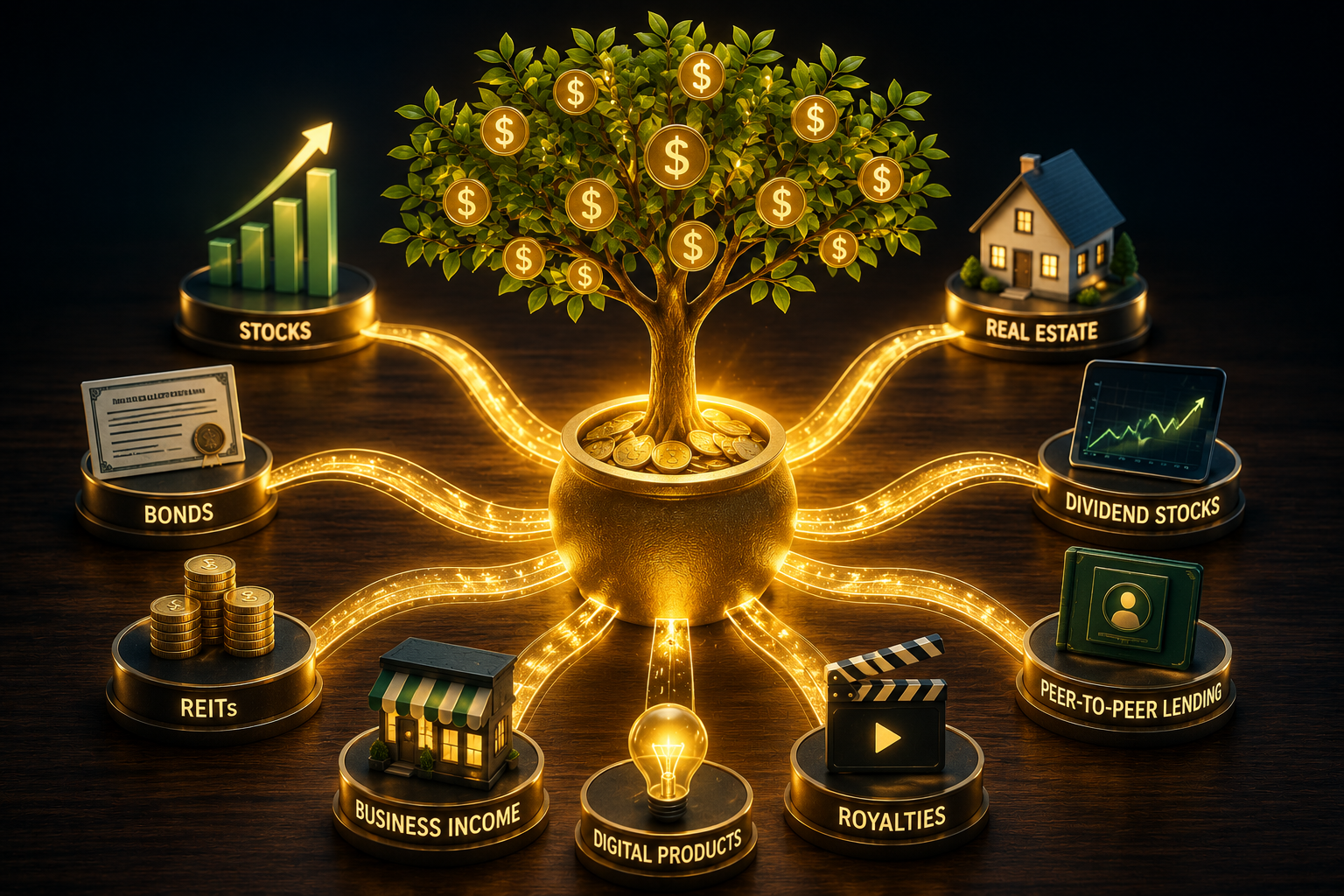
Most households still depend on a single source of cash flow. If that source pauses, every bill pauses with it. The fix is not one big bet. It is a portfolio of small, independent income streams that arrive on different days, from different sources, for different reasons, so a slowdown in one never becomes a crisis in your budget.
Not financial advice. This article explains how different income streams work so you can evaluate them for your own situation. It is educational content, not a personalized recommendation. Yields, rates, and tax rules change, and you should confirm current numbers and consult a licensed financial or tax professional before investing.
Why One Income Stream Is Not Enough
A salary is a single point of failure. So is a single rental property, a single stock, or a single client. Multiple streams of investment income spread that risk across asset classes that do not all move together. When stock dividends slow during a downturn, bond interest and rental income often keep arriving. When real estate cools, cash and Treasury yields can still be working.
The goal is not necessarily to get rich from any single stream. The goal is resilience: enough independent cash flow that no single disruption, a layoff, a rate cut, a vacant unit, knocks your entire financial plan off course.
5-7Income streams most diversified investors track
3.50-3.75%Federal funds rate range, June 2026
2.7%Fed’s 2026 inflation projection
Income that depends on you showing up to work is a wage. Income that keeps arriving whether you show up or not is wealth.
The 2026 Rate and Inflation Backdrop
Context matters for income investing, because the rates available on cash, bonds, and dividend-paying assets shift with monetary policy. As of the Federal Reserve’s June 2026 meeting, the first under new Chair Kevin Warsh, the federal funds rate has been held at 3.50 percent to 3.75 percent for a fourth consecutive meeting. Policymakers raised their 2026 inflation forecast to roughly 2.7 percent, above the Fed’s 2 percent target, partly due to higher oil prices tied to renewed conflict in the Middle East. A resilient labor market and steady consumer spending have reduced the urgency to cut rates further this year.
For income investors, that combination matters in three ways. Cash and short-term instruments such as high-yield savings accounts, money market funds, and CDs continue to pay competitive rates relative to the last decade. Bond yields remain attractive versus the near-zero environment of the early 2020s. And dividend stocks, REITs in particular, are being judged on whether their payouts can outrun a borrowing cost that is no longer falling quickly. None of this is permanent. Rate decisions are reassessed at every Fed meeting, so the numbers in this guide should be treated as a snapshot, not a forecast.
1. Dividend Stocks
Dividend stocks pay you a slice of company profits, usually quarterly, simply for holding shares. The best long-term holdings are companies with decades of consistent or growing payouts, not just the highest current yield.
A high yield alone is not a sign of quality; it can also signal that the market expects a dividend cut. Look instead at payout ratio, free cash flow coverage, and dividend growth history. As of June 2026, several real-estate-adjacent dividend payers such as Mid-America Apartment Communities had extended multi-decade streaks of uninterrupted payouts, including 16 consecutive years of dividend increases, illustrating how durable cash flow tends to come from steady, unglamorous businesses rather than the highest headline yield.
What to screen for
A payout ratio generally under 75 percent of earnings or funds from operations, so the company has room to keep paying during a rough quarter.
A multi-year history of maintaining or raising the dividend, not just announcing one.
Revenue that does not depend on a single product cycle or customer.
A yield that is competitive with, but not wildly above, its sector average; outliers deserve extra scrutiny.
2. REITs and Real Estate Funds
Moderate to high risk by subtype
Real estate investment trusts let you collect rent-like income from office buildings, apartments, warehouses, data centers, and cell towers without buying or managing a single property. By law, REITs must distribute at least 90 percent of taxable income to shareholders, which is why their yields tend to run well above the broader stock market.
Sector matters enormously. Going into mid-2026, industrial REITs were yielding around 5.5 percent, residential REITs near 4.7 percent, healthcare REITs near 4.6 percent, while mortgage REITs, which use leverage to buy mortgage-backed securities, were yielding closer to 10.9 percent on average, reflecting their materially higher interest-rate risk. Specialty REITs tied to single industries have shown some of the widest swings: a cannabis-focused REIT was yielding above 16 percent in early 2026 even as its revenue and funds from operations per share both declined double digits year over year, a reminder that an unusually high yield is compensation for unusually high risk, not a free lunch.
Monthly-paying REITs can be useful for matching bills that arrive every month rather than every quarter, but a monthly payment schedule says nothing about dividend safety on its own.
3. Bonds, Treasuries, and CDs
Fixed-income instruments pay a set interest rate for a set period. U.S. Treasuries are backed by the federal government; corporate and municipal bonds add yield in exchange for credit risk; certificates of deposit trade liquidity for a guaranteed rate at a bank or credit union.
With the federal funds rate sitting at 3.50 to 3.75 percent through mid-2026, short and intermediate Treasury yields remain historically attractive compared with the ultra-low-rate years between 2020 and 2021. Laddering, buying bonds or CDs that mature in staggered intervals such as 6, 12, 18, and 24 months, lets you reinvest portions regularly without guessing the single best moment to lock in a rate.
Where fixed income fits
Bonds and CDs are the ballast of an income portfolio. They will rarely be the highest-yielding piece, but they are the piece most likely to behave predictably when stocks or real estate do not.
4. High-Yield Savings and Money Market Funds
This is the most liquid income stream available: cash sitting in an FDIC-insured high-yield savings account or a money market fund, earning interest that resets with the Fed’s policy rate. With the funds rate elevated through 2026, top nationally available high-yield savings accounts have continued paying yields that beat inflation for many savers, a meaningful change from the near-zero rates of the prior decade.
This stream will not make anyone wealthy on its own, but it plays a specific role: it is the emergency fund and short-term cash buffer that keeps you from having to sell dividend stocks or REIT shares at a bad time just to cover an unexpected expense.
5. Rental Real Estate
Active income stream
Owning a rental property, a single-family home, a duplex, or a small multifamily building, produces monthly rent minus expenses. Unlike most items on this list, it requires ongoing effort: tenant screening, maintenance, vacancy management, and financing decisions.
The appeal is leverage and tax treatment. A mortgage lets you control an appreciating asset with a fraction of its value in cash, and depreciation can shelter a meaningful portion of rental income from tax in a given year. The tradeoff is illiquidity and management burden; a tenant who stops paying or a roof that needs replacing can erase months of cash flow at once. Investors who want real estate exposure without the phone calls about a broken water heater typically choose REITs instead, sometimes alongside, rather than in place of, direct ownership.
6. Private Credit and Peer-to-Peer Lending
Private credit funds and peer-to-peer lending platforms let investors lend directly to businesses or individual borrowers in exchange for interest payments, often higher than what public bonds offer. Business development companies, a public, regulated way to access private credit, frequently carry double-digit yields because they take on credit risk that banks have stepped back from.
The honest tradeoff: these are less liquid and less transparent than publicly traded bonds, default risk is real, and higher advertised yields usually compensate for both. This stream works best as a smaller, satellite position rather than a core holding.
7. Royalties and Digital Products
This category sits between investing and entrepreneurship: royalties from music, books, patents, or licensed photography, and recurring revenue from self-published courses, templates, or apps. The upfront work is heavy and the payoff uncertain, but successful products keep paying long after the creation effort ends.
This is the least “set it and forget it” stream here, because most royalty income requires either upfront creative work or capital to purchase existing royalty rights through specialized marketplaces. It is included because it is genuinely independent of stock and bond markets, which makes it a useful diversifier for investors who already have a financial portfolio and want a stream that does not move with interest rates.
8. Dividend ETFs and Index Funds
For investors who want diversified dividend exposure without picking individual stocks, dividend-focused exchange-traded funds bundle dozens or hundreds of payers into a single holding. Broad dividend growth ETFs, high-yield dividend ETFs, and REIT-sector ETFs each express a different tradeoff between current yield and growth. This is often the simplest entry point into income investing: one purchase delivers instant diversification across companies, sectors, and, in many cases, dividend track records that would take years to research individually.
Building Your Diversified Income Portfolio
There is no single correct allocation; the right mix depends on your time horizon, need for liquidity, and tolerance for volatility. The table and chart below illustrate one common framework, weighted toward core, liquid holdings with smaller satellite positions in higher-yield, higher-risk streams.
Illustrative income stream comparison
Income Stream
Typical Yield Range
Liquidity
Effort Required
High-yield savings / money market
3.5% to 4.5%
High
Low
Treasuries / CDs (laddered)
3.5% to 5%
Medium
Low
Dividend stocks
2% to 5%
High
Low to medium
Dividend / REIT ETFs
3% to 7%
High
Low
Equity REITs
4% to 8%
High
Low
Mortgage REITs
9% to 16%+
High
Low, higher risk
Rental real estate
5% to 10% cash-on-cash
Low
High
Private credit / P2P
7% to 12%
Low
Low to medium
Royalties / digital products
Highly variable
Low
High upfront
A simple build order
Fund three to six months of expenses in a high-yield savings account first. This is your shock absorber, not your growth engine.
Add a core of broad dividend or REIT ETFs inside a tax-advantaged account where possible, for low-effort diversification.
Layer in individual dividend stocks or direct real estate only once you can research them properly, not because a headline yield looks attractive.
Treat private credit, royalties, and other higher-yield satellites as the smallest slice of the portfolio, sized so a worst-case loss would not derail your plan.
Tax Considerations
Qualified dividends from most U.S. corporations are taxed at long-term capital gains rates, which are lower than ordinary income tax rates for most investors, provided holding-period rules are met.
REIT dividends are generally taxed as ordinary income, since REITs do not pay corporate tax on distributed earnings, which is part of why high REIT yields can look better on paper than after-tax.
Interest from savings accounts, CDs, and most bonds is taxed as ordinary income in the year it is earned, even if reinvested automatically.
Rental income can often be reduced for tax purposes by depreciation and deductible expenses, though depreciation may be recaptured at sale.
Holding high-yield, ordinary-income-taxed assets such as REITs and bonds inside tax-advantaged accounts, while holding qualified-dividend stocks in taxable accounts, is a common way investors manage their overall tax bill.
Tax rules change and vary by state, so confirm current details with a CPA or tax advisor rather than relying on general guidance like this.
Mistakes That Derail Income Investors
Chasing the highest yield
An unusually high yield is the market pricing in risk, not a discount. Before buying any double-digit yielder, check whether the payout is covered by actual cash flow or earnings, not just promised by management.
Treating every stream the same
A high-yield savings account and a private credit fund are not interchangeable just because both pay “income.” Match each stream’s liquidity and risk to the job you need it to do.
Ignoring correlation
Five dividend stocks in the same sector are not five independent income streams; they are one bet with five tickers. True diversification spans asset classes, not just security count.
Forgetting taxes until April
Ordinary-income-taxed streams like REIT dividends and bond interest can create a larger tax bill than expected if you have not set aside a portion throughout the year.
Frequently Asked Questions
How much money do I need to start building multiple income streams?
There is no minimum to begin. Many brokerages allow fractional shares of dividend stocks and ETFs for a few dollars, and high-yield savings accounts often have no minimum balance. The bigger constraint is usually time: building a meaningful number of streams happens gradually, not all at once.
Is real estate or the stock market a better income stream in 2026?
They serve different roles rather than competing directly. Stocks and REITs offer liquidity and low effort; direct real estate offers leverage and tax benefits at the cost of liquidity and active management. Most diversified income investors hold some combination rather than choosing one exclusively.
How many income streams should I realistically aim for?
Three to five well-chosen streams, sized appropriately, typically capture most of the diversification benefit. Adding a tenth stream that overlaps heavily with an existing one adds complexity without meaningfully reducing risk.
Are dividend yields likely to rise or fall through the rest of 2026?
That depends on Federal Reserve policy and company-specific earnings, neither of which can be reliably predicted. As of June 2026, the Fed has held rates steady for four consecutive meetings while signaling patience rather than committing to a direction, so investors should plan for a range of outcomes rather than a single forecast.
The Bottom Line
Multiple streams of investment income are less about finding one perfect asset and more about deliberately not depending on any single one. Start with a liquid cash cushion, build a diversified core of dividend and REIT exposure, add fixed income for stability, and only then layer in higher-yield, higher-effort streams sized to what you can afford to have go wrong. Revisit the mix at least once a year, since rates, valuations, and your own life circumstances will all keep changing.