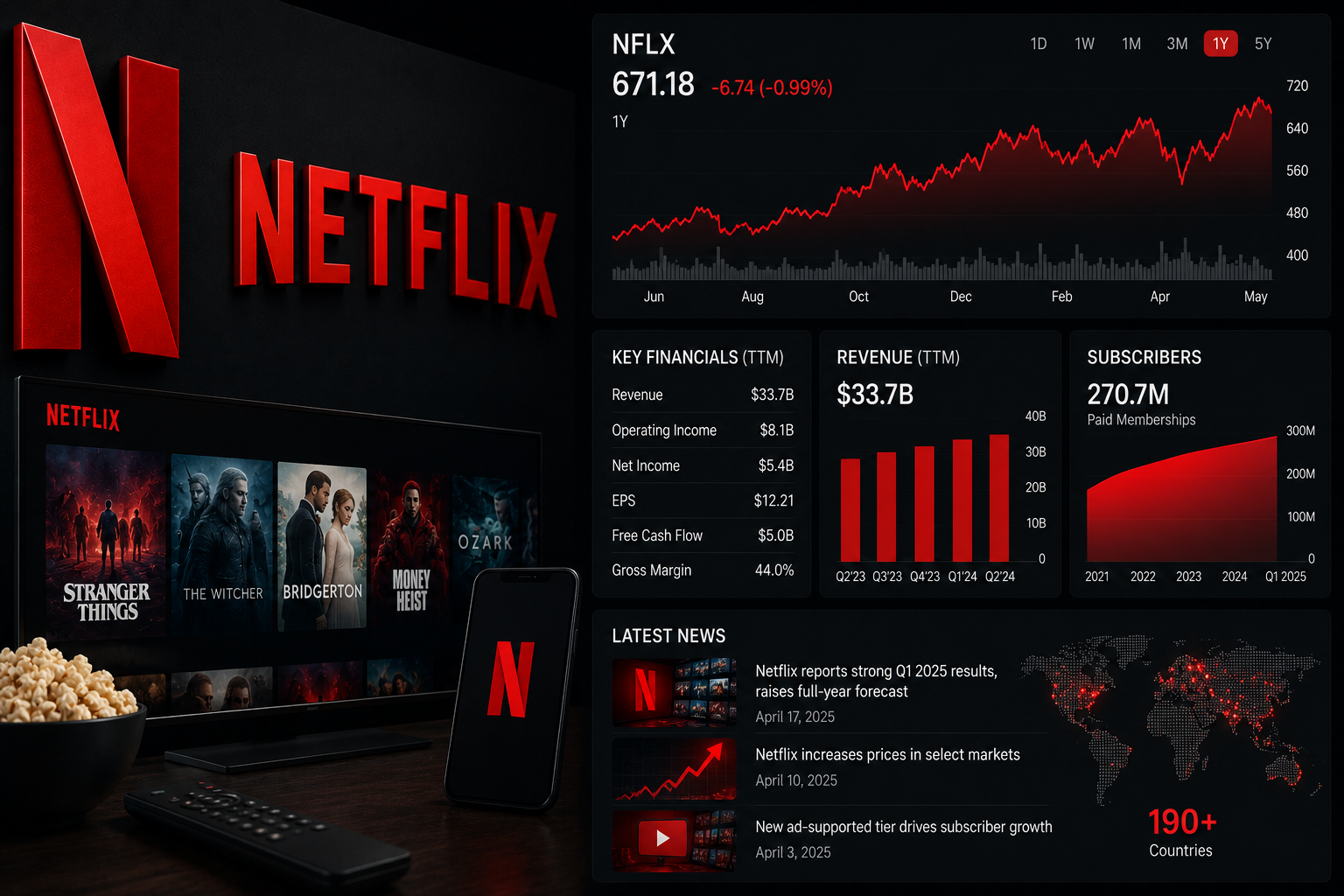
Quick summary: Netflix Inc is the world’s largest subscription streaming entertainment service, founded in 1997 by Reed Hastings and Marc Randolph and headquartered in Los Gatos, California. Trading on the Nasdaq under the ticker NFLX, the company serves paid memberships across more than 190 countries and has evolved from a DVD-by-mail business into a global content and advertising powerhouse. As of early July 2026 shares trade in the mid 70 dollar range following a 10-for-1 stock split, giving the company a market capitalization near 325 billion dollars, well off its all time high after a sharp pullback tied to a failed bid for Warner Bros. Discovery and broader streaming sector jitters. Netflix is led today by Co-CEOs Ted Sarandos and Greg Peters, with co-founder Reed Hastings serving as Executive Chairman. This guide covers Netflix’s history, founders, leadership, business segments, revenue breakdown, financial performance, stock data, dividend policy, competitors, and the latest company news.
Ticker: NFLX (Nasdaq). Sector: Streaming Media and Entertainment. Headquarters: Los Gatos, California, USA.
Streaming entertainment, content production, and digital advertising
IPO year
2002
Approximate stock price
Around 74 to 78 dollars per share (early July 2026, post stock split)
Market capitalization
Roughly 325 billion dollars
Paid memberships
More than 325 million globally, as of the last reported count
Full year 2025 revenue
Approximately 45 billion dollars
Figures reflect publicly reported data as of early July 2026 and change frequently. Always confirm live pricing with your broker before trading.
What Is Netflix?
Netflix is a subscription based entertainment company that streams television series, films, documentaries, live events, and mobile games to members around the world. What began as a mail order DVD rental business in the late 1990s has grown into one of the largest media companies on the planet, combining a massive content library, extensive original programming, a fast growing advertising business, and an expanding push into live sports and event programming.
Unlike traditional media companies, Netflix operates without cable networks, movie theaters, or physical retail stores. Its entire business model runs through direct-to-consumer streaming, supported by one of the largest content budgets in the industry. In recent years the company has diversified its revenue base by introducing an advertising supported subscription tier, expanding into live sports and cultural events, and building out a slate of mobile games, while also making headlines for a high profile but ultimately unsuccessful attempt to acquire the studio and streaming assets of Warner Bros. Discovery.
Company History
Netflix was founded on August 29, 1997, in Scotts Valley, California, by Reed Hastings and Marc Randolph, reportedly inspired in part by Hastings’s frustration with a late fee from a traditional video rental store. The company launched its website in 1998 as a DVD rental by mail service, initially charging per rental before shifting to an unlimited monthly subscription model by the end of 1999, a move that would come to define the company’s approach to pricing for decades. Netflix went public in 2002, and by the mid 2000s had become the dominant DVD by mail rental service in the United States, eventually surpassing five billion total DVD shipments over the life of that business before it was discontinued in 2023.
The pivotal turning point in Netflix’s history came in January 2007, when the company launched its Watch Now streaming feature, allowing subscribers to instantly stream a portion of its catalog over the internet. Streaming quickly became the company’s central focus, and Netflix invested heavily in expanding its library, building global infrastructure, and eventually producing its own original programming, beginning with House of Cards in 2013. That strategy transformed Netflix from a distributor of licensed content into one of the largest producers of scripted television and film in the world, with award winning series and films spanning nearly every genre and language.
Over the following decade Netflix expanded into more than 190 countries, weathered intensifying competition from a wave of rival streaming services launched by major media companies, and navigated a difficult stretch in 2022 when subscriber growth stalled for the first time in the company’s history. In response, management introduced a cheaper advertising supported tier, cracked down on password sharing, and expanded into live programming and gaming, moves that helped reaccelerate growth. In January 2026 Netflix completed a 10-for-1 stock split, making shares more accessible to a broader base of individual investors following a long period of share price appreciation.
Netflix Milestones Timeline
1997 Founded
DVD by mail
Scotts Valley
2007 Streaming launch
Watch Now
Streaming era
2013 Originals begin
House of Cards
Original content
2022 Ad tier launch
New revenue line
Advertising business
2026 Stock split
10 for 1
Broader access
Timeline reflects major strategic turning points rather than a complete company history.
Founders
Netflix was co-founded by Reed Hastings and Marc Randolph. Hastings, a computer scientist and mathematician, had previously co-founded Pure Software, which was acquired for 750 million dollars in a deal that was one of the largest in Silicon Valley at the time. He provided the majority of Netflix’s early seed funding and became the company’s CEO in 1999. Randolph, who had previously co-founded a computer mail order company and served in marketing roles at other technology firms, served as Netflix’s first chief executive officer and led many of the company’s foundational early decisions, including its focus on a subscription model rather than per rental pricing. Randolph left the company in 2004, while Hastings went on to lead Netflix for more than two decades before transitioning to Executive Chairman in January 2023.
CEO and Leadership
Netflix is currently led by two Co-Chief Executive Officers, Ted Sarandos and Greg Peters. Sarandos joined Netflix in 2000 and rose to become the company’s chief content officer, playing a central role in building its original programming strategy before being promoted to co-CEO in 2020. Peters previously served as the company’s chief operating officer and chief product officer, and was named co-CEO in January 2023 as part of a broader leadership transition. The two executives split their time between Netflix’s headquarters in Los Gatos and its Los Angeles operations, reflecting the company’s dual focus on technology and content production.
Reed Hastings stepped down from his role as CEO in January 2023 to become Executive Chairman, a role in which he continues to provide strategic guidance while stepping back from day to day operations. Netflix also completed a board declassification process by 2025, meaning all directors are now elected annually, a governance change that increases shareholder influence over the company’s board.
Headquarters
Netflix is headquartered in Los Gatos, California, a city in the San Francisco Bay Area near San Jose. The company also maintains a significant operational presence in Los Angeles, reflecting its deep involvement in film and television production, along with international offices across Asia, Europe, and Latin America, including locations in Canada, France, Brazil, the Netherlands, India, Italy, Japan, Poland, South Korea, and the United Kingdom. Netflix operates production hubs in Los Angeles, Albuquerque, London, Madrid, Vancouver, and Toronto to support its global content pipeline.
Business Segments
Netflix reports its financial results primarily by geographic region rather than by product line, reflecting the fact that its core streaming business operates as a single global service. The company’s main reporting regions are as follows.
United States and Canada (UCAN)
Netflix’s largest and most mature region by revenue per member, UCAN includes the company’s home market and remains a key driver of both subscription and advertising revenue.
Europe, Middle East, and Africa (EMEA)
A large and fast growing region for Netflix, encompassing a wide range of markets with different content preferences, pricing tiers, and regulatory environments.
Latin America (LATAM)
An important growth market for Netflix, though one that has also introduced regulatory complexity, including the company’s ongoing tax dispute with authorities in Brazil.
Asia-Pacific (APAC)
Netflix’s fastest growing region by percentage in recent periods, reflecting continued subscriber growth across a large and diverse set of countries.
Layered across all four regions, Netflix’s advertising business has emerged as an increasingly important growth engine, alongside newer initiatives in live programming and mobile gaming.
Products and Services
Streaming subscription plans: Netflix offers multiple subscription tiers, including a lower cost advertising supported plan and premium ad free plans with varying video quality and simultaneous stream limits.
Original series and films: Netflix produces a large slate of original scripted and unscripted programming across genres and languages, representing one of the largest content budgets in the entertainment industry at roughly 17 to 20 billion dollars annually.
Licensed content: in addition to its originals, Netflix licenses a wide range of third party television series and films to complement its in-house catalog.
Live events and sports: Netflix has expanded into live programming, including boxing events, WWE Raw, NFL games, and other cultural events such as major concerts, favoring high profile event style programming over long term traditional sports rights packages.
Advertising products: Netflix’s ad-supported tier includes tools for advertisers such as first party data measurement and attribution, with the company continuing to expand its ad formats and advertiser base.
Netflix Games: a growing library of mobile games available to subscribers at no additional cost, part of the company’s push into interactive entertainment through its Netflix Playground initiative.
Revenue Breakdown
Netflix’s revenue is generated primarily through paid subscriptions across its various pricing tiers, supplemented by a rapidly growing advertising business. For full year 2025 the company reported revenue of approximately 45 billion dollars, up 16 percent from the prior year, with operating margin expanding to about 29.5 percent for the year. Advertising revenue grew by more than two and a half times in 2025 compared to the prior year, surpassing 1.5 billion dollars, as the company’s ad-supported tier attracted a growing share of new sign-ups in markets where it is available.
In the first quarter of 2026, Netflix reported revenue of about 12.25 billion dollars, up 16 percent year over year, with all major regions posting double digit growth. Management has reiterated its target of reaching approximately 3 billion dollars in advertising revenue for full year 2026, which would represent a doubling from the prior year, positioning advertising as an increasingly important second growth engine alongside core subscription revenue.
Q1 2026 Revenue by Region (approximate, in billions of dollars)
UCAN
$5.25B
$5.25B
EMEA
$4.00B
$4.00B
LATAM
$1.50B
$1.50B
APAC
$1.25B
~$1.25B
Regional figures are drawn from Netflix’s Q1 2026 shareholder letter. APAC figure is approximate based on reported year over year growth rates.
Financial Performance
Netflix’s financial performance has continued to strengthen even as the company navigated a high profile and ultimately unsuccessful attempt to acquire Warner Bros. Discovery’s studio and streaming assets. First quarter 2026 net income reached about 5.28 billion dollars, up sharply from the prior year, aided in part by a 2.8 billion dollar termination fee Netflix received after Warner Bros. Discovery ended its merger agreement with Netflix in favor of a competing all cash offer from Paramount Skydance. Diluted earnings per share came in at 1.23 dollars, well above analyst expectations, while free cash flow for the quarter reached about 5.09 billion dollars.
Excluding the one time termination fee and other unusual items, Netflix’s underlying business also showed continued strength, with operating margin reaching 32.3 percent in the first quarter, supported by higher than planned subscription revenue and continued growth in advertising. The company has guided for full year 2026 revenue of roughly 50.7 to 51.7 billion dollars, alongside an annual content budget of approximately 20 billion dollars, one of the largest in the entertainment industry. Netflix has also flagged a one time 619 million dollar non-income tax charge tied to an ongoing dispute with Brazilian tax authorities, which weighed on an earlier quarterly earnings report, though management has said it does not expect the issue to materially affect future results.
Key Financial Metrics (Q1 2026, approximate)
Metric
Approximate Value
Total revenue
$12.25 billion, up 16 percent year over year
Diluted EPS
$1.23, up 86 percent year over year
Net income
$5.28 billion, including a $2.8 billion Warner Bros. termination fee
Operating margin
32.3 percent, up from 31.7 percent a year earlier
Free cash flow
Approximately $5.09 billion for the quarter
Paid memberships
More than 325 million globally (last reported count)
Full year 2026 revenue guidance
Approximately $50.7 to $51.7 billion
Annual content budget
Approximately $20 billion
Stock Information
NFLX trades on the Nasdaq exchange. As of early July 2026, shares have traded in a range of roughly 74 to 78 dollars, giving the company a market capitalization around 325 billion dollars. These figures reflect Netflix’s 10-for-1 stock split completed in January 2026, which reduced the per share price while proportionally increasing the number of shares outstanding, a move that did not change the company’s overall market value but made shares more accessible to individual investors.
52 Week Trading Range Gauge
Low: $70.86Current: ~$74 to $78High: $130.23
Current price sits near the low end of the 52 week range, reflecting a sharp pullback of roughly 45 percent from the stock’s all time high reached in mid 2025. Prices change constantly, so check a live quote before making any decision.
Much of Netflix’s recent stock weakness followed the collapse of its planned acquisition of Warner Bros. Discovery’s studio and streaming operations, a deal that would have significantly expanded Netflix’s content library and production capacity. After Warner’s board determined that a competing all cash offer from Paramount Skydance was superior, Netflix declined to raise its bid and walked away, receiving a 2.8 billion dollar termination fee in the process. While that outcome removed a major source of acquisition related uncertainty and provided a one time financial windfall, some investors had hoped the deal would close, and the stock has traded well below its highs since the situation was resolved. Despite the pullback, Wall Street sentiment on the stock remains largely positive, with the majority of covering analysts maintaining buy or equivalent ratings.
Selected Analyst Snapshot (2026)
Metric
Approximate Figure
Average 12 month price target
Around $114
High analyst estimate
Around $151
Low analyst estimate
Around $80
Analyst consensus rating
Buy, with the large majority of covering analysts rating the stock a buy
Trailing P/E ratio
Approximately 24 to 25
Analyst targets vary widely and change frequently. This information is provided for context only and is not a recommendation to buy or sell any security.
Netflix walked away from one of the largest proposed media acquisitions in history, collected a multi billion dollar payout for its trouble, and is now refocusing investor attention on its core streaming and advertising growth engines.
Dividends
Netflix does not pay a dividend to its shareholders and has never done so as a public company. Management has consistently prioritized reinvesting cash flow into content production, technology infrastructure, and global expansion, while also returning capital to shareholders through share buyback programs rather than dividend payments. This approach is common among high growth technology and media companies that prioritize reinvestment and capital appreciation over regular income distributions.
Investors seeking dividend income typically look elsewhere in the media and entertainment sector, while NFLX shareholders are generally focused on the company’s subscriber growth, advertising expansion, content slate, and overall margin trajectory as the primary drivers of long term shareholder value. There is no indication that Netflix plans to introduce a dividend in the near term, given its continued heavy investment in content and live programming.
Competitors
Netflix competes in a crowded and rapidly evolving streaming and entertainment landscape.
Direct Streaming Competitors
Disney, through Disney Plus, Hulu, and ESPN’s streaming offerings
Amazon, through Prime Video, which is bundled with Amazon’s broader retail subscription service
Apple, through Apple TV Plus, which emphasizes prestige original programming
Warner Bros. Discovery’s HBO Max, which is set to combine with Paramount Plus following the completion of the Paramount Skydance acquisition
Comcast’s Peacock, along with other broadcaster owned streaming services
Broader Attention and Advertising Competitors
YouTube, which competes for both viewing time and advertising dollars
TikTok and other short form video platforms, which compete heavily for younger audience attention
Traditional pay television and live sports broadcasters, particularly as Netflix expands further into live event programming
The competitive landscape has shifted meaningfully following the Warner Bros. Discovery and Paramount Skydance merger, which consolidates two major streaming services and studios under one roof, creating a larger direct competitor to Netflix in both scripted content and, potentially, live sports and news programming through assets such as CNN and CBS News.
Recent News
Netflix walks away from Warner Bros. Discovery deal: after agreeing in December 2025 to acquire Warner’s studio and streaming divisions for about 82.7 billion dollars including debt, Netflix declined in late February 2026 to match a superior all cash counteroffer from Paramount Skydance, ending its pursuit and collecting a 2.8 billion dollar termination fee.
Paramount Skydance completes Warner Bros. Discovery acquisition process: Warner Bros. Discovery shareholders approved the Paramount Skydance merger in April 2026, with the transaction expected to close in the third quarter of 2026, reshaping the competitive streaming landscape.
10-for-1 stock split: Netflix completed a 10-for-1 stock split around the start of 2026, reducing its per share price while proportionally increasing shares outstanding, aimed at making the stock more accessible to a broader range of investors.
Strong Q1 2026 results with a soft Q2 outlook: Netflix beat first quarter 2026 revenue and earnings expectations, but a second quarter outlook that did not raise full year operating margin guidance contributed to a sharp drop in the stock following the earnings report.
Brazilian tax dispute charge: a 619 million dollar non-income tax charge tied to a Brazilian Supreme Court ruling on technology transfer taxes weighed on an earlier quarterly earnings report, though management described the impact as largely non-recurring.
Continued live sports and events push: Netflix has expanded its live programming slate with events such as NFL games, WWE Raw, boxing matches, and major concerts, part of its strategy to boost engagement and advertising appeal without committing to costly long term traditional sports rights deals.
Upcoming earnings date: Netflix is scheduled to report second quarter 2026 financial results on July 16, 2026, an event that will be closely watched for updates on subscriber trends, advertising revenue, and full year guidance.
Frequently Asked Questions
What does Netflix actually do?
Netflix is a subscription streaming service that offers television series, films, documentaries, live events, and mobile games to paid members in more than 190 countries, supported by a growing advertising business.
Who founded Netflix and who runs it today?
Reed Hastings and Marc Randolph founded Netflix in 1997. The company is currently led by Co-CEOs Ted Sarandos and Greg Peters, with Hastings serving as Executive Chairman.
Did Netflix buy Warner Bros. Discovery?
No. Netflix agreed to acquire Warner Bros. Discovery’s studio and streaming assets in December 2025, but declined to match a higher competing offer from Paramount Skydance in February 2026 and walked away from the deal, receiving a 2.8 billion dollar termination fee.
Does NFLX pay a dividend?
No. Netflix has never paid a dividend and instead reinvests cash flow into content and technology while returning capital to shareholders through share buybacks.
Why did Netflix stock split?
Netflix completed a 10-for-1 stock split around the start of 2026 to reduce its per share price and make the stock more accessible to a wider range of individual investors, without changing the company’s overall market value.
Why has NFLX stock fallen from its highs?
NFLX has pulled back significantly from its mid 2025 all time high, partly due to uncertainty and eventual disappointment around its unsuccessful bid for Warner Bros. Discovery, along with investor concerns over content costs, competitive pressure, and quarterly guidance that has not always matched high expectations.
How does Netflix make money from advertising?
Netflix sells advertising placements within its lower cost, ad-supported subscription tier, offering advertisers access to a large global audience along with tools for measurement and attribution, with the company targeting about 3 billion dollars in advertising revenue for 2026.
Is Netflix still growing?
Yes. Netflix reported 16 percent revenue growth in the first quarter of 2026 and has continued to expand its advertising business, live programming slate, and international subscriber base, even as growth rates have moderated somewhat from earlier years.
Disclaimer: This article is for informational and educational purposes only and does not constitute financial, investment, tax, or legal advice. Stock prices, financial results, and company developments change frequently and figures presented here reflect publicly available data as of early July 2026. Always verify current figures with official company filings, a licensed financial advisor, or your brokerage before making investment decisions. Investing in stocks involves risk, including the possible loss of principal.