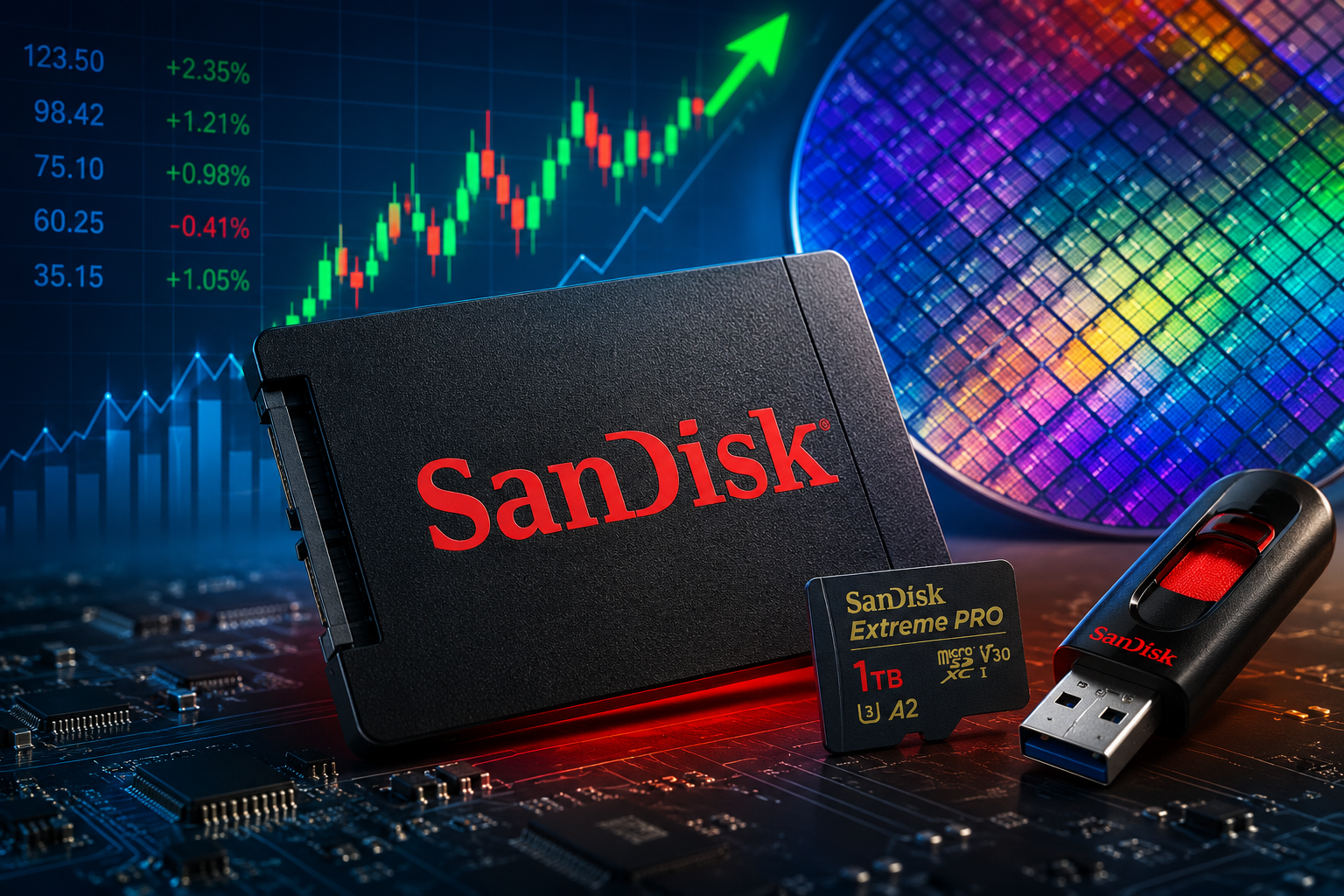
Quick summary: Sandisk Corporation, ticker SNDK on the Nasdaq, is the independent flash memory and solid state storage company that separated from Western Digital on February 24, 2025. Sandisk designs and sells NAND flash products including enterprise SSDs, consumer SSDs, memory cards, USB drives and embedded storage for smartphones, PCs, gaming and automotive applications.
Since the spin off, Sandisk has ridden a historic memory pricing upswing tied to AI data center demand, with quarterly revenue climbing from about $1.7 billion in the quarter before separation to more than $3 billion by early 2026 and guidance pointing toward $4.4 to $4.8 billion for the following quarter. The stock has been one of the best performing Nasdaq names of 2026, though it remains highly volatile and does not pay a dividend.
Below you will find a full breakdown of Sandisk’s history, founders, leadership, business segments, products, revenue mix, financial performance, stock data, dividend policy, competitors, recent news and answers to the most common questions investors ask.
Quick Facts
Item
Detail
Company name
Sandisk Corporation
Ticker symbol
SNDK (Nasdaq)
Founded
1988 as SunDisk, renamed Sandisk in 1995
Re listed as independent company
February 24, 2025
Headquarters
951 Sandisk Drive, Milpitas, California 95035
Chairman and CEO
David Goeckeler
Industry
Semiconductors, NAND flash memory and data storage
Employees
Approximately 8,000 to 11,000 depending on the reporting source and quarter
Fiscal year end
Late June or early July, roughly aligned with a June close
FY2025 revenue
About $7.36 billion
Dividend
None currently paid
Main competitors
Samsung, SK Hynix, Micron, Kioxia, Western Digital, Seagate
What Is Sandisk?
Sandisk Corporation is an American semiconductor and data storage company that designs, manufactures and sells products built around NAND flash memory. Its portfolio spans solid state drives for laptops, desktops, gaming consoles and enterprise data centers, along with removable memory cards, USB flash drives, embedded flash for mobile phones and automotive systems, and raw wafers and components sold to other manufacturers.
Today’s Sandisk is technically a new public company. It traces its brand and engineering heritage back to the original Sandisk founded in 1988, but the entity trading under SNDK now is the flash storage business that Western Digital spun off into an independent, publicly traded corporation in early 2025. That means Sandisk carries decades of flash memory expertise while operating with a fresh balance sheet and a management team focused squarely on one thing: NAND flash and the storage systems built around it.
Sandisk sells to a wide customer base that includes computer makers, original equipment manufacturers, cloud and hyperscale data center operators, retailers, distributors and everyday consumers who buy its memory cards and USB drives at electronics stores. Its growth story in 2025 and 2026 has been closely tied to surging demand for high capacity flash storage in artificial intelligence infrastructure, where solid state drives are increasingly replacing traditional hard disk drives in large scale data centers.
Company History
Sandisk’s roots go back nearly four decades, and its corporate structure has changed dramatically more than once. Here is the timeline that matters most for understanding the company you see trading today.
1988: The company is founded in Milpitas, California under the name SunDisk, built around a floating gate memory technology capable of holding data without external power.
1991: SunDisk builds the first flash based solid state drive in a 2.5 inch hard drive form factor for IBM, with 20 megabytes of capacity priced at roughly $1,000.
1994: The company introduces CompactFlash, a format that becomes an early industry standard for digital cameras and portable devices.
1995: SunDisk changes its name to SanDisk to avoid confusion with Sun Microsystems and completes its initial public offering on the Nasdaq under the ticker SNDK.
2000: Sandisk and Toshiba form a joint venture to produce NAND flash memory together, a partnership structure that continues in different forms with Kioxia (formerly Toshiba Memory) today.
2005 to 2014: Sandisk expands aggressively through acquisitions including Matrix Semiconductor, M Systems, Pliant Technology, FlashSoft, Schooner Information Technology, SMART Storage Systems and Fusion io, building out its enterprise and embedded storage capabilities.
2016: Western Digital acquires Sandisk for approximately $19 billion, folding the flash storage business into its broader hard drive and storage portfolio.
2023 to 2024: Western Digital announces plans to separate its hard disk drive and flash businesses into two independent public companies, citing very different market dynamics and investor bases for each segment.
February 24, 2025: The separation is completed. Sandisk begins trading again as an independent public company on the Nasdaq under the ticker SNDK, with former Western Digital CEO David Goeckeler leading the new company.
2025 to 2026: Sandisk rides a sharp recovery in NAND flash pricing driven by AI related data center demand, posts several quarters of accelerating revenue and returns to consistent profitability, while rebranding some of its consumer SSD lines under the Sandisk Optimus name.
Founders
Sandisk was founded in 1988 by three engineers who set out to prove that solid state, non volatile memory could realistically replace spinning hard drives for certain applications.
Eli Harari: An Israeli born physicist who invented the floating gate EEPROM technology underlying modern flash memory. Harari served as CEO for many years and later received the National Medal of Technology and Innovation for his contributions to flash storage.
Sanjay Mehrotra: A co founder who went on to lead Sandisk as CEO in later years before eventually becoming CEO of Micron Technology, one of Sandisk’s current competitors.
Jack Yuan: The third co founder, who contributed to the company’s early engineering work on non volatile memory systems.
It is worth noting that none of the original three founders lead today’s Sandisk Corporation. The current, re listed public company that trades as SNDK is a corporate spin off from Western Digital rather than a direct continuation of the founder led startup, even though it uses the same brand, headquarters city and much of the same engineering culture.
CEO
Sandisk is led by Chairman and Chief Executive Officer David Goeckeler. Goeckeler previously served as CEO of Western Digital, where he oversaw the strategic decision to separate the company’s flash and hard disk drive businesses. When the spin off completed in February 2025, Goeckeler moved from leading Western Digital to leading the newly independent Sandisk Corporation.
Under Goeckeler’s leadership, Sandisk has focused on three priorities: expanding its presence in enterprise and data center solid state drives, maintaining discipline on costs and capital spending through the notoriously cyclical memory market, and pushing new technology such as BiCS8 NAND and High Bandwidth Flash aimed at artificial intelligence workloads. The company’s finance function is led by Chief Financial Officer Luis F. Visoso, who joined around the time of the separation.
Headquarters
Sandisk Corporation is headquartered at 951 Sandisk Drive, Milpitas, California 95035, in the heart of Silicon Valley. Milpitas has been home to Sandisk’s operations since the company’s early years, and the headquarters remained in place through the 2016 acquisition by Western Digital and the 2025 spin off back into an independent company. Sandisk also maintains global engineering, manufacturing partnership and sales operations across the United States, Japan, and other parts of Asia, reflecting its long standing joint venture relationship with Kioxia for NAND flash fabrication.
Business Segments
Sandisk reports its results across three end market segments. The names of these segments changed slightly starting in fiscal 2026 to better reflect where the business is headed.
Segment (current name)
Former name
What it covers
Datacenter
Cloud
High capacity enterprise solid state drives sold to hyperscale cloud providers, enterprise data centers and storage OEMs
Edge
Client
Solid state drives and embedded flash storage built into laptops, desktops, gaming consoles and mobile devices
Consumer
Consumer
Retail memory cards, USB flash drives and consumer SSDs sold under the Sandisk brand
The renaming from Cloud to Datacenter and Client to Edge, which took effect in fiscal 2026, signals management’s intent to be viewed less as a legacy PC component supplier and more as a data center infrastructure company riding the artificial intelligence storage wave.
Products and Services
Sandisk’s product catalog spans nearly every category of flash based storage on the market today.
Enterprise and data center SSDs: High density solid state drives designed for hyperscale cloud providers and large enterprise storage systems, increasingly used to replace hard disk drives in AI training and inference infrastructure.
Client and consumer SSDs: Drives for upgrading desktops, laptops and gaming rigs, marketed under the Sandisk Optimus and Optimus GX lines following the January 2026 rebrand of the former WD Blue and WD Black product families.
Memory cards: SD, microSD and CompactFlash cards used in cameras, drones, smartphones and handheld gaming devices, including a co branded microSD Express card built for the Nintendo Switch 2.
USB flash drives: Portable storage products sold under the Sandisk Ultra and Sandisk Extreme lines, a category the company has served since the early 2000s.
Embedded flash storage: Flash components built directly into smartphones, tablets, wearables, automotive systems and Internet of Things devices.
Wafers and components: Raw NAND flash wafers and components sold to other manufacturers and partners.
Emerging technology: BiCS8 NAND architecture for higher density and better energy efficiency, plus High Bandwidth Flash, a new memory format aimed at supporting large scale AI inference workloads.
Revenue Breakdown
For fiscal year 2025, the year ended in late June 2025, Sandisk generated total revenue of roughly $7.36 billion. The Client segment, since renamed Edge, was by far the largest contributor, followed by Consumer and then the smaller but fast growing Cloud segment, since renamed Datacenter.
Edge (formerly Client), 56 percent, about $4.13BConsumer, 31 percent, about $2.27BDatacenter (formerly Cloud), 13 percent, about $0.96B
Sandisk fiscal year 2025 revenue by end market segment. Datacenter revenue is the smallest slice today but has been the fastest growing segment by percentage since the spin off.
The mix has been shifting quickly. In the first two quarters of fiscal 2026, datacenter revenue climbed sharply on a sequential basis as hyperscale customers moved through qualification for Sandisk’s enterprise SSD platforms, even though it remains a smaller dollar contributor than Edge and Consumer for now.
Financial Performance
Sandisk’s financial results since becoming independent tell a clear story of a company moving from a deep industry downturn into a sharp upcycle. Fiscal 2024 revenue was about $6.66 billion with the company posting a net loss, reflecting a period of oversupply and weak NAND pricing across the whole memory industry. Fiscal 2025 revenue rose to about $7.36 billion, though the year still closed with a net loss of roughly $1.64 billion due to charges and weak pricing earlier in the year. The turnaround accelerated once NAND flash pricing recovered alongside surging AI related demand for enterprise storage.
Quarterly revenue trend from the quarter before the AI driven memory upswing through management’s guidance midpoint for the next reported quarter. Guidance figures are management targets, not guaranteed results.
Selected quarterly results
Period
Revenue
GAAP net income or loss
Notes
Q3 FY2025
$1.695 billion
Loss of $0.30 per share
Bottom of the down cycle, weak NAND pricing
Q4 FY2025
$1.901 billion
Loss of $23 million
Sequential recovery begins, above guidance
Q1 FY2026
$2.308 billion
Profit of $112 million
Datacenter revenue up 26 percent sequentially
Q2 FY2026
$3.03 billion
Profit of $803 million
Datacenter revenue up 64 percent sequentially
Q3 FY2026 guidance
$4.40 to $4.80 billion
Non GAAP diluted EPS guided at $12.00 to $14.00
Management guidance issued in late January 2026
Gross margin has expanded just as quickly as revenue. Management has pointed to a shift toward higher margin enterprise SSD products and a broad NAND flash pricing recovery as the two biggest drivers of margin improvement through fiscal 2026. As of early January 2026, the company reported roughly $1.48 billion of cash on hand, putting it in a net cash positive position earlier than many analysts had expected.
Stock Information
Sandisk trades on the Nasdaq under the ticker SNDK. Since its relisting in February 2025, the stock has been one of the more dramatic movers on the exchange, swinging from deep pessimism about the memory cycle to intense enthusiasm tied to AI infrastructure spending.
Approximate 52 week trading range as of early July 2026. Sandisk shares have traded across an extremely wide band, reflecting both the deep 2025 downturn and the sharp 2026 AI driven rally. Share prices reflect the post spin off trading history and can shift materially within days.
Metric
Approximate value (early July 2026)
Exchange
Nasdaq
Ticker
SNDK
Recent share price
Around $1,762
Market capitalization
Roughly $280 to $290 billion
Shares outstanding
About 148 million
Trailing price to earnings ratio
Roughly 65 to 72, reflecting a small GAAP profit base against a large market value
Average analyst rating
Buy, based on coverage from roughly 20 or more Wall Street analysts
Selected price targets
BofA raised its target to $2,500, Bernstein raised its target to $3,000
Because Sandisk operates in the highly cyclical NAND flash market, its share price tends to move quickly on any news about memory chip pricing, hyperscaler capital spending, or earnings from peers such as Micron. In one widely covered example, shares of Sandisk, Micron and Western Digital all jumped sharply in late June 2026 after Micron reported quarterly results that beat Wall Street expectations, since strong results from one major memory supplier are often read as a signal for the whole industry.
Dividends
Sandisk does not currently pay a dividend. The company has stated directly that it does not issue dividends at this time, and dividend tracking services show a trailing and forward yield of 0.00 percent since the February 2025 spin off. This is fairly typical for a company in Sandisk’s position: it is reinvesting heavily in manufacturing capacity, research and new technology such as BiCS8 and High Bandwidth Flash, while also working through the capital intensity that comes with the memory chip industry’s boom and bust cycles.
Investors looking for income today are unlikely to find it in SNDK shares. The stock is better understood as a growth and cyclical recovery play tied to NAND flash pricing and AI infrastructure demand rather than an income holding.
Competitors
Sandisk competes in the global NAND flash memory and flash storage market, one of the most capital intensive and consolidated segments in all of semiconductors. A small handful of companies control the overwhelming majority of global NAND supply.
Competitor
What they compete on
Samsung Electronics
The world’s largest NAND flash producer, competing across enterprise SSDs, consumer SSDs and memory cards
SK Hynix
A major South Korean memory maker competing in both NAND flash and DRAM
Micron Technology
A leading US based memory company competing directly in NAND and DRAM, coincidentally once led by Sandisk co founder Sanjay Mehrotra
Kioxia Holdings
Sandisk’s long standing NAND flash manufacturing joint venture partner in Japan, and also a competitor in certain product lines
Western Digital
Sandisk’s former parent company, now focused on hard disk drives but still a storage industry peer and partial shareholder
Seagate Technology
A major hard disk drive maker that increasingly competes with SSD suppliers as flash storage takes share from spinning disks
Because so few companies produce NAND flash at scale, pricing across the whole industry tends to move together. When one major supplier signals strong demand or tight supply, shares of Sandisk, Micron, SK Hynix and Kioxia’s public affiliates often move in the same direction.
Recent News
Memory sector rally, late June 2026: Sandisk, Micron and Western Digital shares all surged after Micron posted quarterly results that beat expectations, reinforcing the narrative that AI infrastructure spending is driving a durable memory pricing upcycle.
Analyst price target increases: Bernstein raised its price target on Sandisk from $1,700 to $3,000, while BofA lifted its target from $2,100 to $2,500, both citing tightening supply and demand dynamics in the NAND flash market.
Sandisk Optimus rebrand, January 2026: Sandisk renamed its former WD Blue and WD Black branded consumer SSD lines to Sandisk Optimus and Optimus GX, completing the transition of its retail SSD portfolio to the Sandisk brand following the spin off.
Board appointment: Alexander R. Bradley joined Sandisk’s board of directors and was appointed to the audit committee effective December 30, 2025.
Gaming partnerships: Sandisk highlighted strong sales of its co branded microSD Express card for the Nintendo Switch 2, along with an expanded presence in handheld gaming through microSD products designed for devices such as the ROG Ally.
Kioxia joint venture progress: Sandisk and Kioxia announced continued ramp of joint NAND flash fabrication capacity in Japan, supporting future supply as demand from data center customers grows.
First half 2026 stock performance: Sandisk and Micron were widely cited among the best performing stocks of the first half of 2026, though coverage in early July 2026 also noted a pullback of roughly 9 percent in a single session as investors began questioning how much further the memory rally could run in the near term.
Frequently Asked Questions
What does Sandisk actually make?
Sandisk designs and sells NAND flash based storage products, including solid state drives for consumers, businesses and data centers, memory cards, USB flash drives, embedded flash for smartphones and other devices, and raw flash wafers and components sold to other manufacturers.
Is Sandisk the same company as the original SanDisk from the 1990s and 2000s?
It shares the same brand, headquarters location and much of the engineering heritage, but the entity trading today as SNDK is legally a new public company. It was spun off from Western Digital in February 2025 after Western Digital had owned the original Sandisk business since 2016.
Who is the CEO of Sandisk?
David Goeckeler is Chairman and Chief Executive Officer of Sandisk. He previously served as CEO of Western Digital before leading the spin off and becoming CEO of the newly independent Sandisk Corporation.
Does Sandisk pay a dividend?
No. Sandisk does not currently pay a dividend, and the company has stated it does not issue dividends at this time. The stock is generally viewed as a growth and cyclical play rather than an income investment.
Why has SNDK stock been so volatile?
Sandisk operates in the NAND flash memory market, which is extremely cyclical and heavily influenced by global supply and demand balances. In 2025 the industry was working through oversupply and weak pricing, while by 2026 a sharp recovery tied to AI data center demand pushed prices and profits up quickly, and the stock has moved dramatically in both directions as a result.
What is Sandisk’s stock ticker and where does it trade?
Sandisk trades on the Nasdaq stock exchange under the ticker symbol SNDK.
Who are Sandisk’s biggest competitors?
Sandisk’s main competitors in the global NAND flash and storage market include Samsung Electronics, SK Hynix, Micron Technology, Kioxia Holdings, Western Digital and Seagate Technology.
Is Sandisk profitable?
Sandisk moved from a net loss in fiscal 2024 and fiscal 2025 to consistent profitability starting in fiscal 2026, driven by a recovery in NAND flash pricing and rapid growth in its data center and enterprise SSD business.
This article is for informational and educational purposes only and does not constitute financial, investment, tax or legal advice. Stock prices, market capitalization, revenue figures and analyst price targets change frequently and the figures above reflect publicly available data as of early July 2026. Always verify current numbers with a live market data source and consider speaking with a licensed financial advisor before making investment decisions involving Sandisk Corporation or any other security.