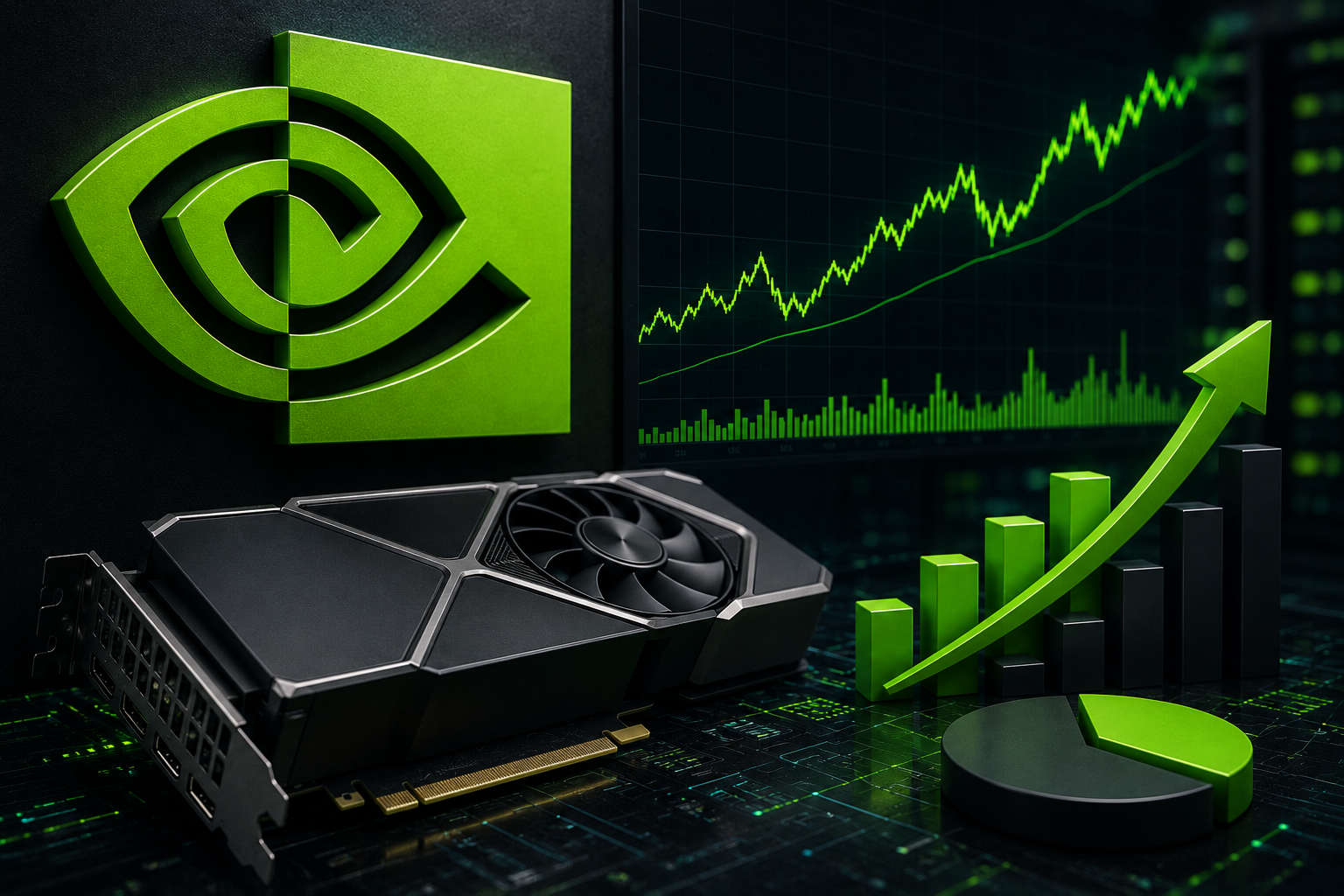
NVIDIA is the chip designer at the center of the artificial intelligence buildout, supplying the graphics processing units that train and run most of the world’s large AI models. NVIDIA trades on the Nasdaq under the ticker NVDA, with a market capitalization near 4.7 trillion dollars in mid 2026, making it one of the most valuable companies in the world.
Founded in 1993 by Jensen Huang, Chris Malachowsky, and Curtis Priem.
Jensen Huang remains founder and CEO more than three decades later.
Fiscal year 2026 revenue reached a record 215.9 billion dollars, up 65 percent year over year.
Data Center is now the company’s dominant segment, making up roughly 90 percent of total revenue.
NVIDIA raised its quarterly dividend twenty five times over, from 0.01 dollars to 0.25 dollars per share, in May 2026.
The stock carries a Strong Buy leaning analyst consensus, though a growing number of prominent investors have flagged AI bubble concerns.
Semiconductors, AI infrastructure, accelerated computing
Business Segments
Compute and Networking, Graphics (reported publicly as Data Center, Gaming, Professional Visualization, Automotive, OEM and Other)
FY2026 Revenue
215.9 billion dollars
FY2026 Diluted EPS (GAAP)
4.90 dollars
Market Capitalization
Approximately 4.6 to 4.8 trillion dollars (mid 2026)
Dividend
0.25 dollars per share, paid quarterly, raised from 0.01 dollars in May 2026
Website
nvidia.com
What Is NVIDIA?
NVIDIA designs the graphics processing units, or GPUs, that power modern artificial intelligence. What began as a company focused on making video games look better has become the primary supplier of the chips, networking gear, and software used to train and run large language models, image generators, and other AI systems used by nearly every major technology company.
NVIDIA does not manufacture its own chips. Instead it designs them and relies on foundry partners, most notably Taiwan Semiconductor Manufacturing Company, to produce the silicon. Its real advantage comes from CUDA, a software platform built over nearly two decades that makes NVIDIA GPUs the default choice for AI researchers and enterprises, creating a deep ecosystem that competitors have struggled to replicate.
Because so much of the AI industry, from cloud providers to startups to national governments, depends on NVIDIA hardware, the company’s quarterly results are watched almost as closely as broader economic data for signs of AI spending strength or weakness.
Company History
NVIDIA has moved through several distinct eras: gaming graphics pioneer, mobile and workstation chip maker, and finally the central supplier to the AI industry.
Key milestones
1993: Jensen Huang, Chris Malachowsky, and Curtis Priem found NVIDIA in Sunnyvale, California, aiming to accelerate graphics for gaming and multimedia.
1999: NVIDIA goes public on Nasdaq and launches the GeForce 256, which the company marketed as the world’s first GPU.
2006: NVIDIA introduces CUDA, a programming platform that lets developers use GPUs for general purpose computing, laying the groundwork for its future in AI.
2012: Researchers use NVIDIA GPUs to train AlexNet, a breakthrough deep learning model, sparking the modern AI boom and a surge in demand for GPU accelerated computing.
2020 to 2022: Data center revenue grows rapidly as cloud providers race to build AI infrastructure, and NVIDIA acquires networking company Mellanox to strengthen its data center offering.
2023: NVIDIA becomes the first chipmaker to reach a 1 trillion dollar market capitalization, driven by explosive demand for its H100 AI chips following the launch of ChatGPT.
2024: NVIDIA completes a ten for one stock split and briefly becomes the most valuable public company in the world as its market cap surges past several trillion dollar milestones in rapid succession.
2025 to 2026: The Blackwell chip platform ramps to full volume, full year revenue tops 215 billion dollars, and NVIDIA sharply raises its dividend while continuing to navigate export restrictions on AI chip sales to China.
Founders
Jensen Huang
Co-founder and CEO since the company’s inception in 1993. Huang previously worked as a chip designer at LSI Logic and AMD before starting NVIDIA, and he remains one of the longest serving CEOs in the technology industry.
Chris Malachowsky
Co-founder and engineer who helped shape NVIDIA’s early graphics chip designs. Malachowsky has continued in senior technical and fellow roles within the company for decades.
Curtis Priem
Co-founder who contributed foundational graphics architecture work in NVIDIA’s early years. Priem later stepped back from day to day operations but remains associated with the company’s founding story.
CEO
Jensen Huang has led NVIDIA as founder and CEO since 1993, an unusually long tenure that has spanned the PC graphics era, the mobile chip era, and now the AI infrastructure era. Huang is known for popularizing the term GPU and for reorienting the company’s entire strategy around accelerated computing and artificial intelligence well before most of the industry recognized the opportunity.
On recent earnings calls, Huang has described the current moment as the beginning of an industrial revolution built on AI factories, positioning NVIDIA’s chips, networking, and software as the foundational layer for a wave of enterprise and sovereign AI spending that he expects to continue for years.
Headquarters
NVIDIA is headquartered in Santa Clara, California, at a campus that includes its distinctive triangular Endeavor and Voyager buildings. The company operates major engineering and business hubs across the United States, Taiwan, Israel, India, and other locations, and depends heavily on manufacturing partners such as TSMC in Taiwan to produce its chips.
Business Segments
NVIDIA reports two formal segments in its financial statements, Compute and Networking and Graphics, but breaks out results publicly across five platform categories.
Data Center
NVIDIA’s largest and fastest growing business, covering AI training and inference GPUs, networking gear, and software. It generated 193.74 billion dollars in fiscal year 2026, roughly 90 percent of total company revenue.
Gaming
GeForce graphics cards for PC gaming and creative work, plus the GeForce NOW cloud gaming service. Full year revenue rose 41 percent to a record 16.0 billion dollars in fiscal 2026.
Professional Visualization
RTX workstation GPUs and Omniverse software used for design, engineering, and industrial simulation. This was NVIDIA’s fastest growing smaller segment in fiscal 2026, up nearly 70 percent to 3.19 billion dollars.
Automotive
The NVIDIA DRIVE platform for autonomous and electric vehicle software and hardware. Revenue reached 2.35 billion dollars in fiscal 2026.
OEM and Other
A small, miscellaneous category covering legacy and other hardware sales, contributing about 619 million dollars in fiscal 2026.
Products and Services
Data center GPUs: The Blackwell platform, including the GB200 NVL and B200 chips, now ramping to full production, alongside the prior generation Hopper H100 and H200 chips.
Next generation architecture: Vera Rubin rack scale AI systems, unveiled at Computex 2026 and moving into full production.
Gaming GPUs: GeForce RTX graphics cards, DLSS AI upscaling technology, and the GeForce NOW cloud streaming service.
Networking: Quantum InfiniBand and Spectrum-X Ethernet platforms that connect thousands of GPUs into large scale AI clusters.
Software and platforms: CUDA, NVIDIA AI Enterprise, NIM microservices, Nemotron open models, and DGX Cloud.
Omniverse: A simulation and 3D collaboration platform used for industrial digital twins and robotics development.
Automotive: NVIDIA DRIVE hardware and software for autonomous and electric vehicle platforms.
Edge and robotics: Jetson embedded computing modules used in robotics, drones, and other edge AI devices.
Consumer and creator hardware: The newly announced RTX Spark, combining a Blackwell GPU with an N1X or N1 processor for AI enabled PCs.
Revenue Breakdown
The chart below shows NVIDIA’s revenue by platform for fiscal year 2026, the most recently completed full year. Data Center dwarfs every other category, reflecting how thoroughly the AI buildout has reshaped the company.
NVIDIA Revenue by Segment, Fiscal Year 2026
Figures in billions of US dollars, fiscal year ended January 25, 2026
Source: NVIDIA fourth quarter and fiscal 2026 earnings release, reported February 2026.
Data Center revenue of 193.74 billion dollars accounted for roughly 90 percent of NVIDIA’s total business in fiscal 2026, up from about 88 percent the year before, underscoring how completely AI infrastructure spending now drives the company’s growth. Gaming remains a meaningful but comparatively small business at 16.0 billion dollars, while Professional Visualization, Automotive, and OEM and Other together made up less than 3 percent of total revenue.
Financial Performance
NVIDIA’s revenue has grown at an extraordinary pace since the AI boom accelerated in 2023, roughly quadrupling over three fiscal years.
NVIDIA Annual Revenue, Fiscal Years 2023 to 2026
Figures in billions of US dollars
Source: NVIDIA annual reports and SEC filings. Fiscal years end in late January.
Fiscal year 2026 highlights
Record full year revenue of 215.9 billion dollars, up 65 percent from fiscal 2025.
GAAP gross margin of 71.1 percent and non-GAAP gross margin of 71.3 percent for the year.
GAAP diluted earnings per share of 4.90 dollars and non-GAAP diluted earnings per share of 4.77 dollars.
Fourth quarter revenue alone reached 68.1 billion dollars, up 73 percent year over year, with Data Center revenue of 62.3 billion dollars.
NVIDIA returned 41.1 billion dollars to shareholders during the year through buybacks and dividends.
First quarter fiscal 2027 highlights
Record quarterly revenue of 81.6 billion dollars, up 85 percent year over year and 20 percent from the prior quarter.
Record Data Center revenue of 75.2 billion dollars, up 92 percent year over year.
GAAP and non-GAAP gross margins of 74.9 percent and 75.0 percent, both improving from the prior quarter.
GAAP diluted earnings per share of 2.39 dollars and non-GAAP diluted earnings per share of 1.87 dollars.
Announced an additional 80 billion dollar share repurchase authorization and a twenty five fold increase to the quarterly dividend.
Guided second quarter fiscal 2027 revenue to approximately 91.0 billion dollars, while noting the outlook assumes no Data Center compute revenue from China.
Metric
Q1 FY2027
Q1 FY2026
Change
Total revenue
81.6B
44.1B
+85%
Data Center revenue
75.2B
39.1B
+92%
GAAP gross margin
74.9%
60.5%
Higher
GAAP diluted EPS
2.39
0.81
Higher
Non-GAAP diluted EPS
1.87
0.78
+140%
Quarterly dividend
0.25
0.01
25x
Stock Information
NVIDIA trades under the single ticker NVDA on the Nasdaq and is one of the largest companies in the world by market capitalization, alongside Apple, Microsoft, and Alphabet. The stock has split six times since its 1999 IPO, most recently a ten for one split in June 2024, which brought shares within reach of a broader base of retail investors.
NVDA 52 Week Trading Range
Approximate price levels in US dollars
Source: market data compiled early July 2026. Verify against a live quote before trading.
Exchange
Nasdaq
Recent Price
Approximately 194 to 200 dollars
Market Cap
Approximately 4.6 to 4.8 trillion dollars
52 Week Range
152.97 to 236.54 dollars
All Time High Close
235.47 dollars, set May 14, 2026
Trailing P/E Ratio
Approximately 29.8x
EPS (TTM)
Approximately 6.53 dollars
Dividend Yield
Approximately 0.5 percent, based on the new 0.25 dollar quarterly rate
Next Earnings Date
Expected in late August 2026, for the second quarter of fiscal 2027
This is general market information, not personalized investment advice. NVDA has been prone to sharp moves around AI infrastructure news, export policy changes, and hyperscaler capital spending updates. Always confirm current figures with a live broker feed or NVIDIA’s investor relations site before making financial decisions.
Dividends
NVIDIA has paid a dividend for more than a decade, but for most of that period the payout was a token gesture relative to the company’s soaring profits. That changed in May 2026, when NVIDIA raised its quarterly dividend twenty five fold, from 0.01 dollars to 0.25 dollars per share, alongside an 80 billion dollar increase to its share buyback authorization.
Current quarterly dividend: 0.25 dollars per share, paid starting June 26, 2026.
Payout ratio: Still low, at roughly 0.6 percent of earnings, leaving substantial room for future increases.
Capital return strategy: Management has indicated a goal of returning roughly half of free cash flow to shareholders over time through a combination of buybacks and dividends, while continuing heavy investment in AI infrastructure.
Even after the increase, NVIDIA remains primarily viewed as a growth stock rather than an income investment, since the dividend yield remains modest relative to the company’s earnings power.
Competitors
AI accelerators
AMD’s Instinct MI series GPUs are NVIDIA’s most direct merchant silicon competitor in AI training and inference hardware.
Custom hyperscaler chips
Google’s TPU, Amazon’s Trainium and Inferentia, and Microsoft’s Maia represent growing in house alternatives that reduce some hyperscaler reliance on NVIDIA GPUs.
Legacy chip makers
Intel continues to develop its own AI accelerators and competes with NVIDIA in data center and PC graphics silicon, though it trails significantly in AI market share.
Networking and ASICs
Broadcom and Marvell Technology supply custom AI networking chips and application specific silicon that compete with parts of NVIDIA’s data center platform.
China market
Huawei’s Ascend chips are the leading domestic alternative to NVIDIA in China, a market where US export restrictions have limited NVIDIA’s ability to sell its most advanced chips.
Gaming graphics
AMD Radeon and, to a lesser extent, Intel Arc compete with GeForce in the consumer graphics card market, though NVIDIA holds a dominant share.
Recent News
Capital returnsNVIDIA raised its quarterly dividend from 0.01 dollars to 0.25 dollars per share and authorized an additional 80 billion dollars in share buybacks alongside record first quarter fiscal 2027 results.
EarningsFirst quarter fiscal 2027 revenue hit a record 81.6 billion dollars, up 85 percent year over year, with Data Center revenue up 92 percent, though the outlook excludes any Data Center compute revenue from China.
MarketsInvestor Michael Burry disclosed bearish positions against NVIDIA, Tesla, and Caterpillar, warning of what he described as AI bubble risk, adding to a broader debate about AI infrastructure spending sustainability.
GovernanceNVIDIA shareholders backed the board’s proposed governance changes at the company’s annual meeting in late June 2026.
ProductAt Computex 2026, NVIDIA said its Vera Rubin rack scale AI systems are ramping into full production and unveiled the RTX Spark, a combined Blackwell GPU and CPU chip aimed at AI enabled personal computers.
PartnershipsNVIDIA expanded its strategic collaboration with Palantir Technologies to run NVIDIA AI and Nemotron open models in sovereign and government environments.
CommentaryAMD shares rallied after NVIDIA CEO Jensen Huang suggested networking and custom silicon partner Marvell Technology could become the next trillion dollar chip stock, highlighting the broadening AI infrastructure supply chain.
Frequently Asked Questions
What does NVIDIA actually make?
NVIDIA designs GPUs and related networking hardware, along with the CUDA software platform that lets developers run AI and other high performance workloads on that hardware. It does not manufacture its own chips, relying instead on foundry partners such as TSMC.
Why is NVIDIA’s Data Center segment so much larger than Gaming?
Cloud providers and enterprises are spending enormous sums building AI infrastructure, and the majority of that spending flows to NVIDIA GPUs and networking gear. Data Center revenue reached 193.74 billion dollars in fiscal 2026, compared with 16.0 billion dollars for Gaming.
Does NVIDIA pay a dividend?
Yes. NVIDIA has paid a dividend for years, but it was largely symbolic until May 2026, when the company raised its quarterly payout twenty five fold to 0.25 dollars per share. The yield remains modest since NVIDIA’s earnings and stock price have both grown so quickly.
Who founded NVIDIA?
NVIDIA was founded in 1993 by Jensen Huang, Chris Malachowsky, and Curtis Priem. Huang remains the company’s CEO more than three decades later, an unusually long tenure for a major technology company.
Why did NVIDIA stock split?
NVIDIA has split its stock six times since going public in 1999, most recently a ten for one split completed in June 2024. Splits lower the per share price without changing the company’s total value, generally making shares more accessible to individual investors.
Is NVIDIA affected by export restrictions to China?
Yes. US government export controls have limited NVIDIA’s ability to sell its most advanced AI chips into China. Management has said its recent revenue outlooks assume no Data Center compute revenue from China, reflecting the ongoing impact of these restrictions.
What is an AI bubble concern, and does it apply to NVIDIA?
Some investors worry that AI infrastructure spending by cloud providers and enterprises could slow or prove less profitable than expected, which would hit NVIDIA hard given how concentrated its revenue is in Data Center sales. Prominent investors including Michael Burry have publicly taken bearish positions on this basis, while many analysts remain bullish on continued AI spending growth.
How big is NVIDIA compared to other major companies?
NVIDIA is one of the most valuable public companies in the world, with a market capitalization near 4.7 trillion dollars in mid 2026, placing it alongside Apple, Microsoft, and Alphabet at the top of global rankings by market value.
Is NVIDIA stock a good buy?
That depends on individual goals, time horizon, and risk tolerance. NVIDIA carries a generally bullish analyst consensus tied to continued AI infrastructure demand, but the stock is also concentrated in a single fast moving industry and has drawn public skepticism from some well known investors. This is not personalized investment advice, and anyone considering NVIDIA stock should review current financial statements and consult a licensed financial advisor.
This article is for informational and educational purposes only and does not constitute financial, investment, or legal advice. Figures are sourced from NVIDIA’s public filings, earnings releases, and reputable financial news outlets as of early July 2026, and are subject to change. Always verify current data before making investment decisions.