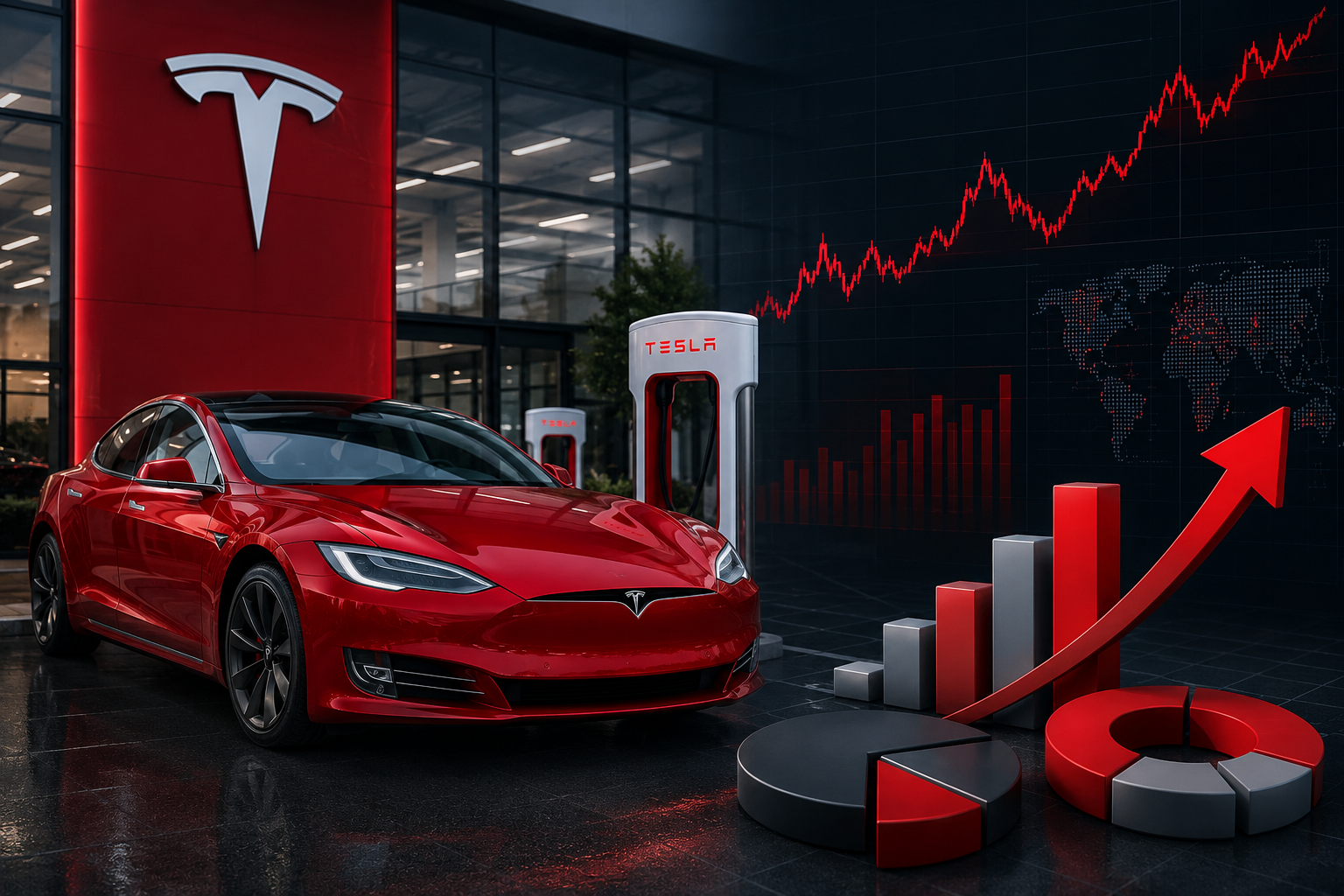
Tesla, Inc. is the world’s most valuable automaker by market capitalization and the leading pure play electric vehicle manufacturer, now expanding aggressively into robotaxis, humanoid robots, and AI compute. Tesla trades on the Nasdaq under the ticker TSLA, with a market capitalization near 1.5 trillion dollars in mid 2026.
Founded in 2003 by Martin Eberhard and Marc Tarpenning; Elon Musk joined as chairman in 2004 and became CEO in 2008.
Headquarters: Austin, Texas, at the Gigafactory Texas campus.
Full year 2025 revenue came in at 94.83 billion dollars, the company’s first annual revenue decline.
Second quarter 2026 deliveries hit a record 480,126 vehicles, up 25 percent year over year.
Tesla pays no dividend and reinvests cash into factories, batteries, robotaxis, and AI infrastructure.
The stock remains one of the most volatile large cap names on the market, swinging on delivery numbers, margin trends, and Elon Musk headlines.
Electric vehicles, energy storage, solar, robotics, artificial intelligence
Business Segments
Automotive, Energy Generation and Storage, Services and Other
FY2025 Revenue
94.83 billion dollars
FY2025 Net Income
3.79 billion dollars
Market Capitalization
Approximately 1.4 to 1.5 trillion dollars (mid 2026)
Dividend
None; Tesla has never paid a dividend
Website
tesla.com
What Is Tesla?
Tesla designs, builds, and sells fully electric vehicles alongside a growing lineup of energy products, including home batteries, utility scale storage, and solar systems. The company is widely credited with pushing the entire auto industry toward electrification, turning what was once a niche category into a mainstream product line dominated by the Model 3 and Model Y.
In recent years Tesla has reframed itself as more than a car company. Elon Musk now talks about Tesla primarily in terms of autonomy and robotics: the Full Self Driving software stack, the Robotaxi ride hailing service, the Optimus humanoid robot, and the AI compute needed to train and run all of it. Investors are increasingly asked to value Tesla not just on vehicle deliveries but on the future potential of self driving fleets and robotics, which helps explain why the stock trades at a far higher earnings multiple than traditional automakers.
Company History
Tesla was named after inventor Nikola Tesla and set out from day one to prove that electric cars could be genuinely desirable rather than a compromise.
Key milestones
2003: Martin Eberhard and Marc Tarpenning incorporate Tesla Motors in San Carlos, California.
2004: Elon Musk leads a 6.5 million dollar Series A funding round and joins as chairman of the board.
2008: Tesla delivers the Roadster, its first vehicle, and Musk becomes CEO during a period of severe financial strain for the company.
2010: Tesla goes public on Nasdaq, raising roughly 226 million dollars in its IPO.
2012: The Model S sedan launches, establishing Tesla as a serious luxury and technology competitor.
2015 to 2017: Tesla launches the Model X SUV and then the Model 3, its first mass market vehicle, alongside rapid Supercharger network expansion.
2020: Tesla joins the S&P 500 after several consecutive profitable quarters and its market value soars.
2021: Tesla relocates its headquarters from Palo Alto, California, to Austin, Texas.
2023 to 2024: Cybertruck deliveries begin, and Tesla shifts significant investment toward Full Self Driving, Robotaxi, and the Optimus robot program.
2025 to 2026: Tesla posts its first annual revenue decline, launches paid Robotaxi service in Austin and additional cities, winds down Model S and Model X production, and prepares Cybercab and Tesla Semi for volume production.
Founders
Martin Eberhard
Co-founder of Tesla Motors and its first CEO. Eberhard helped set the original engineering vision for a high performance electric sports car and later left the company amid disputes with the board in 2007.
Marc Tarpenning
Co-founder alongside Eberhard, contributing early software and business development work. Tarpenning also departed Tesla’s day to day operations in the years following the company’s early funding rounds.
Elon Musk
Joined in 2004 as the lead investor and chairman, then took over as CEO in 2008. Although not a founding member of the original team, Musk has been the company’s public face and controlling strategic voice for nearly two decades, and Tesla legally recognizes him alongside Eberhard, Tarpenning, JB Straubel, and Ian Wright as a co-founder.
CEO
Elon Musk has served as Tesla’s CEO since 2008, guiding the company from near bankruptcy through its rise into the world’s most valuable automaker. Musk also leads SpaceX, xAI, and other ventures, which has periodically raised investor questions about the amount of time he devotes to Tesla.
Musk’s current strategy centers on autonomy and robotics. On recent earnings calls he has directed investor attention away from near term vehicle delivery numbers and toward Robotaxi expansion, Full Self Driving progress, and the Optimus humanoid robot program, describing them as the primary long term drivers of Tesla’s value.
Headquarters
Tesla is headquartered at Gigafactory Texas in Austin, Texas, following a relocation from Palo Alto, California, that was completed in December 2021. The company operates additional major manufacturing sites at the original Fremont, California factory, Gigafactory Nevada, Gigafactory Shanghai, Gigafactory Berlin-Brandenburg in Germany, and a growing set of facilities dedicated to battery production, AI compute, and chip fabrication.
Business Segments
Tesla reports results across two primary segments, with a services category tracked alongside them in financial disclosures.
Automotive
Design, manufacturing, and sales of electric vehicles, plus sales of regulatory credits to other automakers. This remains the core of Tesla’s business, generating 16.23 billion dollars in the first quarter of 2026.
Energy Generation and Storage
Powerwall home batteries, Megapack utility scale storage, and solar products. Revenue was 2.41 billion dollars in the first quarter of 2026, down 12 percent year over year as large scale deployments slowed.
Services and Other
Vehicle service, used vehicle sales, Supercharging, insurance, and Full Self Driving subscriptions. This segment grew 42 percent year over year in the first quarter of 2026, the fastest growth rate of any part of the business.
Products and Services
Vehicles: Model 3, Model Y, Cybertruck. Model S and Model X production has been wound down as Tesla narrows its consumer lineup.
Upcoming vehicles: Cybercab, a purpose built robotaxi without a steering wheel, and the Tesla Semi, both targeting volume production in 2026.
Autonomy software: Full Self Driving (Supervised), with more than 1.28 million active subscribers and packages sold, and ongoing work toward unsupervised, fully autonomous driving.
Robotaxi: A paid ride hailing service currently operating in Austin and expanding to additional US cities, competing directly with Alphabet’s Waymo.
Robotics: Optimus, Tesla’s humanoid robot program, positioned by Musk as a major future revenue driver.
Energy products: Powerwall, Megapack, Solar Roof and Solar Panels, sold to residential, commercial, and utility customers.
Infrastructure: The Tesla Supercharger network, now opened in part to other automakers’ vehicles under the North American Charging Standard.
AI and compute: Custom inference chips including the AI5 processor, and large scale AI training infrastructure supporting Robotaxi and Optimus.
Revenue Breakdown
The chart below shows Tesla’s revenue by segment for the first quarter of 2026, the most recent quarter reported. Automotive sales remain dominant, though services and software are growing far faster than the core vehicle business.
Tesla Revenue by Segment, Q1 2026
Figures in billions of US dollars
Source: Tesla Q1 2026 shareholder update, reported April 2026.
Automotive revenue reached 16.23 billion dollars for the quarter, up 16 percent year over year, helped by higher average selling prices and lower per unit costs. Services and other revenue climbed 42 percent to 3.75 billion dollars, driven by Supercharging, used vehicle sales, and Full Self Driving subscription growth. Energy generation and storage revenue fell 12 percent to 2.41 billion dollars as large scale Megapack deployments slowed compared with the prior year quarter.
Financial Performance
Tesla’s annual revenue grew rapidly through 2023 before flattening and then declining in 2025, the company’s first ever full year revenue drop.
Tesla Annual Revenue, 2021 to 2025
Figures in billions of US dollars
Source: Tesla annual reports and SEC filings.
Fiscal year 2025 highlights
Full year revenue of approximately 94.83 billion dollars, down about 3 percent from 97.69 billion dollars in 2024, marking Tesla’s first ever annual revenue decline.
Full year net income of approximately 3.79 billion dollars, down about 47 percent from 7.09 billion dollars in 2024.
Fourth quarter 2025 net income fell 61 percent year over year as automotive revenue slid 11 percent.
First quarter 2026 highlights
Total revenue of 22.39 billion dollars, up 16 percent year over year, though slightly below the roughly 22.6 billion dollar analyst consensus.
GAAP gross margin expanded sharply to 21.1 percent, up from 16.3 percent a year earlier, helped in part by one time warranty and tariff related benefits.
GAAP net income of 477 million dollars, up 17 percent year over year; non-GAAP net income of 1.45 billion dollars.
Non-GAAP earnings per share of 0.41 dollars, beating the 0.34 dollar consensus estimate by roughly 21 percent.
Free cash flow of 1.44 billion dollars, well above expectations for a negative figure.
Management guided to roughly 5 billion dollars in additional 2026 spending above prior guidance, tied to Robotaxi, Optimus, and AI infrastructure buildout.
Metric
Q1 2026
Q1 2025
Change
Total revenue
22.39B
19.34B
+16%
Automotive revenue
16.23B
13.97B
+16%
Energy revenue
2.41B
2.73B
-12%
Services and other revenue
3.75B
2.64B
+42%
GAAP gross margin
21.1%
16.3%
+478 bps
GAAP net income
477M
409M
+17%
Stock Information
Tesla trades under the single ticker TSLA on the Nasdaq and remains one of the most actively traded and most volatile large cap stocks in the market, with daily price swings that regularly outpace those of other members of the so called Magnificent Seven group of technology companies.
TSLA 52 Week Trading Range
Approximate price levels in US dollars
Source: market data compiled early July 2026. Verify against a live quote before trading.
Exchange
Nasdaq
Recent Price
Approximately 390 to 420 dollars, highly variable
Market Cap
Approximately 1.4 to 1.5 trillion dollars
52 Week Range
288.77 to 498.83 dollars
Trailing P/E Ratio
Very high, often 200x or more, reflecting growth expectations beyond current earnings
Average Daily Volume
Roughly 49 million shares, with much higher volume around earnings and delivery reports
Dividend Yield
None
Next Earnings Date
Expected mid to late July 2026, following the second quarter delivery report
This is general market information, not personalized investment advice. Tesla stock is known for large, rapid price swings around delivery numbers, earnings, and comments from Elon Musk. Always confirm current figures with a live broker feed or Tesla’s investor relations site before making financial decisions.
Dividends
Tesla has never declared or paid a cash dividend on its common stock. The company has consistently reinvested cash flow into Gigafactory construction, battery production, Robotaxi expansion, Optimus development, and AI compute rather than returning capital to shareholders.
Current dividend: None.
Capital return approach: Reinvestment in growth, with occasional share repurchase discussion but no established buyback program on the scale of mature technology peers.
Outlook: A dividend is not considered likely in the near term given the scale of planned spending on Robotaxi, Optimus, and AI infrastructure.
Competitors
Electric vehicles
BYD, Rivian, Lucid Group, and traditional automakers including Ford, General Motors, Volkswagen, and Hyundai-Kia, all of which now offer competing EV lineups.
China market
BYD, NIO, and Xpeng compete intensely with Tesla in China, often on price, and BYD has at times outsold Tesla globally on total EV volume.
Autonomous ride hailing
Alphabet’s Waymo is Tesla’s most direct Robotaxi competitor, with both companies now operating paid autonomous or supervised rides in overlapping US markets, including Florida.
Energy storage
Fluence, LG Energy Solution, and other battery and storage providers compete with Tesla’s Megapack and Powerwall product lines.
Autonomous driving software
Waymo, Mobileye, and a range of advanced driver assistance systems from legacy automakers compete with Tesla’s Full Self Driving stack.
Robotics
Figure AI, Boston Dynamics, and other humanoid robot developers are emerging competitors to Tesla’s Optimus program, though the category is still in its early commercial stages.
Recent News
DeliveriesTesla reported record second quarter 2026 deliveries of 480,126 vehicles, up 25 percent year over year, yet shares fell roughly 7 to 8 percent on the news amid renewed concerns about margins and pricing.
RobotaxiTesla expanded its Robotaxi service into Florida, setting up a more direct contest with Alphabet’s Waymo, which already operates a large autonomous fleet in multiple US cities.
ProductTesla confirmed it is winding down Model S and Model X production entirely while preparing Cybercab and the Tesla Semi for planned volume production later in 2026.
EarningsFirst quarter 2026 results beat non-GAAP earnings expectations and showed a sharp gross margin rebound to 21.1 percent, though revenue came in slightly below consensus and management raised full year spending guidance by about 5 billion dollars.
MarketsHigh profile investor Michael Burry has disclosed a bearish position against Tesla shares, adding to a running debate between bulls focused on Robotaxi and Optimus potential and skeptics focused on current automotive fundamentals.
SoftwareTesla rolled out a Spring software update across its fleet, adding a redesigned Full Self Driving app, a voice activated assistant feature, and updated driver assistance tools, with FSD package subscribers and owners reaching about 1.28 million.
AI infrastructureTesla said it completed the final chip design for its next generation AI5 inference processor and is expanding into semiconductor fabrication to secure chip supply for Robotaxi and Optimus production.
Frequently Asked Questions
What does Tesla actually make money from?
Most of Tesla’s revenue still comes from selling electric vehicles, primarily the Model 3 and Model Y. A smaller but fast growing share comes from services such as Supercharging, used car sales, and Full Self Driving subscriptions, plus energy products like Powerwall and Megapack.
Who founded Tesla?
Tesla was founded in 2003 by Martin Eberhard and Marc Tarpenning. Elon Musk joined in 2004 as the lead investor and chairman and became CEO in 2008. Tesla recognizes Musk, JB Straubel, and Ian Wright alongside Eberhard and Tarpenning as co-founders.
Does Tesla pay a dividend?
No. Tesla has never paid a cash dividend and instead reinvests its cash flow into factories, batteries, Robotaxi expansion, and AI and robotics development.
Why did Tesla’s stock fall after a record delivery quarter?
Investors often react to more than the headline delivery number. Analysts pointed to concerns about pricing, incentive spending, and margin pressure needed to hit the record volume, which weighed on shares even though the delivery figure itself beat expectations.
Is Tesla profitable?
Yes, but profitability has declined. Tesla posted net income of about 3.79 billion dollars for full year 2025, down roughly 47 percent from 2024, as price cuts and competition pressured automotive margins. Margins improved again in the first quarter of 2026.
What is Tesla Robotaxi?
Robotaxi is Tesla’s autonomous ride hailing service, currently operating in Austin and expanding to additional US cities including parts of Florida. It competes directly with Alphabet’s Waymo, which has a larger operating footprint today.
What is Optimus?
Optimus is Tesla’s humanoid robot program. Elon Musk has described it as a potentially significant long term revenue driver for the company, though it remains an early stage program without meaningful reported revenue yet.
Why is Tesla’s stock price so volatile?
Tesla trades at a much higher earnings multiple than traditional automakers because investors are pricing in future Robotaxi, Optimus, and AI compute revenue rather than just current vehicle sales. That growth premium tends to produce larger price swings around delivery reports, earnings calls, and comments from Elon Musk.
Is Tesla stock a good buy?
That depends on individual goals, time horizon, and risk tolerance. Tesla is widely followed by both bulls who focus on Robotaxi and Optimus potential and skeptics who focus on current automotive fundamentals. This is not personalized investment advice, and anyone considering Tesla stock should review current financial statements and consult a licensed financial advisor.
This article is for informational and educational purposes only and does not constitute financial, investment, or legal advice. Figures are sourced from Tesla’s public filings, earnings releases, and reputable financial news outlets as of early July 2026, and are subject to change. Always verify current data before making investment decisions.