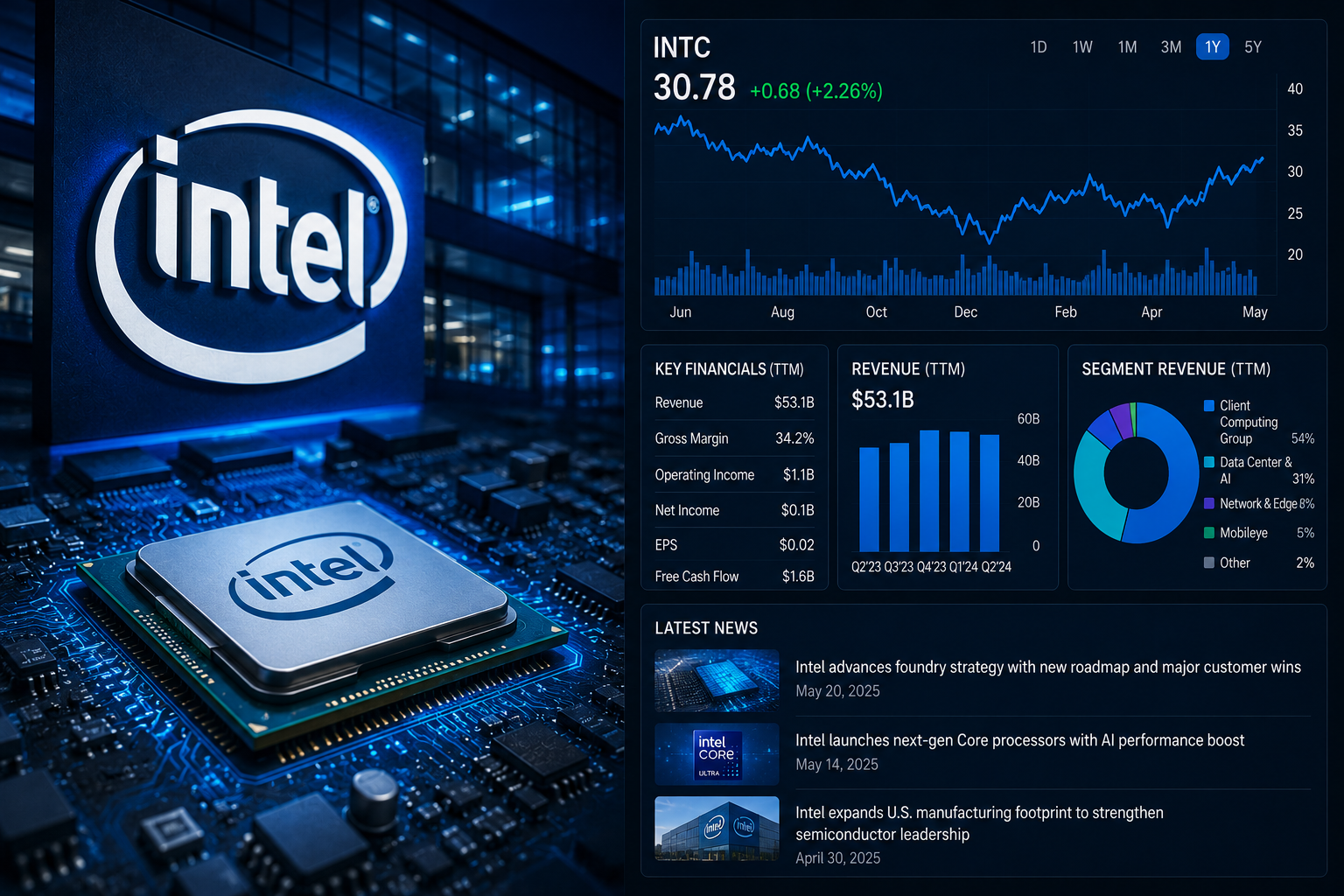
Quick summary: Intel Corporation is one of the oldest and most influential semiconductor companies in the world, founded in 1968 by Robert Noyce and Gordon Moore. Trading on the Nasdaq under the ticker INTC, Intel designs and manufactures processors for personal computers and data centers while also operating Intel Foundry, its contract chip manufacturing arm. As of early July 2026 shares trade in the low to mid 100 dollar range, giving the company a market capitalization well above 600 billion dollars, a dramatic recovery from lows near 19 dollars a share in mid 2025. Under CEO Lip-Bu Tan, who took over in March 2025, Intel has pushed through major restructuring, secured billions of dollars in outside investment from the United States government and Nvidia, and is racing to ramp its advanced 18A manufacturing process. This guide covers Intel’s history, founders, leadership, business segments, revenue breakdown, financial performance, stock data, dividend status, competitors, and the latest company news.
Ticker: INTC (Nasdaq). Sector: Semiconductors, Computer Hardware and Chip Manufacturing. Headquarters: Santa Clara, California, USA.
Robert Noyce, Gordon Moore, with early backing from Arthur Rock
Headquarters
Santa Clara, California, United States
CEO
Lip-Bu Tan (since March 2025)
Board chair
Dr. Craig Barratt (effective May 2026), succeeding Frank Yeary
Industry
Semiconductor design and manufacturing
IPO year
1971
Approximate stock price
Around 120 to 135 dollars per share (early July 2026 trading range)
Market capitalization
Roughly 600 to 675 billion dollars
Major recent investors
United States government (about 10 percent stake), Nvidia (5 billion dollars), SoftBank (2 billion dollars)
Trailing twelve month revenue
Approximately 53.8 billion dollars
Figures reflect publicly reported data as of early July 2026. INTC has been unusually volatile over the past year, so always confirm live pricing with your broker before trading.
What Is Intel?
Intel Corporation is an American technology company that designs and manufactures microprocessors, the chips that serve as the central processing brains of personal computers, servers, and a wide range of other devices. For decades Intel was the dominant name in computer processors, popularized by the well known Intel Inside marketing campaign. In recent years the company has repositioned itself around two complementary goals: regaining leadership in chip design for AI era computing, and building out Intel Foundry, a manufacturing business that produces chips for outside customers in addition to Intel’s own products.
Intel’s story over the last several years has been one of a difficult turnaround. After losing ground to rivals in advanced chip manufacturing and facing years of manufacturing delays, the company brought in veteran technology executive Lip-Bu Tan as CEO in 2025 to cut costs, sharpen focus, and accelerate its next generation 18A manufacturing process. That turnaround effort has been supported by unusual and large outside investments, including a direct equity stake taken by the United States federal government and a multi billion dollar investment from rival chipmaker Nvidia.
Company History
Intel was incorporated on July 18, 1968, in Mountain View, California, by Robert Noyce, a physicist and co-inventor of the integrated circuit, and Gordon Moore, a chemist known for articulating Moore’s Law, the observation that the number of transistors on a chip tends to double roughly every two years. Both men had previously co-founded Fairchild Semiconductor, and venture capitalist Arthur Rock helped finance the new venture. The company’s name was derived from the phrase Integrated Electronics.
Intel’s early business centered on computer memory chips, and the company created the world’s first commercially available microprocessor, the Intel 4004, in 1971. The company went public that same year. Intel’s fortunes changed dramatically in the early 1980s when IBM selected Intel’s 8088 processor for its original personal computer, cementing Intel’s position at the center of the PC revolution for decades to come. Under CEO Andy Grove, who took over company leadership in the late 1980s, Intel became one of the most valuable and influential technology companies in the world, dominating both PC and server processor markets for years.
The 2010s and early 2020s brought new challenges, as Intel’s chip manufacturing technology fell behind rivals such as Taiwan Semiconductor Manufacturing Company, while competitors including AMD and Nvidia gained ground in both processors and the fast growing market for AI focused chips. Years of manufacturing delays, executive turnover, and heavy spending on new factories weighed on the company’s finances and stock price, which fell to multi year lows in 2025. The appointment of Lip-Bu Tan as CEO in March 2025 marked a turning point, with the company undertaking large layoffs, spinning out non core assets, and securing major new capital from outside investors to fund its recovery.
Bars are scaled against the 52 week high for visual comparison. Source figures compiled from company filings and market data providers.
Founders
Intel was founded by Robert Noyce and Gordon Moore, two of the most respected engineers in early Silicon Valley history. Noyce, credited as a co-inventor of the integrated circuit, served as Intel’s first chief executive officer from 1968 to 1975. Moore, famous for Moore’s Law, succeeded Noyce as CEO and later became chairman. Andy Grove, who joined the company almost immediately after its founding, became Intel’s third key leader, eventually rising to president in 1979 and adding the CEO title in 1987, a role in which he is widely credited with turning Intel into a dominant global technology company.
Early investor Arthur Rock helped provide the capital and credibility needed to launch the company, and later served as chairman of Intel’s board. The trio of Noyce, Moore, and Grove is often cited as the foundation of Intel’s engineering driven, innovation focused corporate culture.
CEO and Leadership
Lip-Bu Tan has served as Intel’s Chief Executive Officer since March 18, 2025, after being appointed by the company’s board following a period of interim co-leadership. Tan is a veteran technology executive and investor with decades of semiconductor industry experience, having previously led major roles across the chip design software space. Since taking over, Tan has moved quickly to cut costs, reduce headcount, streamline the company’s product portfolio, and pursue new capital partnerships aimed at funding Intel’s expensive manufacturing roadmap.
David Zinsner continues to serve as Executive Vice President and Chief Financial Officer, providing continuity through the leadership transition. In 2026 Intel’s board also announced a change at the top, with independent chair Frank Yeary retiring after leading the board through the CEO search and turnaround period, to be succeeded by Dr. Craig Barratt following the company’s annual shareholder meeting.
Headquarters
Intel is headquartered in Santa Clara, California, in the heart of Silicon Valley, at 2200 Mission College Boulevard. The company has operated from this Northern California base since its founding, and Santa Clara remains closely associated with Intel’s identity as one of the valley’s founding technology companies. Intel also operates major manufacturing and research sites across the United States, including large scale chip fabrication plants in Arizona, Oregon, New Mexico, and Ohio, along with international operations in Ireland, Israel, and other countries.
Business Segments
Intel organizes its business into several reporting segments that reflect its dual identity as both a chip designer and a chip manufacturer.
Client Computing Group (CCG)
This segment covers processors and related products for laptops, desktops, and other personal computing devices, including Intel’s Core and Core Ultra product lines used across the PC industry. AI capable PC processors have become an increasingly important growth driver within this segment.
Data Center and AI (DCAI)
This segment includes Intel’s Xeon server processors and related data center products, which compete directly with rivals for cloud computing, enterprise server, and AI infrastructure workloads. This has recently been Intel’s fastest growing reporting segment.
Intel Foundry
Intel Foundry is the company’s manufacturing arm, producing chips both for Intel’s own product lines and, increasingly, for outside customers under contract. This segment is central to Intel’s long term strategy of competing directly with dedicated contract chip manufacturers, and its performance is closely tied to progress on advanced manufacturing nodes such as Intel 18A and the upcoming Intel 14A.
All Other (including Altera and Mobileye)
This category includes Intel’s stake in Mobileye, a self driving and driving assistance technology company, along with Altera, a programmable chip business that Intel has been repositioning through a partnership with private equity firm Silver Lake.
Products and Services
Core and Core Ultra processors: Intel’s mainstream lineup of central processing units for laptops, desktops, and AI enabled personal computers.
Xeon server processors: Intel’s data center focused CPU lineup, including recent Xeon 6 and Xeon 6+ generations aimed at cloud, enterprise, and AI infrastructure customers.
Intel Foundry manufacturing services: contract chip fabrication for outside customers, including advanced packaging services and access to Intel’s newest process nodes.
Mobileye driving technology: driving assistance and self driving systems used by automakers around the world, offered through Intel’s majority owned Mobileye subsidiary.
Altera programmable chips: field programmable gate array, or FPGA, products used in networking, industrial, and communications applications.
AI infrastructure collaboration products: new joint development efforts with partners such as Nvidia, combining Intel’s x86 processor technology with partner accelerator technology for both data center and PC products.
Revenue Breakdown
Intel’s revenue is generated primarily across its four main reporting segments. In the first quarter of 2026 the company reported total revenue of about 13.6 billion dollars, up roughly 7 percent from the same period a year earlier and well ahead of analyst expectations. Client Computing Group contributed about 7.7 billion dollars in revenue, up modestly year over year. Data Center and AI revenue reached about 5.1 billion dollars, up roughly 22 percent year over year, making it the company’s fastest growing segment, driven by strong demand for Xeon server processors tied to AI infrastructure buildouts. Intel Foundry revenue rose about 16 percent to approximately 5.4 billion dollars, reflecting early progress in the company’s push to attract outside manufacturing customers. The All Other category, which includes Altera and Mobileye, declined by roughly a third year over year to about 628 million dollars.
Q1 2026 Revenue by Segment (approximate, in billions of dollars)
Client Computing
$7.7B
$7.7B
Intel Foundry
$5.4B
$5.4B
Data Center and AI
$5.1B
$5.1B
All Other
$0.6B
$0.63B
Segment figures include intersegment activity for Intel Foundry and are drawn from the company’s Q1 2026 earnings release. Bars are scaled against Client Computing Group revenue for visual comparison.
Financial Performance
Intel’s financial results have shown clear signs of stabilizing in 2026 after a difficult multi year stretch. First quarter 2026 non-GAAP net income attributable to Intel reached about 1.5 billion dollars, a sharp improvement from around 690 million dollars a year earlier, while non-GAAP diluted earnings per share came in at 0.29 dollars, far above analyst estimates near breakeven. On a GAAP basis, however, the company still reported a net loss of roughly 3.7 billion dollars for the quarter, driven mainly by several billion dollars in restructuring charges and a significant goodwill impairment related to Mobileye, along with mark to market losses on escrowed shares tied to earlier corporate transactions.
This divergence between adjusted and GAAP results reflects the scale of Intel’s ongoing transformation. The company has been simultaneously cutting costs, restructuring its workforce, absorbing charges from asset sales and impairments, and investing heavily in new manufacturing capacity, all of which distort year over year comparisons. Management guided second quarter 2026 revenue to a range of about 13.8 billion to 14.8 billion dollars, with non-GAAP gross margin guidance of about 39 percent, and highlighted expectations for continued growth in both the Client Computing and Data Center and AI segments.
Key Financial Metrics (Q1 2026, approximate)
Metric
Approximate Value
Total revenue
$13.6 billion, up 7 percent year over year
Non-GAAP diluted EPS
$0.29 versus consensus near $0.01
GAAP diluted EPS
Loss of approximately $0.73
GAAP net loss attributable to Intel
Approximately $3.7 billion
Non-GAAP operating margin
12.3 percent, up from 5.4 percent a year earlier
Cash and short term investments
Approximately $17.25 billion
Total debt
Approximately $45.03 billion
Q2 2026 revenue guidance
$13.8 billion to $14.8 billion
Stock Information
INTC trades on the Nasdaq exchange. As of early July 2026, shares have traded in a range of roughly 122 dollars to 135 dollars, giving the company a market capitalization between approximately 600 billion and 675 billion dollars depending on the trading session. This marks an extraordinary rebound from the stock’s 52 week low near 18.97 dollars, reached in mid 2025 amid deep investor concern over Intel’s manufacturing setbacks and cash needs, to a 52 week high near 142.35 dollars.
52 Week Trading Range Gauge
Low: $18.97Current: ~$122 to $134High: $142.35
Current price sits near the high end of the 52 week range, reflecting the stock’s sharp recovery following new investment from the US government and Nvidia along with improving earnings. Prices change constantly, so check a live quote before making any decision.
The stock’s remarkable turnaround has been driven by several catalysts layered on top of one another during 2025 and 2026, including the federal government’s roughly 10 percent equity stake, Nvidia’s 5 billion dollar common stock investment, a 2 billion dollar investment from SoftBank, and steadily improving quarterly financial results under CEO Lip-Bu Tan. Even so, Intel’s price to earnings ratio remains negative or unusually high on a trailing basis because of ongoing GAAP losses, meaning many analysts prefer to value the stock using revenue multiples, segment level profitability, and progress on the company’s foundry roadmap rather than traditional earnings multiples.
Selected Analyst and Valuation Snapshots (2026)
Metric or Source
Approximate Figure
Cantor Fitzgerald price target
Raised to $150 from $90
Average analyst target (select estimate)
Around $82, reflecting a wide range of analyst views
Trailing P/E ratio
Negative, reflecting GAAP net losses over the trailing twelve months
Beta (volatility versus market)
Approximately 1.5, indicating higher than average volatility
Analyst targets vary widely and change frequently given the stock’s volatility and the pace of news around Intel’s turnaround. This information is provided for context only and is not a recommendation to buy or sell any security.
Intel’s stock has gone from a cautionary tale about lost manufacturing leadership to one of the most closely watched turnaround stories in the semiconductor industry, fueled by government backing, a landmark Nvidia partnership, and early signs of stabilizing financial performance.
Dividends
Intel does not currently pay a dividend to common shareholders. The company suspended its quarterly dividend in 2024 as part of a broader effort to preserve cash for its capital intensive manufacturing expansion and turnaround plan, ending a dividend payment history that had spanned more than three decades. As of mid 2026 the dividend remains suspended, with management prioritizing debt reduction, factory construction, and research and development spending over returning cash to shareholders.
Investors seeking income today generally look elsewhere in the semiconductor sector, while INTC shareholders are instead betting on capital appreciation tied to the success of Intel’s manufacturing turnaround, its AI related product roadmap, and continued support from strategic investors. Management has not provided a specific timeline for reinstating a dividend, and any decision would likely depend on Intel Foundry reaching sustained profitability and the company’s broader balance sheet improving further.
Competitors
Intel competes across several distinct markets, each with its own set of major rivals.
PC and Server Processor Competitors
AMD, Intel’s longtime rival in both desktop and laptop CPUs as well as data center server processors
Qualcomm, which has pushed into PC processors built on Arm based architecture
Apple, whose custom silicon has reduced Intel’s presence in the Mac lineup
Data Center and AI Accelerator Competitors
Nvidia, the dominant player in AI accelerator chips and now also a strategic investor and product partner of Intel
AMD, which offers competing data center CPUs and AI accelerators
Custom silicon efforts from major cloud providers, which increasingly design their own processors for internal use
Foundry and Manufacturing Competitors
Taiwan Semiconductor Manufacturing Company, the world’s largest dedicated contract chip manufacturer and Intel’s primary benchmark in advanced process technology
Samsung Electronics, which operates its own large scale foundry business alongside its device and memory chip operations
Intel’s position is unusual in the industry because it both designs its own chips and operates its own manufacturing, competing simultaneously with fabless chip designers like Nvidia and AMD and with pure play foundries like Taiwan Semiconductor Manufacturing Company and Samsung.
Recent News
United States government equity stake: in August 2025 Intel confirmed an 8.9 billion dollar investment from the federal government in exchange for roughly a 10 percent common stock stake, funded through previously committed CHIPS Act grants and Secure Enclave program funding, an unusual move aimed at supporting domestic chip manufacturing.
Nvidia partnership and investment: Nvidia agreed in September 2025 to invest 5 billion dollars in Intel common stock at 23.28 dollars per share, closing the purchase of more than 214 million shares in December 2025 after clearing regulatory review. The two companies are jointly developing custom data center and PC chips that combine Intel’s x86 processor technology with Nvidia’s accelerated computing and graphics technology.
SoftBank investment: SoftBank agreed to invest 2 billion dollars in Intel common stock at 23 dollars per share, part of a broader wave of strategic capital that flowed into the company during the second half of 2025.
Leadership transition at the board level: Intel announced in early 2026 that independent board chair Frank Yeary would retire following the May 2026 annual meeting, to be succeeded by Dr. Craig Barratt, continuing the governance changes that began with Lip-Bu Tan’s appointment as CEO.
Strong Q1 2026 earnings and improving guidance: Intel’s first quarter 2026 results beat both revenue and adjusted earnings expectations by a wide margin, with management pointing to accelerating AI linked server CPU demand and continued progress ramping the Intel 18A manufacturing process at its Arizona fab.
Google and other Foundry and Xeon customer commitments: Intel has highlighted new commitments from customers including Google to use multiple generations of Intel Xeon processors for AI workloads, along with continued external interest in Intel Foundry’s advanced packaging capacity from customers across the AI supply chain.
Upcoming earnings date: Intel is expected to report its next quarterly financial results on July 23, 2026, an event likely to be closely watched for updates on 18A production yields, foundry customer wins, and full year guidance.
Frequently Asked Questions
What does Intel actually do?
Intel designs and manufactures semiconductor chips, including processors for personal computers and servers, while also operating Intel Foundry, a manufacturing business that produces chips for both Intel’s own products and outside customers.
Who founded Intel and who runs it today?
Robert Noyce and Gordon Moore founded Intel in 1968, with early financial backing from investor Arthur Rock. Lip-Bu Tan has served as Chief Executive Officer since March 2025.
Does the United States government own part of Intel?
Yes. In August 2025 the federal government took an equity stake of roughly 10 percent in Intel, funded through previously committed CHIPS Act and Secure Enclave program grants, as part of an effort to support domestic semiconductor manufacturing.
Does INTC pay a dividend?
No. Intel suspended its dividend in 2024 to preserve cash for its manufacturing turnaround and has not reinstated it as of mid 2026.
Why did Nvidia invest in Intel?
Nvidia invested 5 billion dollars in Intel common stock as part of a broader partnership to jointly develop custom data center and personal computer chips, combining Intel’s x86 processor technology and manufacturing capacity with Nvidia’s accelerated computing and graphics technology.
Why has INTC stock been so volatile?
Intel’s stock has swung dramatically due to years of manufacturing delays and losses followed by a rapid turnaround under new leadership, large new investments from strategic partners and the government, and continued uncertainty around the pace and profitability of the company’s foundry expansion.
Is Intel profitable?
Intel’s non-GAAP, or adjusted, results turned solidly positive in recent quarters, but the company continues to report GAAP net losses due to large restructuring charges, impairments, and other one time costs tied to its ongoing turnaround and manufacturing investments.
What is Intel Foundry?
Intel Foundry is Intel’s contract chip manufacturing business, which produces semiconductors both for Intel’s own product lines and for outside customers, positioning Intel to compete directly with dedicated foundries such as Taiwan Semiconductor Manufacturing Company and Samsung.
Disclaimer: This article is for informational and educational purposes only and does not constitute financial, investment, tax, or legal advice. Stock prices, financial results, and company developments change frequently and figures presented here reflect publicly available data as of early July 2026. Always verify current figures with official company filings, a licensed financial advisor, or your brokerage before making investment decisions. Investing in stocks involves risk, including the possible loss of principal.