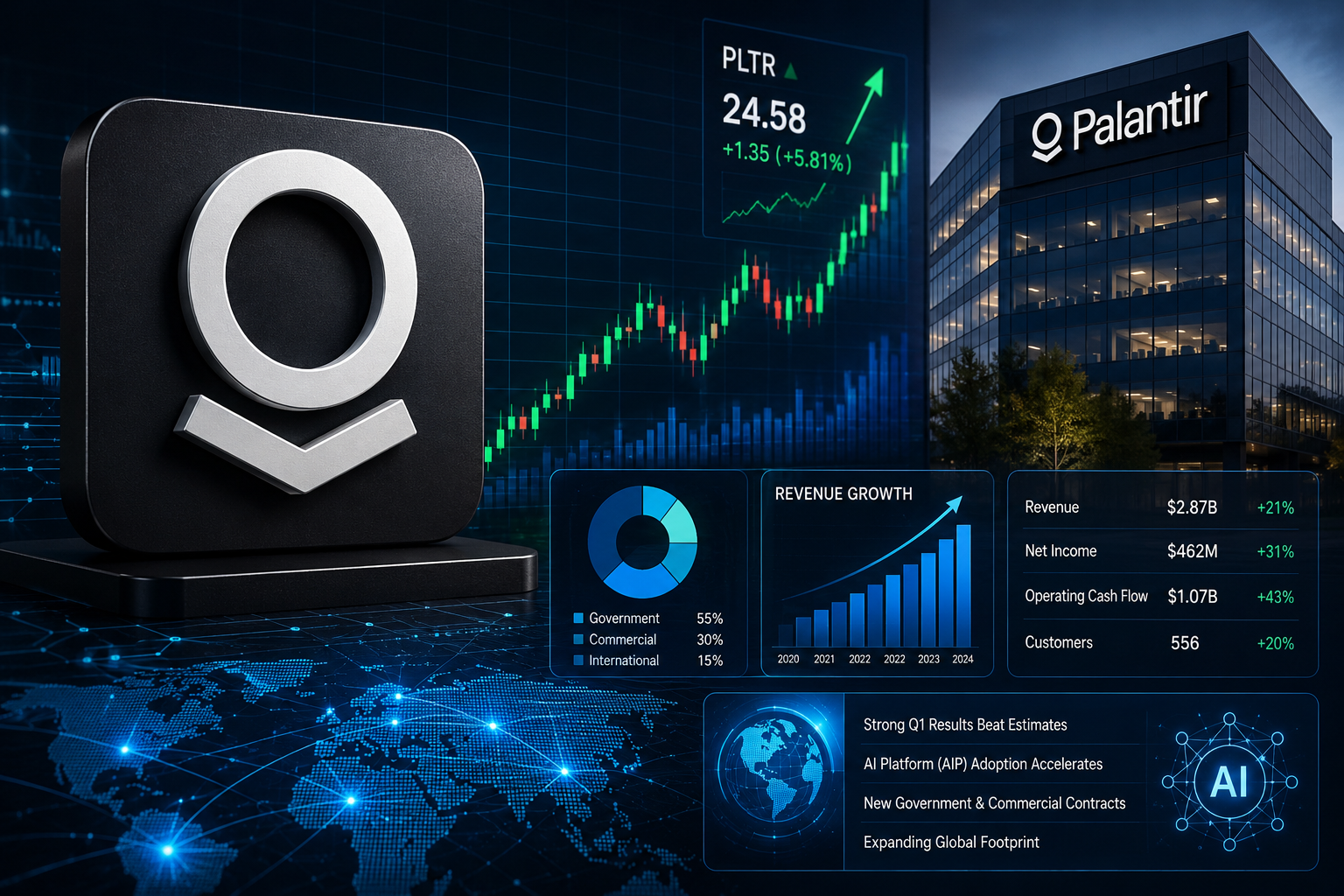
Palantir Technologies Inc. (Nasdaq: PLTR) is a US software company that builds data analysis and artificial intelligence platforms for government agencies and large enterprises. Founded in 2003 by Peter Thiel, Alex Karp, Stephen Cohen, Joe Lonsdale, and Nathan Gettings, Palantir has become one of the most closely watched AI stocks on Wall Street, known for its Gotham, Foundry, Apollo, and AIP platforms and for its deep relationships with the US government and defense community.
In the first quarter of 2026, Palantir posted $1.633 billion in revenue, up an industry leading 85 percent year over year, with GAAP net income of $871 million. For full year 2025, revenue reached $4.48 billion, and management now guides full year 2026 revenue toward roughly $7.65 billion. As of early July 2026, PLTR shares trade around $126 to $130, giving the company a market capitalization of roughly $300 billion, though the stock remains well below its 52 week high near $207.
This guide covers what US investors and researchers need to know about Palantir: its history, founders, leadership, business segments, revenue mix, financial performance, stock profile, dividend policy (or lack of one), competitors, and the latest company news.
Quick Facts
Palantir Technologies, Inc. at a Glance
Legal name
Palantir Technologies Inc.
Ticker symbol
PLTR
Exchange
Nasdaq (moved from the NYSE in November 2024)
Founded
2003
Founders
Peter Thiel, Alex Karp, Stephen Cohen, Joe Lonsdale, Nathan Gettings
CEO
Dr. Alexander C. Karp (Co-Founder and Chief Executive Officer)
Headquarters
Aventura, Florida, USA (relocated from Denver, Colorado in 2026)
Industry
Enterprise software, big data analytics, artificial intelligence platforms
Palantir Technologies is an American software company that builds platforms allowing governments and large organizations to integrate, manage, and act on massive volumes of data. Palantir’s software is used across defense, intelligence, healthcare, manufacturing, energy, and financial services to bring together disparate data sources into a single operational view, often referred to internally as an “ontology,” and to increasingly deploy AI powered agents and automation on top of that data.
Palantir first built its reputation working with US intelligence and defense agencies, helping analysts identify patterns in vast datasets for counterterrorism and national security purposes. Over the past several years, the company has expanded aggressively into commercial industries through its Artificial Intelligence Platform, known as AIP, positioning itself as an operating system for enterprises trying to deploy AI agents in a controlled, auditable way rather than relying purely on third party AI models.
Company History
2003: Palantir Technologies is founded, drawing on early work related to PayPal’s fraud detection systems, with a mission to build software that could identify suspicious patterns in data while protecting civil liberties.
2000s to 2010s: Palantir builds Palantir Gotham for government and intelligence customers and later Palantir Foundry for commercial enterprises, growing largely as a private company backed by venture capital, including early funding tied to In-Q-Tel, the CIA’s venture arm.
August 2020: Palantir moves its headquarters from Palo Alto, California to Denver, Colorado, explicitly distancing itself from the Silicon Valley tech establishment.
September 2020: Palantir goes public on the New York Stock Exchange through a direct listing rather than a traditional IPO, with an ambition described at the time as becoming the default operating system for data across the United States.
2023: Palantir reports its first quarter of positive GAAP net income, a turning point that helped shift investor sentiment toward the stock.
2024: Palantir’s stock joins the S&P 500 index, and the company moves its stock listing from the NYSE to the Nasdaq.
2025 to 2026: Palantir accelerates commercial growth through its AIP platform, expands government contracts across defense and federal agencies, forms a major partnership with Nvidia around sovereign AI infrastructure, and announces plans to relocate its headquarters to Florida.
Founders
Palantir was founded in 2003 by Peter Thiel, Alex Karp, Stephen Cohen, Joe Lonsdale, and Nathan Gettings. Thiel, a co-founder of PayPal, and Karp, who met Thiel while studying at Stanford Law School, are generally credited as the driving forces behind the company’s founding and its early ties to the US intelligence community. Thiel remains a major shareholder and continues to be closely associated with the company’s public image, while Karp has run day to day operations as CEO since inception.
CEO
Dr. Alexander C. Karp has served as Palantir’s Chief Executive Officer since co-founding the company in 2003, making him one of the longest serving CEOs among major US technology companies. Karp holds a law degree from Stanford and a doctorate in philosophy from Goethe University Frankfurt, and he has cultivated a distinctive, outspoken public persona, frequently making pointed comments about rival AI companies, US national security, and the state of the broader technology industry in media appearances and shareholder letters.
Under Karp’s leadership, Palantir has leaned heavily into its identity as a company that supports Western democracies and the US government, a positioning that has drawn both strong customer loyalty in defense and public sector markets and criticism from civil liberties groups over its work with agencies such as immigration enforcement.
Headquarters
Palantir’s headquarters has moved twice in recent years. The company was originally based in Palo Alto, California, before relocating to Denver, Colorado in August 2020 as part of a deliberate break from its Silicon Valley roots. In February 2026, Palantir announced plans to relocate its corporate headquarters again, this time to the Aventura and Miami, Florida area, continuing the company’s pattern of positioning itself outside the traditional tech hubs of California.
Business Segments
Palantir reports its results across two primary customer segments: Commercial and Government, each broken down further into US and international revenue.
Government Segment
US federal, defense, and allied government customers
Palantir’s original core market, still its largest segment, spanning defense, intelligence, and civilian agencies.
Commercial Segment
Enterprises across healthcare, finance, energy, manufacturing
Palantir’s fastest growing segment, powered largely by adoption of the AIP platform among US businesses.
In the first quarter of 2026, Palantir’s government revenue grew 76 percent year over year to $858 million, while commercial revenue climbed even faster, with US commercial revenue alone up 133 percent year over year. Growth in the commercial segment, particularly in the United States, has been the central story behind Palantir’s re-rating on Wall Street over the past two years.
Products and Services
Palantir Gotham: The company’s original platform, built for defense and intelligence analysts to identify patterns across signals intelligence, informant reports, and other sensitive data sources.
Palantir Foundry: A data integration and operations platform used by commercial enterprises to unify data across departments and systems, forming the operational backbone for many of Palantir’s business customers.
Palantir Apollo: A cloud agnostic software delivery layer that manages continuous deployment of Palantir’s platforms across any environment, including classified, on premises, and multi cloud settings.
Palantir Artificial Intelligence Platform (AIP): Palantir’s flagship AI product, which connects large language models to an organization’s own data and workflows through its ontology framework, letting enterprises deploy governed, auditable AI agents rather than open ended chatbots.
Sovereign AI partnerships: Palantir has partnered with Nvidia to help governments and enterprises build and control their own AI infrastructure and open weight models, an approach the company markets as an alternative to renting AI capacity from large frontier labs.
Revenue Breakdown
Palantir’s revenue is split between its Government and Commercial segments, with government work, particularly US defense and intelligence contracts, still representing the larger share, even as commercial revenue grows at a much faster rate.
Source: Palantir Q1 2026 earnings release and investor presentation. Figures rounded; commercial revenue is closing the gap with government revenue as US commercial adoption of AIP accelerates.
Within the US business specifically, government revenue reached $687 million in Q1 2026, up 84 percent year over year, while US commercial revenue reached $595 million, up 133 percent year over year, making the United States by far Palantir’s most important and fastest growing market.
Financial Performance
Palantir’s growth has accelerated sharply since 2024, driven by surging demand for its AIP platform among both government agencies and commercial enterprises adopting AI at scale.
Annual Revenue, FY2022 to FY2025 (USD Billions)
FY2022
$1.91B
1.91
FY2023
$2.23B
2.23
FY2024
$2.87B
2.87
FY2025
$4.48B
4.48
Source: Palantir annual reports and SEC filings (Form 10-K, Form 8-K). Bars scaled relative to FY2025 revenue.
FY2025 Revenue
$4.48 billion
Up approximately 56 percent year over year
FY2025 Net Income
Approximately $1.6 billion
GAAP net margin of roughly 36 percent
Q1 2026 Revenue
$1.633 billion
Up 85 percent year over year, the fastest growth since going public
Q1 2026 Net Income
$871 million
GAAP net margin of 53 percent
Palantir’s Rule of 40 score, a common software industry metric that combines revenue growth with profit margin, reached 145 percent in the first quarter of 2026, a level management has described as far above typical enterprise software companies and comparable only to a handful of other AI infrastructure businesses. The company ended Q1 2026 with $8.0 billion in cash, cash equivalents, and short term US Treasury securities, giving it a large balance sheet cushion relative to its size.
For full year 2026, Palantir has guided total revenue of $7.650 billion to $7.662 billion, representing roughly 71 percent growth, along with US commercial revenue guidance of more than $3.224 billion, representing at least 120 percent growth for that segment alone.
Investor note: Palantir’s valuation is a frequent topic of debate. The stock trades at a high price to earnings multiple relative to most software peers, reflecting expectations of continued rapid growth. Some analysts view this premium as justified by Palantir’s growth rate and margins, while others, including well known short sellers, have flagged valuation risk if growth decelerates.
Stock Information
Palantir trades on the Nasdaq under the ticker PLTR. As of early July 2026, shares trade in the $126 to $130 range, down significantly from a 52 week high of $207.52, giving the company a market capitalization of roughly $300 billion.
52 Week Trading Range
Current: ~$129
52 Week Low: $106.3752 Week High: $207.52
Range and current price are indicative for early July 2026 and will move with the market. Always check a live quote before making investment decisions.
Key Stock Statistics
Current price (approx.)
$126 to $130
Market capitalization
Approximately $300 billion
52 week range
$106.37 to $207.52
Beta
Approximately 2.0, indicating well above average volatility versus the S&P 500
Q1 2026 GAAP EPS
$0.34 (adjusted EPS of $0.33)
Trailing P/E ratio
Well above 100x, among the highest of any large cap US technology stock
Next earnings date
Early August 2026 (estimated)
Palantir stock has been highly volatile in 2026, having fallen roughly a third from its early year highs even as the underlying business posted record revenue growth. Shares have reacted sharply to earnings beats, new government and commercial contract announcements, the Nvidia partnership, and public commentary from CEO Alex Karp about the broader AI industry.
Dividends
Palantir does not currently pay a dividend to shareholders. As a high growth technology company still in an aggressive expansion phase, Palantir has chosen to reinvest its cash flow into research and development, sales expansion, and its balance sheet rather than returning capital directly to shareholders through dividends or, so far, meaningful share buybacks.
Dividend Snapshot
Current dividend
None
Dividend yield
0 percent
Capital return strategy
Reinvestment in growth; large cash and short term Treasury balance retained on the balance sheet
Investors seeking income should not expect a Palantir dividend in the near term. The investment case for PLTR is built almost entirely around revenue growth, margin expansion, and long term earnings potential rather than current income.
Competitors
Palantir competes across several overlapping markets, including government data analytics, enterprise data platforms, and the fast growing category of enterprise AI and AI agent orchestration.
Snowflake: A major competitor in enterprise data platforms and analytics infrastructure.
C3.ai: A smaller enterprise AI software company competing for some of the same commercial and government AI contracts.
Microsoft: Competes with Palantir in enterprise AI orchestration and government cloud and AI contracts, while also serving as a cloud infrastructure partner in some deployments.
IBM: A long standing competitor in government and enterprise data analytics and consulting driven technology deployments.
Anduril and other defense technology firms: Compete with Palantir for defense modernization budgets, particularly around AI enabled military systems.
ServiceNow and Salesforce: Increasingly compete with Palantir’s AIP platform in the emerging market for enterprise AI agent orchestration and workflow automation.
Frontier AI labs such as OpenAI and Anthropic: Not direct platform competitors, but increasingly relevant rivals as enterprises choose between renting AI capability from large model providers or building governed systems on top of open models through platforms like Palantir’s.
Recent News
Nvidia sovereign AI partnership: In late June and early July 2026, Palantir expanded its partnership with Nvidia to help US government agencies and enterprises deploy Nvidia’s open weight Nemotron models on Palantir’s Sovereign AI Operating System, aiming to give customers more direct ownership and control over their AI infrastructure and data.
Karp criticizes frontier AI labs: In a widely covered CNBC interview on July 1, 2026, CEO Alex Karp sharply criticized major AI labs including OpenAI and Anthropic, arguing that their token based pricing models overcharge enterprise customers while exposing sensitive business data, a claim those companies have not directly addressed in the same forum.
Record Q1 2026 growth: Palantir reported its fastest revenue growth as a public company in the first quarter of 2026, with total revenue up 85 percent year over year and US revenue more than doubling, prompting the company to raise full year guidance for the second consecutive quarter.
New government contracts: Palantir highlighted new agreements during the first half of 2026, including an expanded agriculture and supply chain contract with the US Department of Agriculture and continued work with the US Navy on ship maintenance and manufacturing approval workflows.
Headquarters relocation: Palantir announced in February 2026 that it would move its corporate headquarters from Denver, Colorado to the Aventura and Miami area of Florida.
Valuation debate continues: Despite strong fundamentals, PLTR shares have declined roughly a third from their 2025 highs amid broader concerns about AI stock valuations, with prominent investors publicly divided on whether the stock’s premium multiple is justified by its growth rate.
Frequently Asked Questions
What does Palantir do?
Palantir builds software platforms, including Gotham, Foundry, Apollo, and its Artificial Intelligence Platform (AIP), that help governments and large enterprises integrate data and deploy AI powered tools and agents in a controlled, auditable way.
Who is the CEO of Palantir?
Dr. Alexander C. Karp, who co-founded the company in 2003, remains Palantir’s Chief Executive Officer.
Is Palantir profitable?
Yes. Palantir has been consistently GAAP profitable since 2023 and reported GAAP net income of $871 million in the first quarter of 2026 alone, with a net margin of 53 percent that quarter.
Does Palantir pay a dividend?
No. Palantir does not currently pay a dividend and instead reinvests its cash flow into growth and maintains a large cash and short term Treasury balance on its balance sheet.
How much revenue does Palantir make?
Palantir generated $4.48 billion in revenue for full year 2025 and $1.633 billion in the first quarter of 2026 alone, with revenue split between its Government and Commercial segments.
What is Palantir’s stock ticker symbol?
Palantir trades on the Nasdaq exchange under the ticker symbol PLTR, after moving its listing there from the New York Stock Exchange in November 2024.
Why is Palantir stock so volatile?
Palantir combines very high revenue growth with a premium valuation, which tends to make the stock highly sensitive to changes in growth expectations, interest rates, and broader sentiment toward AI stocks, leading to larger price swings than most established software companies.
Who are Palantir’s biggest competitors?
Palantir’s main competitors include Snowflake, C3.ai, Microsoft, IBM, and defense technology firms such as Anduril, along with enterprise software companies like ServiceNow and Salesforce that are also building AI agent and automation capabilities.
Disclaimer: This article is for informational and educational purposes only and does not constitute financial, investment, or legal advice. Stock prices, financial figures, and market data change frequently and figures shown here reflect publicly available information as of early July 2026. Always verify current prices and consult a licensed financial advisor before making investment decisions.
Sources: Palantir Technologies SEC filings (Form 10-K and Form 10-Q), Palantir quarterly earnings releases, and financial news reporting from outlets including Reuters, CNBC, Forbes, and Yahoo Finance.