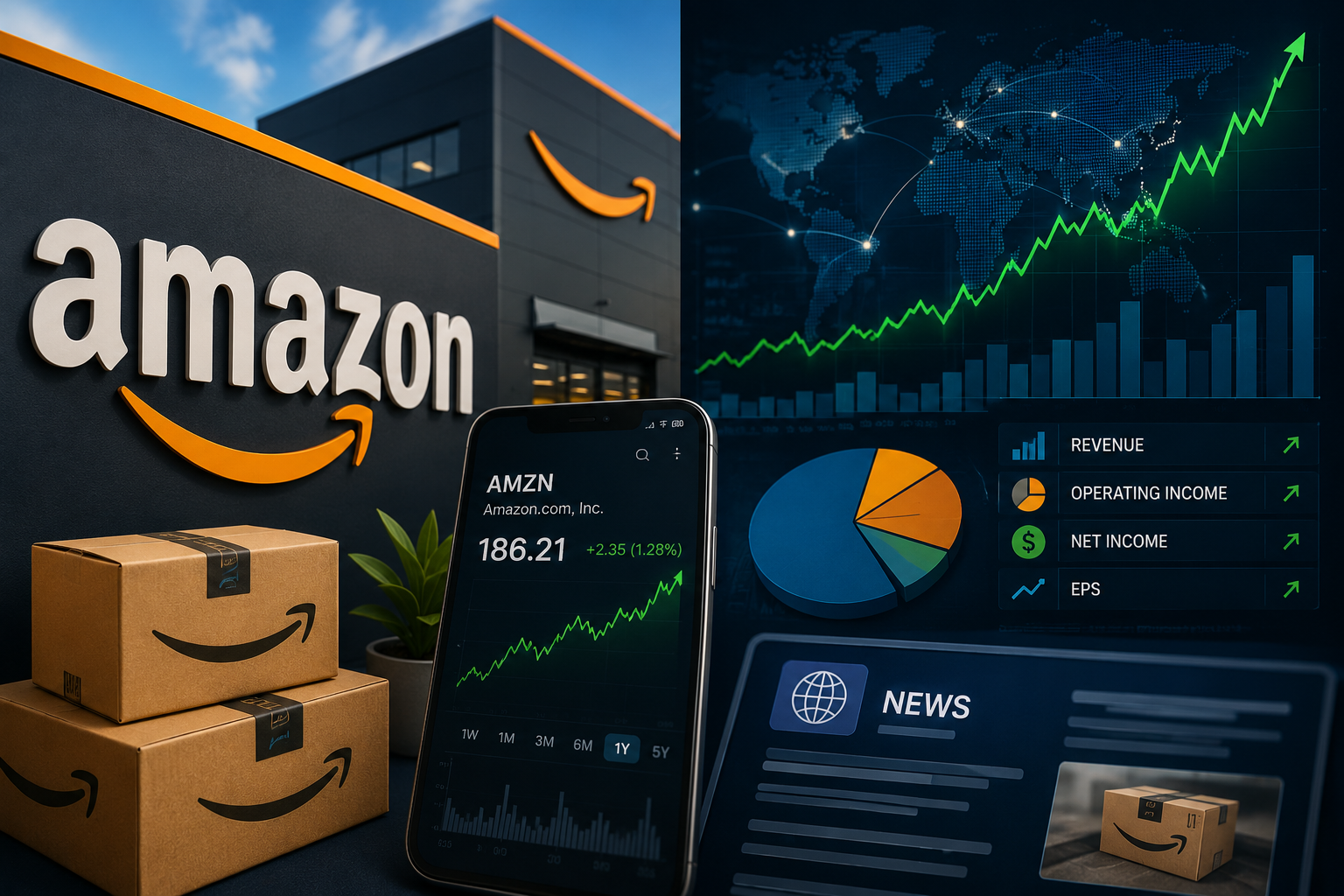
Amazon.com, Inc. (NASDAQ: AMZN) is one of the largest companies in the world by revenue and market value, operating across online retail, cloud computing through Amazon Web Services (AWS), digital advertising, streaming, and consumer electronics. Founded by Jeff Bezos in 1994 and now led by CEO Andy Jassy, Amazon reported full year 2025 revenue of about 716.9 billion dollars and net income of about 77.7 billion dollars. In the first quarter of 2026, revenue climbed 17 percent year over year to 181.5 billion dollars, driven by a 28 percent surge in AWS, the company’s fastest cloud growth rate in 15 quarters. AMZN shares trade near 243 dollars, giving the company a market capitalization of roughly 2.61 trillion dollars. This guide covers Amazon’s history, leadership, business segments, revenue breakdown, financial performance, stock data, dividend policy, competitors, and the most recent company news, with simple charts to help USA based investors and shoppers understand the business at a glance.
Seattle, Washington, with a second headquarters (HQ2) in Arlington, Virginia
Employees
Roughly 1.58 million worldwide
IPO date
May 15, 1997, at 18 dollars per share
Stock price (recent)
Around 243 dollars per share
Market capitalization
About 2.61 trillion dollars
FY2025 revenue
About 716.9 billion dollars
FY2025 net income
About 77.7 billion dollars
Dividend
None currently paid
Main segments
North America, International, Amazon Web Services (AWS)
What Is Amazon?
Amazon is a multinational technology and retail company that began as an online bookstore and has grown into one of the largest businesses on the planet by revenue. Today Amazon sells consumer goods directly and through third party sellers, operates the AWS cloud computing platform, runs a fast growing digital advertising business, produces streaming video and music through Prime Video and Amazon Music, and designs consumer electronics such as Kindle, Fire TV, Echo, Ring, and eero devices.
The company generates revenue through several channels: direct product sales, commissions and fees from third party marketplace sellers, subscription fees from Amazon Prime, advertising placements across its sites and apps, and usage based fees from AWS customers ranging from startups to the largest enterprises and government agencies in the world.
Source: Amazon annual reports and SEC filings, fiscal years 2021 through 2025. 2025 revenue is highlighted as the most recent full fiscal year.
Company History
Amazon was founded on July 5, 1994, by Jeff Bezos, who started the company as an online bookstore operating out of his garage in Bellevue, Washington. Bezos chose the name Amazon after the world’s largest river, aiming to reflect the scale he wanted the business to reach. Amazon.com launched publicly in July 1995 and sold its first book within weeks.
The company went public on May 15, 1997, at an IPO price of 18 dollars per share (equal to about 1.50 dollars after adjusting for later stock splits). Amazon expanded quickly beyond books into music, electronics, toys, and general merchandise during the late 1990s, a period that also included three stock splits: a 2 for 1 split in June 1998, a 3 for 1 split in January 1999, and another 2 for 1 split in September 1999.
Key milestones since then include the 2002 launch of Amazon Web Services, which turned internal infrastructure into a rentable cloud platform for outside businesses; the 2005 introduction of Amazon Prime; the 2007 release of the Kindle e reader; the 2014 debut of the Echo smart speaker and Alexa voice assistant; the 2017 acquisition of Whole Foods Market for about 13.7 billion dollars, marking Amazon’s major entry into physical grocery retail; and the June 2022 stock split of 20 for 1, which lowered the per share price and made the stock more accessible to individual investors. Andy Jassy became CEO in July 2021, succeeding founder Jeff Bezos, who moved into the role of Executive Chairman.
In recent years, Amazon has invested heavily in artificial intelligence infrastructure, custom chip design through its Trainium and Inferentia silicon, and satellite based internet connectivity through Project Kuiper, branded Amazon Leo, positioning the company for its next phase of growth beyond e-commerce and traditional cloud hosting.
Founders
Amazon has a single founder, Jeff Bezos. Before starting Amazon, Bezos worked in finance and technology roles in New York City. He identified online bookselling as an early opportunity in the internet economy because books were a standardized product with an enormous catalog that no physical store could stock in full. Bezos served as CEO from Amazon’s founding until July 2021 and remains involved with the company as Executive Chairman, while also leading the aerospace company Blue Origin.
CEO
Andy Jassy has served as Amazon’s president and CEO since July 5, 2021. Jassy joined Amazon in 1997 and spent much of his career building Amazon Web Services from an internal project into the company’s most profitable segment, serving as CEO of AWS before his promotion to lead the entire company. Under Jassy, Amazon has focused on cost discipline in its retail operations, expansion of same day delivery, and a large scale push into generative AI, including the Bedrock platform, custom Trainium chips, and partnerships with AI companies such as Anthropic and OpenAI.
Headquarters
Amazon’s global headquarters is located in Seattle, Washington, where the company has occupied a large downtown campus, including the distinctive Spheres greenhouse structures. In 2018, Amazon announced a second headquarters, known as HQ2, in Arlington, Virginia, just outside Washington, D.C. HQ2 has become a major hub for corporate, cloud, and engineering staff on the East Coast of the United States.
Business Segments
Amazon reports its financial results across three primary segments:
North America
Retail sale of consumer products and subscription services through North America focused online and physical stores, plus related seller and advertising services. This is Amazon’s largest segment by revenue.
International
The same categories of retail, subscription, seller, and advertising services delivered through internationally focused stores outside the United States, spanning Europe, Asia, and other regions.
Amazon Web Services (AWS)
Cloud infrastructure, storage, database, artificial intelligence, and machine learning services sold to businesses, startups, and government agencies. AWS carries the highest margins of the three segments and drives a disproportionate share of operating income.
Products and Services
Online and physical stores: Amazon.com marketplace, Whole Foods Market, and Amazon Fresh grocery stores.
Amazon Prime: A paid subscription offering fast shipping, Prime Video streaming, Prime Music, and other perks.
Amazon Web Services: Compute (EC2), storage (S3), databases, analytics, and generative AI tools including Bedrock and the Trainium chip family.
Advertising: Sponsored product listings, display ads, and video advertising across Amazon properties and Prime Video, along with Twitch.
Devices: Kindle e readers, Fire tablets and TV devices, Echo smart speakers, Ring home security, and eero mesh Wi Fi systems.
Content and entertainment: Prime Video originals, MGM Studios film and television library, Amazon Music, Audible audiobooks, and Twitch live streaming.
Seller services: Fulfillment by Amazon (FBA), Amazon Marketplace, and publishing tools such as Kindle Direct Publishing.
Emerging bets: Amazon Leo satellite internet service, Rufus AI shopping assistant, and expanding same day and same week delivery networks.
Revenue Breakdown
For full year 2025, Amazon’s segment revenue was approximately 426 billion dollars from North America, 162 billion dollars from International, and roughly 129 billion dollars from AWS, out of total net sales of 716.9 billion dollars. In the most recent quarter, the first quarter of fiscal 2026 ended March 2026, the mix looked like this:
Source: Amazon Q1 2026 earnings release, reported April 29, 2026. AWS posted its fastest growth rate in 15 quarters.
Within these segments, online store sales generated 64.3 billion dollars in the quarter, third party seller services contributed heavily to both North America and International totals, and advertising services revenue reached 17.24 billion dollars, up 24 percent year over year, a pace that continues to outgrow the rest of the retail business. Trailing twelve month advertising revenue has now surpassed 70 billion dollars.
Financial Performance
Metric
FY2023
FY2024
FY2025
Q1 FY2026
Net sales
$574.8B
$638.0B
$716.9B
$181.5B
Operating income
$36.9B
$68.6B
$80.0B
$23.9B
Net income
$30.4B
$59.2B
$77.7B
$30.3B
Operating margin
6.4%
10.8%
11.2%
13.1%
Amazon’s profitability has expanded sharply since 2023, when higher fulfillment and energy costs weighed on margins. Operating income more than doubled from fiscal 2023 to fiscal 2025, helped by fulfillment network efficiency, cost cutting in the retail business, and the growing weight of high margin AWS and advertising revenue in the overall mix. In the first quarter of 2026, Amazon posted net income of 30.3 billion dollars, or 2.78 dollars per diluted share, well above analyst estimates of about 1.63 dollars per share, and CEO Andy Jassy called the 13.1 percent operating margin the highest quarterly figure in company history.
Free cash flow has come under pressure as Amazon ramps capital spending on AI infrastructure and data centers, with cash capital expenditures of about 43.2 billion dollars in the first quarter of 2026 alone and full year 2026 capital expenditure guidance of roughly 200 billion dollars, directed mainly at AWS data centers, custom chips, and logistics capacity. For the second quarter of 2026, Amazon guided net sales between 194 billion and 199 billion dollars and operating income between 20 billion and 24 billion dollars.
Stock Information
Data Point
Value
Exchange
Nasdaq
Recent price
About $243 per share
Market capitalization
About $2.61 trillion
52 week range
$196.00 to $278.56
P/E ratio (trailing)
About 29
EPS (trailing twelve months)
About $8.36
Average 12 month analyst price target
About $312.91 (range $207 to $370)
Analyst consensus
Strong Buy (62 buy ratings, 0 sell ratings)
Next earnings date
July 30, 2026
Stock splits
1998 (2 for 1), 1999 (3 for 1), 1999 (2 for 1), 2022 (20 for 1)
AMZN stock is widely held by both institutional and individual investors and is a component of major indexes including the S&P 500 and Nasdaq 100. The stock is frequently grouped with the so called Magnificent Seven, a set of large technology companies that includes Amazon, Apple, Microsoft, Alphabet, Meta Platforms, Nvidia, and Tesla. Shares trade with meaningful volatility, reflected in a beta above 1.8, and price action often reacts strongly to AWS growth figures, capital spending updates, and guidance for the following quarter.
Dividends
Amazon does not currently pay a dividend to shareholders. Since its founding, the company has chosen to reinvest nearly all available cash flow into growth initiatives such as fulfillment network expansion, AWS data centers, original content, advertising technology, and more recently artificial intelligence infrastructure and satellite internet. This growth first approach is a key reason Amazon has historically traded at a premium valuation compared with traditional retailers, and it means investors seeking regular income from AMZN shares would need to rely on price appreciation and potential future capital return programs rather than dividend payments. Amazon has, however, used share buybacks in some periods as an alternative method of returning capital to shareholders.
AWS remains the segment facing the most direct competitive pressure, as Microsoft Azure and Google Cloud have both reported faster percentage growth in recent quarters, even though AWS remains the largest cloud provider by revenue. Reports have also emerged of Meta Platforms exploring a cloud infrastructure business of its own, which some analysts view as a long term risk to Amazon’s cloud dominance, though AWS retains substantial scale advantages, an enormous enterprise customer backlog, and a fast growing artificial intelligence product line built around Bedrock and custom Trainium chips.
Recent News
AWS growth reaccelerates: AWS revenue grew 28 percent year over year in the first quarter of 2026 to 37.6 billion dollars, its fastest growth rate in 15 quarters, with an annualized run rate near 150 billion dollars and a reported backlog of about 364 billion dollars.
Major AI partnerships: OpenAI expanded an existing AWS cloud commitment by 100 billion dollars over eight years, while Amazon has separately committed to invest roughly 50 billion dollars in OpenAI, deepening the two companies’ relationship even as they also compete in AI services.
Amazon Leo satellite internet: Amazon has deployed enough satellites under its Leo program (formerly Project Kuiper) to plan a public launch of satellite internet service later in 2026, positioning the company to compete with Starlink in broadband connectivity.
Record Prime Day sales: Amazon’s June 2026 Prime Day event generated sales of about 26.4 billion dollars, up 9 percent from the prior year event.
FTC settlement: Amazon reached a settlement with the Federal Trade Commission tied to subscription and marketplace practices, highlighting continued regulatory scrutiny of the company’s scale in retail and data heavy businesses.
Capital spending at scale: Amazon reiterated plans to spend roughly 200 billion dollars in 2026 on AI infrastructure, data centers, and logistics, among the largest capital budgets of any company in the world.
Upcoming earnings: Amazon is scheduled to report second quarter 2026 results on July 30, 2026, with investors focused on whether AWS growth can sustain its recent acceleration.
Frequently Asked Questions
What does the ticker AMZN stand for?
AMZN is the Nasdaq stock ticker symbol used to identify shares of Amazon.com, Inc. in the stock market.
Is Amazon stock a buy right now?
Wall Street analysts currently rate AMZN a Strong Buy on average, with 62 analysts recommending buy ratings and none recommending sell, and an average 12 month price target well above the current share price. That said, all investing involves risk, and readers should do their own research or speak with a licensed financial advisor before making investment decisions, since this article is for informational purposes only and is not financial advice.
Does Amazon pay a dividend?
No. Amazon does not currently pay a dividend and instead reinvests its profits into growth areas such as AWS data centers, logistics, and artificial intelligence infrastructure.
Who is the CEO of Amazon?
Andy Jassy has been CEO of Amazon since July 5, 2021. He previously led Amazon Web Services and succeeded founder Jeff Bezos, who now serves as Executive Chairman.
What is Amazon’s most profitable business segment?
Amazon Web Services (AWS) generates the highest operating margins of Amazon’s three segments and is responsible for a large share of total company operating income, even though it represents a smaller portion of overall revenue than the North America retail segment.
How many times has Amazon stock split?
Amazon has split its stock four times: 2 for 1 in June 1998, 3 for 1 in January 1999, 2 for 1 in September 1999, and 20 for 1 in June 2022.
What is Amazon’s market capitalization?
Amazon’s market capitalization is approximately 2.61 trillion dollars, making it one of the most valuable public companies in the world alongside Apple, Microsoft, Nvidia, Alphabet, and Meta Platforms.
When is Amazon’s next earnings report?
Amazon is scheduled to release its second quarter 2026 earnings report on July 30, 2026.
Disclaimer: This article is for general informational and educational purposes only and does not constitute financial, investment, or legal advice. Stock prices, financial figures, and analyst estimates change frequently and may have moved since publication. Always verify current data through official sources such as Amazon’s investor relations site and the U.S. Securities and Exchange Commission before making any financial decision, and consider consulting a licensed financial advisor.