While most people worry about rising prices pushing up their cost of living, central bankers and monetary policy experts often lie awake at night fearing the exact opposite: deflation.
To the average consumer, the idea of falling prices sounds like an absolute dream. Imagine walking into a supermarket and finding that your weekly grocery bill is lower than it was last month, or discovering that electronics, cars, and rent are steadily becoming cheaper.
However, in macroeconomics, prolonged deflation is considered a toxic economic condition. It is a symptom of a deeply broken system and a trap that is famously difficult to escape.
This detailed guide breaks down what deflation is, why top economists consider it far more dangerous than moderate inflation, how it plays out in the real world today, and what it means for your financial health.
What Is Deflation? A Simple Definition
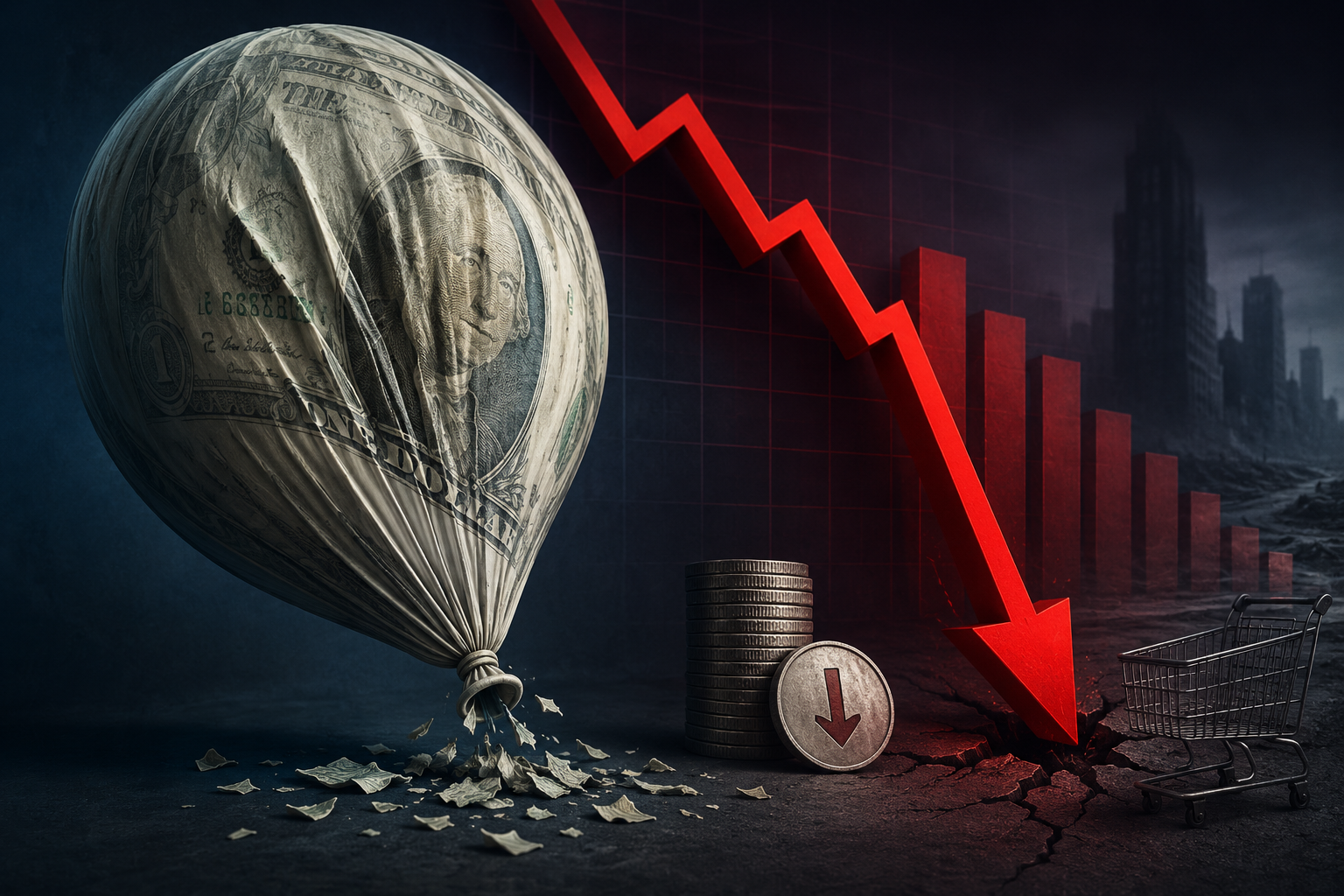
Deflation occurs when the general price level of goods and services across an entire economy decreases over a sustained period. This is equivalent to an increase in the purchasing power of money, meaning your cash can buy more goods tomorrow than it can today.
It is critical to distinguish true macroeconomic deflation from price drops in specific industries. For example, technology items like television sets and computer microchips consistently fall in price due to rapid technological innovations and manufacturing efficiencies. This localized trend is not deflation. True deflation is widespread and measured by a negative reading in the Consumer Price Index (CPI), indicating a systemic contraction across the board.
Deflation vs. Disinflation
People frequently confuse these two terms, but they describe entirely different economic environments:
Disinflation: This is a slowdown in the rate of inflation. For instance, if the annual inflation rate drops from 8% to 3%, prices are still rising, but they are doing so at a much slower pace.
Deflation: This is a negative inflation rate, such as minus 1.5%. Prices are actively dropping below their previous levels.
Why Do Economists Fear Deflation? The Toxic Mechanics
If inflation acts like a fever that makes an economy run hot, deflation is like hypothermia, slowing down economic vital signs until growth freezes entirely.
The primary danger of deflation is that it triggers a self-reinforcing downward spiral that strips central banks of their traditional economic tools. Economists fear it for four structural reasons.
1. The Deflationary Spiral
The single most terrifying aspect of deflation is how easily it turns into a psychological feedback loop known as the deflationary spiral.
When consumers observe that prices are falling month after month, their purchasing behavior changes fundamentally. Instead of buying a new car, upgrading an appliance, or purchasing a home today, they choose to delay their purchases, knowing that the item will be cheaper if they wait six months.
When millions of consumers collectively postpone spending, aggregate demand falls off a cliff. To clear inventory and attract buyers, businesses are forced to slash prices even further. This confirms the consumer expectation that things will get cheaper, leading to further delays in spending.
2. Slashed Corporate Profits and Layoffs
As retail prices slide downward, corporate revenues diminish. However, a business cannot easily lower its fixed operational overhead. Rent contracts, raw material agreements, and utility costs are frequently locked into multi-year agreements.
Most importantly, worker wages suffer from nominal wage rigidity, meaning it is legally difficult and culturally unpopular to cut an employee’s base salary by 5% just because overall consumer prices dropped by 5%.
Stuck between plummeting revenues and rigid fixed costs, companies look for alternatives to protect their survival:
They freeze hiring and cut capital investments.
They reduce production capacities.
They execute massive corporate layoffs to slash their total payroll burden.
This leads to rising unemployment, reducing total consumer spending power and feeding directly back into the deflationary loop.
3. The Paradox of Real Debt Burden
Deflation behaves like a wealth transfer from borrowers to lenders. While nominal prices and wages fall during a deflationary period, the nominal value of existing debt remains completely fixed.
If you owe $300,000 on a home mortgage, that debt balance does not decrease when the CPI hits negative territory. In fact, as your nominal income falls or your business revenue shrinks, that fixed monthly mortgage payment consumes a much larger percentage of your real disposable cash flow.
When an entire population uses its remaining cash to pay off heavy legacy debts rather than buying new products, consumer velocity stalls completely, forcing asset values down further. This phenomenon, termed Debt-Deflation, was identified by economist Irving Fisher as a core driver of the Great Depression.
4. The Monetary Policy Zero Lower Bound Trap
When an economy encounters high inflation, central banks have a clear remedy: raise benchmark interest rates to cool down borrowing and spending.
When faced with deflation, a central bank’s primary lever is to cut nominal interest rates toward 0% to encourage borrowing and investment. However, once interest rates hit zero, the central bank encounters the Zero Lower Bound.
If nominal interest rates are at 0% and the economy is experiencing 3% deflation, the real interest rate is actually positive 3%.
This mathematical reality means that even when a central bank sets its policy rate to absolute zero, the real, inflation-adjusted cost of borrowing remains high, discouraging businesses from taking out expansion loans.
Historical Precedents: Lessons from the Past
To understand why international economic policymakers fear deflationary indicators so intensely, look at the historical precedents.
The Great Depression (1929 to 1933)
The most severe deflationary crisis in modern history occurred during the onset of the Great Depression. Following the stock market crash of 1929, a systemic banking panic caused the US money supply to contract by roughly one third.
Faced with a collapse in liquidity, consumer prices plummeted by roughly 25% over a four-year window. This drop caused the real burden of agricultural and corporate debt to spike, leading to widespread bankruptcies, thousands of bank failures, and an unemployment rate that neared 25%.
Japan’s Lost Decades (1990s to 2010s)
In the late 1980s, Japan experienced a massive real estate and stock market asset bubble. When that bubble burst in 1990, the nation’s commercial banks were left holding trillions of yen in non-performing toxic loans.
The resulting economic stagnation triggered a long-term deflationary regime. For more than twenty years, the Bank of Japan battled near-zero growth and persistent, low-level deflation. Consumers grew so accustomed to flat or falling prices that multiple generations adjusted their behavior, creating a stagnant economic environment that resisted massive central bank interventions.
Current Realities: Deflationary Pressures and News
While major advanced economies like the United States, the United Kingdom, and the Eurozone spent the early 2020s wrestling with post-pandemic inflation spikes, global macroeconomic conditions are shifting. Today, global trade is fracturing into distinct regional trade regimes, creating uneven economic pressures worldwide.
China’s Fight Against Deflationary Forces
The most significant structural deflation story centers on China. In 2026, the Chinese economy continues to struggle with structural demand issues, highlighted by the government setting a conservative GDP growth target of 4.5% to 5% within its 15th Five-Year Plan (2026–2030).
Following a major correction in its domestic real estate sector, Chinese consumer confidence has remained soft. Rather than rebalancing the economy toward domestic household consumption, Beijing’s policies continue to favor supply-side industrial investments and high-tech manufacturing. This structural focus has unleashed a surge of low-cost industrial exports into global markets, exporting deflationary pressures to international trading partners.
Island Economies and Demographic Headwinds
Deflationary vulnerabilities are also surfacing in unique ways outside of large industrial hubs:
Regional Demand Shocks: Developing, tourism-dependent island nations face localized deflationary adjustments when external factors shift. For instance, temporary domestic policy changes like value-added tax (VAT) reductions, combined with cooling international visitor arrivals, pushed Fiji into a ten-month deflationary cycle, concluding with a 1.4% deflation rate for that calendar year.
Demographic Drag: Across Northeast Asia, including South Korea and Taiwan, long-term growth prospects are constrained by secular stagnation. Rapid demographic aging, shrinking domestic workforces, and structural domestic inequalities are limiting aggregate demand, leaving these nations vulnerable to long-term deflation traps.
What Causes Deflation?
Deflation is generally categorized into two distinct forms based on its root causes: Demand-Pull Deflation (bad deflation) and Supply-Side Deflation (good deflation).
Metric
Demand-Pull Deflation (“Bad” Deflation)
Supply-Side Deflation (“Good” Deflation)
Primary Driver
Severe collapse in consumer and business demand
Innovations, technological advances, and supply abundance
This variant occurs when aggregate demand falls far below the economy’s productive capacity. It is triggered by factors such as:
Systemic Financial Crises: A banking system collapse that freezes consumer credit and contracts the total circulating money supply.
Severe Geopolitical or Energy Shocks: Major international disruptions that drain fiscal space or create supply-chain chaos, such as the global impacts of the 2026 Middle East energy shocks.
Contractionary Fiscal Policy: Governments raising taxes while slashing infrastructure and social spending, reducing overall cash velocity.
2. Supply-Side Deflation (The Productive Form)
This occurs when industry efficiencies, technological breakthroughs, or resource discoveries increase total production capacity, allowing companies to lower retail prices while protecting their profit margins.
The rapid proliferation of enterprise artificial intelligence applications and automation software across global service sectors is a prime example of a supply-side force that safely lowers production costs without harming workers.
How Central Banks Battle Deflation
Because deflation resists traditional monetary fixes, central banks deploy unconventional strategies to kickstart spending and increase inflation back toward standard targets (typically around 2%).
Quantitative Easing (QE)
When short-term nominal interest rates reach 0%, central banks begin buying massive quantities of long-term government bonds and private financial assets directly from commercial institutions. This injection of liquidity expands the central bank’s balance sheet, pumps reserves into the commercial banking system, lowers long-term borrowing yields, and encourages commercial lending.
Negative Interest Rate Policy (NIRP)
In extreme situations, central banks like the European Central Bank (ECB) and the Bank of Japan have pushed nominal target interest rates below zero. Under a negative interest rate policy, commercial banks are charged a fee for storing excess cash reserves at the central bank. The goal is to financially disincentivize commercial banks from hoarding cash, forcing them to lend funds to businesses and everyday consumers instead.
Forward Guidance
Central banks explicitly pledge to keep interest rates pinned at rock-bottom levels for an extended period, promising the public that they will not raise rates until a sustained, healthy level of inflation is achieved. This helps shape consumer expectations and stabilizes long-term corporate financial planning.
Real Interest Rate & Deflation Risk Calculator
See how falling prices change your true cost of debt or return on cash reserves.
%
%
*Use a negative sign (-) to specify a deflationary environment.
Adjusted Real Interest Rate
+2.50%
Because prices are falling, your cash gains purchasing power even at 0% nominal interest. However, if this is a loan, your true debt burden is increasing.
Fisher Equation: Real = Nominal – InflationInteractive Article Tool
How to Protect and Position Your Portfolio During Deflation
Deflation shifts the optimal strategy for managing personal finances and investments. When cash increases in purchasing power over time, traditional inflation hedges lose their utility.
1. The Value of Liquid Cash
During inflationary regimes, holding idle cash is a losing strategy because rising consumer costs erode its purchasing power. During a deflationary cycle, cash is a high-performing asset. Because market prices are falling across the board, the cash sitting in a standard bank account gains real value every single day, completely risk-free.
2. Focus on High-Quality, Fixed-Income Bonds
Fixed-income investments become highly lucrative during deflationary cycles. If you purchase a long-term, high-grade government or corporate bond that guarantees a fixed annual coupon payment of 4.5%, and consumer prices are deflating by 1.5%, your real investment yield climbs to an effective 6%. Additionally, as market interest rates are driven down by central banks, the resale value of existing, high-coupon bonds rises sharply.
3. Equities: Focus on Consumer Staples
Broad equity markets generally face severe headwinds during deflationary recessions because declining consumer demand hurts corporate earnings. If you choose to maintain stock allocations, look for high-quality defensive companies with strong balance sheets and low debt burdens.
Focus on consumer staple companies that sell non-discretionary necessities like utilities, medications, and basic foods. Consumers cannot defer buying food or electricity, regardless of whether they expect prices to drop further next quarter.
4. Pay Down Variable and High-Interest Debt
Because deflation increases the real, inflation-adjusted cost of carrying debt, entering a deflationary period with heavy variable liabilities can be financially dangerous. Prioritize paying off outstanding lines of credit, credit cards, and adjustable mortgages. Wiping out these nominal balances prevents your personal cash flow from being consumed by fixed debt payments as your real income drops.
Summary: The Hidden Dangers of Deflation
Deflation is a prime example of the fallacy of composition in economic theory: what sounds beneficial for an individual consumer can prove catastrophic when scaled across an entire national economy.
While paying less at the store checkout register seems like a win on the surface, the structural trade-offs—including corporate revenue drops, systemic payroll lay-offs, mounting real debt burdens, and the erosion of central bank interest rate tools—make deflation a dangerous macroeconomic problem.
This explains why central banks monitor price data so closely, preferring the predictable predictability of moderate inflation over the chaotic risks of a deflationary spiral.