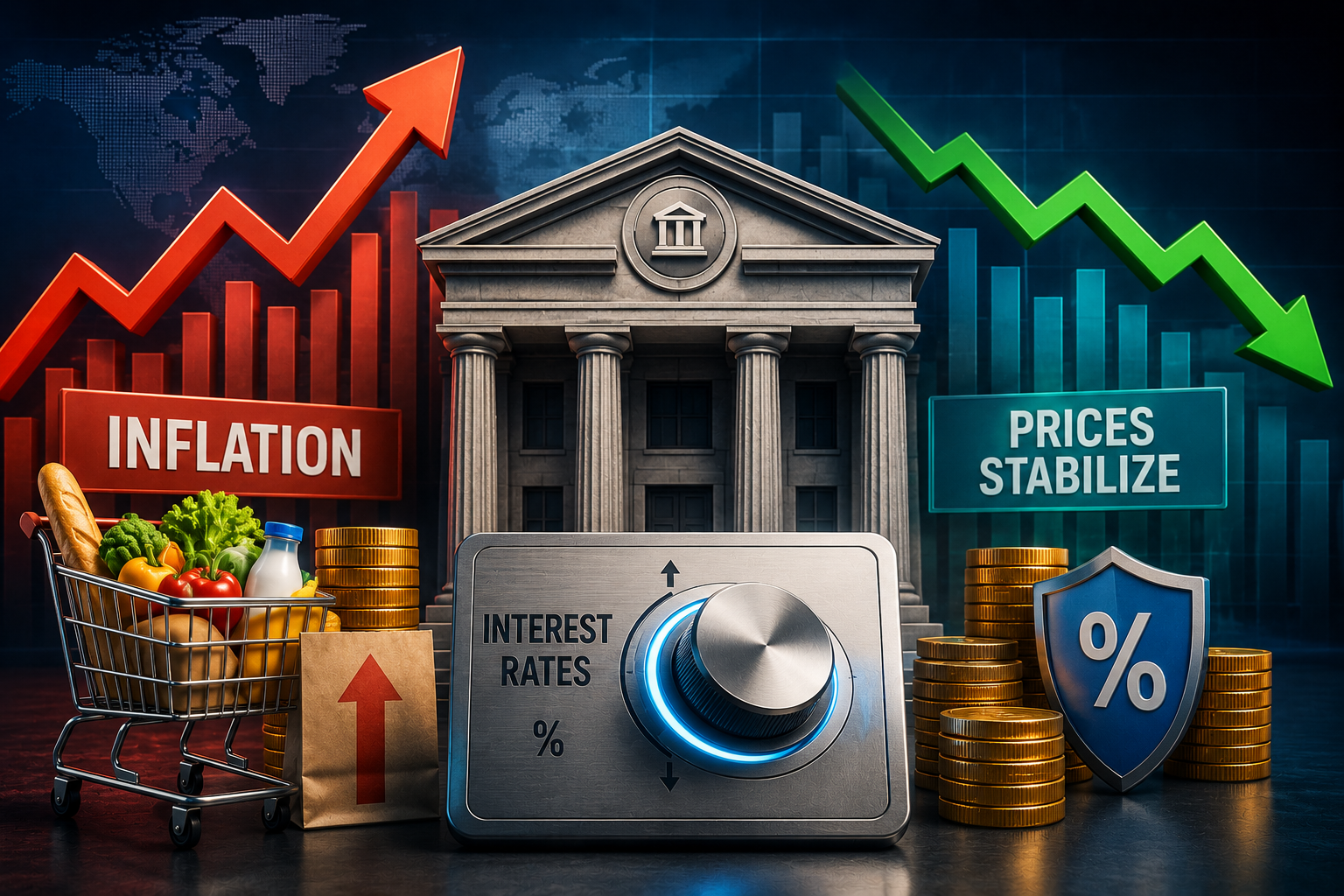
When the cost of living climbs, grocery bills spike, and energy prices soar, the spotlight falls squarely on macroeconomic policy. At the heart of this financial ecosystem are central banks, the institutional anchors tasked with maintaining price stability.
Understanding how central banks control inflation is vital for investors, businesses, and everyday consumers alike. This comprehensive guide breaks down the core mechanisms of monetary policy, examines real world strategies, and reviews current economic realities shaping global markets today.
1. What is Inflation and Why Does It Matter?
Inflation represents the rate at which the general level of prices for goods and services rises, subsequently eroding consumer purchasing power. While moderate inflation is a natural byproduct of a growing economy, runaway inflation can destabilize entire financial systems.
The Two Core Types of Inflation
Demand Pull Inflation: This occurs when aggregate demand outpaces aggregate supply. In simpler terms, consumer and business demand is growing too fast, creating a scenario where too much money chases too few goods.
Cost Push Inflation: This happens when aggregate supply drops due to rising production costs. Recent global events highlight how sudden spikes in raw materials, such as crude oil or agricultural products, push consumer prices upward regardless of domestic demand.
Why Price Stability is the Ultimate Goal
Most major global central banks operate under a explicit or implicit target, typically aiming for an annual inflation rate around 2%. This specific threshold is low enough to prevent purchasing power from eroding rapidly, yet high enough to encourage consumers to spend or invest rather than hoard cash.
When inflation exceeds these healthy levels, it functions as a regressive tax. It hits low income households hardest because a larger percentage of their income goes toward basic necessities like food, utilities, and rent.
2. The Core Tools of Monetary Policy
Central banks do not set the prices of store items directly. Instead, they manipulate the broader financial environment using specific tools that alter the cost and availability of credit.
Interest Rates: The Primary Lever
The most visible tool in the central bank toolkit is the benchmark interest rate, known as the Federal Funds Rate in the United States, the Official Cash Rate in New Zealand, or the Main Refinancing Rate in the Eurozone.
When inflation rises, central banks increase this benchmark rate. This adjustment directly influences commercial banks, raising the cost of borrowing across the entire economy.
Reserve Requirements
Commercial banks are legally required to hold a specific percentage of their deposits in reserve, either in their vaults or at the central bank. By raising this reserve requirement, central banks restrict the total volume of funds available for lending, effectively reducing the velocity of money flowing through the economy.
Open Market Operations (OMO)
Open Market Operations involve the buying and selling of government securities in the open market.
To curb inflation: The central bank sells government bonds to commercial banks. This drains liquidity out of the banking sector because commercial funds flow into the central bank, leaving less cash available for consumer loans.
To stimulate growth: The central bank buys back bonds, injecting fresh capital into the private banking system to spur lending.
Quantitative Tightening (QT)
During severe economic downturns, central banks utilize Quantitative Easing (QE) by purchasing massive volumes of long term assets to lower long term borrowing costs. Conversely, when inflation threatens the economy, they switch to Quantitative Tightening (QT). Under QT, central banks let these bonds mature and roll off their balance sheets, pulling liquidity directly out of global capital markets.
3. Current Global Context: Inflation Dynamics in 2026
Global monetary policy is navigating an exceptionally intricate landscape. Following an extended period of interest rate cuts and stabilization efforts throughout late 2024 and 2025, geopolitical disruptions have reintroduced major supply side shocks.
Rising Pressures in Major Economies
The global energy market has faced substantial disruption due to ongoing conflicts affecting critical shipping corridors like the Strait of Hormuz. This has driven sharp upticks in headline inflation metrics worldwide.
United States: In May 2026, the annual consumer price index accelerated to 4.2%, up from 3.8% in April. This shift was heavily fueled by energy costs jumping 23.5%. Consequently, the Federal Reserve under new Chair Kevin Warsh has paused its easing cycle, holding the federal funds rate steady at 3.50% to 3.75% while economists increasingly project potential rate hikes before the end of the year.
Australia: The Reserve Bank of Australia adjusted aggressively early in the year, lifting its official cash rate to 4.1% following persistent inflation numbers that settled well above their preferred 2% to 3% target range.
New Zealand: In a parallel move, the Reserve Bank of New Zealand kept its official cash rate steady at 2.25% during its mid year review. However, with annual domestic inflation hovering at 3.1%, policymakers have signaled that rate hikes remain on the table for later in 2026 if core pricing pressures do not subside.
Region
Current Policy Stance (Mid 2026)
Recent Annual Inflation Rate
Target Inflation Band
United States
Paused at 3.50% to 3.75% (Hike under consideration)
4.2%
2.0%
Australia
Active Tightening (4.1% Cash Rate)
3.8%
2.0% to 3.0%
New Zealand
Holding at 2.25% (Hawkish bias)
3.1%
1.0% to 3.0%
4. Interactive Policy Tool: The Central Bank Simulator
To see firsthand how these economic variables interact, try adjusting the inputs in the calculator below. This simulator models how changing a benchmark interest rate influences consumer demand, unemployment, and trailing inflation over an eighteen month macroeconomic cycle.
Interactive Central Bank Monetary Simulator
Act as a central bank governor. Adjust the policy benchmark interest rate and toggle global energy shock conditions to see the direct transmission effects on employment, market demand, and trailing core inflation metrics over an 18-month macroeconomic lag phase.
Global Supply-Side Energy Shock Premium(Exogenous Shock)+1.5%
0.0% (Stable Global Markets)+3.0% (Severe Supply Disruption)
5. The Transmission Mechanism: How Policy Filters Down
When a central bank alters its core policy rate, the effects take time to manifest across the real economy. This lag, often lasting between twelve and eighteen months, travels through several pathways known collectively as the monetary transmission mechanism.
The Bank Lending Channel
Commercial financial institutions borrow funds from one another and from the central bank. When the base cost of these funds increases, banks preserve their profit margins by raising rates on retail credit products. This includes credit cards, personal loans, and commercial business lines of credit.
The Asset Price Channel
Higher interest rates alter the discounted present value of future corporate cash flows, often causing a cooling effect in equity markets. Additionally, as fixed income yields rise, capital flows away from speculative equities and into bonds. Higher mortgage rates also depress real estate markets by reducing the maximum loan size a borrower can qualify for.
The Exchange Rate Channel
When a country increases its interest rates relative to foreign nations, it attracts international yield seeking capital. To invest in those domestic fixed income assets, foreign investors must purchase the domestic currency, driving up its value on global foreign exchange markets. A stronger domestic currency lowers the cost of imported items, directly muting imported inflation.
The Expectations Channel
Perhaps the most psychological component of monetary policy is managing inflation expectations. If consumers and businesses believe a central bank is committed to fighting inflation, they are less likely to demand aggressive wage increases or raise retail consumer prices. This trust anchors long term inflation expectations, preventing a wage price spiral from taking root.
6. Challenges and Unintended Consequences of Tight Policy
Controlling inflation through aggressive monetary tightening is a delicate process, often compared to steering a massive ship through a narrow strait.
The Risk of a Policy Induced Recession
The primary danger of raising interest rates too quickly is a hard landing. If borrowing costs become prohibitive, businesses will delay capital expenditures, freeze hiring, or downsize existing payrolls. If aggregate demand drops too sharply, the economy may tip from a healthy deceleration into a full recession.
Sovereign Debt Pressures
Governments worldwide carry historic levels of public debt, much of it accumulated during global crises. As older bonds mature, governments must issue new sovereign debt at current, higher interest rates. This increases national debt servicing costs, forcing difficult decisions regarding fiscal austerity or increased tax burdens.
Delayed Effects and Policy Lags
Because monetary policy operates with long, variable lags, central banks are effectively driving by looking through the rearview mirror. If a committee keeps raising rates until inflation drops precisely to 2%, they may inadvertently over tighten, causing severe economic stress down the road even after the initial inflationary pressures have completely dissolved.
7. Summary: The Path Forward for Investors
Central banks play a fundamental role in preserving long term purchasing power, yet their actions introduce significant shifts across the broader financial landscape. Navigating periods of high inflation and restrictive interest rates requires proactive, strategic positioning.
Key Takeaways for Financial Strategy
Monitor Core vs. Headline Metrics: Pay close attention to core inflation figures, which strip out volatile food and energy costs. Central banks typically base their long term choices on core trajectories rather than short term commodity shocks.
Understand Interest Rate Sensitivities: High interest rates present clear challenges for growth oriented equities and capital intensive businesses reliant on cheap debt. Conversely, cash reserves and short term fixed income instruments offer their strongest yields in over a decade.
Watch Global Central Bank Alignment: Divergent monetary policies affect exchange rates and international trade flows. Tracking whether regional institutions are actively hiking, pausing, or cutting provides critical context for global asset allocation.