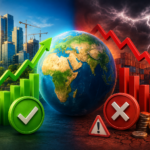
Understanding the business cycle is one of the most vital skills for investors, business owners, and employees alike. The economy does not move in a straight line. Instead, it travels through a series of natural ups and downs that repeat over time. These fluctuations, known as the business cycle, dictate everything from your job security to the interest rates on your mortgage.
As of June 2026, the global economy is navigating a unique period. While resilience in global growth persists, fragility remains due to geopolitical tensions and the rapid integration of artificial intelligence into the workforce. Whether you are planning a business strategy or managing personal finances, knowing where we are in this cycle is critical.
What Is the Business Cycle?
The business cycle refers to the fluctuations in aggregate economic activity over time. It is essentially the heartbeat of the economy. While some people mistakenly believe a recession is strictly defined as two consecutive quarters of negative GDP growth, economists look at a much broader picture. The National Bureau of Economic Research (NBER) defines a recession as a significant decline in economic activity that is spread across the economy and lasts more than a few months.
There is no fixed schedule for these cycles. Some expansions last for years, while others are cut short by external shocks or policy changes.
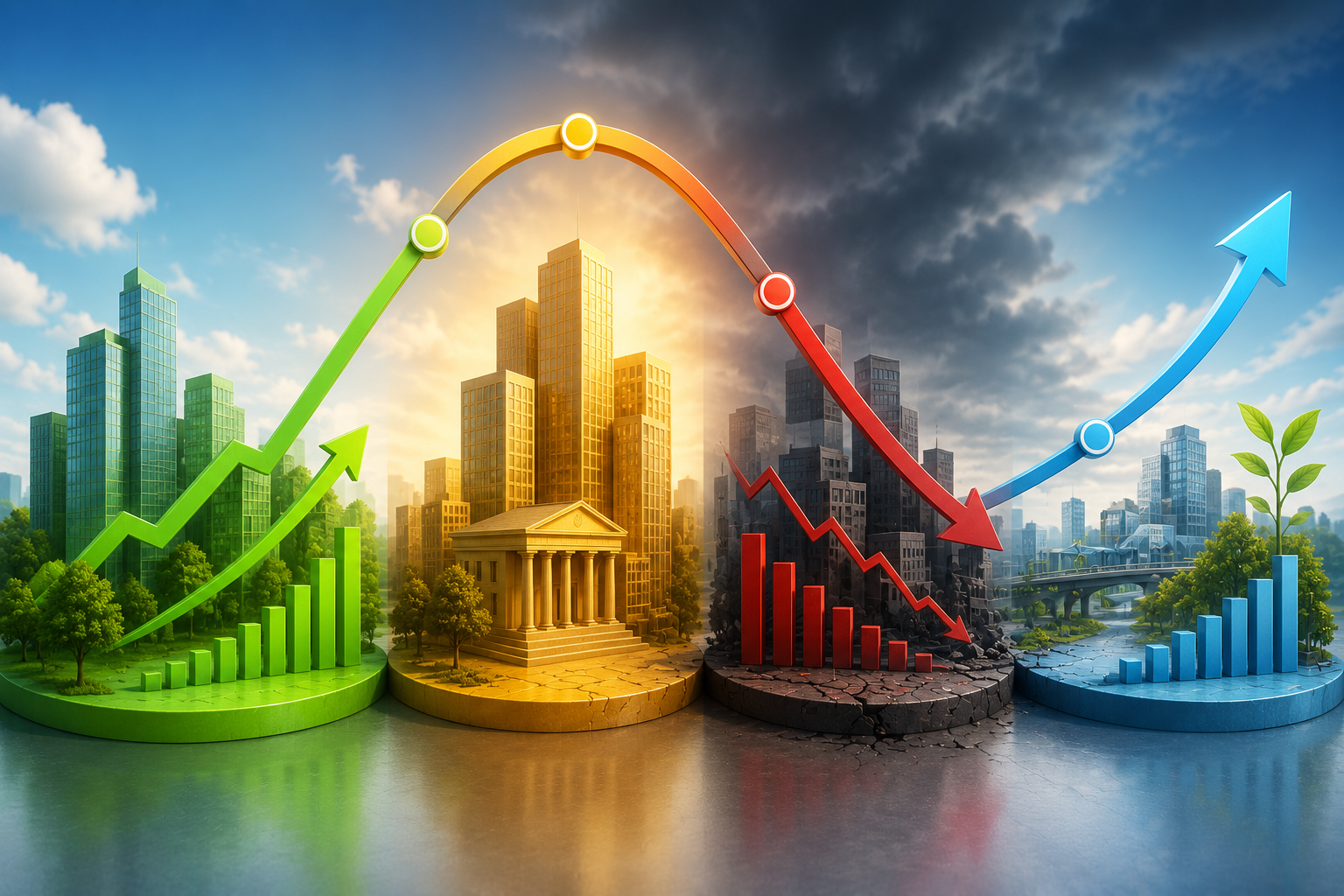
The Four Phases of the Business Cycle
The cycle moves through four distinct phases. While the transition from one to the next is rarely smooth, identifying the characteristics of each stage helps in making informed decisions.
Phase
Economic Activity
Employment
Investor Sentiment
Expansion (Boom)
Increasing
Growing
Optimistic
Peak
Maximum
High
Overconfident
Recession (Contraction)
Declining
Falling
Fearful
Trough
Minimum
Low
Cautious/Pessimistic
Deep Dive into the Phases
1. Expansion (The Boom)
During an expansion, the economy is firing on all cylinders. Businesses are hiring, consumers are spending, and GDP is rising. This is the “growth” phase where innovation often flourishes. In 2026, we see this in sectors heavily investing in AI and new technological workflows.
Key Signals: High consumer confidence, increased business investment, and rising production.
Strategy: This is usually the time to grow, scale your operations, and invest in new opportunities.
2. The Peak
The peak is the highest point of economic activity before a downturn. It is often characterized by “overheating.” Inflation may start to climb as demand outpaces supply, and central banks may raise interest rates to cool the economy down.
Key Signals: Asset prices are often at their highest, interest rates are rising, and businesses may struggle to find enough workers.
Strategy: Protect your gains. Many investors begin to shift toward more defensive assets (like cash or high-quality bonds) during this period.
3. Recession (Contraction)
A recession is a period of decline. Economic output falls, and unemployment tends to rise. While the word “recession” sounds scary, it is a natural, albeit painful, correction mechanism. It often helps clear out inefficiencies in the market.
Key Signals: Declining sales, hiring freezes, layoffs, and falling GDP.
Strategy: Focus on cash flow. Cut non-essential spending and prioritize liquidity.
4. The Trough
The trough is the bottom of the cycle. It is the moment just before the economy begins to turn upward again. While it feels like the darkest point, it is often where the most significant opportunities for long-term growth begin to emerge.
Key Signals: Economic indicators stop falling, and business leaders start looking for the next opportunity to reinvest.
Strategy: Look for value. Assets are often undervalued during the trough.
The Economic Climate of 2026: A Snapshot
To understand the current cycle, we must look at the data. As of June 2026, the global economy presents a complex picture.
Geopolitical Risks and Resilience
Global growth has shown remarkable resilience, but it remains fragile. Geopolitical shocks, such as trade restrictions and supply chain disruptions for key commodities, remain a constant threat. These factors can create sudden liquidity shocks and market volatility.
The AI Transformation
Artificial Intelligence is currently shifting from a productivity “assistant” to a job “substitute” in some sectors. This is creating a structural shift in the labor market. While AI boosts output for many knowledge workers, the transition is creating uncertainty about employment in white-collar roles.
Economic Insight: The current cycle is notably gradual. Since the unemployment trough in 2023, the rise in joblessness has been historically slow. This slow-moving environment requires a different kind of vigilance compared to the rapid crashes of the past.
Interactive Business Cycle Simulator
Select an economic phase to simulate market indicators and visualize the phase on the curve.
Expansion
Peak
Recession
Trough
Economic Indicator
Simulated Level / Status
GDP Growth Rate
High & Rising (+3.5%)
Unemployment Rate
Low & Falling (3.8%)
Consumer Confidence
Strong / Optimistic
Recommended Action
Invest in growth and scale operations.
How to Adapt Your Strategy
Whether you are an individual or a business owner, your strategy should shift with the phases.
During Expansion/Boom
Invest for Growth: If you have capital, deploy it.
Hire Strategically: Competition for talent is fierce. Focus on retention.
During Peak
Manage Debt: If interest rates are rising, pay down variable-rate debt.
Stay Liquid: Don’t tie up all your cash in illiquid assets.
During Recession
Prioritize Resilience: Ensure your business or household can survive with lower income.
Look for Value: Assets are cheaper now. Keep your eyes open for long-term opportunities.
During Trough
Prepare for Recovery: Start planning for the next phase of growth.
Invest in Skills: If you are an individual, use this time to learn new capabilities (like AI tools) that will be in demand when the boom returns.
Frequently Asked Questions
Does the business cycle have to occur?
Most economists believe that a balanced, full-employment economy could theoretically stay steady forever. However, disturbances like sudden policy changes, technological shocks, or geopolitical events constantly push the economy above or below its potential.
How do I know when the cycle is turning?
It is difficult to time exactly. Economists look at multiple indicators simultaneously, including nonfarm payroll employment, real personal income, and retail sales. No single metric tells the whole story.
What should I do if a recession is predicted?
Don’t panic. Panic leads to bad decisions. Focus on the fundamentals: reduce your high-interest debt, build an emergency fund, and maintain a long-term investment horizon.
Conclusion
The business cycle is not a monster to be feared, but a rhythm to be understood. By tracking the indicators, staying aware of global shifts like AI adoption and geopolitical risks, and adjusting your financial behavior accordingly, you can navigate the ups and downs with confidence. Remember, every peak eventually turns, and every recession eventually reaches its trough and rises again. Stay informed, stay prepared, and keep looking ahead.