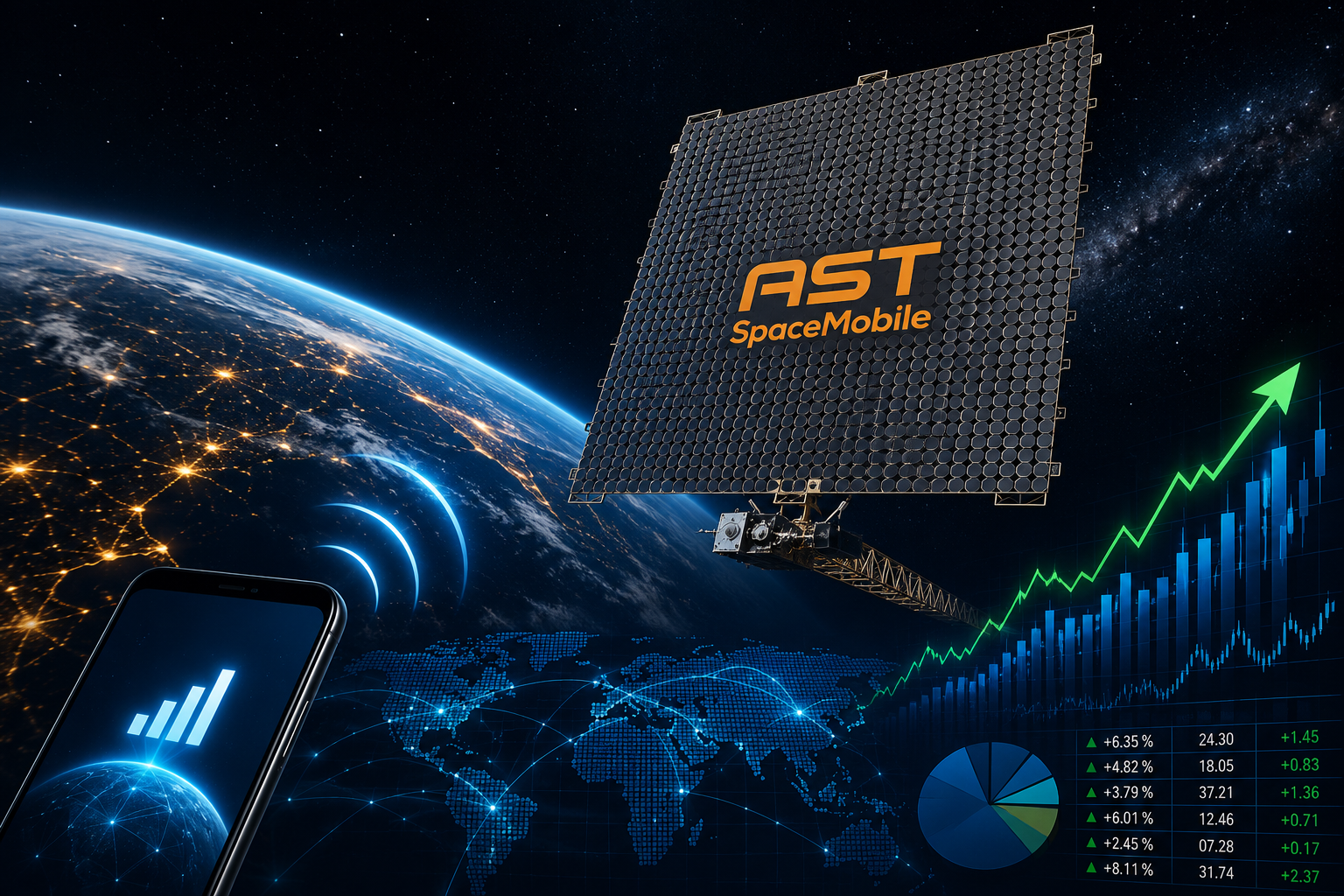
AST SpaceMobile, Inc. (NASDAQ: ASTS) is building the first satellite network designed to connect directly to everyday, unmodified smartphones, without any special hardware or app. Founded in Midland, Texas in 2017 by Abel Avellan, the company went public through a merger with a special purpose acquisition company in April 2021 and has since signed commercial agreements with major mobile carriers including AT&T, Verizon, and Vodafone.
AST SpaceMobile reported first quarter 2026 revenue of $14.7 million, driven by government milestones and commercial gateway hardware sales, and reaffirmed full year 2026 revenue guidance of $150 million to $200 million.
The company held approximately $3.5 billion in cash, cash equivalents, and restricted cash as of March 31, 2026, giving it a large runway to fund satellite manufacturing and launches.
AST SpaceMobile has commercial agreements with nearly 60 mobile network operators worldwide, covering more than 3 billion subscribers, including AT&T, Verizon, Vodafone, Rakuten, and others.
The company does not currently generate meaningful commercial service revenue at scale, since its business depends on successfully launching and operating dozens of additional BlueBird satellites.
ASTS does not pay a dividend and remains a high volatility, pre commercialization growth stock, with shares swinging sharply on satellite launch news, regulatory decisions, and partner announcements.
Quick Facts
AST SpaceMobile, Inc. at a glance (figures current as of early July 2026)
Ticker
ASTS (Nasdaq)
Founded
May 2017, as AST and Science LLC
Public listing
April 2021, via merger with a special purpose acquisition company
Headquarters
Midland, Texas, United States
Founder
Abel Avellan
CEO
Abel Avellan (Founder, Chairman, and Chief Executive Officer)
Industry
Satellite communications, direct to device cellular broadband
Market capitalization
Roughly $25 billion to $33 billion depending on daily trading
Employees
Approximately 1,126
Q1 2026 revenue
$14.7 million
FY2026 revenue guidance
$150 million to $200 million
Cash position
Approximately $3.5 billion as of March 31, 2026
Dividend
None paid
Key commercial partners
AT&T, Verizon, Vodafone, Rakuten, Google, American Tower, stc Group
What Is AST SpaceMobile?
AST SpaceMobile is a satellite communications company attempting something no company has done at commercial scale: connecting standard, unmodified smartphones directly to a satellite network for voice, text, and broadband data, in places where there is no ground based cellular tower coverage. Rather than requiring a special satellite phone or add on hardware, the company’s BlueBird satellites are designed to work with the phone already in a customer’s pocket, using spectrum leased or licensed from partner mobile network operators.
The company describes its mission as eliminating mobile dead zones, whether in rural areas, at sea, in disaster zones where terrestrial towers have failed, or in countries with limited cellular infrastructure. Its business model depends on partnerships rather than competing directly with wireless carriers. Instead, AST SpaceMobile works with existing mobile network operators such as AT&T, Verizon, and Vodafone, extending their coverage footprint through space rather than replacing their networks.
AST SpaceMobile is still in the early stages of full commercialization. The company has demonstrated the technology, including live voice calls, text messages, and video calls over its satellites using ordinary phones, and it has begun limited commercial and government service, but continuous, nationwide direct to device coverage depends on launching dozens more satellites over the coming years.
Company History
AST SpaceMobile was founded in May 2017 in Midland, Texas by Abel Avellan, an engineer and entrepreneur who had previously built and sold a satellite communications company. Avellan used proceeds from that earlier sale to fund the earliest stages of what became AST SpaceMobile, originally organized as AST and Science LLC.
In its early years the company focused on research, patent development, and raising strategic capital from telecommunications and technology partners rather than public markets. A pivotal Series B round in March 2020, led by Vodafone and Rakuten with participation from Samsung Next, American Tower, and Cisneros, raised $110 million and helped validate the technology with major industry names. The company went public in April 2021 through a merger with a special purpose acquisition company, New Providence Acquisition Corp, listing on the Nasdaq under the ticker ASTS.
Key milestones
Selected company history timeline
Period
Event
May 2017
Founded in Midland, Texas by Abel Avellan as AST and Science LLC.
March 2018
Acquired a controlling interest in NanoAvionics, a Lithuanian satellite manufacturer.
March 2020
Raised $110 million in a Series B round led by Vodafone and Rakuten.
April 2021
Completed its public listing through a merger with a special purpose acquisition company, beginning to trade as ASTS.
September 2022
Launched BlueWalker 3, its first large scale test satellite, demonstrating the core direct to device technology in orbit.
2024
Completed the first native voice calls and text messages over satellite using unmodified smartphones on AT&T and Verizon networks, and launched its first five commercial BlueBird satellites in September.
December 2024
Announced a commercial contract with Vodafone to provide space based cellular broadband across Europe and Africa.
2025
Signed definitive commercial agreements with Verizon and Saudi Arabia’s stc Group, expanded its Vodafone relationship through the SatCo joint venture, and secured more than $1 billion in aggregate contracted revenue commitments from commercial partners.
Late 2025 into 2026
Began launching Block 2 BlueBird satellites via SpaceX and Blue Origin, received FCC authorization for commercial Supplemental Coverage from Space service in the United States, and secured Japanese government subsidies for a joint venture with Rakuten.
2026
Continued satellite deployment toward a year end target of approximately 45 BlueBird satellites in orbit, while expanding government and defense contracts, including work related to national security programs.
Founders
AST SpaceMobile was founded by a single principal founder, Abel Avellan, though the company’s technical and commercial buildout has relied heavily on a small executive team and a board stocked with representatives from its largest strategic partners.
Abel Avellan
Founder, Chairman, and Chief Executive Officer. An electrical engineer originally from Venezuela and a naturalized United States citizen, Avellan previously founded Emerging Markets Communications, a satellite communications provider he sold in 2016 for approximately $550 million. He holds more than twenty United States patents related to satellite and wireless technology.
Early strategic backers
Vodafone, Rakuten, American Tower, Samsung Next, and Cisneros were among the earliest institutional investors, joining a 2020 Series B round that helped fund satellite development well before the company’s 2021 public listing.
AST SpaceMobile’s board of directors includes several individuals tied to its largest commercial partners, including representatives connected to Vodafone, Rakuten, and American Tower, reflecting how central those relationships are to the company’s strategy.
CEO
Abel Avellan has served as Chairman and Chief Executive Officer of AST SpaceMobile since founding the company in 2017, and formally since the company’s April 2021 public listing. Avellan is the primary architect of the underlying direct to device technology and has led the company’s largest capital raises and strategic partnerships with telecommunications companies including AT&T, Verizon, Vodafone, Rakuten, and Google. He also serves as a Commissioner of the United Nations Broadband Commission for Sustainable Development. Notably, Avellan has taken no salary or cash bonus since the company’s 2021 business combination, with his compensation instead tied primarily to equity awards.
Headquarters
AST SpaceMobile is headquartered in Midland, Texas, where the company operates a large satellite manufacturing facility used to build its BlueBird satellites at scale. The choice of Midland reflects the company’s need for significant industrial space to support in house satellite design, assembly, and testing, rather than relying entirely on third party manufacturers. The company also maintains additional offices and operations to support its global partner network across multiple countries.
Business Segments
AST SpaceMobile operates a single core business focused on space based cellular broadband, but its revenue and activity can be grouped into a few functional areas.
Commercial mobile network operator partnerships
Agreements with carriers such as AT&T, Verizon, Vodafone, Rakuten, and stc Group, under which AST SpaceMobile extends those carriers’ coverage using its satellite network and the carriers’ own licensed spectrum.
United States government and defense
Contracts supporting national security and defense applications, including work connected to broader government satellite communication initiatives, which have become a meaningful near term revenue driver.
Satellite manufacturing and gateway hardware
In house design and production of BlueBird satellites, along with ground based gateway equipment sold or delivered to commercial partners as part of network buildout.
International joint ventures
Structures such as SatCo, a jointly owned venture with Vodafone targeting European and African mobile operators, and a joint venture with Rakuten in Japan supported by government subsidies.
Products and Services
AST SpaceMobile’s core product is its SpaceMobile service, delivered through a constellation of satellites known as BlueBirds, engineered specifically to communicate directly with ordinary cell phones.
BlueBird satellites: Large, purpose built satellites featuring extensive phased array antennas designed to communicate directly with standard 2G, 3G, 4G, and 5G devices without any special equipment.
SpaceMobile Service: The direct to device cellular broadband service delivered in partnership with mobile network operators, covering voice calls, text messaging, and broadband data in areas outside normal tower coverage.
Government and defense connectivity: Specialized satellite communication capabilities developed for United States government and defense customers, including applications tied to national security programs.
Gateway infrastructure: Ground station and gateway hardware sold or deployed to mobile network operator partners to integrate SpaceMobile service with their existing terrestrial networks.
SatCo joint venture: A jointly owned venture with Vodafone intended to serve mobile network operators across Europe and Africa with space based cellular broadband.
Revenue Breakdown
AST SpaceMobile’s revenue today comes primarily from two sources: milestone based payments under United States government contracts, and commercial gateway hardware and service revenue from mobile network operator partners. Continuous, large scale consumer subscription revenue is expected to build over time as the BlueBird constellation expands.
Full year revenue guidance for 2026
AST SpaceMobile reported approximately $70.9 million in revenue for full year 2025 and has guided for $150 million to $200 million in 2026, with roughly half of that range supported by existing contracted backlog.
Management has said that about half of its 2026 revenue guidance is already supported by existing contracted backlog, primarily tied to government milestones and mobile network operator agreements, with the remainder dependent on continued satellite deployment and new contract execution. The company has also disclosed more than $1 billion in aggregate contracted revenue commitments from commercial partners, along with a $175 million prepayment from Saudi Arabia’s stc Group, signaling meaningful forward demand even though near term reported revenue remains small relative to the company’s market valuation.
Financial Performance
AST SpaceMobile remains a pre commercialization, capital intensive business. Revenue is small and variable quarter to quarter, net losses are large, and capital expenditure is heavy as the company builds and launches its satellite constellation.
Quarterly revenue trend
Quarterly revenue has been volatile due to the timing of government contract milestones and gateway hardware deliveries. Management expects revenue to build sequentially through 2026 as more satellites reach orbit.
Selected first quarter 2026 financial results
Metric
Q1 2026
Detail
Revenue
$14.7 million
Driven by commercial gateway deliveries across four customers and government milestones across five contracts
Net loss attributable to common stockholders
$191.0 million
Loss per share of approximately $0.66
Total operating expenses
$164.1 million
Includes depreciation, amortization, and stock based compensation
Adjusted operating expenses
$91.2 million
Down from $95.7 million in the fourth quarter of 2025
Cash, cash equivalents, and restricted cash
Approximately $3.5 billion
Includes proceeds from a February 2026 convertible notes offering
In February 2026, AST SpaceMobile raised additional capital through a convertible senior notes offering carrying a 2.25 percent coupon over ten years, with an effective conversion price of roughly $116.30 per share, further strengthening its balance sheet ahead of a capital intensive satellite deployment phase. For full year 2026, the company has reiterated non-GAAP adjusted operating expense guidance of $70 million to $80 million, excluding cost of revenue, along with capital expenditure guidance in the range of roughly $350 million to $425 million tied to satellite manufacturing and launch costs.
Why the losses matter less than the satellites: Because AST SpaceMobile is still building out its network rather than operating it at scale, most analysts treat quarterly revenue and net loss as secondary to more concrete milestones, such as the number of BlueBird satellites successfully launched, spectrum and regulatory approvals secured, and progress toward continuous nationwide coverage.
Stock Information
AST SpaceMobile began trading on the Nasdaq in April 2021 following its merger with a special purpose acquisition company, New Providence Acquisition Corp. Shares were extremely volatile in the years that followed, falling to a low near $1.97 in April 2024 before surging on commercial and technical milestones, including the company’s first commercial satellite launch confirmation in 2024.
Key stock price levels
ASTS has traded in a wide 52 week range between roughly $36 and $134, and shares remain far above 2024 lows even after sharp pullbacks, reflecting both strong long term investor interest and high short term volatility.
Snapshot trading data as of early July 2026
Recent share price
Approximately $82 to $87, varying by session
Market capitalization
Roughly $25 billion to $33 billion depending on the trading day and data provider
52 week range
Approximately $36.08 to $133.86
Beta
Approximately 1.1, moderate relative to the broader market despite large single stock swings
Price to earnings ratio
Negative, reflecting current net losses
Price to book ratio
Roughly 12 times, reflecting a valuation based on future growth rather than current assets or earnings
Next earnings date
Expected in mid August 2026
ASTS has a history of sharp single day moves tied to satellite launch announcements, new mobile network operator agreements, regulatory approvals such as Federal Communications Commission authorizations, and broader sentiment toward the commercial space sector. Analyst opinions on the stock are notably split, with average twelve month price targets in past reports ranging from roughly $41 to over $115, reflecting genuine disagreement about execution risk versus long term market opportunity.
Dividends
AST SpaceMobile does not pay a dividend. The company is still in a pre commercialization, heavy capital expenditure phase, building and launching satellites, expanding manufacturing capacity, and investing in spectrum and regulatory approvals. Nearly all available cash is directed toward that buildout rather than shareholder distributions. This is standard for early stage space and satellite companies, and investors considering ASTS are generally underwriting future growth in direct to device connectivity rather than current income.
Competitors
AST SpaceMobile operates in the emerging direct to device, or D2D, satellite connectivity market, competing with a mix of established satellite operators and newer entrants.
Selected AST SpaceMobile competitors
Competitor
Positioning
SpaceX Starlink
The most direct large scale competitor in direct to cell satellite service, already partnered with T-Mobile in the United States for a direct to device offering that reached market ahead of AST SpaceMobile’s own nationwide rollout.
Lynk Global
An early direct to device satellite company pursuing a similar model of connecting standard phones to satellites through partnerships with mobile network operators.
Globalstar
An established satellite operator with an existing direct to device relationship with Apple for satellite messaging features on iPhone.
Amazon Project Kuiper
A large, well capitalized low earth orbit broadband constellation that could expand into device connectivity partnerships over time.
Traditional satellite phone providers
Companies such as Iridium and Viasat offer established satellite communication services, though generally requiring dedicated satellite hardware rather than unmodified smartphones.
AST SpaceMobile’s key competitive claim is that its satellites are purpose built with unusually large phased array antennas specifically to connect with ordinary phones using standard cellular spectrum, rather than requiring a special device or app, which the company argues differentiates it from rivals that rely on proprietary hardware or narrower messaging only services.
Recent News
2026, satellite deployment progress: AST SpaceMobile has continued launching Block 2 BlueBird satellites through partners SpaceX and Blue Origin, working toward its year end 2026 target of approximately 45 satellites in orbit to support continuous coverage in key markets.
May 2026, first quarter results: The company reported $14.7 million in quarterly revenue, below some analyst estimates, alongside a wider net loss, but reaffirmed full year 2026 revenue guidance of $150 million to $200 million, and the stock rose after the report as investors focused on satellite milestones over the quarterly numbers.
Early 2026, FCC authorization: The Federal Communications Commission granted AST SpaceMobile Supplemental Coverage from Space authorization, permitting commercial direct to device broadband service in the United States using a network of up to 248 satellites, alongside separate FCC action opening additional 800 MHz spectrum for direct phone to satellite connectivity.
2026, expanding carrier network: AST SpaceMobile added new mobile network operator partners, including Telus in Canada alongside existing partner Bell Canada, and Axian Telecom in Africa alongside Vodacom, Orange, and MTN, bringing its total partner base to nearly 60 operators covering more than 3 billion subscribers.
2026, Japan joint venture funding: AST SpaceMobile secured approximately $926 million in Japanese government subsidies to support its joint venture with Rakuten aimed at building a direct to mobile satellite network in Japan.
February 2026, convertible notes offering: The company raised additional capital through a 2.25 percent coupon, ten year convertible senior notes offering, strengthening its already large cash position ahead of continued satellite manufacturing and launch spending.
Ongoing, government and defense expansion: AST SpaceMobile has been expanding its dedicated government and defense subsidiary, pursuing contracts tied to national security priorities, including initiatives sometimes referenced under broader programs such as Golden Dome, which management has said could grow into larger programs of record over time.
Ongoing, sector volatility: Along with peers such as Rocket Lab, AST SpaceMobile shares have moved sharply through 2026 alongside broader swings in commercial space and satellite stocks, including volatility tied to major industry events such as SpaceX’s own initial public offering.
Frequently Asked Questions
What does AST SpaceMobile actually do?
AST SpaceMobile is building a satellite network designed to connect directly to standard, unmodified smartphones for voice calls, text messages, and broadband data, in partnership with mobile network operators such as AT&T, Verizon, and Vodafone, in areas without normal cellular tower coverage.
Is AST SpaceMobile profitable?
No. AST SpaceMobile reported a net loss attributable to common stockholders of $191.0 million in the first quarter of 2026 alone, and the company remains in an early, capital intensive phase of building and launching its satellite constellation rather than generating meaningful commercial service revenue.
Who are AST SpaceMobile’s major partners?
Major mobile network operator partners include AT&T, Verizon, and Vodafone in developed markets, along with Rakuten in Japan and stc Group in Saudi Arabia. Strategic investors and board connected partners have also included Google and American Tower.
Does AST SpaceMobile pay a dividend?
No. AST SpaceMobile does not currently pay a dividend and is directing its capital toward satellite manufacturing, launches, and spectrum related investment rather than shareholder distributions.
Why is ASTS stock so volatile?
ASTS shares are highly sensitive to individual news events, including satellite launch outcomes, regulatory approvals such as FCC authorizations, new mobile network operator agreements, and quarterly progress toward the company’s constellation targets, since the business is still pre commercialization at meaningful scale.
When did AST SpaceMobile go public?
AST SpaceMobile became a publicly traded company in April 2021 through a merger with a special purpose acquisition company, New Providence Acquisition Corp, and began trading on the Nasdaq under the ticker ASTS.
How many satellites does AST SpaceMobile need for full coverage?
Management has said that continuous SpaceMobile service in key markets such as the United States, Europe, and Japan would require roughly 45 to 60 BlueBird satellites in orbit, while broader worldwide coverage in additional strategic markets could require approximately 90 satellites.
How does AST SpaceMobile compare to Starlink’s direct to cell service?
Starlink, operated by SpaceX, already offers a direct to cell service in partnership with T-Mobile in the United States and reached commercial availability ahead of AST SpaceMobile’s own nationwide rollout. AST SpaceMobile’s satellites are purpose built with very large antennas specifically for this use case and are positioned around a broader roster of carrier partnerships globally, but the company is still working to match Starlink’s head start in commercial deployment.
This article is for general informational and educational purposes only and does not constitute investment, financial, tax, or legal advice. Stock prices, financial figures, and company statistics change frequently and the numbers above reflect publicly reported data available as of early July 2026, which may have since changed. Always verify current figures with primary sources such as AST SpaceMobile’s investor relations page and official SEC filings, and consult a licensed financial advisor before making investment decisions. This article does not constitute a recommendation to buy or sell any security.