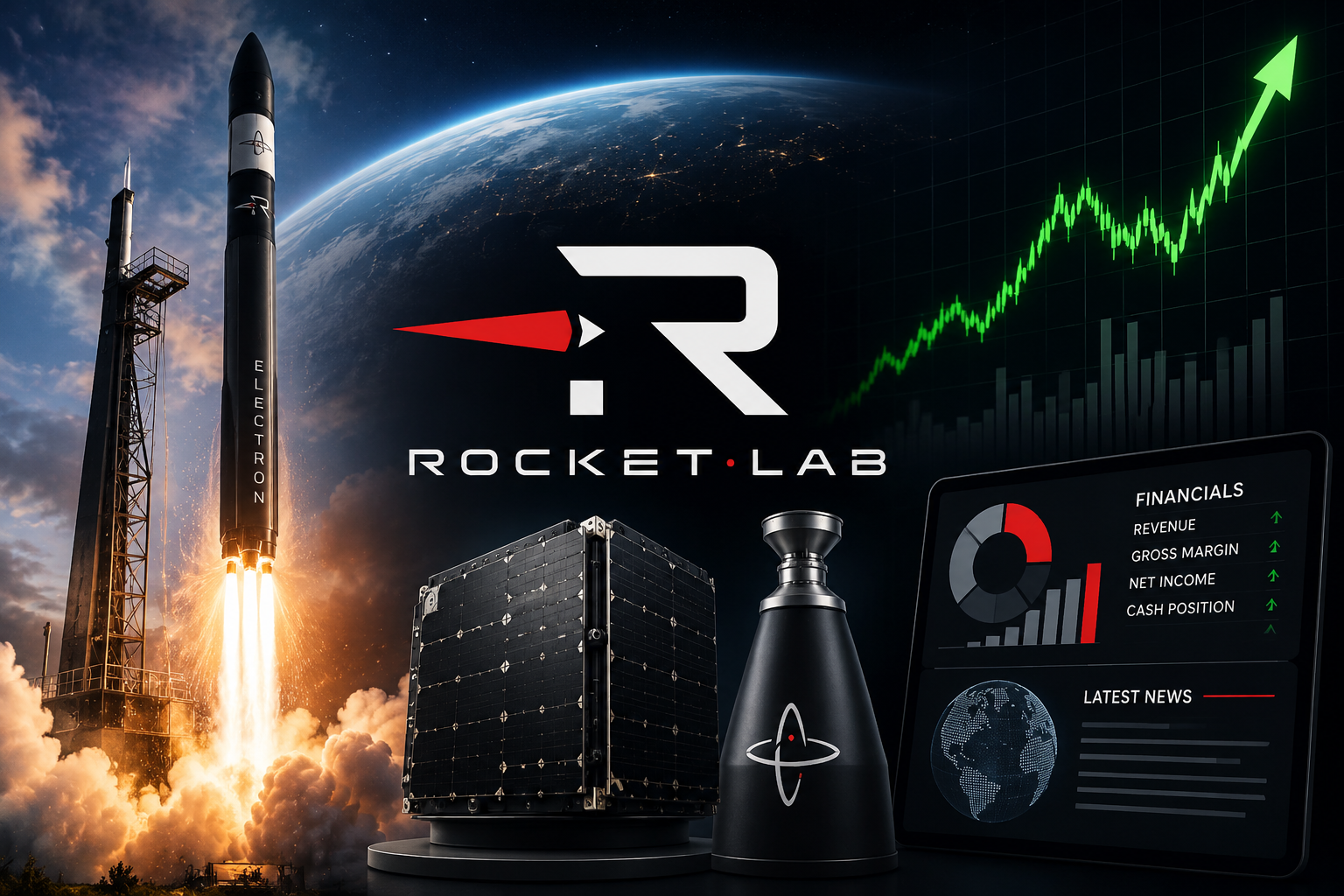
Quick summary: Rocket Lab Corporation (NASDAQ: RKLB) is a Long Beach, California based space company founded in 2006 by New Zealand engineer Sir Peter Beck. The company began as a small satellite launch provider and has grown into a vertically integrated space business that designs, builds, and launches rockets and spacecraft for commercial, government, and national security customers.
Rocket Lab delivered record full year 2025 revenue of $601.8 million, up 38 percent from 2024, and followed that with record first quarter 2026 revenue of $200.3 million, up 63.5 percent year over year. The company’s backlog stood at $2.2 billion as of the first quarter of 2026, up 108 percent year over year, reflecting strong demand across both its launch and spacecraft manufacturing businesses.
The biggest recent development is Rocket Lab’s announced $8 billion cash and stock acquisition of satellite communications provider Iridium Communications, unveiled on June 29, 2026, a deal analysts say could transform Rocket Lab into a fully vertically integrated space platform. RKLB stock, which trades with significant volatility, jumped sharply on the news and traded in the high $90s to around $107 in early July 2026, off its all time high of $151.00 reached in May 2026. Rocket Lab is led by founder, Chairman, President, and CEO Peter Beck and does not pay a dividend.
Quick Facts
Full Name
Rocket Lab Corporation
Ticker Symbol
NASDAQ: RKLB
Founded
2006, in New Zealand
Founder
Sir Peter Beck
Headquarters
Long Beach, California
CEO
Sir Peter Beck, Founder, Chairman, President, and CEO
Employees
Approximately 2,600
Industry
Space launch services and spacecraft manufacturing
IPO
Became public in August 2021 through a SPAC merger with Vector Acquisition Corporation
FY2025 Revenue
$601.8 million, up 38 percent year over year
Market Capitalization
Approximately $57 to $60 billion (as of early July 2026)
Dividend
None, Rocket Lab does not currently pay a dividend
Stock Exchange
Nasdaq
What Is Rocket Lab?
Rocket Lab is an end to end space company that designs, manufactures, and launches rockets, and also builds spacecraft and satellite components for other operators. Unlike many launch providers that only offer rides to orbit, Rocket Lab positions itself as a vertically integrated space business, capable of designing a satellite, manufacturing it, and launching it on the company’s own rocket.
The company’s Electron rocket has become the most frequently flown small satellite launch vehicle in the world, while its larger, partially reusable Neutron rocket is under development to compete for medium lift missions, including large satellite constellations. Rocket Lab also runs a substantial Space Systems business supplying spacecraft components, satellite buses, and complete satellites to commercial and government customers.
Company History
Rocket Lab was founded in June 2006 by Peter Beck, a self-taught New Zealand engineer who had no formal university education but had spent years building increasingly sophisticated rockets in his spare time. Beck started the company after a trip to the United States, where he met aerospace professionals and concluded he could build a viable rocket company back home, funded initially with $300,000 from angel investor Mark Rocket.
In November 2009, Rocket Lab’s Atea-1 suborbital rocket reached space, making it the first private company in the Southern Hemisphere to do so. The company later developed its orbital Electron rocket, first launched unsuccessfully in May 2017 before achieving its first successful orbital flight in January 2018. Around 2013, Rocket Lab shifted its corporate registration and opened a second headquarters in the United States to gain better access to customers, capital, and talent, while retaining its original launch site and a large New Zealand workforce.
Rocket Lab went public on the Nasdaq in August 2021 through a merger with special purpose acquisition company Vector Acquisition Corporation, a deal that valued the combined company at roughly $4.1 billion and provided approximately $750 million in growth capital. Since then, the company has expanded aggressively through acquisitions, including spacecraft software company Advanced Solutions, satellite separation system maker Planetary Systems Corporation, solar power supplier SolAero, and national security payload provider Geost, steadily building out its vertically integrated Space Systems business alongside continued Electron launches and development of the larger Neutron rocket.
Founders
Sir Peter Beck, who founded Rocket Lab in 2006 after years of self-taught rocketry experimentation in New Zealand, including building rocket powered bicycles and jet packs. Beck had no formal aerospace education and was turned away from internships at NASA and Boeing before deciding to start his own company. He was knighted by New Zealand in 2024 for his contributions to the country’s aerospace industry.
Early seed investors who backed Beck’s vision included New Zealand internet entrepreneur Mark Rocket, businessman Stephen Tindall, venture capitalist Vinod Khosla, and the New Zealand government, support that helped Rocket Lab progress from a small experimental rocket program to a company capable of reaching orbit.
CEO
Peter Beck has served as Rocket Lab’s Chief Executive Officer since founding the company, and has also held the title of President since 2013 and Chairman of the Board since the company’s 2021 public listing. Beck is known for his hands-on, engineering-first leadership style and continues to be closely involved in Rocket Lab’s technical direction, including its development of 3D-printed rocket engines and reusable launch technology.
Beck has said he took Rocket Lab public partly to build a durable, multigenerational company that would not be overly dependent on any single individual, while also gaining a public equity currency to fund acquisitions. Under his leadership, Rocket Lab has completed more than a dozen acquisitions since going public and has pursued an increasingly ambitious strategy culminating in the proposed 2026 acquisition of satellite operator Iridium Communications.
Headquarters
Rocket Lab is headquartered in Long Beach, California, having consolidated its main operations there after initially opening a United States base in nearby Huntington Beach around 2013. The company maintains a significant presence in New Zealand, including its original Launch Complex 1 on the Mahia Peninsula, and operates additional facilities across the United States, including a second launch site at Wallops Island, Virginia, along with manufacturing and engineering sites in states such as Colorado, New Mexico, and Maryland gained through acquisitions.
Business Segments
Rocket Lab reports its financial results across two main business segments:
Launch Services, which includes revenue from Electron and, once operational, Neutron rocket launches, offered on both dedicated mission and rideshare bases to commercial, civil, and national security customers.
Space Systems, which includes spacecraft design and engineering services, satellite components, complete spacecraft manufacturing, and on-orbit management and constellation management services.
Space Systems has grown to become Rocket Lab’s larger segment by revenue, reflecting the company’s strategy of expanding beyond launch into the broader spacecraft manufacturing and satellite component supply chain, a strategy that would be extended further into satellite network operations if the pending Iridium acquisition is completed.
Products and Services
Electron Rocket
A small orbital launch vehicle and the most frequently flown small-lift rocket in the world, known for 3D-printed engines and carbon composite construction.
Neutron Rocket
A medium-lift, partially reusable launch vehicle in development, designed for large satellite constellations, interplanetary missions, and potentially future human spaceflight.
Photon Spacecraft Platform
A configurable satellite bus used for missions ranging from Earth orbit to deep space, including NASA’s CAPSTONE mission to the Moon.
Spacecraft Components
Star trackers, reaction wheels, solar panels, electric propulsion systems, software-defined radios, separation systems, and electro-optical and infrared sensors sold to other satellite builders.
HASTE
Hypersonic Accelerator Suborbital Test Electron, a suborbital variant of Electron used for hypersonic technology testing for government customers.
National Security and Optical Systems
Payload and electro-optical and infrared sensor capabilities gained through the Geost acquisition, positioning Rocket Lab as a supplier to U.S. national security space programs.
Revenue Breakdown
In the first quarter of 2026, Rocket Lab’s Space Systems segment generated more revenue than Launch Services, continuing a trend in which spacecraft manufacturing has grown into the company’s larger business line.
Rocket Lab Q1 2026 Revenue by Segment
Source: Rocket Lab Q1 2026 earnings release. Total Q1 2026 revenue was $200.3 million, up 63.5 percent year over year.
Rocket Lab’s backlog, which represents future contracted revenue, reached $2.2 billion as of the first quarter of 2026, up 108 percent year over year, reflecting strong demand for both spacecraft manufacturing contracts and upcoming Electron and Neutron launches.
Financial Performance
Rocket Lab’s annual revenue has grown rapidly since its public listing, compounding at a high rate as both its launch cadence and spacecraft manufacturing business have scaled.
Rocket Lab Annual Revenue, 2021 to 2025
Source: Rocket Lab annual earnings releases, fiscal years 2021 through 2025.
Key recent financial results include:
Full year 2025 revenue of $601.8 million, up 38 percent from 2024, with a GAAP net loss of $198.2 million, widening slightly from the prior year as the company continued to invest heavily in Neutron development.
First quarter 2026 revenue of $200.3 million, a record for the company and up 63.5 percent year over year, with non-GAAP gross margins of 43 percent, exceeding company guidance.
First quarter 2026 GAAP net loss narrowed to $0.07 per share, an improvement from a $0.09 per share loss in the fourth quarter of 2025.
Backlog of $2.2 billion as of the first quarter of 2026, up 108 percent year over year, split across both Launch Services and Space Systems contracts.
Second quarter 2026 guidance calling for revenue between $225 million and $240 million, with GAAP gross margins of 33 to 35 percent and non-GAAP gross margins of 38 to 40 percent.
Trailing twelve month revenue through March 31, 2026 of approximately $680 million, up nearly 46 percent year over year, reflecting continued acceleration in the business.
Rocket Lab remains unprofitable on a GAAP basis as it continues to invest heavily in developing the Neutron rocket and integrating recent acquisitions, though losses per share have generally narrowed over time as revenue has scaled and gross margins have improved.
Stock Information
Rocket Lab trades on the Nasdaq exchange under the ticker symbol RKLB. The stock has been one of the more dramatic movers among recently public space companies, rising from single digits shortly after its 2021 debut to an all time high above $150 in May 2026, before pulling back sharply and then rallying again on the announced Iridium acquisition.
Rocket Lab Stock, Approximate 12 Month Price Range
Approximate figures as of early July 2026. RKLB has a history of large single day and single month price swings, so treat this as a general reference, not a real time quote.
Selected RKLB Stock Metrics, Early July 2026
Recent Trading Range
Approximately $98 to $107
52 Week Range
$33.73 to $151.00
All Time High
$151.00, reached May 27, 2026
Market Capitalization
Approximately $57 to $60 billion
Beta
Approximately 3.0, indicating very high volatility relative to the broader market
Analyst Consensus
Majority Buy ratings among covering analysts
Average Analyst Price Target
Roughly $110 to $130, with several targets raised following the Iridium acquisition announcement
RKLB shares jumped as much as 16 percent in a single session after the Iridium acquisition was announced on June 29, 2026, and multiple analysts, including firms such as BofA, Citizens, and Craig-Hallum, raised their price targets in the following days, citing the deal’s potential to add a large, recurring revenue satellite communications business to Rocket Lab’s existing launch and spacecraft manufacturing operations.
Dividends
Rocket Lab does not currently pay a dividend to shareholders. As a company still investing heavily in developing its Neutron rocket, expanding its Space Systems business, and now pursuing a large acquisition of Iridium Communications, Rocket Lab has prioritized reinvestment and growth over returning capital to shareholders.
Dividend Frequency: None
Dividend Yield: Not applicable
Capital Allocation Priority: Neutron rocket development, spacecraft manufacturing capacity, acquisitions, and integration of the pending Iridium Communications deal
Given Rocket Lab’s current stage of growth and its ongoing capital intensive rocket development program, a dividend is unlikely in the foreseeable future.
Competitors
Rocket Lab competes across launch services, spacecraft manufacturing, and increasingly satellite communications. Its main competitors include:
SpaceX
The dominant player in global launch services and Rocket Lab’s most significant competitor, particularly as Rocket Lab’s Neutron rocket aims to compete for medium lift missions.
United Launch Alliance
A joint venture between Boeing and Lockheed Martin that competes with Rocket Lab for U.S. government and national security launch contracts.
Blue Origin
Jeff Bezos’ space company, developing its own orbital launch vehicles that compete with Rocket Lab’s Neutron rocket in the medium lift category.
Firefly Aerospace
A smaller launch and lunar lander company competing with Rocket Lab in parts of the small and medium launch market.
Intuitive Machines
A space company focused on lunar landers and space infrastructure that overlaps with some of Rocket Lab’s Space Systems and national security work.
Satellite Communications Providers
Companies such as SpaceX’s Starlink and Viasat compete in satellite communications, a market Rocket Lab would enter more directly if its proposed Iridium acquisition is completed.
Recent News
Rocket Lab announced an $8 billion cash and stock acquisition of satellite communications provider Iridium Communications on June 29, 2026, a deal analysts described as transformative for the company’s position in the space industry.June 29, 2026
RKLB shares rose as much as 16 percent following the Iridium announcement, with multiple Wall Street analysts subsequently raising their price targets, citing the deal’s potential to add a vertically integrated satellite network to Rocket Lab’s launch and manufacturing businesses.Late June to early July 2026
Rocket Lab reported record first quarter 2026 revenue of $200.3 million, up 63.5 percent year over year, with backlog growing 108 percent to $2.2 billion.Early 2026
Rocket Lab completed its acquisition of Optical Support, Inc. in February 2026, adding around 20 team members and additional component machining and testing facilities to its Space Systems business.February 2026
Rocket Lab continued regular Electron launch operations in 2026, including its tenth consecutive satellite launch for Japan-based Earth observation company Synspective.2026
Rocket Lab’s stock reached an all time high of $151.00 on May 27, 2026, before pulling back more than 45 percent over the following month amid a broader pullback in high growth space and technology stocks.May to June 2026
Rocket Lab continued development of its Neutron medium lift rocket at Wallops Island, Virginia, with commercial and government launches targeted as the vehicle approaches its debut flight.2026
Frequently Asked Questions
What does Rocket Lab do?
Rocket Lab designs, manufactures, and launches rockets, and also builds spacecraft, satellite components, and mission software for commercial, civil, and national security customers, positioning itself as a vertically integrated, end to end space company.
Who is the CEO of Rocket Lab?
Sir Peter Beck, who founded Rocket Lab in 2006, serves as its Chairman, President, and Chief Executive Officer.
Where is Rocket Lab headquartered?
Rocket Lab is headquartered in Long Beach, California, with a significant additional presence in New Zealand, including its original Launch Complex 1 launch site, as well as facilities in Virginia and several other U.S. states.
Does Rocket Lab pay a dividend?
No. Rocket Lab does not currently pay a dividend and instead reinvests its capital into rocket development, spacecraft manufacturing, and acquisitions such as its pending purchase of Iridium Communications. This is general information, not personalized investment advice.
Why did Rocket Lab stock rise sharply in 2026?
Rocket Lab stock jumped after the company announced an $8 billion acquisition of satellite communications provider Iridium Communications in June 2026, a deal that analysts said could transform Rocket Lab into a fully vertically integrated space platform with a large, recurring revenue satellite network business.
What is Rocket Lab’s largest source of revenue?
Rocket Lab’s Space Systems segment, which includes spacecraft manufacturing and components, has become the company’s larger revenue source, generating $136.7 million in the first quarter of 2026, ahead of Launch Services at $63.7 million.
Who founded Rocket Lab?
Rocket Lab was founded in 2006 by Sir Peter Beck, a self-taught New Zealand engineer with no formal aerospace education.
What are Rocket Lab’s main competitors?
Rocket Lab’s key competitors include SpaceX, United Launch Alliance, Blue Origin, and Firefly Aerospace in launch services, along with satellite communications providers such as Starlink and Viasat as the company expands through its proposed Iridium acquisition.
This article is for general informational and educational purposes only and does not constitute financial, investment, or legal advice. Stock prices, financial metrics, and company details change frequently, and Rocket Lab operates in the capital intensive and highly volatile space industry. Always verify current figures with official Rocket Lab investor relations materials, SEC filings, or a live market data source before making any investment decision.
Sources: Rocket Lab Investor Relations shareholder letters and earnings releases (2021 through 2026), Rocket Lab SEC filings, and recent market and news reporting from outlets including Reuters, CNBC, Yahoo Finance, and Forbes.