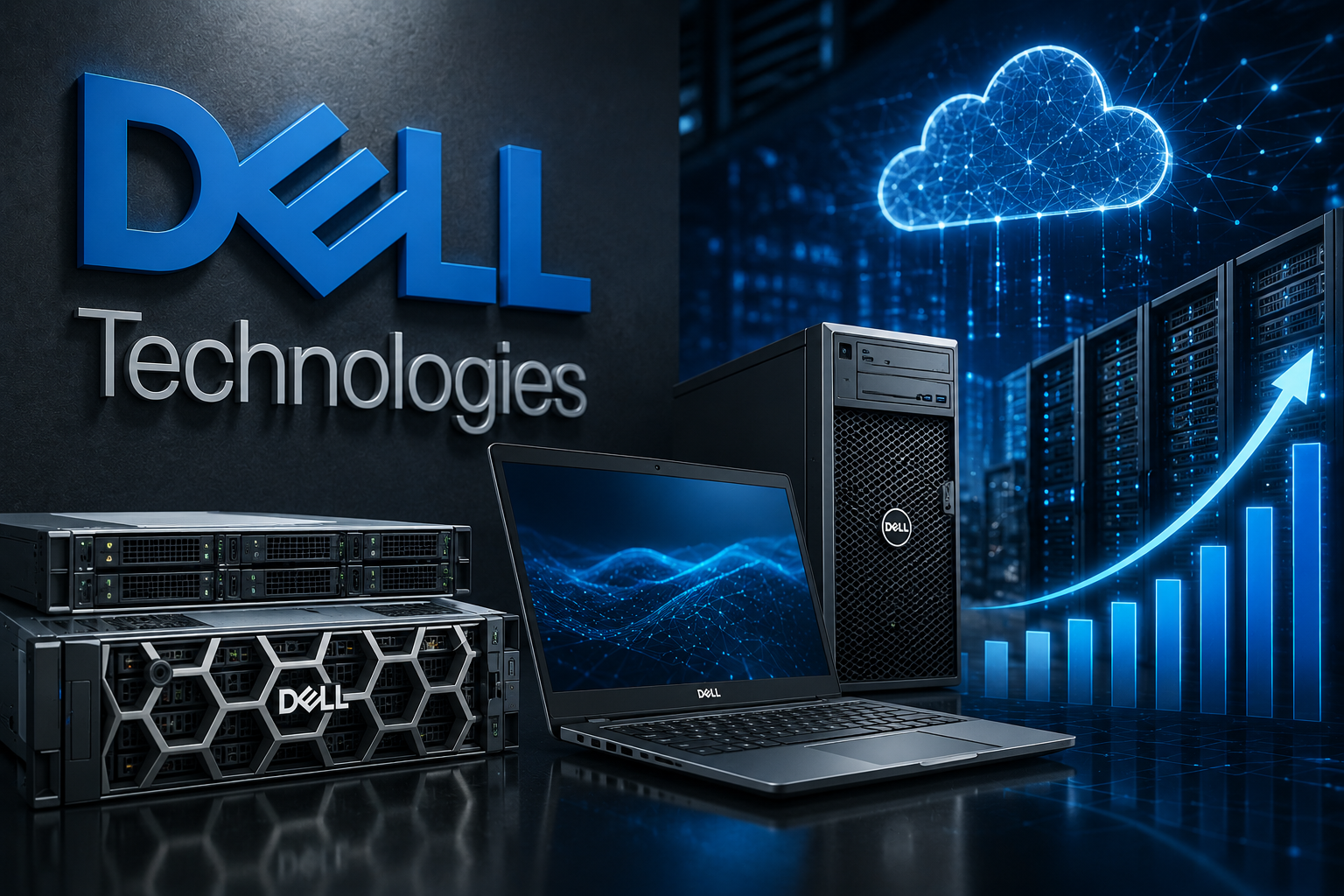
Dell Technologies Inc. (NYSE: DELL) is a global technology company best known for personal computers, enterprise servers, and data storage, which has become one of the primary beneficiaries of the AI data center buildout through its Infrastructure Solutions Group. Founded by Michael Dell in his University of Texas dorm room in 1984, the company has grown from a direct to consumer PC seller into a diversified infrastructure and AI server provider serving businesses, governments, and consumers worldwide.
Dell reported record fiscal 2027 first quarter revenue of $43.8 billion, up 88 percent year over year, with AI optimized server revenue of $16.1 billion, up 757 percent, and a record AI order backlog of $51.3 billion.
Management raised full year fiscal 2027 revenue guidance to a range of $165 billion to $169 billion and increased its AI server revenue target for the year to approximately $60 billion.
Dell’s Infrastructure Solutions Group, which includes servers, networking, and storage, has become the company’s primary growth engine, with revenue up 181 percent year over year in the most recent quarter.
Dell pays a regular quarterly dividend and has continued returning significant capital to shareholders through both dividends and share repurchases even while ramping AI server production.
DELL stock has surged dramatically over the past year, driven by explosive AI server demand, though shares remain volatile and sensitive to updates on memory chip supply constraints and AI order backlog conversion.
Quick Facts
Dell Technologies Inc. at a glance (figures current as of early July 2026)
Ticker
DELL (New York Stock Exchange)
Founded
1984, as PC’s Limited, in Austin, Texas
Renamed Dell Technologies
2016, following the EMC merger
Headquarters
Round Rock, Texas, United States
Founder
Michael Dell
CEO
Michael Dell, Chairman and Chief Executive Officer
Corporate domicile
Reincorporated from Delaware to Texas, effective July 1, 2026
Industry
Computer hardware, enterprise infrastructure, AI servers
Market capitalization
Roughly $255 billion to $280 billion depending on daily trading
Q1 FY2027 revenue
$43.8 billion, up 88 percent year over year
FY2027 revenue guidance
$165 billion to $169 billion
AI server backlog
$51.3 billion as of the most recent quarter
Dividend
Paid quarterly; most recent dividend of $0.63 per share
Key customers and partners
Nvidia, CoreWeave, Google Cloud, OpenAI, Palantir
What Is Dell Technologies?
Dell Technologies is an American technology company that designs, manufactures, sells, and supports a broad range of computing hardware, from personal laptops and desktops to enterprise servers, storage systems, and networking equipment. The company built its original reputation on a direct to consumer sales model, allowing customers to configure and order custom built computers, a strategy that disrupted the traditional retail dominated personal computer market in the 1980s and 1990s.
Today, Dell operates through two primary business segments: the Infrastructure Solutions Group, which sells servers, storage, and networking equipment to businesses and data centers, and the Client Solutions Group, which sells personal computers, laptops, and workstations to consumers and businesses. In recent years, Dell has become one of the most important hardware suppliers to the artificial intelligence infrastructure boom, building large scale AI optimized servers packed with Nvidia graphics processing units for AI labs, cloud providers, and enterprises.
Dell’s scale, global supply chain, and long standing enterprise relationships have positioned it as one of a small number of companies capable of delivering large, complex AI server clusters quickly, a capability that has driven explosive recent growth in its Infrastructure Solutions Group.
Company History
Dell Technologies traces its roots to 1984, when 19 year old Michael Dell founded PC’s Limited in his dorm room at the University of Texas at Austin with approximately $1,000 in starting capital. Dell’s core insight was that personal computers could be sold directly to customers, built to order from off the shelf components, bypassing traditional retail markups and delivering better value and customization than competitors selling through stores.
The company grew rapidly through the late 1980s and 1990s, renaming itself Dell Computer Corporation in 1988 and going public that same year. Michael Dell became the youngest Chief Executive Officer ever to lead a Fortune 500 company in 1992. Over the following decades, Dell expanded from consumer and small business PCs into enterprise servers, storage, and services, including acquisitions such as EqualLogic in 2008 and Perot Systems in 2009.
Key milestones
Selected company history timeline
Period
Event
1984
Founded as PC’s Limited by Michael Dell in a University of Texas dorm room with approximately $1,000 in capital.
1988
Renamed Dell Computer Corporation and completes its initial public offering.
1992
Michael Dell becomes the youngest Chief Executive Officer to lead a Fortune 500 company.
2008 to 2009
Acquires storage company EqualLogic and IT services provider Perot Systems, expanding into enterprise storage and services.
2013
Michael Dell and private equity firm Silver Lake complete a $24.9 billion leveraged buyout, taking Dell private.
2016
Completes its roughly $67 billion acquisition of EMC Corporation, including EMC’s majority stake in VMware, forming Dell Technologies and creating what was then the largest privately controlled technology company in the world.
2018
Dell Technologies returns to public markets through a Class V share exchange, listing on the New York Stock Exchange under the ticker DELL.
2021
Spins off VMware as an independent, publicly traded company, simplifying Dell’s structure and improving financial flexibility.
2024 to 2025
Dell’s AI optimized server business accelerates sharply, with AI order backlog and shipments both growing rapidly as demand from AI labs, cloud providers, and enterprises surges.
2026
Dell reports record fiscal 2027 first quarter revenue of $43.8 billion, raises full year AI server revenue guidance to approximately $60 billion, and completes its redomestication from Delaware to Texas, effective July 1, 2026.
Founders
Dell Technologies was founded by a single principal founder, Michael Dell, who has remained the company’s controlling shareholder and top executive for most of its more than four decade history.
Michael Dell
Founder, Chairman, and Chief Executive Officer. Michael Dell started the company in 1984 while a 19 year old student at the University of Texas at Austin, building IBM compatible personal computers from stock components and selling them directly to customers. He has led the company for most of its history, including its leveraged buyout in 2013, its transformative EMC merger in 2016, and its return to public markets in 2018.
Early backing
Dell’s earliest capital came from family and personal savings rather than institutional venture investors, with Michael Dell securing approximately $300,000 in additional family capital shortly after founding the company to allow him to leave school and focus on the business full time.
Michael Dell’s continued large ownership stake and voting control, maintained through the company’s dual class share structure and reinforced by the 2013 buyout alongside private equity firm Silver Lake, has given him significant influence over Dell Technologies’ strategic direction throughout its history, including major decisions such as the EMC acquisition and the VMware spin off.
CEO
Michael Dell serves as Chairman and Chief Executive Officer of Dell Technologies, a role he has held for the vast majority of the company’s history since founding it in 1984, apart from a period between 2004 and 2007 when he stepped back from the CEO title before returning. Dell has guided the company through several major strategic transformations, including its 2013 leveraged buyout, its 2016 acquisition of EMC and VMware, and its 2018 return to public markets. Alongside Michael Dell, Vice Chairman and Chief Operating Officer Jeff Clarke has played a central operational role in recent years, particularly in scaling Dell’s AI optimized server business and managing the company’s response to surging AI infrastructure demand.
Headquarters
Dell Technologies is headquartered in Round Rock, Texas, near Austin, where Michael Dell originally founded the company. In 2026, Dell’s board of directors and shareholders approved changing the company’s state of incorporation from Delaware to Texas, a redomestication that became effective on July 1, 2026. The move formally aligned Dell’s legal home with its long standing operational headquarters and workforce concentration in Texas, though it did not change the company’s operations, management, or capital structure. Dell also maintains a large global footprint, with manufacturing, research, and sales operations across the Americas, Europe, the Middle East, and Asia.
Business Segments
Dell Technologies reports its results primarily through two main business segments.
Infrastructure Solutions Group (ISG)
Dell’s data center and enterprise infrastructure business, covering servers, storage, and networking products, including its fast growing AI optimized server line used to build large scale AI training and inference clusters for cloud providers, AI labs, and enterprises.
Client Solutions Group (CSG)
Dell’s personal computing business, covering notebooks, desktops, workstations, and branded peripherals such as displays, docking stations, and accessories, sold to both commercial and consumer customers.
Within Infrastructure Solutions Group, Dell further breaks out AI optimized servers, traditional servers and networking, and storage as distinct revenue lines, reflecting how central AI infrastructure has become to the company’s overall growth story. Within Client Solutions Group, Dell separately tracks commercial client revenue, which has posted multiple consecutive quarters of growth, and consumer revenue, which has grown more modestly.
Products and Services
Dell’s product portfolio spans consumer and business personal computers, enterprise data center hardware, and a growing range of AI infrastructure systems.
AI optimized servers: Large scale server systems built around Nvidia graphics processing units, including rack scale systems such as the PowerEdge XE9812 and newer PowerRack designs built on Nvidia’s latest Vera Rubin platform, used by cloud providers and AI labs to train and run large AI models.
Traditional servers and networking: General purpose enterprise servers and networking equipment used to run everyday business applications, which have also seen strong growth as enterprises refresh aging hardware fleets.
Storage systems: All flash, purpose built, hyperconverged infrastructure, and software defined storage products used by enterprises to manage and protect their data.
Notebooks, desktops, and workstations: Dell’s core personal computing lineup, sold to consumers, small businesses, and large enterprises under various product lines and configurations.
Peripherals and accessories: Branded displays, docking stations, keyboards, mice, webcams, and audio devices that complement Dell’s core computing hardware.
Financing and as-a-service offerings: Payment and consumption solutions including leases, loans, subscriptions, and utility based pricing models that allow customers to access Dell hardware without large upfront capital expenditure.
Revenue Breakdown
Dell’s revenue has shifted dramatically toward its Infrastructure Solutions Group in recent quarters, driven almost entirely by explosive growth in AI optimized server sales.
Q1 fiscal 2027 revenue by segment
Infrastructure Solutions Group revenue of $29.01 billion, up 181 percent year over year, has become Dell’s dominant growth engine, roughly double the size of Client Solutions Group revenue of $14.61 billion, up 17 percent.
Within Infrastructure Solutions Group, AI optimized server revenue reached $16.13 billion in the most recent quarter, up 757 percent year over year, while traditional servers and networking revenue grew 92 percent to $8.54 billion and storage revenue grew 8 percent to $4.33 billion. Within Client Solutions Group, commercial client revenue grew 18 percent to $13.02 billion, marking its seventh consecutive quarter of growth, while consumer revenue grew 9 percent to $1.59 billion. Dell booked $24.4 billion in new AI orders during the quarter and ended it with a record AI server backlog of $51.3 billion, with management describing customer demand as spanning neocloud providers, sovereign government deployments, and large enterprises.
Financial Performance
Dell’s financial results have been transformed by the AI server boom, with revenue, earnings, and cash flow all reaching record levels in the most recent reported quarter.
Quarterly revenue growth
Dell’s fiscal 2027 first quarter revenue of $43.8 billion, up 88 percent year over year, beat Wall Street consensus estimates of approximately $35.5 billion by a wide margin.
Selected fiscal 2027 first quarter financial results
Metric
Q1 FY2027
Year over year change
Revenue
$43.8 billion
Up 88 percent
GAAP diluted EPS
$5.24
Up 282 percent
Non-GAAP diluted EPS
$4.86
Up 214 percent
GAAP net income
$3.44 billion
Up 256 percent from $965 million
Cash flow from operations
$4.1 billion
A first quarter record for the company
Capital returned to shareholders
$2.1 billion
Comprised of $1.6 billion in buybacks and $464 million in dividends
AI server backlog
$51.3 billion
Record level, with active AI customers surpassing 5,000
For the second quarter of fiscal 2027, Dell guided for revenue of approximately $44.5 billion, plus or minus $500 million, representing roughly 49 percent year over year growth at the midpoint. For the full fiscal year, management raised guidance to a range of $165 billion to $169 billion in revenue, up from prior guidance issued only 90 days earlier, alongside diluted earnings per share guidance of approximately $17.90 at the midpoint. Management has been explicit that supply, particularly memory chip availability, rather than customer demand, remains the primary constraint on how quickly Dell can convert its AI backlog into recognized revenue, and has said it expects to exit the fiscal year with meaningful backlog still remaining.
Why the backlog matters: Dell’s AI server backlog of $51.3 billion provides unusually strong forward revenue visibility compared to Dell’s traditional PC business, which is more sensitive to near term economic conditions. At the same time, the sheer size of the backlog puts pressure on Dell’s supply chain, particularly around memory chip sourcing and large scale cluster integration, making execution the key variable investors are watching over the coming quarters.
Stock Information
Dell Technologies returned to public markets in December 2018 through a Class V share exchange following its 2016 acquisition of EMC, listing on the New York Stock Exchange under the ticker DELL. The stock traded in a relatively narrow range for several years before surging dramatically starting in 2025 as AI server demand accelerated sharply.
Key stock price levels over the past year
DELL shares have traded between roughly $110 and $469 over the past 52 weeks, with the stock up well over 200 percent year over year, driven by the sharp acceleration in AI server demand.
Snapshot trading data as of early July 2026
Recent share price
Roughly $395 to $432, varying by session
Market capitalization
Approximately $255 billion to $280 billion depending on the trading day
52 week range
Approximately $110.22 to $469.47
Trailing twelve month EPS
Approximately $8.68 to $12.97, varying by data provider and reporting basis
Dividend yield
Approximately 0.5 percent to 0.6 percent
Beta
Approximately 1.78, indicating higher volatility relative to the broader market
Next earnings date
Expected September 3, 2026
DELL shares have shown a pattern of sharp single day moves tied to quarterly earnings, AI order backlog updates, and industry news involving competitors such as Super Micro Computer. Several major banks, including Morgan Stanley, raised their price targets on DELL shares in June 2026, citing evidence that enterprise server demand has proven more resilient than expected even amid price increases, supported by compute shortages, hardware refresh cycles, and growing AI infrastructure needs. Some analysts have also flagged Dell’s forward valuation as attractive relative to AI infrastructure peers, given its lower earnings multiple and more diversified revenue base compared to pure play AI server companies.
Dividends
Dell Technologies pays a regular quarterly cash dividend to shareholders, with a recent quarterly dividend of $0.63 per share. The company’s dividend yield has generally remained under 1 percent in recent periods, reflecting the stock’s strong price appreciation, and Dell’s payout ratio has remained relatively conservative, in the range of roughly 18 percent to 28 percent of earnings in recent years. Alongside dividends, Dell has returned significant additional capital to shareholders through share buybacks, including $1.6 billion in repurchases in a single recent quarter, reflecting management’s approach of balancing shareholder returns with continued heavy investment in AI server manufacturing capacity.
Competitors
Dell competes across both its enterprise infrastructure and personal computing businesses, facing a mix of established hardware makers and newer AI focused entrants.
Selected Dell Technologies competitors
Competitor
Positioning
Hewlett Packard Enterprise (HPE)
Dell’s closest direct competitor in enterprise servers, storage, and networking, also competing aggressively for AI server contracts with hyperscalers and enterprises.
Super Micro Computer (SMCI)
A high profile AI server specialist that competes directly with Dell’s AI optimized server business, though it has faced governance and accounting scrutiny that Dell has generally avoided.
Lenovo
A major competitor in personal computers and, increasingly, enterprise servers, with a growing presence in the AI PC market that competes with Dell’s Client Solutions Group.
HP Inc.
A significant competitor in the consumer and commercial personal computer market, though it does not compete directly with Dell in enterprise servers and storage to the same degree.
Cisco Systems
A competitor in networking equipment and, through partnerships and its own hardware, increasingly in data center infrastructure relevant to AI deployments.
Analysts have generally noted that Dell’s global distribution network, long standing enterprise relationships, and diversified revenue base across PCs, servers, and storage give it scale advantages in winning large AI deployment contracts compared to narrower AI server specialists such as Super Micro Computer. At the same time, Dell faces the risk of margin compression if AI server pricing becomes more competitive as more hardware makers pursue the same large scale AI infrastructure contracts.
Recent News
May 2026, record Q1 fiscal 2027 results: Dell reported record revenue of $43.8 billion, up 88 percent year over year, record AI server revenue of $16.1 billion, and a record AI backlog of $51.3 billion, prompting a significant upward revision to full year guidance.
July 2026, redomestication to Texas completed: Dell completed its previously approved conversion from a Delaware corporation to a Texas corporation, effective July 1, 2026, following shareholder approval at its June 25, 2026 annual meeting, a move the company said would align its legal home with its long standing Texas headquarters.
June 2026, Arrow distribution relationship ended: Dell ended its decade long enterprise computing distribution partnership with Arrow Electronics’s ECS unit in North America following a formal review process, a change analysts described as likely immaterial to Dell’s own earnings.
June 2026, analyst price target increases: Morgan Stanley and other major banks raised their price targets on DELL shares, citing evidence that enterprise server demand has proven more resilient than expected amid compute shortages and AI related infrastructure needs.
2026, new AI partnerships and product launches: Dell announced new AI infrastructure partnerships with Nvidia, Google Cloud, OpenAI, and Palantir, alongside first shipments of Nvidia Vera Rubin based rack scale systems, including the PowerRack with PowerEdge XE9812, to customers such as CoreWeave.
Late June 2026, competitor scrutiny: Reports of a Taiwan office raid connected to alleged Nvidia chip smuggling involving competitor Super Micro Computer drew renewed attention to Dell’s comparatively stable governance profile among AI server makers.
Ongoing, insider stock activity: Dell insiders, including large shareholders and directors, have made notable stock transactions in 2026 amid the stock’s sharp rally, drawing investor attention as a sentiment signal alongside the company’s fundamental AI server growth story.
Frequently Asked Questions
What does Dell Technologies actually do?
Dell designs, manufactures, and sells personal computers, enterprise servers, data storage systems, and networking equipment, and has become a major supplier of AI optimized servers used to build large scale artificial intelligence computing clusters for cloud providers, AI labs, and enterprises.
Is Dell Technologies profitable?
Yes. Dell reported GAAP net income of $3.44 billion in its fiscal 2027 first quarter, up 256 percent year over year, driven primarily by explosive growth in its AI optimized server business within the Infrastructure Solutions Group.
Who founded Dell Technologies?
Dell Technologies was founded in 1984 by Michael Dell, who started the company as PC’s Limited in his University of Texas dorm room with approximately $1,000 in starting capital, and who continues to serve as the company’s Chairman and Chief Executive Officer.
Does Dell Technologies pay a dividend?
Yes. Dell pays a regular quarterly cash dividend, with a recent quarterly payment of $0.63 per share, alongside significant additional capital returned to shareholders through share buybacks.
Why has DELL stock risen so sharply?
DELL stock has surged primarily due to explosive growth in its AI optimized server business, with AI server revenue up 757 percent year over year in the most recent quarter and a record AI order backlog of $51.3 billion providing strong forward revenue visibility.
When did Dell Technologies go public?
Dell first went public in 1988 as Dell Computer Corporation, was taken private in a 2013 leveraged buyout led by Michael Dell and Silver Lake, and returned to public markets in December 2018 as Dell Technologies following its 2016 acquisition of EMC.
What is Dell’s Infrastructure Solutions Group?
The Infrastructure Solutions Group, or ISG, is Dell’s data center and enterprise hardware business, covering servers, storage, and networking equipment, including its fast growing AI optimized server line, which has become the company’s dominant revenue and growth driver.
How does Dell compare to HPE and Super Micro Computer in AI servers?
Dell is generally viewed as having scale advantages over both competitors, with a larger and more diversified enterprise customer base than Super Micro Computer and a broader global distribution network than HPE, though all three companies compete directly for large scale AI server contracts with cloud providers and enterprises.
This article is for general informational and educational purposes only and does not constitute investment, financial, tax, or legal advice. Stock prices, financial figures, and company statistics change frequently and the numbers above reflect publicly reported data available as of early July 2026, which may have since changed. Always verify current figures with primary sources such as Dell Technologies’ investor relations page and official SEC filings, and consult a licensed financial advisor before making investment decisions. This article does not constitute a recommendation to buy or sell any security.