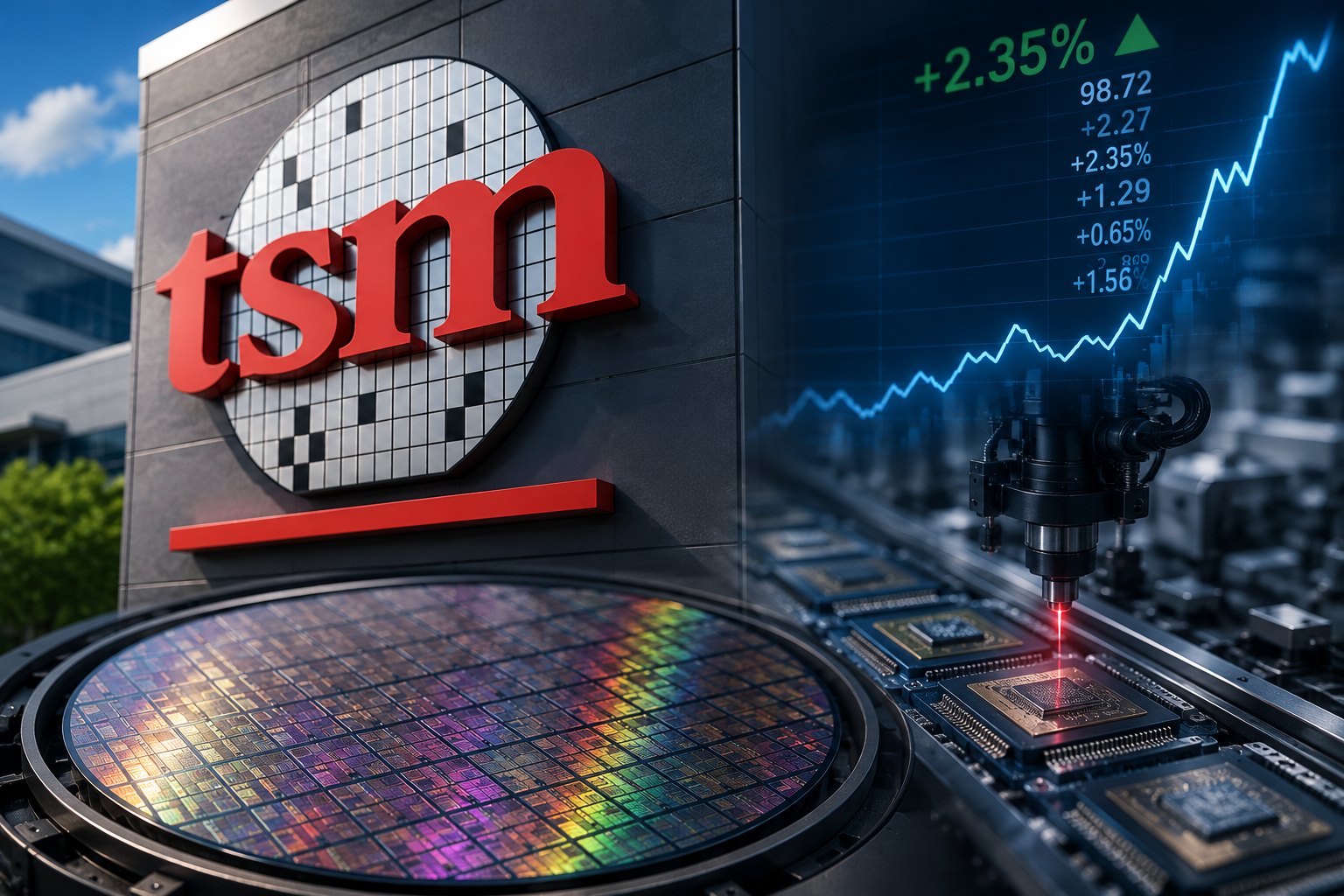
Taiwan Semiconductor Manufacturing Company Limited (NYSE: TSM) is the world’s largest dedicated semiconductor foundry, manufacturing chips designed by other companies rather than selling chips under its own brand. Founded in Hsinchu, Taiwan in 1987 by Morris Chang, TSMC pioneered the pure play foundry model that now underpins the global fabless semiconductor industry, producing advanced chips for customers including Nvidia, Apple, AMD, and Qualcomm.
TSMC reported record first quarter 2026 revenue of $35.90 billion, up 40.6 percent year over year in US dollar terms, with net income up 58.3 percent and gross margin reaching 66.2 percent.
Management guided for second quarter 2026 revenue of $39.0 billion to $40.2 billion and raised full year 2026 revenue growth guidance to above 30 percent in US dollar terms, driven by surging demand for AI and high performance computing chips.
TSMC controls an estimated 70 percent or more of the global dedicated foundry market, with advanced nodes of 7 nanometers and below making up 74 percent of wafer revenue in the first quarter of 2026.
The company is expanding aggressively outside Taiwan, with new fabs in Arizona, Kumamoto in Japan, and Dresden in Germany, backed by 2026 capital expenditure guidance of $52 billion to $56 billion.
TSMC pays a regular cash dividend to shareholders and raised its 2026 dividend by approximately 28 percent, even as it continues to invest heavily in capacity expansion.
Quick Facts
Taiwan Semiconductor Manufacturing Company at a glance (figures current as of early July 2026)
Ticker
TSM (New York Stock Exchange, ADR); 2330 (Taiwan Stock Exchange)
Founded
February 1987, in Hsinchu, Taiwan
Headquarters
Hsinchu City, Taiwan
Founder
Morris Chang
CEO
Dr. C.C. Wei, Chairman and Chief Executive Officer
Roughly $2.0 trillion to $2.4 trillion depending on daily trading
Q1 2026 revenue
$35.90 billion, up 40.6 percent year over year in US dollar terms
Full year 2026 guidance
Revenue growth above 30 percent in US dollar terms
Global foundry market share
Approximately 70 percent or more of the dedicated foundry market
Dividend
Paid quarterly; 2026 annual dividend raised to at least NT$23 per share, up from NT$18
Key customers
Nvidia, Apple, AMD, Qualcomm, Broadcom, MediaTek
What Is Taiwan Semiconductor Manufacturing?
Taiwan Semiconductor Manufacturing Company, universally known as TSMC, is the world’s largest dedicated semiconductor foundry. Rather than designing and selling chips under its own brand, TSMC manufactures chips designed by other companies, a business model known as pure play foundry manufacturing. Customers such as Nvidia, Apple, AMD, and Qualcomm design their own chips and then pay TSMC to fabricate them using TSMC’s advanced manufacturing processes.
This model has made TSMC the indispensable manufacturing backbone of the modern semiconductor industry. Nearly every advanced processor powering smartphones, AI accelerators, and high performance computing systems around the world passes through a TSMC fabrication facility at some point, giving the company an outsized and largely irreplaceable role in global technology supply chains. TSMC’s advanced process technologies, including its leading edge 3 nanometer and 2 nanometer nodes, are widely considered to be at least a generation ahead of most competitors.
TSMC’s scale and technological leadership have made it central to the artificial intelligence boom, since virtually all cutting edge AI accelerator chips, including those from Nvidia and AMD, are manufactured at TSMC facilities.
Company History
TSMC was founded in February 1987 by Morris Chang, a Taiwanese American engineer who had previously spent a long career at Texas Instruments before being recruited by the Taiwanese government to help build the island’s semiconductor industry. Chang pioneered the pure play foundry concept, an idea that both Intel and Texas Instruments had reportedly turned down, betting that separating chip design from chip manufacturing would eventually reshape the industry.
TSMC was established as a joint venture, with Taiwan’s National Development Fund taking a stake of roughly 48 percent, Dutch electronics company Philips contributing capital and technology licensing at just under 28 percent, and private investors making up the remainder. The company’s first major foreign customer win came in late 1987, when Intel visited TSMC to have some of its older, less advanced chip designs manufactured, an early signal of TSMC’s credibility with major American semiconductor companies.
Key milestones
Selected company history timeline
Period
Event
February 1987
Founded in Hsinchu, Taiwan by Morris Chang as a joint venture between Taiwan’s government, Philips, and private investors.
1987
Secures Intel as its first major American customer, validating the pure play foundry business model.
1993 to 1997
Lists on the Taiwan Stock Exchange in 1993 and becomes the first Taiwanese company listed on the New York Stock Exchange in 1997.
1995
Surpasses $1 billion in annual revenue for the first time.
2005
Morris Chang steps down as Chief Executive Officer, though he later returns to the role in 2009 after a period of slower growth under his successor.
2018
Morris Chang retires fully from TSMC, with Mark Liu becoming Chairman and C.C. Wei becoming Chief Executive Officer.
2020 to 2024
TSMC accelerates global expansion, breaking ground on major new fabs in Arizona, Kumamoto in Japan, and Dresden in Germany, with the first Arizona fab entering high volume production in late 2024.
2025
Full year revenue reaches NT$3,809 billion, up 35.6 percent, with high performance computing overtaking smartphones as TSMC’s single largest revenue platform.
2026
TSMC reports its eighth consecutive quarterly earnings beat, raises full year revenue growth guidance to above 30 percent, and continues ramping 2 nanometer production alongside new capacity in Arizona, Japan, and Germany.
Founders
TSMC was founded by a single principal figure, Morris Chang, often described as the father of Taiwan’s semiconductor industry, though the company’s formation relied heavily on Taiwanese government backing and a key technology partnership with Philips.
Morris Chang
Founder, and Chief Executive Officer from 1987 to 2005, later returning as CEO in 2009 before serving as Chairman until his full retirement in 2018. Chang previously spent decades at Texas Instruments before being recruited by the Taiwanese government in the mid 1980s to help develop the country’s semiconductor industry, ultimately founding TSMC and pioneering the pure play foundry business model.
Early backers
Taiwan’s National Development Fund provided roughly 48 percent of TSMC’s initial capital, while Dutch electronics company Philips contributed capital and licensed key production technology and intellectual property in exchange for just under a 28 percent stake, with the remainder coming from private Taiwanese investors.
Jim Dykes, a former General Electric semiconductor executive, was brought in by Chang as an early president to help TSMC establish credibility with American and European semiconductor customers, reflecting the company’s early strategy of pairing Taiwanese manufacturing with experienced Western industry connections.
CEO
Dr. C.C. Wei serves as Chairman and Chief Executive Officer of TSMC. Wei has been with the company since 1998 and was named Chief Executive Officer in 2018 when Morris Chang fully retired, initially sharing the role before later also assuming the Chairman title following Mark Liu’s departure. Under Wei’s leadership, TSMC has continued to extend its technology lead with the ramp of 3 nanometer and 2 nanometer process nodes, pursued an aggressive global expansion strategy into the United States, Japan, and Germany, and positioned the company to capture outsized demand from the artificial intelligence and high performance computing boom. Wei has repeatedly described AI related demand as extremely robust in recent earnings calls, underpinning TSMC’s raised growth guidance for 2026.
Headquarters
TSMC is headquartered in Hsinchu City, Taiwan, in the heart of the Hsinchu Science Park, a technology hub that has served as the center of Taiwan’s semiconductor industry since the 1980s. The company operates a network of advanced wafer fabrication facilities, known as fabs, across Taiwan, and has increasingly expanded its manufacturing footprint internationally, with major new facilities in Arizona in the United States, Kumamoto in Japan, and Dresden in Germany, reflecting both customer demand for geographic diversification and growing government pressure to localize advanced chip production outside Taiwan.
Business Segments
TSMC organizes its business primarily around the end markets its manufactured chips serve, referred to internally as platforms, rather than traditional corporate divisions.
High performance computing
TSMC’s largest and fastest growing platform, covering AI accelerators, graphics processing units, and other chips used in data centers and AI infrastructure, which overtook smartphones as the company’s top revenue source in 2025.
Smartphones
Chips used in mobile devices, historically TSMC’s largest platform and still a very large, though now second largest, share of total revenue.
Internet of Things, automotive, and digital consumer electronics
A diversified set of smaller platforms covering embedded systems, automotive semiconductors, and consumer electronics, which help smooth demand fluctuations across the broader business.
Advanced packaging and specialty technologies
Services including TSMC’s 3DFabric advanced packaging technologies, such as CoWoS, which are increasingly critical bottleneck technologies for connecting AI chips to high bandwidth memory.
Products and Services
TSMC’s core service is contract wafer fabrication, but the company also provides a range of supporting design, packaging, and testing services to its semiconductor customers.
Advanced process node manufacturing: Leading edge fabrication technologies including 3 nanometer and 2 nanometer nodes, used to manufacture the most advanced AI accelerators, smartphone processors, and high performance computing chips in the world.
Specialty and mature process technologies: A broad portfolio of older and specialty process nodes serving automotive, industrial, and consumer electronics customers who do not require the most advanced technology.
3DFabric advanced packaging: Silicon stacking and packaging technologies, including CoWoS, or Chip on Wafer on Substrate, which connect multiple chips and high bandwidth memory into a single advanced package, a critical enabling technology for modern AI accelerators.
Design and mask making services: Supporting services that help fabless chip designers bring their products to manufacturing, including photomask production and design ecosystem support.
Testing services: Post manufacturing testing services that help ensure chip quality and reliability before shipment to customers.
Revenue Breakdown
TSMC’s revenue is best understood by end market platform and by process technology node, both of which have shifted meaningfully toward AI and advanced nodes in recent years.
Revenue by platform, full year 2025
High performance computing, which includes AI accelerators and data center chips, reached approximately 58 percent of TSMC’s total wafer revenue in full year 2025, overtaking smartphones as the company’s largest platform for the first time.
Q1 2026 wafer revenue by process node
Advanced technologies of 7 nanometers and below made up 74 percent of TSMC’s wafer revenue in the first quarter of 2026, led by the 5 nanometer node at 36 percent and the 3 nanometer node at 25 percent.
Geographically, TSMC’s revenue has become increasingly concentrated in North America, which is home to major customers such as Nvidia, Apple, and AMD, while revenue from China has declined significantly in recent years as a share of the total, falling from over one fifth to under one tenth of revenue, largely due to United States export restrictions limiting TSMC’s ability to sell advanced node capacity to certain Chinese customers.
Financial Performance
TSMC has delivered eight consecutive quarters of earnings beats through early 2026, supported by surging AI and high performance computing demand alongside consistently expanding margins.
Quarterly revenue growth
TSMC’s first quarter 2026 revenue of $35.90 billion increased 40.6 percent year over year in US dollar terms and exceeded the company’s own prior guidance.
Selected first quarter 2026 financial results
Metric
Q1 2026
Year over year change
Revenue
$35.90 billion (NT$1,134.10 billion)
Up 40.6 percent in USD, 35.1 percent in NTD
Net income
NT$572.48 billion
Up 58.3 percent
Diluted EPS
NT$22.08 (US$3.49 per ADR unit)
Up 58.3 percent
Gross margin
66.2 percent
Up 7.4 percentage points
Operating margin
58.1 percent
Up 9.6 percentage points
Net profit margin
50.5 percent
Up 7.4 percentage points
Return on equity
40.5 percent
Up 7.8 percentage points
Free cash flow
NT$348.21 billion
Supports both capacity expansion and dividends
For the second quarter of 2026, TSMC guided for revenue of $39.0 billion to $40.2 billion, gross margin of 65.5 percent to 67.5 percent, and operating margin of 56.5 percent to 58.5 percent. For full year 2026, management raised its revenue growth guidance to above 30 percent in US dollar terms and lifted long term gross margin targets above 56 percent, while planning capital expenditure toward the high end of a $52 billion to $56 billion range, among the largest single company capital spending plans in the world, aimed at expanding advanced node and packaging capacity to meet AI driven demand.
Why margins matter here: TSMC’s ability to sustain gross margins above 60 percent while spending tens of billions of dollars annually on new fabs is a key reason analysts view the company as the most structurally advantaged player in the AI hardware supply chain. As long as advanced node capacity remains scarce relative to AI chip demand, TSMC has historically been able to pass through cost increases and maintain pricing power with customers such as Nvidia and Apple.
Stock Information
TSMC has been listed on the Taiwan Stock Exchange since 1993 and became the first Taiwanese company listed on the New York Stock Exchange in 1997, trading in the United States as an American Depositary Receipt under the ticker TSM. The stock has been one of the strongest performers among mega cap technology companies over the past several years, driven by TSMC’s central role in manufacturing AI chips.
Key stock price levels over the past year
TSM shares have traded between roughly $223.70 and $479.00 over the past 52 weeks, with the stock up sharply over the past year, driven by strong AI related demand for advanced chip manufacturing.
Snapshot trading data as of early July 2026
Recent share price
Roughly $434 to $455, varying by session
Market capitalization
Approximately $2.0 trillion to $2.4 trillion depending on the trading day
52 week range
Approximately $223.70 to $479.00
Trailing twelve month EPS
Approximately $73.61 per ADR unit
Dividend yield
Approximately 0.8 percent
Analyst consensus
Generally Strong Buy, with price targets recently raised into the $490 to $700 range by several major firms
Next earnings date
Expected July 16, 2026
TSM shares have shown a pattern of sharp moves tied to quarterly earnings, monthly revenue disclosures, updates on AI chip demand from customers such as Nvidia, and geopolitical developments involving Taiwan and China. While the vast majority of Wall Street analysts maintain Buy or Strong Buy ratings, some have flagged valuation and geopolitical risk as reasons for caution, and TSMC was notably removed from at least one major bank’s regional conviction stock list in mid 2026 as part of routine portfolio rebalancing rather than a change in fundamental view.
Dividends
Unlike many high growth semiconductor and AI infrastructure companies, TSMC does pay a regular cash dividend to shareholders, distributed quarterly. The company raised its expected 2026 annual dividend to at least NT$23 per share, up from NT$18 per share in 2025, an increase of roughly 28 percent, reflecting strong free cash flow generation even as TSMC simultaneously funds one of the largest capital expenditure programs in the world. TSMC’s payout ratio has generally remained moderate, allowing the company to return cash to shareholders while still reinvesting heavily in new fabs in Taiwan, Arizona, Japan, and Germany. The trailing dividend yield on TSM shares has generally been under 1 percent given the stock’s strong price appreciation, meaning most of the total return to shareholders in recent years has come from capital gains rather than dividend income.
Competitors
TSMC operates in the semiconductor foundry industry, where it holds a dominant leadership position, though it faces competition at different levels of technology and market segment.
Selected TSMC competitors
Competitor
Positioning
Samsung Foundry
The most direct competitor at the advanced process node level, though Samsung has faced persistent yield challenges on its latest nodes and has generally trailed TSMC’s advanced node market share.
Intel Foundry
Intel has been rebuilding its foundry business to manufacture chips for external customers in addition to its own products, positioning itself as a long term potential competitor at the leading edge, though it remains behind TSMC in advanced node maturity.
GlobalFoundries
A significant player in mature and specialty process nodes, though it does not compete at the most advanced technology nodes where TSMC generates the bulk of its high performance computing revenue.
United Microelectronics Corporation (UMC)
A Taiwanese foundry competitor focused primarily on mature and specialty process technologies rather than leading edge nodes.
SMIC
China’s largest foundry, constrained in its ability to compete at the most advanced nodes due to United States export restrictions on key semiconductor manufacturing equipment.
TSMC’s scale advantage is substantial: some industry estimates put its share of the global dedicated foundry market above 70 percent, and its share of the most advanced process nodes considerably higher still. This dominant position, combined with deep customer relationships built over decades with companies like Apple and Nvidia, gives TSMC significant pricing power and makes it difficult for competitors to catch up at the leading edge, even as Samsung and Intel continue to invest heavily in narrowing the gap.
Recent News
April 2026, record Q1 2026 results: TSMC reported record first quarter revenue of $35.90 billion, up 40.6 percent year over year, alongside a 66.2 percent gross margin that beat the high end of guidance, and raised its full year 2026 revenue growth outlook to above 30 percent in US dollar terms.
2026, continued global fab expansion: TSMC has continued ramping its Arizona facilities, with a second fab’s tool move in planned for 2026 and high volume manufacturing expected in the second half of 2027, alongside ongoing capacity additions at its Kumamoto, Japan site and construction progress in Dresden, Germany.
2026, dividend increase: TSMC raised its expected 2026 annual dividend to at least NT$23 per share, up approximately 28 percent from NT$18 in 2025, reflecting strong free cash flow generation.
Mid 2026, analyst price target increases: Multiple major banks, including Bank of America and UBS, raised their price targets on TSM shares significantly in June 2026, citing accelerating AI accelerator demand and an improved long term margin outlook.
Ongoing, geopolitical and export control considerations: TSMC’s China related revenue has continued to decline as a share of the total amid United States export restrictions on advanced chip sales to certain Chinese customers, while the company’s expanding Arizona investment, reported to total around $250 billion, has been positioned partly as a response to United States policy pressure to localize advanced chip production.
2026, CoWoS advanced packaging capacity expansion: TSMC has continued expanding capacity for its CoWoS advanced packaging technology, a critical bottleneck for connecting AI chips to high bandwidth memory, with some analysts raising their capacity forecasts for the technology through 2026.
2026, next earnings report: TSMC is scheduled to report second quarter 2026 results on July 16, 2026, with analysts closely watching whether revenue guidance of $39.0 billion to $40.2 billion is met or exceeded as a signal of continued AI infrastructure spending strength.
Frequently Asked Questions
What does TSMC actually do?
TSMC manufactures semiconductor chips designed by other companies under a pure play foundry model, rather than designing and selling chips under its own brand. It is the primary manufacturer of advanced chips for customers including Nvidia, Apple, AMD, and Qualcomm.
Is TSMC profitable?
Yes, and significantly so. TSMC reported a net profit margin of 50.5 percent in the first quarter of 2026, with net income up 58.3 percent year over year, supported by high capacity utilization and strong demand for its most advanced process nodes.
Does TSMC pay a dividend?
Yes. Unlike many high growth AI infrastructure companies, TSMC pays a regular quarterly cash dividend and raised its 2026 annual dividend to at least NT$23 per share, up approximately 28 percent from 2025, while the trailing dividend yield on TSM shares remains under 1 percent due to strong share price appreciation.
Who are TSMC’s biggest customers?
TSMC’s largest customers include Nvidia, Apple, AMD, and Qualcomm, all of whom rely on TSMC to manufacture their most advanced chips, spanning AI accelerators, smartphone processors, and high performance computing products.
Why is TSMC considered so important to the AI industry?
Because virtually every leading edge AI accelerator chip in the world, including those designed by Nvidia and AMD, is manufactured using TSMC’s advanced process nodes, the company controls a critical chokepoint in the global AI hardware supply chain, giving it significant influence over how quickly AI infrastructure can scale.
When did TSMC go public in the United States?
TSMC became the first Taiwanese company listed on the New York Stock Exchange in 1997, trading as an American Depositary Receipt under the ticker TSM, having already been listed on the Taiwan Stock Exchange since 1993.
Who founded TSMC?
TSMC was founded in 1987 by Morris Chang, a Taiwanese American engineer and former Texas Instruments executive who pioneered the pure play semiconductor foundry business model and led the company as Chief Executive Officer and later Chairman until his full retirement in 2018.
How does TSMC compare to Samsung and Intel in chip manufacturing?
TSMC holds a significantly larger share of the global dedicated foundry market than either Samsung Foundry or Intel Foundry, and is generally considered to lead both competitors in advanced process node technology and manufacturing yields, particularly at the most cutting edge nodes used for AI accelerators.
This article is for general informational and educational purposes only and does not constitute investment, financial, tax, or legal advice. Stock prices, financial figures, and company statistics change frequently and the numbers above reflect publicly reported data available as of early July 2026, which may have since changed. Always verify current figures with primary sources such as TSMC’s investor relations page and official SEC filings, and consult a licensed financial advisor before making investment decisions. This article does not constitute a recommendation to buy or sell any security.