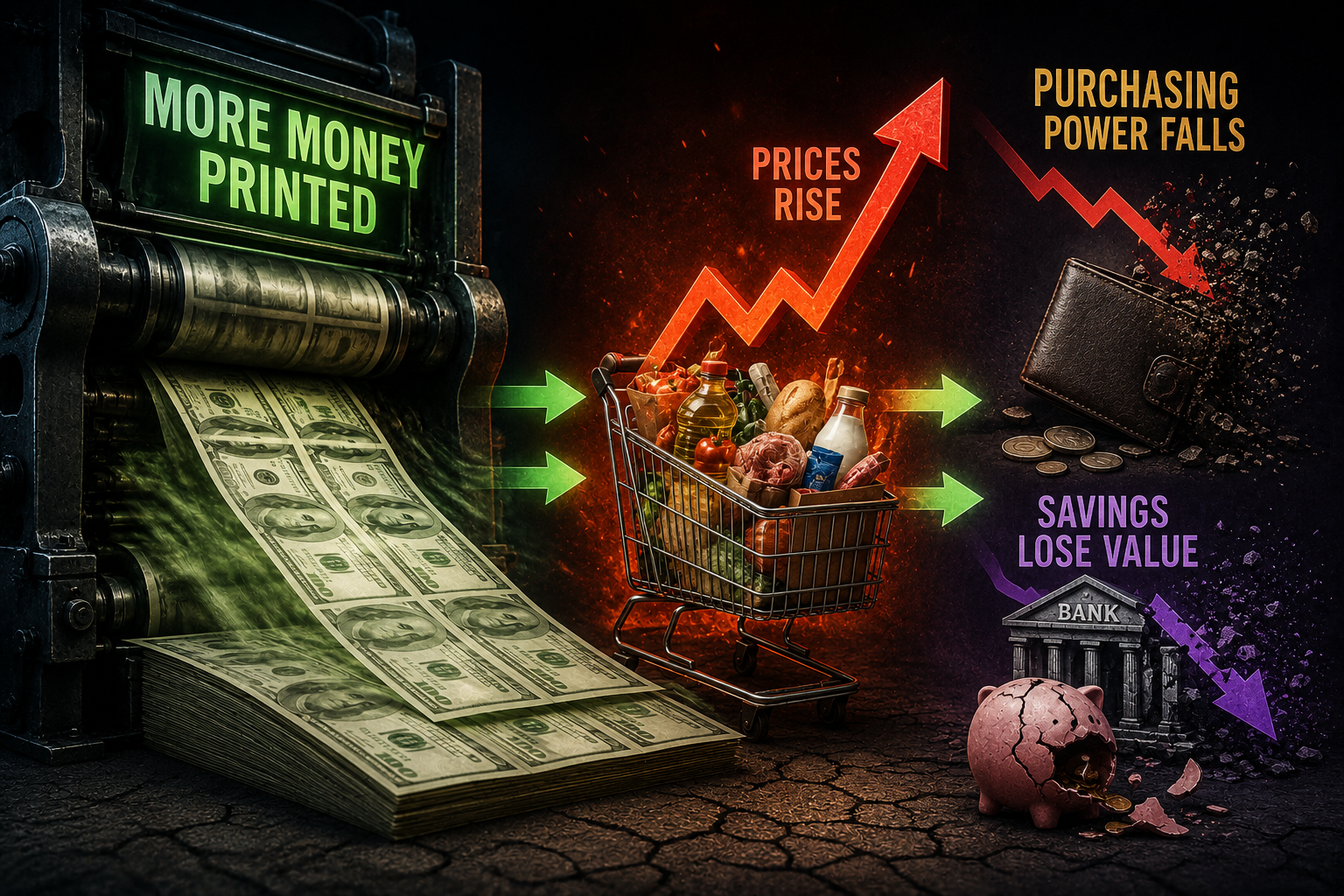
It is a tempting thought for any government facing a financial crisis: if we owe billions of dollars or want to fund massive public projects, why not simply turn on the printing presses and create more money? After all, money is the lifeblood of commerce, and having more of it sounds like an easy path to national wealth.
The reality is that printing money without a matching increase in economic production does not create new wealth. Instead, it systematically dilutes the value of the currency already in circulation. When a central bank increases the broad money supply artificially, it triggers a chain reaction across consumer prices, exchange rates, and public trust.
Global supply chain disruptions and geopolitical conflicts in the Middle East have driven crude oil prices near 100 dollars per barrel. This has forced the International Monetary Fund (IMF) and major central banks to issue warnings about renewed inflationary risks. With the global economy projected to grow at a modest 3.1%, understanding how money printing impacts financial stability is more relevant than ever.
1. The Quantity Theory of Money: The Foundation
To understand exactly why excessive currency creation backfires, economists look to the Quantity Theory of Money. This core macroeconomic principle is expressed through the exchange equation:
M \times V = P \times Y
Within this economic formula:
M represents the total Money Supply.
V represents the Velocity of Money (how frequently a single unit of currency is spent within a year).
P represents the general Price Level of goods and services.
Y represents Real Economic Output (the actual volume of goods and services produced, or Real GDP).
In a stable economy, the velocity of money (V) is generally constant, and real output (Y) grows slowly based on technological advances, population growth, and manufacturing capacity.
If a central bank suddenly doubles the money supply (M) while real production (Y) remains unchanged, the math must balance out. The result is a sharp increase in the general price level (P). In short, if you double the number of tokens in an economy without doubling the number of things those tokens can buy, each individual token simply becomes worth half as much.
2. The Real-World Consequences of Excessive Money Printing
When a state turns to the printing press to manage structural deficits, the negative economic impacts filter through several predictable channels.
Rapid Consumer Price Inflation
When new money is distributed through government spending or direct stimulus, citizens find themselves with more currency units. However, because the supply of real goods like bread, steel, and fuel remains identical, consumers bid against each other for the available supply.
This environment is often described as too much money chasing too few goods. Retailers quickly realize they can increase prices to match the nominal surge in consumer demand, leading to a loss of household purchasing power.
Foreign Exchange and Currency Depreciation
International currency markets react rapidly to aggressive monetary expansion. When global forex traders see a central bank expanding its balance sheet without economic justification, they sell the currency.
As the local currency drops in value relative to stable international benchmarks like the US dollar or the Euro, the cost of importing foreign goods spikes. This dynamic imports inflation from abroad, causing local energy, pharmaceutical, and technology costs to skyrocket.
Wealth Redistribution and the Inflation Tax
Inflation caused by money printing functions as a hidden tax on citizens. It does not affect everyone equally:
Savers and Fixed-Income Earners: This group is harmed the most. Capital kept in traditional savings accounts or fixed pensions loses its real purchasing power rapidly, eroding a lifetime of thrift.
Debtors and Governments: This group benefits in the short term. Because loans are paid back in depreciated, less valuable currency, printing money reduces the real value of existing debt burdens.
Economic Stance
Controlled Money Supply Growth
Excessive Money Supply Growth
Primary Driver
Aligned with real GDP and manufacturing expansion
Budget deficit monetization and political pressure
Sharp depreciation against foreign trading baskets
Investment Outlook
Long-term capital flows into infrastructure and production
Speculative capital flight into tangible hard assets
Social Trust
High confidence in currency as a long-term store of value
Public abandons the local asset for foreign currencies
3. The Ultimate Danger: Hyperinflation and Economic Collapse
When money printing continues unchecked, inflation can quickly turn into hyperinflation, typically defined as price increases exceeding 50% per month. At this stage, the economic damage is no longer linear; it becomes catastrophic.
The Collapse of Velocity and Trust
During hyperinflation, money stops functioning as a reliable store of value. Citizens realize that keeping cash for even a few days means losing significant purchasing power.
As a result, the velocity of money spikes to extreme levels as people rush to spend their earnings the moment they receive them. People trade paper cash for tangible physical goods, such as non-perishable food, gold, or foreign currencies, which strips the domestic currency of all internal utility.
Current Global Monetary Adjustments
We can find important lessons on currency management by looking at recent economic history. For decades, Zimbabwe struggled with chronic hyperinflation driven by aggressive central bank money printing.
However, following a complete structural overhaul, the Reserve Bank of Zimbabwe transitioned to a gold-backed currency called Zimbabwe Gold (ZiG). By capping money supply growth to match real reserves, annual inflation fell to 4.4%. This shift highlights a fundamental truth: the path to price stability requires tying a currency’s supply directly to tangible, finite economic assets.
Use this interactive model to explore how changes in a central bank’s monetary expansion interact with real GDP output. Adjust the printed currency injection amount or modify real production growth to observe the simulated impact on consumer prices and currency valuation.
Inflation & Currency Impact Simulator
Simulate how unbacked central bank money printing spreads through the economy. Adjust structural inputs to observe changes in consumer prices and foreign exchange values.
5. When Is Printing Money Acceptable? Quantitative Easing
While unbacked money printing typically harms an economy, there is a specific exception where central banks expand the money supply safely: Quantitative Easing (QE).
During severe economic recessions, consumer demand drops so low that an economy risks entering a deflationary spiral, where falling prices discourage spending and business investment. To combat this, central banks print electronic money to buy long-term government bonds directly from commercial banks.
This injection of liquidity keeps long-term interest rates low, stabilizes credit markets, and encourages commercial lending. Crucially, during a true liquidity crisis, this newly created money often sits in commercial bank reserves rather than flowing directly into consumer hands, preventing immediate consumer price spikes.
Frequently Asked Questions About Currency Creation
What is the difference between printing money and Quantitative Easing?
Traditional money printing involves creating currency to pay for government spending directly, which injects money straight into the consumer economy and causes inflation. Quantitative Easing prints electronic money to purchase financial assets from commercial banking networks, aiming to lower market interest rates and encourage private sector lending.
Why cannot a country print money to pay off its national debt?
If a government prints money to pay off its national debt, it floods the financial system with excess liquidity. Foreign and domestic investors will quickly realize their bond yields are being paid back in depreciated cash, leading to capital flight, a collapse in national credit ratings, and rapid price inflation.
How do central banks know how much money to create?
Central banks monitor data points like core consumer price indices, structural unemployment rates, industrial capacity utilization, and credit growth. They try to grow the money supply at a pace that matches the natural growth rate of real GDP, helping keep consumer prices stable.