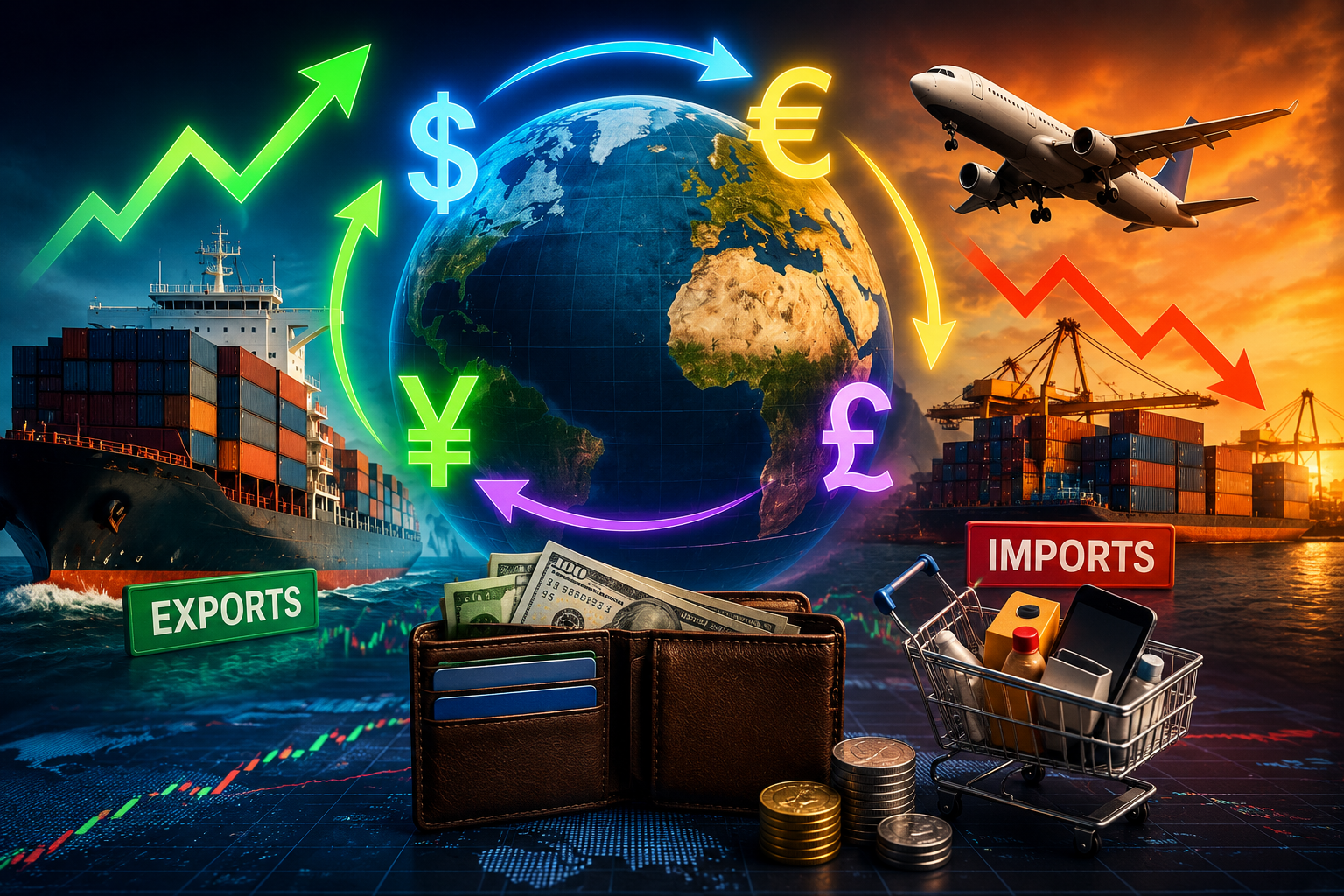
Whether you are booking a summer vacation abroad, ordering a product online, or running a business that relies on international suppliers, your finances are constantly shaped by an invisible global force: exchange rates.
The foreign exchange market operates quietly in the background of daily life, yet its fluctuations have an immediate, powerful impact on what you pay at the grocery store, how easily local companies can expand, and the real value of the cash inside your wallet.
When a currency strengthens or weakens, it sets off a chain reaction across the global economy, altering the profitability of entire industries and shifting the balance of international trade. This guide breaks down exactly how exchange rates work, how they dictate the flow of imports and exports, and what these shifts mean for your personal financial health.
What Is an Exchange Rate?
An exchange rate is simply the price of one country’s currency expressed in terms of another currency. It acts as a conversion metric that allows nations to trade goods, settle debts, and invest across borders.
Most major global currencies use a floating exchange rate system. In this setup, the value of a currency is not fixed by a government; instead, it fluctuates continually based on supply and demand dynamics within global foreign exchange markets.
Three primary mechanisms drive these supply and demand fluctuations:
Central Bank Interest Rates: When a nation’s central bank raises its benchmark interest rates, it offers foreign investors a higher return on capital assets denominated in that currency. This draws in foreign yield-seeking investment, driving up demand and strengthening the domestic currency.
National Inflation Rates: Countries with consistently low inflation rates typically experience an appreciation in their currency’s purchasing power, making their exported goods more competitive over time.
Geopolitical and Economic Stability: During periods of global market stress, international capital flees volatile regions and seeks out safe-haven currencies, such as the United States dollar or the Swiss franc.
The Economics of a Strong Currency vs. a Weak Currency
In global economics, terms like “strong” and “weak” do not carry moral weight. A strong currency is not inherently superior to a weak one; rather, each condition creates a distinct set of economic winners and losers.
Understanding these dynamics requires looking at how a currency’s value alters the cost structures of cross-border commerce.
The Dynamics of an Appreciating (Strong) Currency
When a domestic currency appreciates, its value increases relative to foreign currencies. This means it requires fewer units of the domestic currency to purchase the same amount of foreign money.
The primary effect of a strong currency is that it increases domestic purchasing power on the international stage. Foreign manufacturing components, raw commodities, and imported retail goods become less expensive to purchase.
However, the trade-off is that domestic products become more expensive for foreign buyers, which can hurt local companies that rely heavily on international sales.
The Dynamics of a Depreciating (Weak) Currency
When a domestic currency depreciates, its value drops relative to foreign benchmarks. This means it takes more units of the domestic currency to buy a single unit of foreign cash.
A weak currency makes a country’s exports significantly more competitive in international markets because foreign buyers can purchase those goods using fewer units of their own stronger currency.
The downside is that importing goods becomes more expensive, as local businesses and consumers must spend more domestic cash to acquire foreign commodities, electronics, and finished products.
How Exchange Rates Reshape Imports and Exports
The fluid shifting of currency values serves as a primary rebalancing mechanism for international trade balances, directly affecting both the volume and the profitability of cross-border transactions.
Economic Participant
Impact of a Strong Currency
Impact of a Weak Currency
Domestic Importers
Winner: Lower procurement costs for foreign materials and products.
Loser: Reduced price competitiveness in global retail markets.
Winner: Increased international demand and higher converted revenues.
Everyday Consumers
Winner: Lower retail prices on foreign goods and cheaper foreign travel.
Loser: Higher retail inflation and increased travel costs.
Foreign Tourists
Loser: Local hotels, dining, and transit become expensive.
Winner: Increased purchasing power and cheaper travel experiences.
The Importer Perspective
Importers rely on buying goods from foreign suppliers and selling them within the domestic market. For these businesses, currency strength directly dictates their gross profit margins.
When the domestic currency is strong, importers can purchase raw materials, inventory, and components at lower costs. These savings can either be pocketed as higher profit margins or passed along to local consumers in the form of lower retail prices to win market share.
Conversely, when the domestic currency weakens, importers face a sharp increase in procurement costs. They must then choose between absorbing these higher expenses, which hurts their profitability, or raising retail prices, which can stoke domestic inflation.
The Exporter Perspective
Exporters manufacture goods domestically and sell them to customers overseas. For these firms, a weaker domestic currency provides a distinct competitive advantage.
When a country’s currency depreciates, its manufactured items become instantly cheaper for international buyers, even if the domestic factory gate price has not changed. This price reduction helps boost export volumes, capture international market share, and support local industrial employment.
If the domestic currency appreciates significantly, local exporters can find themselves priced out of highly competitive global markets, forcing them to cut costs or scale back production.
Macroeconomic Consequences: The Trade Balance and Inflation
Because exchange rates alter the price competitiveness of imports and exports, they play a central role in shaping broader macroeconomic indicators like a nation’s trade balance and domestic inflation rate.
Managing the Trade Deficit vs. Trade Surplus
A country’s trade balance is the difference between the total monetary value of its exports and its imports over a given period:
\text{Trade Balance} = \text{Total Value of Exports} - \text{Total Value of Imports}
When a nation’s currency remains strong for an extended period, the combination of rising imports and falling exports often widens its trade deficit.
Conversely, a sustained weak currency tends to push a country toward a trade surplus, as foreign buyers snap up its cheap exports while local consumers cut back on expensive imports.
The J-Curve Effect
Adjustments in a country’s trade balance do not happen overnight when a currency shifts. Economists track this delayed reaction using a model known as the J-Curve Effect.
When a currency depreciates, a country’s trade deficit often deepens initially before it improves. This short-term drop occurs because import contracts are typically locked in months in advance.
In the immediate aftermath of a currency drop, the nation must spend more cash on its pre-existing import commitments, while it takes time for foreign buyers to scale up their orders for the country’s newly cheap exports. Once those behavioral shifts take hold, the trade balance swings upward, tracing the shape of a letter J.
Currency-Driven Inflation
Exchange rates also influence a country’s internal inflation rate through two primary channels:
Direct Cost-Push Inflation: A weak currency drives up the cost of importing key industrial inputs, such as crude oil, minerals, and electronic components. Local manufacturers pass these increased costs down the supply chain, raising the final retail price for everyday consumers.
Demand-Pull Inflation: When a weak currency boosts international demand for a country’s exports, local factories run at higher capacity. This surge in industrial activity increases aggregate demand for labor and raw materials, pushing up domestic prices across the broader economy.
Real-World Context: Foreign Exchange Trends in 2026
The global foreign exchange market is navigating a complex landscape shaped by trade policy shifts, changing interest rate cycles, and regional growth differentials.
The U.S. Dollar and Global Tariff Dynamics
The United States dollar remains a central pillar of international trade, but its valuation is facing counteracting pressures. Global commerce is dealing with a significant wave of trade restrictions and escalating tariff regimes.
With the effective U.S. import tariff rate projected to reach roughly 14%, global supply chains are re-routing, forcing international exporters to absorb additional costs to remain competitive in American retail spaces.
This protectionist environment complicates traditional currency valuations, as trade constraints can reduce overall global trade volumes while keeping domestic prices sticky.
The Japanese Yen and Central Bank Trade-offs
In Asia, the Japanese yen continues to be a focal point for macro analysts. The USD/JPY currency pair has hovered near multi-decade highs, reflecting the wide interest rate gap between the Federal Reserve and the Bank of Japan.
While the Bank of Japan has taken measured steps to normalize its monetary policy by executing gradual interest rate increases, persistent yen weakness has significantly driven up the cost of energy and raw food imports for Japanese households.
Simultaneously, this weak currency environment has boosted the converted earnings of large, export-driven Japanese conglomerates operating globally.
Growth Variations in the Eurozone and Broad Markets
Across the Eurozone, foreign exchange traders are monitoring a slow economic recovery. Prolonged economic stagnation in major manufacturing hubs like Germany has limited the upside potential of the euro.
With European export growth constrained by cooling global demand, the European Central Bank has maintained flexibility regarding interest rate adjustments to support domestic borrowing and investment.
How Exchange Rates Directly Affect Your Wallet
Exchange rates are not just an abstract topic for international bankers; they directly influence your personal purchasing power and everyday financial decisions.
1. The Cost of Daily Grocery Items and Retail Products
A large percentage of the products you purchase at your local retail store are either manufactured abroad or contain foreign-sourced ingredients and components.
If your domestic currency undergoes a sustained depreciation, local retailers face higher costs to restock their shelves. Over time, these rising wholesale expenses are passed along to consumers, increasing the everyday cost of groceries, clothing, and consumer electronics.
2. International Travel and Tourism Expenses
If you plan to vacation abroad, exchange rates dictate the true purchasing power of your travel budget.
When your home currency is strong relative to your destination’s currency, your money goes much further. Hotels, dining out, and local tours become significantly less expensive.
If your home currency weakens, the cost of that same international trip can skyrocket, forcing you to spend more cash for the same travel experience or look for domestic vacation alternatives.
3. Investment Portfolios and International Asset Allocations
For individual investors, currency movements can noticeably alter the total returns of an investment portfolio.
If you own shares in foreign companies or hold international mutual funds, your investment performance is tied to two factors: the asset’s price growth and the shifting value of the underlying currency.
If the foreign stock rises by 8% but that country’s currency depreciates by 5% against your home currency, your net return shrinks when those funds are converted back into your local cash.
Exchange Rate Impact Simulator
Simulate how a sudden shift in your domestic currency value alters imports, exports, and travel costs.
$
%
*Enter a positive value for appreciation (strengthening) or a negative value for depreciation (weakening).
Imports & International Travel
$909.09
Your currency buys more. Foreign items, international flight tickets, and overseas suppliers cost you less.
Local Exporters & Global Sales
$1,100.00
Your products become more expensive for global buyers, making it harder to compete in foreign markets.
Adjusted Value = Base Amount / (1 + Shift)Interactive FX Tool
Summary: Navigating Currency Volatility
Exchange rates serve as a vital link connecting national economies, managing the global flow of imports and exports, and directly shaping consumer price levels around the world.
While a strong currency can lower your immediate costs for foreign goods and international travel, it can also create headwinds for local manufacturing and export-dependent industries. A weaker currency can help domestic factories compete on the world stage, but it often brings the challenge of higher import costs and retail inflation at home.
By keeping an eye on exchange rate trends and understanding how they influence supply chains, you can make more informed decisions about your personal investments, major retail purchases, and international travel planning.