In the study of economics, few concepts are as vital to long term prosperity as productivity. While headlines frequently focus on stock market fluctuations, central bank interest rate decisions, or short term gross domestic product (GDP) growth, these metrics only paint a temporary picture of an economy’s health.
Over decades, a nation’s standard of living is determined almost entirely by its ability to raise its output per worker.
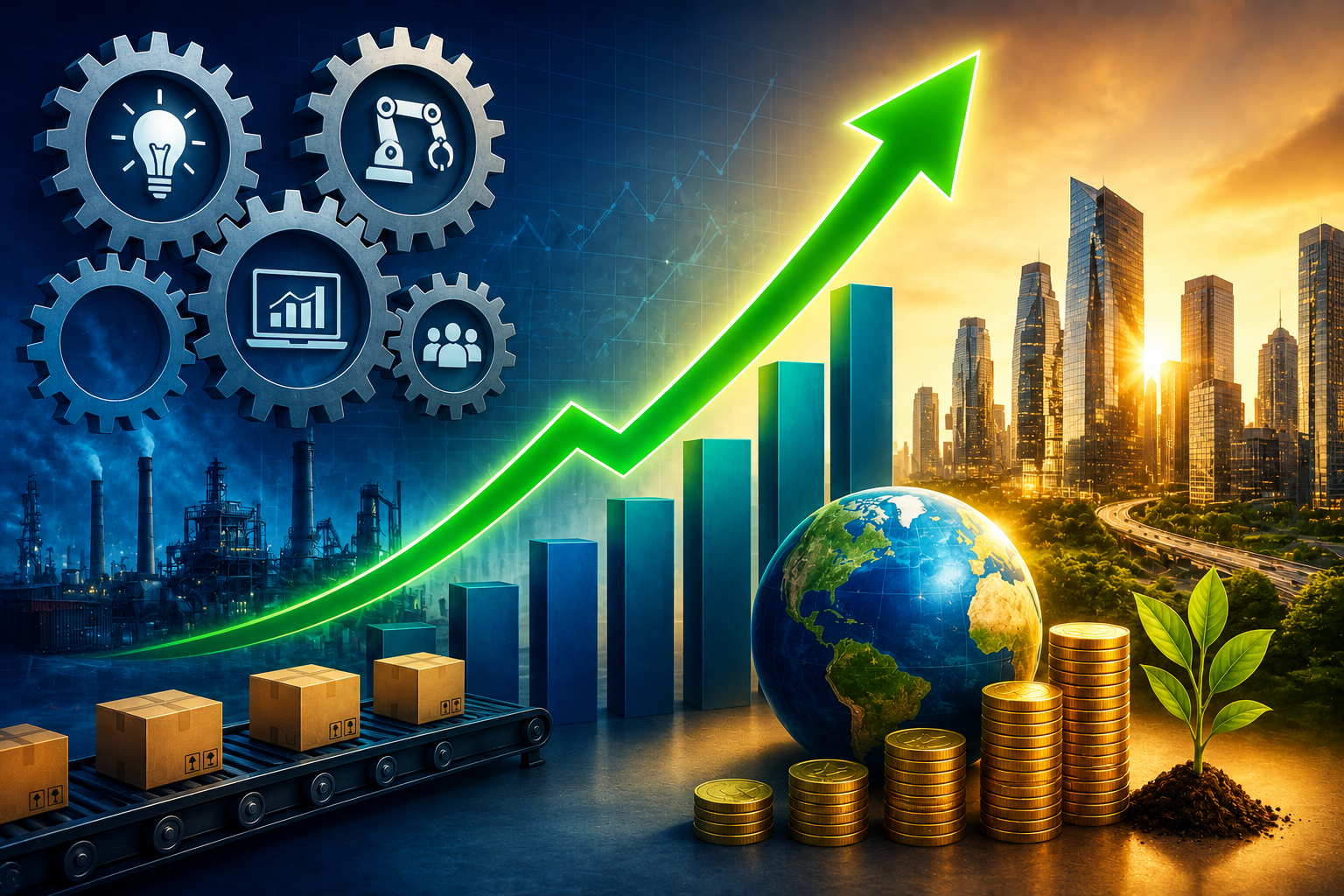
To the average consumer or worker, economic productivity might sound like a corporate buzzword used to justify longer hours or more intense workloads. However, true macroeconomic productivity is not about working harder or sweatier; it is about working smarter. It is the ultimate engine behind rising real wages, business profitability, and stable government balance sheets.
This guide breaks down what economic productivity is, how it is measured, why it serves as the ultimate driver of wealth, and how current trends are reshaping the global workforce.
What Is Economic Productivity? A Clear Definition
At its core, productivity measures the efficiency of production. It is a ratio that compares the total volume of goods and services produced (the output) against the inputs used to create them (such as labor hours, raw materials, capital, and machinery).
When an economy increases its productivity, it means it can produce more high value goods or services using the exact same amount of resources, or produce the same volume of goods using fewer resources.
The Key Distinction: Production vs. Productivity
It is common to confuse production with productivity, but they are fundamentally different concepts:
Production: This is the absolute volume of output produced. For instance, if a factory manufactures 1,000 cars this month and 1,200 cars next month, its production has increased by 20%.
Productivity: This is the output relative to the input. If that same factory grew its car output by 20% but had to hire 40% more workers to do it, its absolute production rose, but its overall productivity actually declined.
The Varieties of Productivity Metrics
Economists look at two primary forms of productivity to assess the structural strength of a national economy.
1. Labor Productivity
Labor productivity is the most widely reported metric. It measures the total real GDP produced per hour worked across the entire economy.
This metric reflects the combined influence of employee skills, the quality of corporate management, and the level of machinery or technology available to those workers.
2. Multi-Factor Productivity (MFP)
Also known as Total Factor Productivity (TFP), this advanced metric measures the efficiency with which both labor and capital inputs are utilized together. If an economy experiences a surge in output that cannot be explained by an increase in the number of workers or a major capital investment in physical factories, that residual growth is credited to MFP. It serves as a direct measurement of technological innovation and organizational efficiency.
Why Economic Productivity Matters: The Virtuous Cycle
The famed economist Paul Krugman once observed that while productivity isn’t everything, in the long run, it is almost everything. A country’s ability to improve its standard of living over time depends almost entirely on its ability to raise its output per worker.
Without productivity growth, an economy can only expand by using up more inputs, such as forcing employees to work longer shifts or exploiting more natural resources, both of which have clear physical limits.
The Microeconomic Impacts: Winners Across the System
When productivity increases across an industry, it sets off a positive chain reaction that benefits all economic participants:
Stakeholder Group
Primary Benefit of Productivity Growth
Long-Term Result
Everyday Workers
Firms can afford to pay higher real wages without triggering price inflation.
Higher purchasing power and better household living standards.
Corporate Businesses
Per-unit production costs drop, expanding gross profit margins.
Greater capital reserves for research, development, and market expansion.
Consumers
Increased market supply and competition drive down the retail prices of goods.
Access to affordable products, from electronics to medical treatments.
National Governments
Economic expansion widens the tax base without needing to raise tax rates.
More fiscal space to fund public infrastructure, education, and healthcare.
The Fight Against Inflation
Productivity is an economy’s most effective natural defense against structural inflation. When wages rise without a corresponding increase in productivity, businesses face higher labor costs. To protect their margins, they raise retail prices, creating a wage-price spiral.
However, if wages rise because workers have become genuinely more productive, the cost to make each individual item stays flat or falls. This allows workers to take home larger paychecks while consumer prices remain stable.
Historical Catalysts of Productivity
To understand how modern changes impact the economy, we can look back at the historical transformations that fundamentally altered human productivity.
The Industrial Revolutions
Prior to the late 1700s, global economic growth was essentially flat. Human output was limited by the muscle power of people and draft animals.
The First Industrial Revolution: The invention of the steam engine and mechanized weaving looms allowed a single worker to generate the textile output of dozens of manual artisans.
The Second Industrial Revolution: The introduction of assembly line manufacturing, widespread electrical grids, and internal combustion engines in the late 19th and early 20th centuries created massive efficiencies, giving rise to the modern middle class.
The Digital Era
The late 20th century witnessed the rapid spread of desktop computers, enterprise software, and the internet. This digital wave automated complex bookkeeping, streamlined global supply chains, and made communications nearly instantaneous, sparking a major wave of labor productivity growth throughout the 1990s.
Current Realities: The Productivity Dynamics
The global economy is navigating a unique structural paradox. While advanced technologies are being adopted at a blistering pace, official statistical agencies are tracking a prolonged slowdown in baseline productivity growth across many major economies.
The Paradox of Enterprise Artificial Intelligence
The most scrutinized economic development is the integration of generative artificial intelligence and enterprise automation tools into corporate service workflows.
While individual firms report significant time savings in code generation, administrative processing, and customer support, these micro-level wins have not yet fully shown up in national GDP accounting data.
Historical patterns suggest this delay is normal. When electricity was first introduced to factories in the 1890s, national productivity did not spike immediately. It took nearly three decades for managers to completely re-architect factory floors, develop safety standards, and unlock the full efficiency potential of the technology. Modern analysts believe AI adoption is tracing a similar path.
Demographic Drags and Global Structural Headwinds
Widespread demographic shifts are also complicating global productivity projections:
Secular Stagnation and Aging Populations: Across western Europe and east Asia, a rapid retirement wave is shrinking the core workforce. This aging trend means a smaller pool of active workers must produce enough output to support a growing retired population, placing a heavy premium on automated efficiency gains.
Shifting Supply Chains: The ongoing fragmentation of international trade corridors has forced many multinational corporations to shift from efficient “just-in-time” international supply chains to localized, defensive supply systems. While this shift reduces geopolitical vulnerabilities, it adds structural costs that can weigh on multi-factor productivity metrics.
What Determines a Nation’s Economic Productivity?
An economy cannot simply wish its way to higher productivity. Long term efficiency gains depend on steady improvements across four core foundational areas.
1. Human Capital Investments
Human capital refers to the collective knowledge, technical skills, health, and practical experience of the workforce. A nation that invests heavily in high quality vocational training, rigorous stem education, and accessible preventative healthcare builds an adaptable workforce capable of operating complex modern machinery and navigating sophisticated software systems.
2. Physical Capital and Infrastructure
Workers need high quality tools to maximize their output. Equipping a construction crew with modern earthmoving machinery allows them to build roads exponentially faster than a crew using basic hand tools.
At a national scale, this requires regular capital investments in high speed fiber optic networks, reliable automated electrical grids, modern deepwater ports, and efficient transport corridors.
3. Institutional Quality and Legal Frameworks
Economic efficiency thrives in stable, predictable institutional environments. Countries that enforce transparent property rights, maintain independent judiciaries, control institutional corruption, and streamline corporate regulatory processes allow businesses to invest capital with confidence.
When corporate leaders spend less time navigating red tape, they can focus more resources on operational innovation.
How to Track Productivity Metrics
For business owners, corporate managers, and individual investors, tracking structural shifts in productivity can provide an early warning system for long term economic trends.
Economic Efficiency & Cost Calculator
Select your target scale multiplier to test regional macroeconomic data sets instantly.
Labor Productivity
$50.00
Value generated per hour worked
Unit Labor Cost
$0.60
Labor spend per dollar of output
Recalculating production system data…
Key Indicators to Monitor
Quarterly Labor Productivity Reports: Published by agencies like the U.S. Bureau of Labor Statistics (BLS) or Eurostat, these releases highlight whether output growth is outpacing aggregate hours worked.
Capital Expenditure (CapEx) Trends: Tracking whether corporations are scaling up capital investments in new software, cloud infrastructure, and factory automation provides a reliable leading indicator for future multi-factor productivity gains.
Unit Labor Costs: This indicator tracks the total consumer-adjusted labor cost required to produce a single unit of output. If unit labor costs are rising faster than productivity, it serves as a strong signal of impending corporate margin compression or consumer retail inflation.
Summary: The Foundation of Long Term Prosperity
Economic productivity is the ultimate engine of long term economic success. While financial market volatility, political cycles, and consumer confidence shifts can cause short term economic expansions or contractions, a society’s foundational wealth is anchored to its productive efficiency.
By continuing to prioritize human capital education, supporting long term physical and digital infrastructure investments, and fostering an environment of institutional stability, nations can build resilient economies capable of raising living standards for future generations.