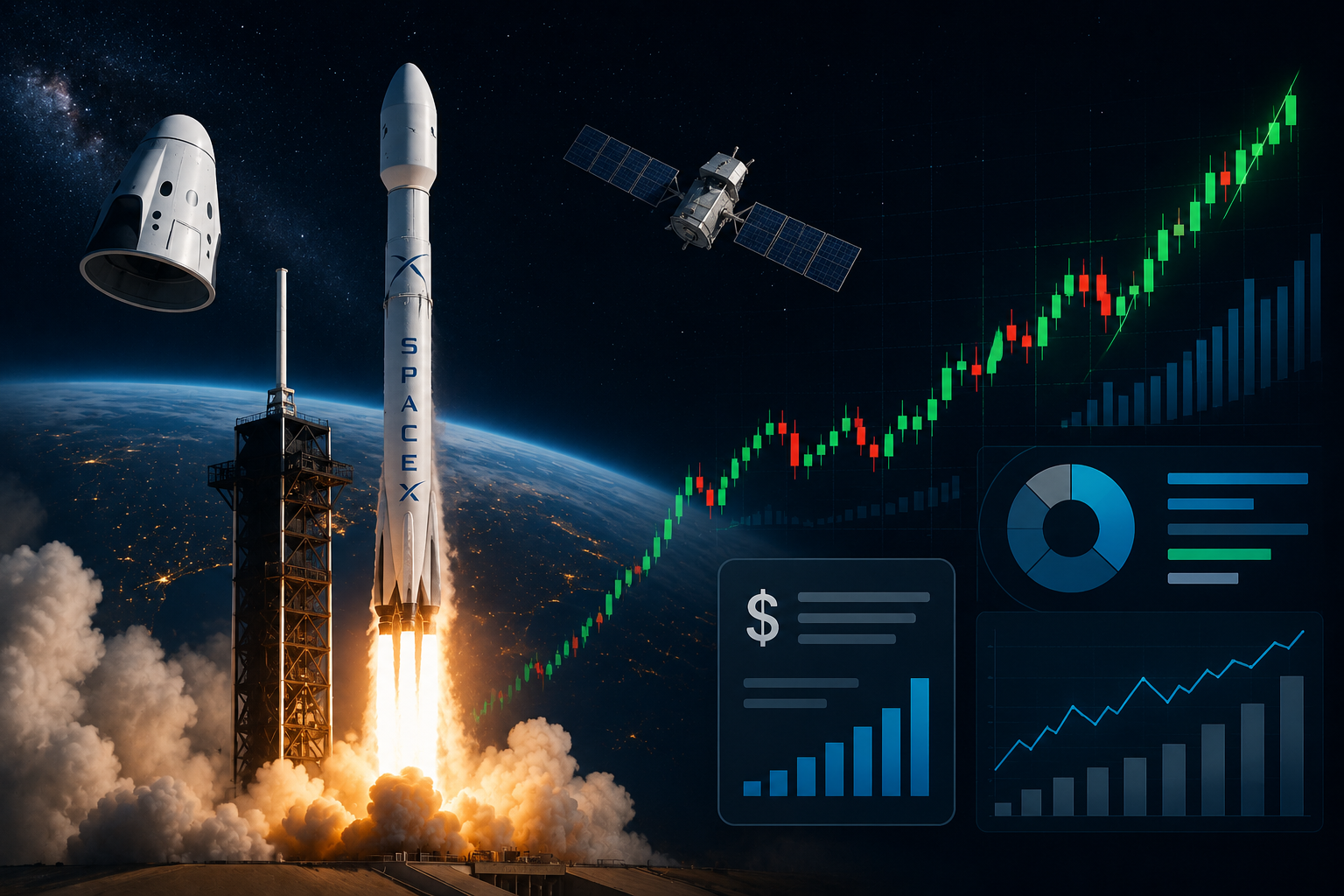
SpaceX, formally Space Exploration Technologies Corp., is the rocket, satellite internet, and artificial intelligence company founded by Elon Musk in 2002. It became a public company on June 12, 2026 through the largest initial public offering in history, raising roughly $85.7 billion and debuting on the Nasdaq under the ticker SPCX at a valuation near $2 trillion.
SpaceX now operates three business segments: Space, which runs the Falcon 9, Falcon Heavy, and Starship rocket programs; Connectivity, built around the Starlink satellite internet network; and AI, formed after SpaceX’s February 2026 merger with Elon Musk’s xAI, covering the Grok chatbot, the X platform, and AI computing infrastructure. Full year 2025 revenue reached $18.67 billion, up 33 percent, but heavy AI infrastructure spending pushed the company to a net loss of $4.9 billion for the year, and losses continued into the first quarter of 2026.
This guide covers SpaceX’s history, founders, leadership, business segments, products, revenue breakdown, financial performance, stock data, dividend policy, main competitors, and the latest company news, plus answers to common investor questions.
Aerospace, satellite internet, and artificial intelligence
Key products
Falcon 9, Falcon Heavy, Starship, Dragon, Starlink, Grok, X
Employees
Roughly 22,000
IPO date
June 12, 2026
IPO price
$135 per share
Fiscal 2025 revenue
$18.67 billion
Fiscal 2025 net result
Net loss of $4.9 billion
Market capitalization
Roughly $2.0 trillion (mid 2026)
Quarterly dividend
None
What Is SpaceX?
SpaceX is an American aerospace manufacturer, launch services provider, and satellite communications company that has expanded into artificial intelligence. It was built around a mission to make human life multiplanetary through reusable rockets, and it grew from a small rocket startup into the dominant force in global space launch before diversifying into satellite internet with Starlink and, more recently, into AI through its 2026 merger with xAI.
SpaceX now conducts the large majority of the world’s orbital rocket launches, operates the largest satellite constellation ever built, and owns the Grok AI model and the X social media platform. That combination makes it one of the most unusual public companies on the market: part aerospace contractor, part telecommunications provider, and part AI infrastructure company, all under one roof.
SpaceX became a publicly traded company on June 12, 2026, ending more than two decades as a private company funded by venture capital, strategic investors, and employee equity. The IPO was the largest in history by dollars raised, and it gave everyday investors their first opportunity to buy shares directly through a brokerage account rather than through private secondary markets.
Company History
Elon Musk founded Space Exploration Technologies Corp. in 2002 after selling PayPal, with a stated goal of dramatically lowering the cost of space travel and eventually enabling human settlement of Mars. The company was first headquartered in a warehouse in El Segundo, California, and later in nearby Hawthorne, and its earliest hires included rocket engineer Tom Mueller and business development lead Gwynne Shotwell, who joined within SpaceX’s first year and remains the company’s president today.
SpaceX’s early years were difficult. Its first rocket, Falcon 1, failed on its first three launch attempts between 2006 and 2008, pushing the company close to insolvency. A successful fourth Falcon 1 launch in September 2008 kept the company alive, and later that year SpaceX won a landmark NASA Commercial Resupply Services contract worth roughly $1.6 billion, providing the financial foundation for the Falcon 9 rocket and Dragon spacecraft that followed.
Through the 2010s, SpaceX transformed the launch industry by successfully landing and reusing rocket boosters starting in 2015, dramatically cutting the cost of reaching orbit compared with traditional expendable rockets. The company became NASA’s primary partner for both cargo and, from 2020 onward, crewed missions to the International Space Station, ending America’s reliance on Russian rockets for astronaut transport.
In 2019, SpaceX launched its first Starlink satellites, beginning the buildout of a low earth orbit internet constellation that has since grown to more than 10,000 satellites, making SpaceX the operator of the largest satellite network ever deployed and, eventually, its most important source of revenue. The company also began developing Starship, a fully reusable next generation rocket intended to eventually replace Falcon 9 and support missions to the Moon and Mars, including NASA’s Artemis lunar landing program.
The most significant recent turning point came in February 2026, when SpaceX completed a merger with xAI, the artificial intelligence company Musk founded in 2023 that develops the Grok chatbot and owns the X social media platform. The deal made AI a formal third pillar of SpaceX’s business and set the stage for the company’s initial public offering just a few months later, on June 12, 2026, when SpaceX raised approximately $85.7 billion in the largest IPO on record and began trading on the Nasdaq under the ticker SPCX.
Founders
SpaceX was founded by Elon Musk alone in 2002, using roughly $100 million of his own capital from the earlier sale of PayPal. Unlike many technology startups, SpaceX did not have a formal group of co-founders splitting equity; instead, Musk retained full ownership at founding and brought in key early technical and business leaders who received equity and stock options as the company grew.
Elon Musk
Founder, CEO, chief engineer, and chairman since 2002. Musk has remained SpaceX’s controlling shareholder through every funding round and continues to hold supermajority voting power following the June 2026 IPO.
Gwynne Shotwell
Joined SpaceX in its first year, in September 2002, as an early business development hire. Promoted to company president in 2008 after negotiating SpaceX’s first major NASA contract, she has run day to day operations for more than two decades and became a public face of the company during its IPO roadshow.
Other early technical hires, including rocket engine specialist Tom Mueller and operations lead Chris Thompson, helped build SpaceX’s initial engineering team, many of them recruited from established aerospace companies such as TRW and Boeing. External capital arrived later than at most startups; Founders Fund made a critical $20 million investment in 2008 after SpaceX’s early launch failures, and Google and Fidelity invested $1 billion for roughly a 10 percent stake in 2015.
CEO
Elon Musk has served as SpaceX’s Chief Executive Officer, Chief Technology Officer, and Chairman since founding the company in 2002. He is also CEO of Tesla and owns several other companies, meaning much of SpaceX’s day to day operational leadership falls to President and COO Gwynne Shotwell.
Musk has publicly stated that SpaceX’s long term purpose is to make humanity a multiplanetary species, and the company’s Starship program and Mars ambitions remain central to his stated vision even as SpaceX’s near term business increasingly runs on Starlink subscriptions and, following the xAI merger, artificial intelligence infrastructure. Following the IPO, Musk retained roughly 82 percent of SpaceX’s voting power through a dual class share structure, giving him effective control over major company decisions despite holding a smaller share of the company’s overall economic value.
Other Key Leadership
Gwynne Shotwell, President and COO: Oversees Falcon, Starlink, Starship, and, since the 2026 merger, xAI operations, and led much of SpaceX’s investor engagement ahead of its public listing.
Bret Johnsen, CFO: Leads SpaceX’s finance organization and has represented the company in investor facing materials tied to its IPO.
Headquarters
SpaceX is headquartered at Starbase, a company town on the Texas Gulf Coast near Brownsville that Musk built specifically to support Starship development and launch operations. The company officially relocated its headquarters from Hawthorne, California to Starbase, and Starbase itself was incorporated as an official city in 2025.
SpaceX also maintains major operations at its original Hawthorne, California manufacturing complex, its Falcon launch sites at Cape Canaveral and Kennedy Space Center in Florida and Vandenberg Space Force Base in California, and a growing set of AI data center campuses built to support Grok and xAI workloads, including large compute clusters known internally as Colossus.
Business Segments
SpaceX reports its results across three business segments following the 2026 xAI merger.
SpaceX’s three reporting segments
Segment
Focus
Space
Rocket launch services and spacecraft development using Falcon 9, Falcon Heavy, Starship, and Dragon, serving commercial, NASA, and national security customers
Connectivity
The Starlink satellite internet network, serving consumer, enterprise, aviation, maritime, and government customers
AI
The Grok large language model, the X platform, and AI computing infrastructure, formed through the February 2026 merger with xAI
Connectivity, built on Starlink, is by far the largest and only consistently profitable segment, generating $4.42 billion in operating income in 2025. Space remains a lower margin, strategically important business built around national security and NASA contracts, while AI is currently the company’s largest source of losses as SpaceX invests heavily in AI data center capacity to compete in the generative AI race.
Products and Services
SpaceX’s product lineup spans launch vehicles, spacecraft, satellite internet hardware, and AI software and platforms.
Falcon 9: SpaceX’s workhorse partially reusable rocket, used for the large majority of the company’s orbital launches, including most Starlink deployments.
Falcon Heavy: A heavy lift rocket built from three Falcon 9 boosters, used for the largest commercial and government payloads.
Starship: A fully reusable, next generation rocket system under active flight testing, intended to eventually replace Falcon 9 and support Moon and Mars missions.
Dragon: SpaceX’s crew and cargo spacecraft, used for NASA astronaut transport to the International Space Station and commercial cargo resupply missions.
Starlink: A satellite internet service delivered through a constellation of more than 10,000 low earth orbit satellites, sold to consumers, businesses, airlines, maritime operators, and governments.
Grok: xAI’s large language model and AI assistant, offered to consumers and enterprise customers.
X: The social media and real time information platform acquired by Musk and folded into the AI segment through the xAI merger.
SpaceX sells launch services directly to commercial satellite operators, national governments, and defense agencies, sells Starlink subscriptions and hardware directly to consumers and businesses worldwide, and monetizes its AI segment through Grok subscriptions, enterprise AI services, and X platform advertising and subscriptions.
Revenue Breakdown
SpaceX’s revenue is now dominated by Starlink, which has grown from a minority contributor to the clear majority of company sales in only a few years, while the AI segment has become the company’s newest and fastest growing, if still unprofitable, business line.
Revenue by Segment
First quarter 2026 revenue of approximately $4.69 billion
Starlink’s share of total revenue rose from 61% in full year 2025 to about 70% in the first quarter of 2026. Source: SpaceX S-1 registration statement and first quarter 2026 disclosures.
Operating Profit and Loss by Segment
Where the Money Comes From, and Where It Goes
Full year 2025 segment operating income or loss, in billions of U.S. dollars
Starlink was SpaceX’s only profitable segment in 2025. Space posted a modest operating loss, while heavy AI infrastructure investment drove a large loss in the AI segment. Source: SpaceX S-1 registration statement.
Geographically, Starlink generates revenue from more than 160 countries and territories, with growth increasingly coming from lower income markets across Africa, Southeast Asia, and Latin America, even as average revenue per subscriber has declined as a result. SpaceX’s Space segment revenue comes primarily from NASA, the U.S. Department of Defense, and commercial satellite operators, while AI segment revenue is still in its early stages relative to the segment’s spending.
Financial Performance
SpaceX’s financial profile is unusual among large public companies: rapid revenue growth combined with a swing from modest profitability to sizable losses, driven almost entirely by its decision to invest aggressively in AI infrastructure following the xAI merger.
Annual Revenue Growth
Full company revenue, figures in billions of U.S. dollars
2024 figure is derived from the S-1 disclosed 33% year over year growth rate to $18.674 billion in 2025. Full year 2026 results are not yet available.
Key Financial Results
Full year 2025 and first quarter 2026
Metric
Full Year 2025
Q1 2026
Revenue
$18.67 billion
$4.69 billion
Revenue growth, year over year
33%
15%
Net income or loss
Net loss of $4.9 billion
Net loss of roughly $4.3 billion
Adjusted EBITDA
$6.58 billion, up 23%
Down 35% year over year
Operating cash flow
$6.8 billion
Roughly $1.0 billion
Capital expenditures
$20.7 billion
$10.1 billion
Free cash flow
Negative, funded partly with debt
Negative $9.1 billion
Contracted backlog
$28.4 billion
–
The core story in SpaceX’s financials is a single profitable business, Starlink, funding two much larger strategic bets. Starlink alone generated roughly $7.2 billion in segment EBITDA at a strong 63 percent margin in 2025, while the AI segment’s rapid buildout of data center capacity, known internally as Colossus, drove billions of dollars in losses and required SpaceX to raise roughly $26 billion in debt and preferred equity during the year to cover the gap between operating cash flow and capital spending.
SpaceX had accumulated $41.3 billion in total losses since its founding as of its IPO filing, reflecting more than two decades of heavy reinvestment in rockets, satellites, and now AI infrastructure rather than a focus on near term accounting profit. Whether the AI segment can eventually turn profitable, and how quickly, is likely to be the single biggest question shaping SpaceX’s financial results over the next several years.
Stock Information
SpaceX trades on the Nasdaq under the ticker symbol SPCX. Its June 12, 2026 initial public offering was the largest in history by dollars raised, pricing shares at $135 each to raise approximately $85.7 billion and value the company at roughly $1.8 trillion at the offer price, with shares opening for trading around $150 and the company’s market capitalization briefly touching approximately $2.3 trillion on its debut, at times surpassing both Amazon and Microsoft.
Trading Range Since IPO
From listing on June 12, 2026 through early July 2026
Because SPCX only began trading in June 2026, this reflects its full trading history rather than a traditional 52 week range. Prices have been volatile since listing.
Key stock statistics, early July 2026
Metric
Approximate Value
Trading range low since IPO
$135.00
Trading range high since IPO
$225.64
Market capitalization
Roughly $2.0 trillion
Price to sales ratio
Roughly 90 times trailing 2025 revenue
Average 12 month analyst price target
Roughly $188, ranging from about $62 to $310
Analyst ratings
Majority buy, based on early coverage
Next scheduled earnings
August 6, 2026
SPCX shares have been unusually volatile even by newly listed stock standards, falling in three straight sessions after their initial post-IPO peak and swinging sharply on individual news events, including a reported drop of roughly 7 percent after Musk publicly disputed a media report about a SpaceX AI phone prototype. The stock also carries a dual class share structure that gives Musk roughly 82 percent of voting power, meaning public shareholders have very limited influence over company decisions despite owning a meaningful share of the economics.
Dividends
SpaceX does not pay a dividend and has never paid one as a private or public company. Given the company’s current net losses, heavy capital expenditure on Starship, Starlink, and AI data centers, and Musk’s stated long term focus on space and AI infrastructure over near term shareholder returns, a dividend appears unlikely in the near future.
Investor note: SpaceX is best understood as a growth and reinvestment story rather than an income investment. Nearly all available cash is currently being redirected into Starship development, Starlink satellite deployment, and AI compute infrastructure rather than shareholder distributions.
Competitors
Because SpaceX operates in three different industries at once, it faces a different competitive set in each part of its business.
Main competitors by business area
Company
Primary Overlap With SpaceX
Blue Origin
Orbital and lunar launch vehicles, competing with Falcon and Starship, and a launch supplier to some Starlink rivals
Rocket Lab
Smaller satellite launch vehicles, with a growing footprint after its Iridium acquisition
United Launch Alliance
U.S. government and commercial launch services, a long time rival for national security missions
Amazon (Amazon Leo, formerly Project Kuiper)
Low earth orbit satellite internet, Starlink’s most well funded emerging competitor
Eutelsat OneWeb
An established low earth orbit satellite internet operator based in Europe
OpenAI, Google DeepMind, and Anthropic
Large language models and AI infrastructure, competing with Grok and xAI
Starlink’s biggest emerging threat is Amazon’s Leo satellite internet service, which has begun launching its constellation using rockets from Blue Origin, United Launch Alliance, and even SpaceX itself, though Starlink’s roughly 10,000 plus satellites in orbit still dwarf Amazon Leo’s early stage deployment of a few hundred. In launch services, SpaceX’s reusable Falcon 9 gives it a significant cost advantage over Blue Origin’s newer New Glenn rocket and traditional providers like United Launch Alliance. In AI, Grok and xAI compete with far more established players such as OpenAI, Google, Anthropic, and Meta, all of which have deeper existing enterprise and consumer AI footprints.
Recent News
June 2026Largest IPO in History Completed
SpaceX completed its initial public offering on June 12, 2026, pricing shares at $135 and raising approximately $85.7 billion, the largest IPO on record, with shares distributed through major brokerage platforms including Charles Schwab, Fidelity, Robinhood, SoFi, and E-Trade.
May 2026xAI Leases Major AI Compute Capacity to Anthropic
SpaceX’s xAI unit agreed to lease a large block of AI computing capacity from its Colossus data center campus to Anthropic, covering roughly 220,000 Nvidia GPUs and more than 300 megawatts of capacity under a multi year deal reported to be worth about $40 billion in total, highlighting how central AI infrastructure has become to SpaceX’s newest business line.
May 2026Starship Completes First V3 Test Flight
SpaceX flew its twelfth Starship test mission on May 22, 2026, the first flight of the upgraded V3 variant featuring Raptor 3 engines, an important milestone as the company works to bring Starship to operational cadence for both Starlink deployment and NASA’s Artemis lunar landing program.
2026Starlink Raises Prices After Years of Subscriber Focused Growth
In May 2026, SpaceX raised Starlink subscription prices by up to $10 per month in some markets, reversing a multi year trend of prioritizing subscriber growth over per user revenue and signaling a shift toward monetizing its large installed base of more than 10 million customers.
2026Stock Volatility Around AI Device Reporting
SPCX shares fell sharply after a media report claimed SpaceX was developing an AI focused phone device, which Musk publicly called inaccurate, illustrating how sensitive the newly public stock remains to individual news headlines.
2026Ongoing OpenAI Legal Dispute
Musk and OpenAI CEO Sam Altman have been reported to be entering mediation in an ongoing legal dispute connected to OpenAI’s corporate structure, a case with potential implications for how xAI, now part of SpaceX, competes in the broader AI industry.
Because SpaceX is a newly public and fast moving stock, always check a live financial news source or SpaceX’s investor relations materials for the most current announcements before making any investment decision.
Frequently Asked Questions
Is SpaceX a public company?
Yes, as of June 12, 2026, SpaceX is a public company trading on the Nasdaq under the ticker SPCX, following the largest initial public offering in history. Before that date, SpaceX was privately held for more than two decades.
Is SpaceX profitable?
Not currently on a net income basis. SpaceX posted a net loss of $4.9 billion in full year 2025 and continued posting losses in the first quarter of 2026, driven mainly by heavy investment in its AI segment. Its Starlink connectivity segment, however, is solidly profitable on its own.
Who founded SpaceX?
Elon Musk founded SpaceX alone in 2002, using capital from the earlier sale of PayPal, with a stated long term goal of making human life multiplanetary.
Who is the CEO of SpaceX?
Elon Musk has served as CEO, CTO, and chairman of SpaceX since founding the company in 2002. Gwynne Shotwell, SpaceX’s president and chief operating officer since 2008, runs the company’s day to day operations.
Does SpaceX pay a dividend?
No, SpaceX does not pay a dividend. The company is currently focused on reinvesting cash into Starship development, Starlink satellite deployment, and AI infrastructure rather than shareholder distributions.
What is SpaceX’s main source of revenue?
Starlink, SpaceX’s satellite internet service, is by far the company’s largest revenue source, making up roughly 61% of total revenue in full year 2025 and around 70% of revenue in the first quarter of 2026, ahead of both the Space launch business and the newer AI segment.
Who are SpaceX’s biggest competitors?
In launch services, SpaceX’s main competitors are Blue Origin, Rocket Lab, and United Launch Alliance. In satellite internet, its biggest emerging rival is Amazon’s Leo service, alongside Eutelsat OneWeb. In AI, xAI and Grok compete with OpenAI, Google DeepMind, Anthropic, and Meta.
Is SpaceX stock risky?
SPCX carries above average risk. The company is currently unprofitable at the net income level, trades at a very high price to sales ratio, has a limited public trading history, and gives founder Elon Musk supermajority voting control through a dual class share structure, all of which add risk beyond that of a typical large cap stock.
Where is SpaceX headquartered?
SpaceX is headquartered at Starbase, Texas, a company town on the Gulf Coast that Musk built around Starship development and launch operations, having relocated its headquarters there from Hawthorne, California.
This article is for general informational and educational purposes only and does not constitute financial, investment, or trading advice. SpaceX has a limited public trading history, and its stock price, financial figures, and company details may change quickly. Always verify current data through SpaceX’s official investor relations materials or a licensed financial data provider, and consult a qualified financial advisor before making investment decisions.