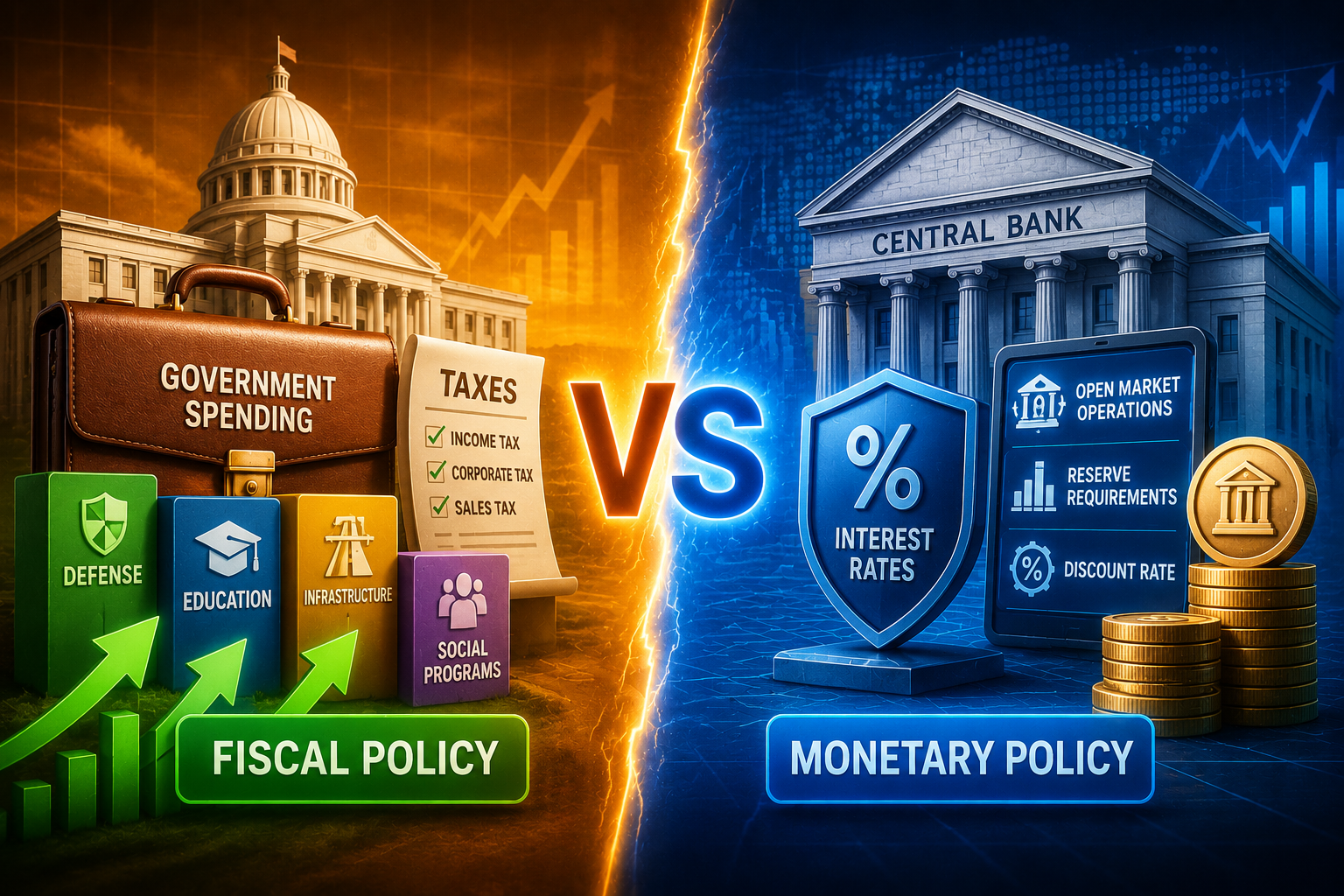
Every modern economy is steered by two separate steering wheels. When the road gets bumpy, policymakers use these controls to prevent the vehicle from sliding into a recession or overheating from runaway inflation. These two levers of macroeconomic management are Fiscal Policy and Monetary Policy.
While both systems share the ultimate goal of maintaining a stable, prosperous economy, they operate in completely different ways, use distinct tools, and are controlled by entirely different institutions.
Understanding the differences between these two forces is essential for business leaders, investors, and voters who want to navigate modern financial realities. Below is an in-depth, comprehensive analysis of how fiscal and monetary policies shape the global economic landscape.
1. What is Fiscal Policy?
Fiscal policy refers to the use of government spending and taxation to influence the level of economic activity. Wielded by the legislative and executive branches of government, such as the parliament, congress, and national treasury, fiscal policy directly alters the flow of capital in the public and private sectors.
The Theoretical Foundation
Fiscal policy is deeply rooted in Keynesian economics, a school of thought pioneered by British economist John Maynard Keynes. Keynes argued that aggregate demand is the primary driver of economic cycles. When private spending contracts during a recession, Keynesians believe the government must step in as the spender of last resort to stabilize the system.
The total aggregate demand within an economy can be represented by the classical macroeconomic equation:
AD = C + I + G + (X - M)
Where:
AD is Aggregate Demand
C is Private Consumption
I is Private Investment
G is Government Spending
X – M is Net Exports (Exports minus Imports)
By adjusting G (spending) or implementing tax policies that modify C and I, the state directly shapes the overall velocity of the economy.
Expansionary Fiscal Policy
When an economy is operating below its potential, showing high unemployment and slow growth, governments deploy expansionary fiscal policy. This is achieved by:
Increasing public spending: Injecting capital directly into the economy via infrastructure projects, education, and defense spending.
Cutting taxes: Leaving more disposable income in the hands of consumers and corporations, which stimulates private consumption and capital investment.
This approach often results in a budget deficit, where government outlays exceed tax revenues. For instance, the Congressional Budget Office (CBO) projected the United States federal budget deficit for fiscal year 2026 to reach approximately $1.9 trillion, or roughly 5.8% of Gross Domestic Product, as a result of ongoing legislative spend, social program allocations, and elevated net interest costs on outstanding debt.
Contractionary Fiscal Policy
Conversely, when an economy is growing too rapidly, characterized by labor shortages and soaring inflation, governments can implement contractionary fiscal policy. This involves:
Reducing government spending: Scaling back public projects and agency budgets.
Raising taxes: Siphoning liquidity out of the private sector to reduce consumer demand and cool business expansion.
A real-world example of this occurred in New Zealand, where the Finance Minister delivered Budget 2026 with a tight net operating package of just $2.1 billion per year. By offsetting new spending with $1.7 billion in targeted savings and baseline cuts, the government sought to rein in inflation and fast-track a return to budget surplus by 2028/29.
2. What is Monetary Policy?
Monetary policy is the process by which a nation’s central bank manages the money supply and controls borrowing costs. Unlike fiscal policy, which is highly political and subject to legislative debates, monetary policy is managed by independent technocrats at central banks, such as the Federal Reserve (Fed) in the United States, the European Central Bank (ECB) in the Eurozone, and the Reserve Bank of New Zealand (RBNZ).
The Theoretical Foundation
Monetary policy is aligned with Monetarism, a school of economic thought led by Milton Friedman. Monetarists argue that inflation is ultimately a monetary phenomenon, caused by too much money chasing too few goods. The relationship is expressed via the Equation of Exchange:
M \cdot V = P \cdot Y
Where:
M is the Total Money Supply
V is the Velocity of Money (how fast currency changes hands)
P is the Average Price Level
Y is the Real Output (Real GDP)
Central banks attempt to balance this equation by managing the expansion or contraction of $M$ to keep prices stable while supporting employment.
Expansionary Monetary Policy
During downturns, central banks seek to make money cheaper and more abundant. This process is executed through:
Lowering policy rates: Reducing the benchmark interest rate, which lowers borrowing costs for home loans, credit cards, and business expansion.
Open Market Operations: Purchasing government bonds from banks, which pumps liquidity directly into the financial system. This process is commonly known as Quantitative Easing (QE).
Reducing reserve ratios: Allowing banks to hold less cash in reserve, which frees up capital to be issued as commercial loans.
Contractionary Monetary Policy
When inflation threatens price stability, central banks put the brakes on the economy. They do this by:
Raising benchmark interest rates: Driving up the cost of credit, which discourages consumer spending and slows down corporate hiring.
Quantitative Tightening (QT): Selling bonds off their balance sheets, effectively pulling currency out of circulation.
A clear demonstration of this arose during the macroeconomic adjustments of 2026. Central banks worldwide had to contend with elevated geopolitical tensions and oil shocks. The Reserve Bank of New Zealand, for example, maintained its Official Cash Rate (OCR) at an elevated level of 2.25% in mid-2026, signaling that rates would need to remain high to ensure inflation returned safely to its 2% target midpoint.
3. Side-by-Side Comparison
To quickly understand how these two economic policies differ, review this comprehensive comparative matrix.
Comparison Vector
Fiscal Policy
Monetary Policy
Governing Authority
National Legislative and Executive Governments (e.g., Congress, Treasury)
Independent Central Banks (e.g., Federal Reserve, ECB, RBNZ)
Core Instruments
Government spending, public infrastructure budgets, individual and corporate taxes
Policy interest rates, reserve requirements, bond purchases (QE/QT)
Primary Target
Aggregate demand, public resource allocation, and social safety nets
Price stability (inflation targeting) and employment figures
Implementation Delay
Very Slow: Requires legislative negotiation, drafting bills, and political debates
Very Fast: Can be changed in a single, scheduled policy meeting
Transmission Impact
Very Fast: Money spent on infrastructure or tax rebates enters the real economy almost instantly
Slow: Rate hikes or cuts typically take 12 to 18 months to filter fully into the real economy
Democratic Input
High. Decisions are made by elected representatives who answer directly to voters
Low. Run by unelected economists to insulate decisions from election-year pressures
Major Side Effects
Growing national debt levels, fiscal deficits, and potential crowding out of private capital
Asset bubbles, wealth inequality, and potential banking sector stress during rapid shifts
4. When Policies Clash: The Modern Macroeconomic Dilemma
In an ideal world, fiscal and monetary policies operate in harmony. During deep recessions, both the government and the central bank cut taxes, spend money, and drop interest rates. This is known as a coordinated expansion.
However, we frequently observe these policies pulling in opposite directions. This tension has been a defining feature of global economics in recent years.
The Fiscal-Monetary Tug of War
When governments run large budget deficits (expansionary fiscal policy) while central banks are trying to cool inflation (contractionary monetary policy), a dangerous conflict arises:
Conflicting Signals: The government pumps money into the system through targeted tax relief, infrastructure initiatives, or energy subsidies.
Central Bank Reaction: The central bank sees this added demand as an inflationary threat. To prevent prices from rising, it must raise interest rates even higher than originally planned.
The Yield Curve Effect: High fiscal deficits require governments to issue a constant stream of new treasury bonds. A surge in bond supply, combined with tight central bank rates, drives up long-term bond yields, making it expensive for governments to service their existing national debt.
Fitch Ratings highlighted this exact challenge, noting that the general United States government deficit was projected to widen to $7.9\%$ of GDP, which, when coupled with persistent fuel-driven inflation pressures, forced credit agencies to closely watch debt-to-GDP levels. Because of this fiscal expansion, researchers noted that the Federal Reserve faced a complex “stagflation challenge,” limiting its ability to cut rates without risking further price spikes.
5. Play the Economic Policymaker: Live Interactive Simulator
Try your hand at managing a national economy. Use the interactive tool below to adjust government tax rates, annual infrastructure spending, and the central bank interest rate. Watch how these variables immediately alter inflation, real GDP growth, and the country’s national debt-to-GDP ratio.
The Fiscal vs. Monetary Policy Coordinator
As prime minister and central bank governor, you must balance the economy. Adjust the levers below to manage inflation, growth, and sovereign debt.
Government Levers (Fiscal Policy)
Higher taxes reduce consumer demand and lower the national deficit.
Pumps money directly into GDP, but can trigger deficit spending.
Central Bank Levers (Monetary Policy)
Raising rates cools inflation but slows down real business expansion.
Economic Vital Signs
Annual Real GDP Growth2.3%
Consumer Price Inflation2.1%
National Debt-to-GDP Ratio85.0%
Current Status: Your economy is currently stable and experiencing moderate expansion.
6. Strategic Outlook for Private Capital and Markets
Because fiscal and monetary policies constantly adapt to changing conditions, businesses and long-term asset allocators must learn to translate policy pivots into concrete investment decisions.
Fixed-Income Allocations
Bond values are exceptionally sensitive to policy updates. When a central bank increases interest rates to slow down inflation, yields rise across new bond offerings, driving down the resale price of older bonds. On the fiscal side, when governments execute large budgets and run perpetual deficits, they must supply an abundance of new sovereign bonds. This surge can dilute existing assets and compress sovereign credit safety margins.
Equity Sector Dynamics
Different sectors respond in unique ways to policy coordinates:
The High-Rate Regime: High interest rates depress valuations on growth stocks, particularly technology startups that rely on long-term cash flow horizons. Conversely, financial firms often see net interest margins improve.
The Stimulatory Pipeline: Large-scale government spending programs provide strong tailwinds for industrial firms, renewable infrastructure, and military defense contractors.
Summary: Navigating the Policy Landscapes
At its core, the difference between fiscal and monetary policy is a separation of powers designed to keep the economy stable:
Fiscal policy targets the redistribution of wealth, public infrastructure, and direct resource deployment through the democratic process.
Monetary policy safeguards the buying power of the currency by managing the credit system and controlling inflation.
An economy is healthiest when these two programs work in tandem. When they pull in opposite directions, it creates market volatility, elevates national debts, and challenges the financial planning of everyday households. By paying close attention to both central bank statements and legislative budget releases, investors and citizens can stay one step ahead of the macroeconomic tide.