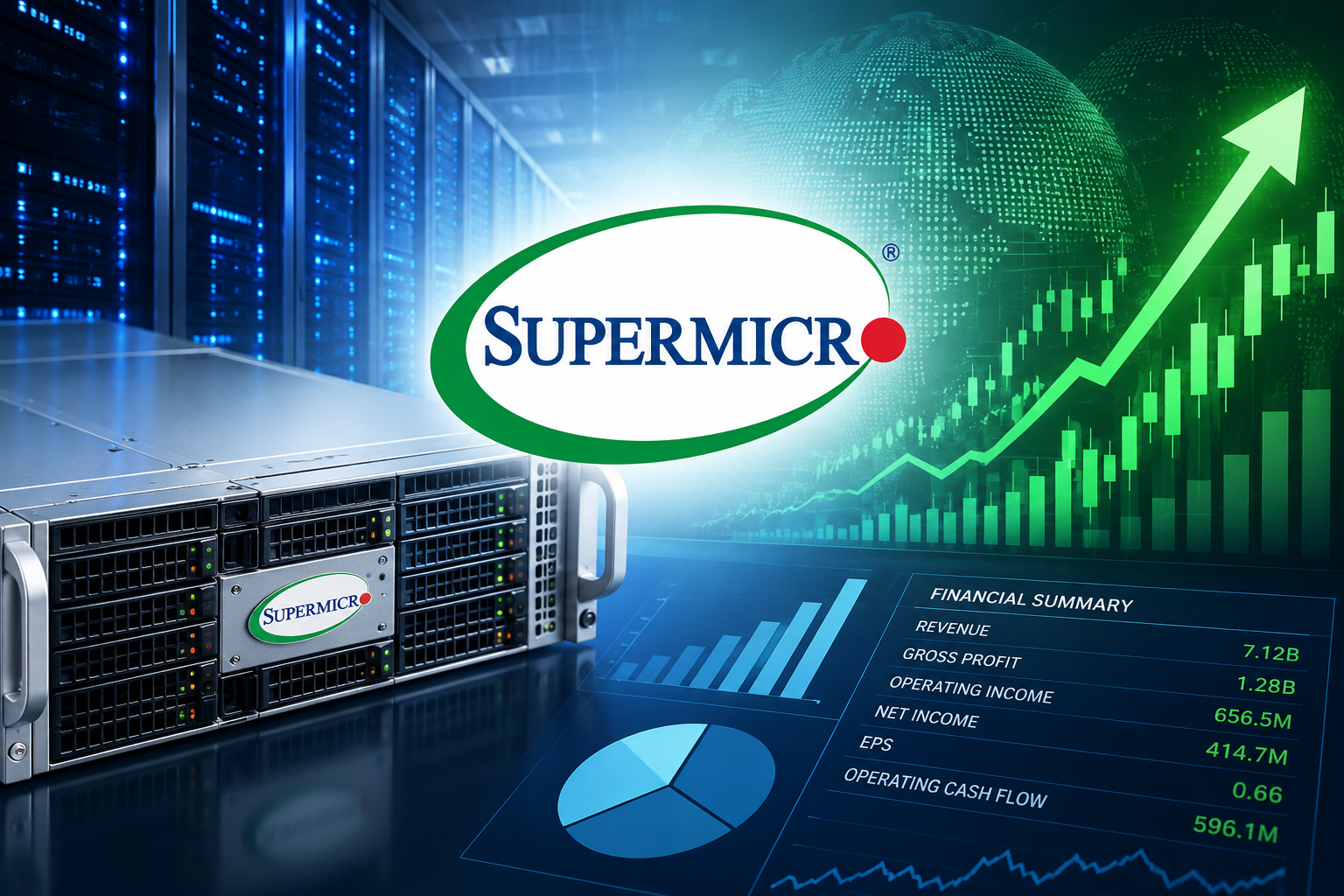
Super Micro Computer, Inc., known commercially as Supermicro (NASDAQ: SMCI), is a San Jose, California based maker of high performance servers, storage systems, and full rack scale solutions that has become one of the most important hardware suppliers for the AI data center boom. Founded by Charles Liang in 1993, the company builds modular, liquid cooled AI server platforms built around Nvidia and AMD accelerators and sells them to hyperscale cloud providers, enterprises, and governments. As of early July 2026, SMCI trades near $27 per share, well below its 52 week high of $62.36, after a volatile stretch marked by both explosive AI driven revenue growth and serious governance controversies, including a 2024 short seller report, delayed financial filings, and a 2026 federal investigation into alleged illegal chip exports to China. Fiscal year 2025 revenue (ended June 30, 2025) reached $21.97 billion, up 46.6% year over year, and the company has guided fiscal 2026 revenue toward roughly $39 billion to $40 billion. Charles Liang remains Chairman, President, and CEO. SMCI does not pay a dividend and remains one of the most volatile large cap technology stocks on Wall Street.
Market capitalization, share price, and financial guidance move quickly for SMCI, which has been one of the most volatile large cap stocks in the market. The figures above reflect trading levels in early July 2026 and are meant as a general reference point rather than a live quote.
What Is Super Micro Computer?
Super Micro Computer, Inc., which does business as Supermicro, designs, manufactures, and sells high performance, high efficiency servers and storage systems built on a modular, open standard architecture. Rather than building general purpose computers for consumers, Supermicro focuses on the infrastructure layer that powers cloud computing, artificial intelligence training and inference, 5G networks, and edge computing. Its core value proposition is speed and customization: the company can configure and ship complex, liquid cooled AI server racks faster than many larger rivals, a capability it markets as “time to online.”
Supermicro trades on the Nasdaq under the ticker SMCI. The company has grown extremely quickly alongside the AI infrastructure buildout, but it has also drawn significant scrutiny over corporate governance, accounting practices, and export compliance, including a Nasdaq delisting scare in 2024 and a Department of Justice investigation in 2026 into alleged unauthorized shipments of advanced chips to China. Investors researching SMCI typically need to weigh genuinely strong underlying demand for its products against a documented history of governance and compliance controversies.
Company History
1993: Charles Liang, his wife Sara Liu, and co founders including Yih Shyan “Wally” Liaw and Chiu Chu Liu Liang found Super Micro Computer in San Jose, California, focused on server motherboards and systems.
2007: Supermicro goes public on Nasdaq, building a reputation over the following decade as a fast moving, engineering driven alternative to larger server vendors.
2018: Supermicro is delisted from Nasdaq after an accounting investigation tied to premature revenue recognition, ultimately settling with the SEC and paying a $17.5 million penalty; the company restates several years of financial results.
2020: Supermicro relists on Nasdaq after remediation efforts and restored compliance with filing requirements.
2022 to 2023: Demand for AI servers accelerates sharply as generative AI adoption spreads, and Supermicro’s revenue and stock price begin a rapid multiyear climb, aided by its early, close relationship with Nvidia.
2024: Supermicro joins the S&P 500 in March, then faces a major crisis later in the year after short seller Hindenburg Research publishes allegations of accounting manipulation and related party dealings; auditor Ernst and Young resigns, the company delays its annual filing, and Nasdaq issues a delisting warning before Supermicro appoints BDO USA as its new auditor and regains compliance.
2025: Supermicro reports record fiscal year revenue of $21.97 billion, continues to expand global manufacturing capacity, and unveils its Data Center Building Block Solutions (DCBBS) platform aimed at software, services, and full rack scale integration.
2026: Federal prosecutors indict three individuals, including Supermicro co founder Wally Liaw, on charges tied to an alleged $2.5 billion scheme to divert Nvidia chips to restricted entities in China; Taiwanese authorities raid company offices and detain staff as part of a parallel investigation; Supermicro itself and CEO Charles Liang are not named as defendants, and the company raises approximately $7 billion in new equity to help fund a large AI server order backlog.
Supermicro has now faced governance related controversies on two separate occasions, in 2018 and again in 2024 through 2026. This pattern is a meaningful part of the company’s investment profile and is discussed in more detail in the Recent News section below.
Founders
Super Micro Computer was founded in September 1993 by Charles Liang together with his wife and co founder Sara Liu, along with early collaborators Yih Shyan “Wally” Liaw and Chiu Chu Liu Liang. Liang, an electrical engineer originally from Taiwan who earned a master’s degree from the University of Texas at Arlington, previously worked as a chief design engineer before starting the company. Liaw, who served for years as an executive and board member, retired in 2018 following the company’s earlier accounting related delisting, returned to Supermicro in a consulting and later executive capacity in the early 2020s, and was later charged in 2026 in connection with the alleged chip export scheme, after which he resigned from the board. Liang remains the company’s largest individual shareholder and has led it continuously since its founding.
CEO
Charles Liang has served as Chairman, President, and Chief Executive Officer of Supermicro since he founded the company in 1993, making him one of the longest tenured founder CEOs in the American hardware industry. Liang has guided the company through multiple technology cycles, from early motherboard manufacturing to today’s liquid cooled, rack scale AI infrastructure business, and has cultivated a close relationship with Nvidia and its leadership. His compensation has at times been structured heavily around performance based stock options rather than cash salary. Liang has also been the central figure through both of the company’s major governance controversies, in 2018 and again beginning in 2024, and has publicly maintained that the more recent chip export allegations reflect the actions of individual employees rather than company wide policy.
Headquarters
Supermicro is headquartered in San Jose, California, in the heart of Silicon Valley. The company has been rapidly expanding its global manufacturing footprint to support surging AI server demand, including facilities in Taiwan, a large campus in Malaysia used for subsystem and rack scale production, an APAC science and technology center, and new or expanding sites in Texas, Mexico, and the Middle East, alongside a planned new Silicon Valley campus. This distributed manufacturing strategy is intended to reduce geopolitical risk and shorten delivery times for customers in different regions.
Business Segments
Supermicro operates and reports as a single operating segment focused on high performance server solutions, rather than dividing results into multiple reportable business segments like some larger, more diversified technology companies. Within that single segment, the business is generally understood along a few key lines:
Data Center and AI Infrastructure (Large Customers): Rack scale, liquid cooled AI server systems sold to hyperscale cloud providers and large AI focused customers. This is currently the company’s largest and fastest growing area, though revenue can be lumpy from quarter to quarter based on individual large customer deployment schedules.
Enterprise and Channel: Servers and storage systems sold to a broader base of enterprise customers, government agencies, and channel partners. Management has emphasized growing this segment’s share of revenue to diversify away from reliance on a small number of very large customers.
Data Center Building Block Solutions (DCBBS): A newer initiative bundling software, networking, services, and rack level management tools alongside hardware, intended to grow higher margin recurring revenue over time.
Geographic Mix: More than half of Supermicro’s revenue is generated in the United States, with the remainder coming from Europe, Asia, and other international markets.
Products and Services
AI and GPU ServersSuperBlade and MicroBladeFlexTwin and BigTwin SystemsGrandTwin Multi Node ServersSuperStorage SystemsFull Rack Scale SolutionsLiquid Cooling (DLC)Server Motherboards and ChassisNetworking SwitchesEdge, IoT, and 5G SystemsWorkstationsDCBBS Software and Services
Supermicro’s core products are servers and storage systems built around a modular, building block design philosophy, which allows customers to configure systems for specific workloads rather than buying fixed, one size fits all machines. Its AI server lineup integrates Nvidia and AMD graphics processing units into liquid or air cooled rack systems designed for large language model training and inference. Beyond hardware, Supermicro offers remote management software such as Supermicro Server Manager and SuperCloud Composer, along with rack level design, deployment, and support services aimed at helping customers stand up entire AI data centers as a turnkey solution rather than assembling one piece at a time.
Revenue Breakdown
Supermicro’s revenue is heavily concentrated in AI and data center infrastructure, with a small number of very large hyperscale and cloud customers historically representing a significant share of total sales. In its fiscal third quarter of 2026, management highlighted a notable shift, with enterprise customers growing to about 28% of revenue, up from roughly 15% the prior quarter, as the company works to diversify its customer base.
Supermicro Revenue Mix by Customer Type, Approximate (Fiscal Q3 2026)
Mix is approximate and based on management commentary for the fiscal third quarter of 2026. This ratio has shifted meaningfully from quarter to quarter and management has stated an intention to keep growing the enterprise share over time.
Metric
Recent Value (Fiscal Q3 2026)
YoY Change
Quarterly Revenue
$10.2 billion
Up 123%, but down 19% sequentially on site readiness delays
Non GAAP Gross Margin
10.1%
Up sharply from 6.4% the prior quarter
United States Revenue Share
more than 50% of total revenue
Consistent with recent history
International Revenue Share
remainder from Europe, Asia, and other regions
Consistent with recent history
Supermicro’s backlog tied to Nvidia’s Blackwell Ultra (GB300 NVL72) platform alone has been reported at more than $13 billion, underscoring how concentrated near term revenue growth is around a small number of very large AI hardware platforms and customers.
Financial Performance
Supermicro’s revenue has grown extremely quickly over the past several fiscal years, closely tracking the broader AI infrastructure investment cycle. Fiscal year 2025 (ended June 30, 2025) revenue reached $21.97 billion, up 46.6% from fiscal 2024, while net income declined slightly to about $1.05 billion as gross margins compressed under competitive pricing pressure and rising costs. Trailing twelve month revenue has since climbed further to roughly $28 billion to $34 billion depending on the reporting period, and management has guided full fiscal 2026 revenue toward a range of $38.9 billion to $40.4 billion.
Supermicro Annual Revenue, Fiscal Years 2022 to 2025 (USD billion)
Figures are GAAP full year net sales for fiscal years ended June 30. Fiscal 2026 revenue is guided toward approximately $39 billion to $40 billion, which would represent another significant increase.
Metric
Fiscal Year 2025
YoY Change
Total Revenue
$21.97 billion
Up 46.6%
Net Income
approx. $1.05 billion
Down 9.0%
Diluted EPS
approx. $1.67
Down from prior year on margin compression
Fiscal 2026 Revenue Guidance
$38.9 billion to $40.4 billion
Up approx. 77% to 84% at midpoint
Fiscal Q4 2026 Gross Margin Guidance
8.2% to 8.4%
Reflects thin but improving hardware margins
Supermicro’s profitability has been volatile as gross margins swing with customer mix, component costs, and one time expenses such as expedite fees. The company has stated a goal of building toward a more sustainable double digit gross margin model over time by growing the share of revenue coming from software, services, and enterprise grade solutions rather than high volume, lower margin hyperscale hardware deals.
Stock Information
Supermicro shares trade on the Nasdaq under the ticker SMCI. The stock has been extraordinarily volatile over the past two years, at various points trading below $20 and above $120 as sentiment has swung between enthusiasm for AI infrastructure demand and concern over governance, accounting, and export compliance issues. As of early July 2026, shares traded around $27, near the lower end of the 52 week range, reflecting pressure from the ongoing federal chip export investigation and a large recent equity raise that diluted existing shareholders.
SMCI 52 Week Trading Range (approx.)
Range illustration based on publicly reported 52 week trading data as of early July 2026. SMCI carries a materially higher beta than the broader market and has shown extreme single day price swings around earnings and legal news.
Stock Metric
Approximate Value (early July 2026)
Exchange
Nasdaq (SMCI)
Recent Price
approx. $27 per share
52 Week Range
$19.48 to $62.36
Market Capitalization
approx. $16 billion to $20 billion
Trailing P/E Ratio
approx. 14 to 15
Average Analyst Price Target
approx. $33 to $37
Analyst Consensus Rating
Mixed, generally described as Hold, with a wide spread between bullish and bearish ratings
Beta
approx. 2.6, substantially more volatile than the broader market
Next Earnings Date (est.)
Early August 2026
Analyst opinion on SMCI is unusually split, with some firms bullish on AI hardware demand and backlog, and others cautious given the unresolved federal investigation, thin hardware margins, and history of governance issues. Ratings and price targets change frequently and should be treated as one input among many.
Dividends
Supermicro does not currently pay a dividend and has not historically paid one. Instead, the company has reinvested essentially all available capital into working capital, manufacturing capacity expansion, and research and development to keep pace with surging AI server demand. In June 2026, Supermicro raised approximately $7 billion through a new equity offering to help fund a large order backlog, a move that diluted existing shareholders and contributed to a sharp single day stock decline, illustrating how the company continues to rely on external capital rather than free cash flow or dividends to fund growth. Investors seeking income focused stocks generally look elsewhere, since SMCI is positioned as a growth and momentum stock rather than an income investment.
Competitors
Competitor
Primary Overlap With Supermicro
Dell Technologies
Enterprise and hyperscale servers, including AI optimized server and storage systems
Hewlett Packard Enterprise (HPE)
Enterprise servers, storage, and AI infrastructure solutions
Lenovo
Data center servers and AI infrastructure hardware
Foxconn and Ingrasys
Original design manufacturing of AI servers directly for hyperscale cloud customers
Quanta Computer
Original design manufacturing of servers and AI infrastructure hardware
Wiwynn
Cloud and AI server manufacturing, closely tied to major hyperscale customers
Celestica
Electronics manufacturing services for networking and server hardware
ASUS and ASRock Rack
Server motherboards and systems, particularly in Asian markets
Supermicro’s most direct competitive pressure comes from large contract manufacturers and original design manufacturers based in Taiwan and China that build servers directly for hyperscale customers such as major cloud providers, often at thin margins and enormous scale. Larger, more diversified vendors such as Dell and HPE compete more on enterprise relationships, financing, and support infrastructure, while Supermicro has generally competed on speed of deployment, customization, and early access to the latest Nvidia and AMD platforms.
Recent News
Chip export investigation: In March 2026, federal prosecutors indicted three individuals, including Supermicro co founder Wally Liaw, in connection with an alleged two year scheme to divert roughly $2.5 billion worth of Nvidia H100 and H200 based servers to restricted entities in China. Supermicro itself and CEO Charles Liang were not named as defendants, and the company says it is cooperating with authorities.
Taiwan office raids: Taiwanese authorities raided Supermicro offices and detained staff in a parallel investigation into the alleged chip smuggling scheme, adding further uncertainty around the company’s compliance controls.
$7 billion equity raise: In June 2026, Supermicro announced an approximately $7 billion equity raise intended to fund a $39 billion AI server order backlog, a move that diluted shareholders and triggered a roughly 30% single day stock decline.
Q3 fiscal 2026 earnings beat despite revenue miss: Supermicro reported fiscal third quarter revenue of $10.2 billion, below consensus due to customer site readiness delays, but non GAAP gross margin recovered sharply to 10.1% and EPS beat expectations, sending shares up roughly 20% in the following session.
DCBBS platform expansion: The company continues to expand its Data Center Building Block Solutions platform, aiming to grow software, services, and networking as a larger share of total profit over the next several years.
Class action litigation: Multiple law firms have filed or announced securities class action lawsuits on behalf of investors related to the chip export allegations and prior disclosures, adding legal and financial uncertainty alongside the ongoing federal investigation.
News developments have moved unusually quickly for SMCI, and both the federal investigation and related litigation remain unresolved. For the latest updates, check Supermicro’s official investor relations site or a live financial news source before making any investment decision.
Frequently Asked Questions
What does Super Micro Computer actually make?
Supermicro designs and manufactures high performance servers, storage systems, and full rack scale solutions used in AI data centers, cloud computing, enterprise IT, and edge or 5G applications. Its products integrate processors and graphics processing units from companies such as Nvidia and AMD into modular, often liquid cooled server systems.
Why has SMCI stock been so volatile?
SMCI’s volatility stems from a combination of extremely rapid, AI driven revenue growth, thin and fluctuating hardware margins, customer concentration among a small number of very large buyers, and a documented history of governance controversies, including a 2018 accounting related delisting and a 2024 through 2026 period marked by a short seller report, delayed filings, and a federal investigation into alleged illegal chip exports.
Is Supermicro involved in the Nvidia chip smuggling case?
Federal prosecutors charged three individuals, including a Supermicro co founder who had served as a senior executive and board member, in connection with an alleged scheme to divert Nvidia based servers to restricted entities in China. Supermicro as a company and CEO Charles Liang were not named as defendants, and the company has stated it is cooperating with the investigation, but the case has weighed heavily on investor sentiment.
Does Supermicro pay a dividend?
No. Supermicro does not currently pay a dividend and has historically reinvested capital into growth rather than shareholder distributions. In 2026 it also raised billions of dollars in new equity to help fund its order backlog, further underscoring its focus on growth over capital return.
Who is the CEO of Supermicro?
Charles Liang has served as Chairman, President, and Chief Executive Officer since founding the company in 1993.
Has Supermicro had accounting problems before?
Yes. Supermicro was delisted from Nasdaq in 2018 following an accounting investigation related to premature revenue recognition, later settling with the SEC and paying a $17.5 million penalty before relisting in 2020. A separate set of allegations emerged in 2024 from short seller Hindenburg Research, followed by the resignation of auditor Ernst and Young and a temporary Nasdaq delisting warning, before the company regained compliance with a new auditor.
Is Supermicro stock a good investment?
That depends on individual goals, risk tolerance, and comfort with governance related uncertainty. Supermicro offers direct exposure to AI infrastructure spending and has shown genuinely strong revenue growth, but it also carries thin hardware margins, customer concentration risk, and an unresolved federal investigation. This article is for informational purposes only and is not investment advice; consult a licensed financial advisor before making investment decisions.
This article is for general informational and educational purposes only and does not constitute financial, investment, tax, or legal advice. Stock prices, financial figures, and company facts change frequently and figures presented here may not reflect real time values. Legal matters described here, including ongoing investigations and litigation, are based on public reporting as of the update date and may change as investigations and court proceedings continue. Always verify current data through official company filings, a licensed broker, or a live financial data provider, and consult a qualified financial advisor before making any investment decision. Neither the author nor the publisher holds responsibility for financial decisions made based on this content.