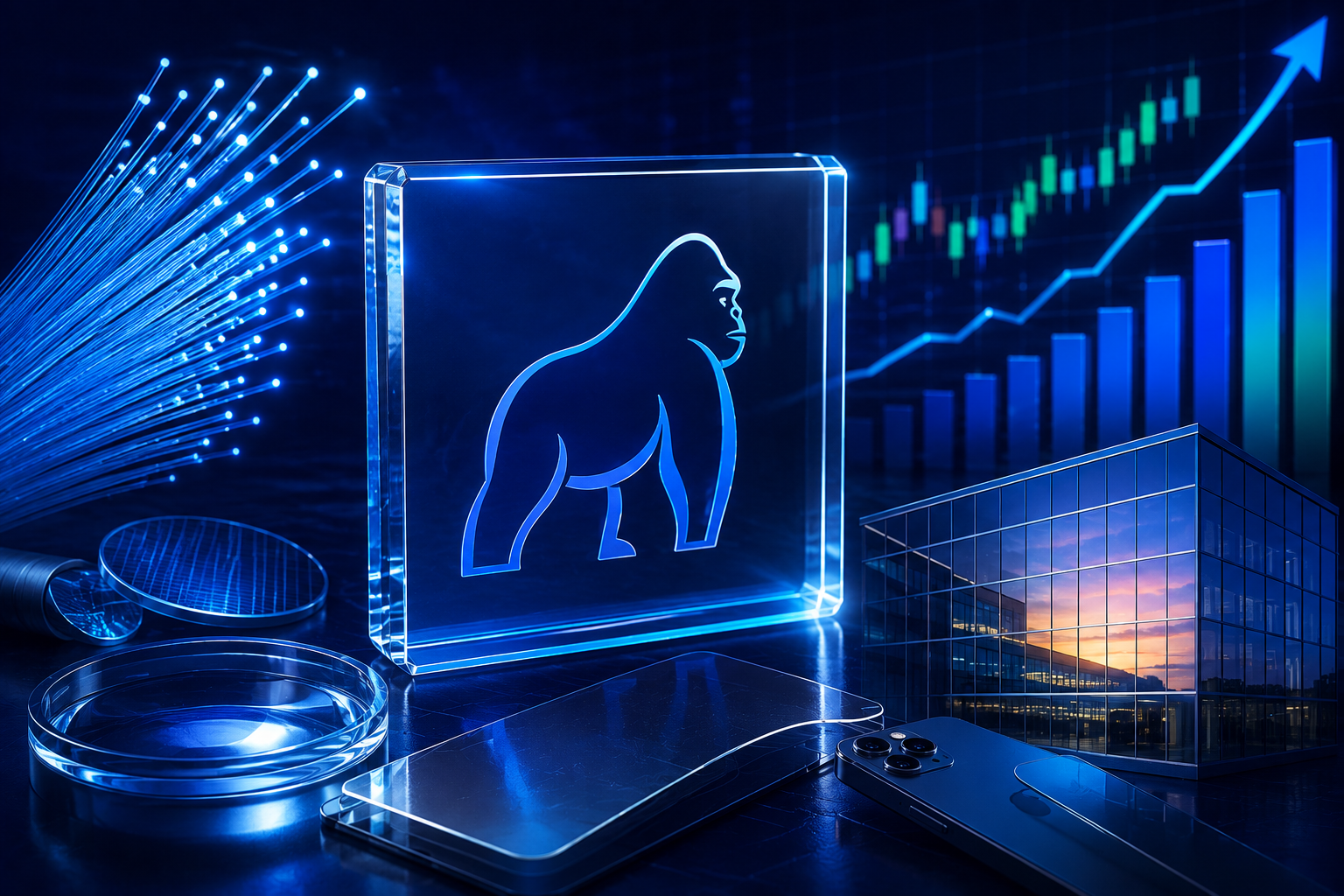
Corning Incorporated (NYSE: GLW) is a 175 year old American materials science company based in Corning, New York, best known for inventing glass optical fiber, developing Gorilla Glass for smartphones, and building the ceramic substrates used in catalytic converters. The company has reinvented itself over the past two years as one of the leading suppliers of optical fiber and connectivity hardware for AI data centers, striking multibillion dollar supply agreements with hyperscale customers including Meta. As of early July 2026, GLW trades near $198 per share after a volatile run that took the stock from roughly $51 to a 52 week high above $270, giving the company a market capitalization of around $170 billion to $220 billion depending on the trading day. Full year 2025 sales reached $15.63 billion on a GAAP basis, up sharply from 2024, driven mainly by explosive growth in the Optical Communications segment. Wendell Weeks has served as Chairman and CEO since 2005. The stock pays a modest quarterly dividend and has become a widely followed proxy for AI infrastructure spending.
Market capitalization, share price, and yield move daily, and GLW has been unusually volatile in 2026. The figures above reflect trading levels in early July 2026 and are meant as a general reference point rather than a live quote.
What Is Corning?
Corning Incorporated is an American technology and materials science company that designs and manufactures specialty glass, ceramics, and optical physics products. Rather than fitting into a single industry, Corning describes itself as a “life changing innovation” company that applies deep expertise in glass science and materials engineering across very different markets, from smartphone screens to car engines to hospital laboratories to fiber optic cables running through data centers. The company was formerly known as Corning Glass Works for most of the 20th century and adopted the name Corning Incorporated in 1989 after divesting many of its household consumer product lines.
Corning trades on the New York Stock Exchange under the ticker GLW, a legacy code that stands for “Glass Works.” The company is one of the longest continuously operating industrial businesses in the United States, and it has repeatedly reinvented its product mix over more than a century, moving from railroad lantern glass and light bulbs, to television tubes, to fiber optics, to smartphone cover glass, and now to the optical infrastructure that powers artificial intelligence data centers.
Company History
1851: Amory Houghton Sr. and partners found a glass business in Somerville, Massachusetts, which later relocates and becomes Corning Glass Works.
1868: The company moves its operations to Corning, New York, the town after which it is named, drawn by rail access and natural gas for glassmaking.
1908: Corning develops Pyrex, heat resistant borosilicate glass that becomes a household name in bakeware and laboratory equipment.
1970: Corning scientists invent the first practical low loss optical fiber, a breakthrough that eventually becomes the backbone of the modern internet.
1989: Corning Glass Works is renamed Corning Incorporated to reflect its broadening portfolio beyond traditional glass products.
1998: Corning divests its consumer products division, including CorningWare and Corelle, selling it to Borden and later World Kitchen, to focus on industrial and technology materials.
2000 to 2002: The dot com and telecom bust hits Corning hard as demand for optical fiber collapses, forcing major restructuring and job cuts.
2007: Corning partners with Apple to help develop the durable cover glass used on the original iPhone, an event widely credited with launching the Gorilla Glass business.
2012 to 2019: Corning expands Gorilla Glass across the global smartphone industry, grows its Life Sciences labware business, and continues to invest in fiber for wireless and broadband buildouts.
2023: Corning launches its “Springboard” plan, a multiyear strategy targeting significant incremental sales and margin expansion through 2026, built around AI driven demand for optical connectivity.
2025: Corning signs a multiyear agreement worth up to $6 billion to supply Meta with AI focused fiber optic infrastructure, and reports record full year sales and profit.
2026: Corning creates new Glass Innovations and Solar reporting segments, continues to sign large scale agreements with hyperscale data center operators, and becomes one of the most closely watched “AI infrastructure” stocks on Wall Street.
Founders
Corning traces its roots to Amory Houghton Sr., a businessman who acquired a stake in a Massachusetts glass company in 1851 and later moved the operation to Corning, New York. The Houghton family controlled and led the company for generations, with successive family members serving as president or chairman well into the 20th century, a rare example of long term family stewardship at a major American industrial company. While the founding predates the modern concept of a startup founder team, the Houghton family’s decision to relocate the business to Corning, New York, and its long term investment in glass science research, shaped the company’s identity as a research driven materials innovator rather than a pure manufacturer.
CEO
Wendell P. Weeks has served as Chairman and Chief Executive Officer of Corning Incorporated since 2005, making him one of the longer tenured CEOs among large cap American industrial and technology companies. Weeks joined Corning in 1983 and rose through a series of leadership roles across the company’s specialty materials and display technologies businesses before being named CEO. Under his leadership, Corning has navigated the aftermath of the early 2000s telecom collapse, built the Gorilla Glass franchise into a dominant force in mobile devices, and more recently launched the “Springboard” strategic plan, which has repositioned optical fiber and connectivity products as the company’s primary growth engine amid surging demand from AI data center operators.
Headquarters
Corning Incorporated is headquartered in Corning, New York, a small city in the Southern Tier region of the state near the Pennsylvania border. The company’s presence dominates the local economy, and the adjacent Corning Museum of Glass, which the company helped found, is one of the region’s best known cultural institutions. Corning also operates major research, manufacturing, and administrative sites across the United States, along with a global manufacturing and sales footprint spanning countries including China, Japan, South Korea, Taiwan, Germany, France, and Mexico.
Business Segments
Effective the first quarter of 2026, Corning revised its segment structure to better reflect how the business is managed. The company now reports results across five primary areas:
Optical Communications: Optical fiber, cable, and connectivity hardware for carrier network and enterprise customers, including the fast growing AI data center and hyperscaler business. This is currently Corning’s largest and fastest growing segment.
Glass Innovations: A newly combined segment merging the former Display Technologies and Specialty Materials businesses, covering glass substrates for televisions, notebooks, and other displays, along with specialty glass, glass ceramics, and precision optics used in semiconductor and mobile device manufacturing.
Solar: A newly created standalone segment combining Hemlock Semiconductor Group’s polysilicon business with Corning’s solar wafer and module manufacturing operations, reflecting the company’s goal of building a multibillion dollar solar and semiconductor materials business.
Automotive: Ceramic substrates and filter products for gasoline and diesel emissions control, along with technical glass and optical solutions used inside and outside vehicles.
Life Sciences and Emerging Growth Businesses: Laboratory products sold under the Corning, Falcon, PYREX, and Axygen brands, along with pharmaceutical glass packaging and other early stage business lines.
Products and Services
Optical Fiber and CableFiber Optic HardwareGorilla GlassDisplay Glass SubstratesCeramic SubstratesPharmaceutical Glass VialsPyrex LabwareFalcon and Axygen LabwarePolysilicon and Solar WafersPrecision OpticsSemiconductor OpticsAutomotive Emissions Filters
Corning’s products span consumer electronics (Gorilla Glass cover glass used by major smartphone and laptop makers), telecommunications infrastructure (optical fiber, cable, and connectors used by carriers, enterprises, and hyperscale data center operators), automotive components (ceramic substrates for emissions control), scientific research (laboratory glassware, plasticware, and cell culture products), pharmaceutical packaging (glass vials and tubing for injectable drugs and vaccines), and clean energy materials (solar grade polysilicon and wafers). This diversity allows Corning to apply the same core glass and materials science expertise across multiple, largely uncorrelated end markets.
Revenue Breakdown
For full year 2025, Corning reported GAAP sales of $15.63 billion, with core (non GAAP) sales of $16.41 billion, up 13% year over year. Optical Communications was by far the largest contributor and the primary driver of growth, fueled by surging demand for fiber and connectivity products used in AI data centers. The chart below shows an approximate breakdown of revenue by segment based on recent quarterly results.
Corning Revenue Share by Segment, Approximate (Early 2026)
Segment shares are approximate and rounded, based on Corning’s recently reported quarterly segment results following the 2026 segment reorganization. Percentages may not sum to exactly 100 due to rounding and corporate eliminations.
Segment
Recent Quarterly Sales (approx.)
YoY Change
Optical Communications
approx. $1.8 billion
Up 36%
Glass Innovations (Display and Specialty Materials)
approx. $1.3 billion combined
Mixed, roughly flat to modestly up
Automotive
approx. $437 million
Down 1%
Solar
approx. $370 million
Up 80%
Life Sciences and Emerging Growth Businesses
approx. $500 million to $600 million
Modest growth
Optical Communications has become the single most important driver of Corning’s results, with both carrier and enterprise sales growing at similar rates as hyperscale cloud and AI companies sign long term supply agreements to secure fiber capacity years in advance.
Financial Performance
Corning’s revenue was relatively flat between 2021 and 2024, held back by a prolonged slump in display glass pricing and softer demand in some industrial end markets. That changed sharply in 2025 and into 2026, as AI related demand for optical fiber and connectivity products drove a step change in both sales and profitability. Full year 2025 GAAP sales rose approximately 19% year over year to $15.63 billion, while net income roughly tripled to about $1.60 billion. The company’s “Springboard” turnaround plan, launched in late 2023, has been the central narrative behind this improvement, with management repeatedly raising its multiyear sales and margin targets.
Corning Annual Revenue, 2021 to 2025 (USD billion, GAAP)
Figures are GAAP full year net sales as reported by Corning. 2025 marked the strongest annual growth in the five year period shown, driven by AI related optical demand.
Metric
Full Year 2025
YoY Change
GAAP Sales
$15.63 billion
Up approx. 19%
Core (Non GAAP) Sales
$16.41 billion
Up 13%
Net Income (GAAP)
approx. $1.60 billion
Up sharply from 2024
Core EPS
$2.52
Up 29%
Core Operating Margin
20.2%
Up 390 basis points versus Q4 2023 baseline
Adjusted Free Cash Flow
$1.72 billion
Nearly doubled versus 2023
Momentum continued into 2026, with first quarter sales of $4.35 billion, up 18% year over year, and EPS of $0.70, up 30% year over year, driven again primarily by Optical Communications and the newly created Solar segment. Corning’s next quarterly earnings report is expected in late July 2026.
Stock Information
Corning shares trade on the New York Stock Exchange under the ticker GLW. The stock has been one of the more dramatic movers among large cap industrial names over the past year, rising from roughly $51 to a 52 week high near $272 as investors piled into AI infrastructure related names, before pulling back sharply amid concerns about valuation and the sustainability of the AI capital spending cycle. As of early July 2026, shares traded around $198, down meaningfully from the 52 week high but still up substantially on a trailing one year basis.
GLW 52 Week Trading Range (approx.)
Range illustration based on publicly reported 52 week trading data as of early July 2026. Actual price position on the range will move daily and Corning has shown notably higher volatility than the broader market over the past year.
Stock Metric
Approximate Value (early July 2026)
Exchange
NYSE (GLW)
Recent Price
approx. $198 per share
52 Week Range
$51.32 to $271.78
Market Capitalization
approx. $170 billion to $220 billion
Trailing P/E Ratio
elevated, roughly in the 90s to low 100s depending on the trading day
Average Analyst Price Target
approx. $190 to $230, with some targets set well above $250
Beta
approx. 0.6, historically lower volatility than the market, though recent price swings have been unusually large
Next Earnings Date (est.)
Late July 2026
Corning was recently reclassified across several FTSE Russell indexes, shifting from value oriented benchmarks toward growth oriented benchmarks, a reflection of how dramatically the market’s view of the company has changed since the launch of the Springboard plan. Analyst price targets and ratings vary widely and change frequently, so treat any single target as one data point rather than a guarantee.
Dividends
Corning has a long history of paying a quarterly dividend and has grown that payout over time, with a five year dividend growth rate in the mid single digits. The company’s most recent quarterly dividend was $0.28 per share, equal to an annualized dividend of approximately $1.12 per share. Because the stock price has risen so quickly, the dividend yield has compressed to roughly 0.5% to 0.6%, low compared to Corning’s own historical yield and to many other industrial dividend payers, simply because the share price has climbed faster than the payout. Corning has generally targeted a payout ratio in the range of roughly half of earnings over a full cycle, while also returning capital to shareholders through share repurchases.
Competitors
Competitor
Primary Overlap With Corning
Fujikura
Optical fiber, cable, and connectivity products for telecom and data center customers
Furukawa Electric
Optical fiber and cable manufacturing, direct global competitor in fiber optics
Prysmian Group
Fiber optic and copper cable manufacturing for telecom and energy infrastructure
CommScope
Network infrastructure and connectivity hardware for carriers and data centers
AGC Inc. (Asahi Glass)
Specialty and display glass, automotive glass, and industrial glass products
Schott AG
Specialty glass, pharmaceutical glass packaging, and precision glass components
Nippon Electric Glass
Display glass substrates and specialty glass products
Lumentum and Coherent
Optical components and photonics products used in data center and telecom networks
In fiber and connectivity, Corning competes most directly with large Asian and European cable manufacturers, while in specialty and display glass it faces competition from Japanese and other Asian glass producers. In photonics components for AI data centers, Corning increasingly overlaps with optical component makers, even as it also partners with technology companies such as Nvidia on next generation co packaged optics initiatives rather than competing with them directly.
Recent News
Meta fiber supply agreement: Corning signed a multiyear agreement worth up to $6 billion to supply Meta with optical fiber and connectivity products for AI focused data center infrastructure, one of the largest disclosed deals in the company’s history.
Hyperscaler demand and capacity expansion: Management has cited multiple new long term agreements with hyperscale data center operators, prompting Corning to expand fiber draw capacity and share investment risk with customers through funding and guaranteed revenue arrangements.
Sharp stock pullback: After a run of well over 300% gains over the prior year, GLW shares fell roughly 11% to 13% over a short period in early July 2026, prompting debate among analysts and financial commentators over whether the AI driven rally in optical and photonics stocks had gotten ahead of fundamentals.
Index reclassification: In late June 2026, Corning was reclassified across several FTSE Russell indexes, moving out of multiple value benchmarks and into growth benchmarks, reflecting the market’s shift in how it categorizes the stock.
Analyst price target changes: Several Wall Street firms raised price targets on Corning through the first half of 2026 following strong quarterly results, even as at least one analyst maintained a more cautious hold rating citing risks around display glass pricing and potential volatility in AI infrastructure spending.
Springboard plan upgrade: With full year 2025 results, Corning raised its multiyear Springboard targets, now aiming to add roughly $11 billion in incremental annualized sales by the end of 2028, up from its original $8 billion goal.
News developments move quickly, especially for a stock as volatile as GLW has been recently. For the latest updates, check Corning’s official investor relations site or a live financial news source before making any investment decision.
Frequently Asked Questions
What does Corning actually make?
Corning makes specialty glass, ceramics, and optical physics products across several different markets, including optical fiber and connectivity hardware for telecom and data center networks, Gorilla Glass for smartphones and laptops, display glass for televisions and monitors, ceramic substrates for automotive emissions control, laboratory glassware and plasticware, and pharmaceutical glass packaging.
Is Corning the same company as Owens Corning?
No. Corning Incorporated (ticker GLW) and Owens Corning (ticker OC) are separate, unrelated public companies today. Owens Corning focuses on building materials such as insulation and roofing products, while Corning Incorporated focuses on specialty glass, ceramics, and optical technology. The two companies share a historical connection through a jointly owned fiberglass venture decades ago, but they have operated as fully independent companies for many years.
Why has GLW stock risen so much recently?
GLW’s rally has been driven primarily by surging demand for optical fiber and connectivity products used in AI data centers, along with large multiyear supply agreements signed with major hyperscale cloud and AI companies. Corning’s own “Springboard” turnaround plan, which set targets for sales growth and margin expansion, has also played a significant role in restoring investor confidence.
Does Corning pay a dividend?
Yes. Corning pays a quarterly dividend, most recently $0.28 per share, equal to an annualized dividend of about $1.12 per share. Because the stock price has risen so quickly, the dividend yield has fallen to roughly 0.5% to 0.6%, which is low relative to Corning’s own history.
Who is the CEO of Corning?
Wendell P. Weeks has served as Chairman and Chief Executive Officer since 2005.
What is Corning’s biggest business segment?
Optical Communications is currently Corning’s largest and fastest growing segment, driven by demand for fiber optic cable and connectivity hardware from telecom carriers, enterprises, and especially AI data center operators.
Is Corning stock a good investment?
That depends on individual goals, risk tolerance, and portfolio strategy. Corning offers exposure to AI infrastructure spending and a long history of innovation, but the stock has shown very high volatility recently and trades at an elevated valuation relative to its own history. This article is for informational purposes only and is not investment advice; consult a licensed financial advisor before making investment decisions.
This article is for general informational and educational purposes only and does not constitute financial, investment, tax, or legal advice. Stock prices, financial figures, and company facts change frequently and figures presented here may not reflect real time values. Always verify current data through official company filings, a licensed broker, or a live financial data provider, and consult a qualified financial advisor before making any investment decision. Neither the author nor the publisher holds responsibility for financial decisions made based on this content.