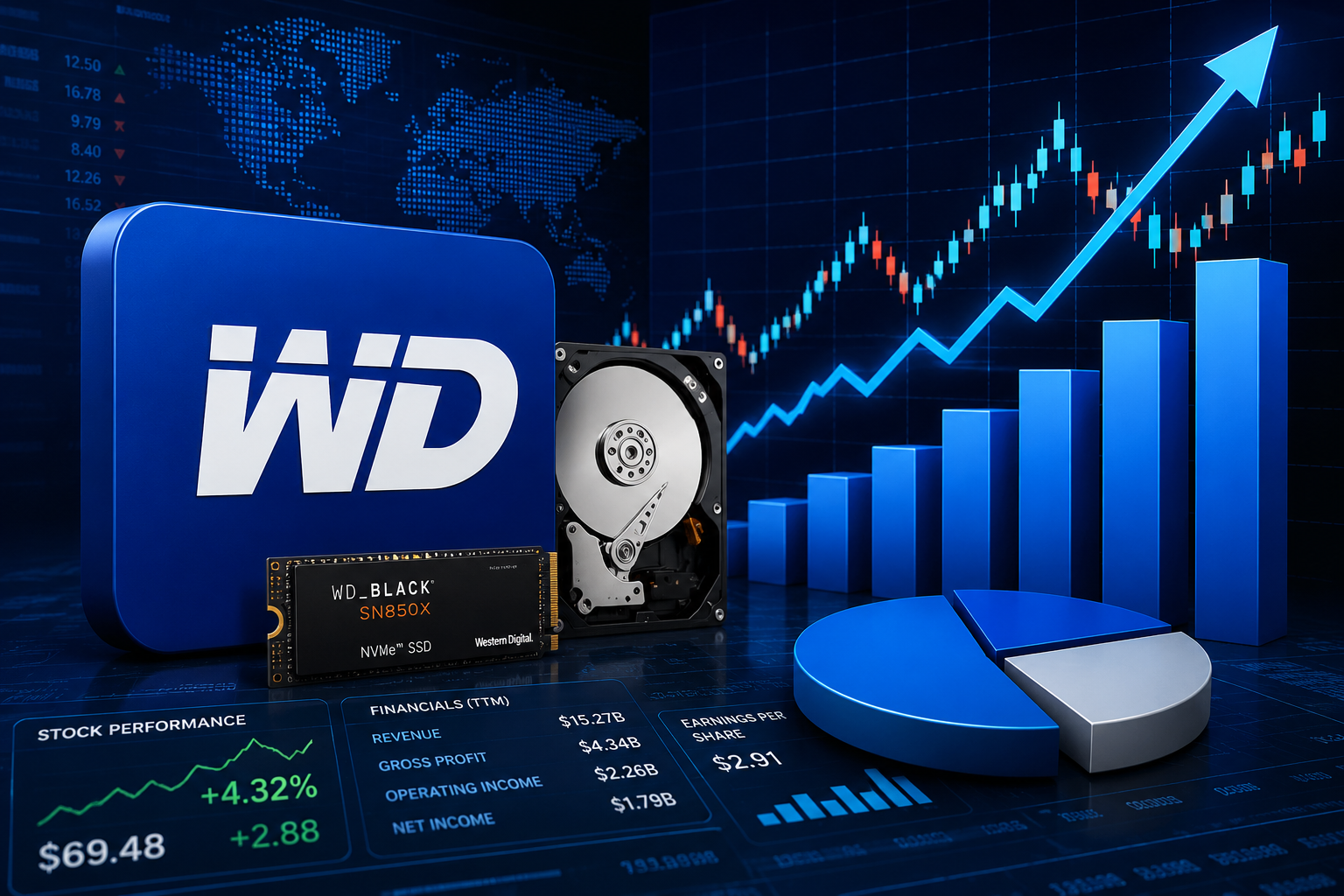
Western Digital Corporation (NASDAQ: WDC) is an American data storage company headquartered in San Jose, California, and one of the two dominant makers of hard disk drives (HDDs) in the world, alongside Seagate Technology. Founded in 1970, the company today builds nearline hard drives and data center storage platforms that power cloud providers, hyperscale data centers, and enterprise customers, along with a smaller lineup of consumer and OEM drives sold under the WD brand.
After spinning off its flash memory business as the independent company SanDisk in February 2025, Western Digital became a focused, pure play HDD supplier riding a historic wave of demand tied to artificial intelligence and cloud data center buildouts. That shift, combined with a supply constrained hard drive market, sent WDC shares up several hundred percent over the twelve months leading into mid 2026, turned Western Digital into a dividend paying company for the first time in years, and made it one of the most closely watched stocks in the data storage and semiconductor adjacent sector.
This guide covers Western Digital’s company history, founders, current leadership, business segments, product lineup, revenue breakdown, recent earnings, dividend policy, competitors, and the latest company news, along with a frequently asked questions section addressing the most common investor queries about WDC stock.
Quick Facts
Legal name
Western Digital Corporation
Ticker symbol
WDC on the Nasdaq Global Select Market
Founded
April 23, 1970, as General Digital Corporation
Founder
Alvin B. Phillips
Headquarters
San Jose, California, United States
CEO
Irving Tan (since February 2025)
CFO
Kris Sennesael (since May 2025)
Industry
Data storage hardware, hard disk drives
Employees
approximately 40,000 worldwide
Fiscal year end
Last Friday in June
Index membership
S&P 500 and Nasdaq 100
Key 2025 event
Spun off flash memory unit as SanDisk (SNDK) on February 21, 2025
What Is Western Digital Corporation?
Western Digital Corporation, commonly known as WD, is a publicly traded American technology company that designs, manufactures, and sells hard disk drives and related data storage systems. The company serves three broad end markets: cloud and hyperscale data centers, original equipment manufacturers building client devices, and everyday consumers who buy external drives and network storage for their homes and small offices.
For most of its history, Western Digital operated as a diversified storage company that made both hard disk drives and NAND flash memory products, largely through its 2016 acquisition of SanDisk. That changed in February 2025, when Western Digital completed a tax free spin off of its entire flash business into a separate public company also named Sandisk Corporation. Since then, Western Digital has operated as a pure play hard drive company, while the flash and solid state drive business trades separately under the ticker SNDK.
Today, Western Digital’s core business is building large capacity nearline hard drives, the workhorse storage devices that hyperscale cloud providers use to store enormous volumes of data cheaply and reliably. Because artificial intelligence workloads generate and retain huge quantities of data, demand for this kind of high capacity storage has surged, and Western Digital has become one of the primary beneficiaries of that trend.
Company History
Western Digital’s story begins in Southern California more than five decades ago and includes several near death experiences, major acquisitions, and one landmark corporate split.
1970s: From semiconductor startup to storage chip maker
The company was founded on April 23, 1970, in Newport Beach, California, as General Digital Corporation, initially producing MOS test equipment before pivoting toward specialty semiconductor chips, including calculator chips. By July 1971 the company had renamed itself Western Digital Corporation. It grew quickly as the largest independent calculator chip maker in the world by 1975, before the oil crisis and the bankruptcy of a major customer pushed the young company into Chapter 11 in 1976.
1980s: The pivot into storage controllers
After recovering under new leadership, Western Digital shifted its focus toward disk controller chips. In 1983, the company won a contract to supply IBM with controllers for the PC and AT, and its WD1003 controller became the technical basis for the ATA interface still used in storage devices today. This controller business funded Western Digital’s push into complete hard disk drives, and the company shipped its first full HDD in 1988, entering the market directly against established rivals such as Seagate and Quantum.
1990s to 2000s: Consolidation and enterprise expansion
The 1990s brought a difficult stretch of price wars, oversupply, and a near bankruptcy scare in 1999, followed by a major restructuring. Western Digital rebuilt around its Caviar consumer drive line and steadily expanded into enterprise storage, acquiring IBM’s Hitachi linked hard drive operations in stages during the 2000s and 2010s to broaden its reach beyond the PC market.
2012 to 2016: HGST and the SanDisk mega deal
Western Digital acquired Hitachi Global Storage Technologies (HGST) in 2012 for roughly $4.3 billion, dramatically expanding its enterprise HDD manufacturing scale. The most transformative move came in 2016, when Western Digital acquired SanDisk Corporation for approximately $19 billion in cash and stock. That deal gave Western Digital full vertical integration into NAND flash memory manufacturing through a long running joint venture with Kioxia, formerly Toshiba Memory, turning Western Digital into one of the few companies in the world that made both hard drives and flash storage at scale.
2025: The SanDisk spin off
On February 21, 2025, Western Digital completed the separation of its flash business into an independent, separately traded company that took back the Sandisk name. The move reversed the 2016 acquisition strategy and reshaped Western Digital into a focused hard disk drive company just as demand for high capacity nearline storage began to accelerate sharply on the back of artificial intelligence infrastructure spending.
Founders
Western Digital was founded by Alvin B. Phillips, a former Motorola engineer, who started the company with roughly $10,000 in initial capital along with backing from individual investors and the industrial conglomerate Emerson Electric. Phillips served as founder and president of the company from its 1970 inception until 1976, when financial trouble tied to the collapse of the calculator chip market led to a change in leadership and a Chapter 11 restructuring. Early company histories also credit figures such as Emerson W. Rogers and John F. Keane with helping build the company’s first product lines, which included the WD1402A UART chip and the WD1771 floppy disk controller, a component that later became a standard part in early personal computers such as the Apple II and the TRS-80.
Chuck Missler joined as chairman and chief executive in 1977 after the bankruptcy filing and became the company’s largest shareholder, steering Western Digital through its recovery and its pivot from pure semiconductors into storage controllers, the decision that ultimately set the company on the path toward becoming a hard drive manufacturer.
CEO
Irving Tan has served as President and Chief Executive Officer of Western Digital since February 2025Current CEO. Before becoming CEO, Tan was Western Digital’s Executive Vice President of Global Operations. Prior to joining Western Digital, he spent many years at Cisco Systems, where he held senior roles including Chairman for Asia Pacific, Japan, and China, Executive Vice President and Global Chief of Operations, and sales leadership positions across the Asia Pacific and Japan region. Tan also serves as chairman of the board of SATS, the Singapore based airport services company.
Tan took over from David Goeckeler, who led Western Digital as CEO from 2020 through the completion of the SanDisk spin off in February 2025 and guided the company through the separation of its HDD and flash businesses. Western Digital’s finance function is led by Kris Sennesael, who joined as Chief Financial Officer in May 2025 after previously serving as CFO of Skyworks Solutions, Enphase Energy, and Standard Microsystems Corporation. The company’s board of directors is chaired by Marty Cole, and the board added technology and AI infrastructure veteran Manuvir Das, a former NVIDIA, Dell EMC, and Microsoft executive, in May 2026.
Headquarters
Western Digital is headquartered in San Jose, California, in the heart of Silicon Valley. The company’s headquarters address has moved several times over its history, from Newport Beach and Santa Ana in the 1970s, to Irvine Spectrum in Orange County during the 1990s and 2000s, and finally to San Jose, where the company consolidated its corporate offices in 2017. Manufacturing, however, is concentrated far from California. Western Digital operates large scale hard drive assembly and component operations in Thailand and Malaysia, two of the most important hubs in the global hard drive supply chain, along with additional engineering and operational sites across Asia, Europe, and the Americas.
Business Segments
Following the SanDisk spin off, Western Digital reports revenue across three end market segments, all built around hard disk drive technology.
Cloud
The Cloud segment sells high capacity nearline HDDs and data center storage platforms, such as JBOD (just a bunch of disks) enclosures, to hyperscale cloud providers and enterprise data center operators. This is by far Western Digital’s largest and fastest growing segment, representing roughly 89 percent of total revenue in the fiscal third quarter of 2026, driven by AI related data growth and multi year supply agreements with major hyperscale customers.
Client
The Client segment supplies hard drives to original equipment manufacturers for use in desktop and notebook computers, gaming consoles, and surveillance recording systems such as those built on the WD Purple product line. This segment has shrunk in relative size as Cloud has grown, now making up a mid single digit percentage of total revenue.
Consumer
The Consumer segment covers Western Digital’s retail facing products, including external portable and desktop drives and network attached storage systems for home and small office use, sold under well known brand names such as WD My Passport, WD My Book, and WD My Cloud. Like Client, this segment now represents a small single digit share of total company revenue.
Products and Services
Western Digital markets its hard drives and storage systems under the long standing WD brand along with the enterprise focused Ultrastar line. Key product families include:
Ultrastar DC HDDs: high capacity nearline hard drives, including drives built on energy assisted magnetic recording technology, designed for hyperscale and enterprise data centers and available in capacities exceeding 30 terabytes, with 40 terabyte class drives planned for release later in 2026.
Ultrastar data center platforms: JBOD storage enclosures such as the Ultrastar Data102 and Data60 families, which pack dozens of drives into dense rack mounted systems for cloud operators.
WD Black, WD Blue, and WD Gold internal HDDs: drives aimed at gaming and performance PCs, mainstream desktop and laptop computers, and enterprise workstations respectively.
WD Red: hard drives designed and validated for network attached storage systems used by home users and small businesses.
WD Purple: drives built for video surveillance systems that need to write continuous footage around the clock.
WD My Passport, My Book, and Elements: external portable and desktop hard drives sold at retail for personal backup and storage.
WD My Cloud: consumer and small business network attached storage devices that allow file access and backup across a home or office network.
Western Digital has also announced what it describes as the industry’s first hard drives built with post quantum cryptography for hyperscale customers, and it maintains a research collaboration with Open Quantum Design focused on quantum error correction technology, reflecting the company’s effort to stay relevant as data security and next generation computing needs evolve.
Revenue Breakdown
Western Digital’s revenue mix has shifted dramatically toward the Cloud segment as hyperscale data center demand for high capacity nearline drives has accelerated. In the fiscal third quarter of 2026, the company generated $3.34 billion in total revenue, with the Cloud segment alone accounting for roughly 89 percent of that figure.
Revenue by Segment, Fiscal Q3 2026
89% Cloud
Cloud, data center and hyperscale: 89%
Client, OEM and surveillance: 6%
Consumer, retail and NAS: 5%
Approximate figures based on company disclosed percentages for the quarter ended roughly March 2026. Individual quarters can shift a few points in either direction.
Segment
Approx. Share of Revenue
Approx. Revenue (Q3 FY2026)
What It Includes
Cloud
89%
$2.97 billion
Nearline HDDs and data center platforms for hyperscalers and enterprises
Client
6%
$200 million
OEM drives for PCs, laptops, gaming, and surveillance
Consumer
5%
$167 million
Retail external drives and home or small office NAS
Financial Performance
Western Digital’s financial results have improved sharply since the SanDisk spin off, with revenue, margins, and profitability all climbing as HDD pricing and demand strengthened through fiscal 2026. Full year fiscal 2025 revenue, reported on a continuing operations basis after the flash separation, came in at $9.52 billion, alongside GAAP net income of roughly $1.64 billion and GAAP diluted earnings per share of $4.74, a sharp turnaround from a loss in the prior fiscal year.
Quarterly Revenue Trend (in millions USD)
$4,285
Q2 FY25
$2,294
Q3 FY25
$2,600
Q4 FY25
$2,820
Q1 FY26
$3,017
Q2 FY26
$3,337
Q3 FY26
The lighter bar marks fiscal Q2 2025, which still included the Flash business before the SanDisk spin off completed on February 21, 2025. The drop into fiscal Q3 2025 reflects that separation rather than a decline in the underlying hard drive business. Growth from fiscal Q3 2025 onward is on a comparable, continuing operations basis.
Period
Revenue
GAAP EPS
Non GAAP EPS
Gross Margin
Fiscal Q1 2026
$2.82 billion
N/A
$1.78
39.5%
Fiscal Q2 2026
$3.02 billion
$4.73
$2.13
45.7%
Fiscal Q3 2026
$3.34 billion
$8.20
$2.72
50.2%
Fiscal Q4 2026 (guidance)
approx. $3.65 billion
N/A
approx. $3.25
51% to 52%
Full fiscal year 2025
$9.52 billion
$4.74
N/A
N/A
Management has guided for continued growth into fiscal 2027, citing multi year hyperscale supply agreements that extend through 2028 and 2029, essentially sold out nearline HDD manufacturing capacity for calendar 2026, and a technology roadmap that includes 40 terabyte class drives in the second half of 2026 with a long term path toward drives exceeding 100 terabytes. Analyst consensus estimates for fiscal 2026 full year revenue have moved higher through the year, with several sources pointing toward a total in the $11 billion to $13 billion range, well above fiscal 2025’s $9.52 billion.
Stock Information
Western Digital trades on the Nasdaq Global Select Market under the ticker WDC and is a member of both the S&P 500 and Nasdaq 100 indexes. The stock has been one of the most volatile large cap names in the market through 2026, climbing from roughly $60 to nearly $800 per share over a twelve month stretch as investors piled into hard drive and memory stocks tied to AI infrastructure spending, before pulling back with the rest of the sector amid concerns about AI chip spending and profit taking after a historic run.
52 week low: $62.9452 week high: $799.87
Exchange
Nasdaq Global Select Market
Sector
Technology, computer storage hardware
Market capitalization
approximately $186 billion (varies daily with the share price)
Shares outstanding
approximately 345 million
Trailing twelve month EPS
approximately $15 to $16
Trailing P/E ratio
approximately 32 to 35
Beta
above 2, meaning WDC has historically moved roughly twice as much as the broader market in either direction
Average daily volume
approximately 13 million shares
Analyst consensus rating
Buy to Strong Buy across most major research desks
Analyst price targets
widely dispersed, ranging from roughly $590 on the lower end of averages to above $1,000 from some of the more bullish banks
Next earnings report
expected late July or early August 2026 (fiscal Q4 2026 results)
Because Western Digital’s share price has swung by double digit percentages in single trading sessions on several occasions in 2026, and because analyst price targets across banks vary enormously, from the mid $500s to over $1,000, this stock should be treated as high risk and high volatility even by growth stock standards. Always check a live quote before trading, since any number in this article can be well out of date within hours.
Dividends
Western Digital did not pay a dividend for several years while it worked through debt reduction and the SanDisk separation. That changed on April 29, 2025, when the company’s board authorized a new quarterly cash dividend program and declared an initial payment of $0.10 per share, with the first payment made in September 2025.
As the company’s cash flow strengthened alongside surging HDD demand, the board raised the quarterly dividend by 20 percent to $0.15 per share, announced alongside fiscal third quarter 2026 results on April 29, 2026, with an ex dividend date of June 5, 2026, and payment made on June 17, 2026. On an annualized basis, that puts the dividend at $0.60 per share.
Date Announced
Dividend per Share
Notes
April 29, 2025
$0.10
Dividend program initiated, first payment since the SanDisk separation
April 29, 2026
$0.15
20% increase, paid June 17, 2026
Given the sharp rise in Western Digital’s share price through 2026, the dividend yield on WDC stock is low, generally estimated at well under half of one percent at recent prices, and the payout ratio relative to earnings is also low. Instead of returning most of its cash to shareholders through dividends, Western Digital has prioritized debt reduction, moving to a net cash position, and share buybacks, including a $2.0 billion repurchase program authorized in July 2025 and a larger $4 billion repurchase program authorized alongside the dividend increase in April 2026. In short, Western Digital today is best understood as a cyclical growth and buyback story with a modest dividend attached, not a stock to buy primarily for dividend income.
Competitors
Western Digital’s most direct competitor is Seagate Technology Holdings (NASDAQ: STX), the only other large scale hard drive manufacturer of comparable size, effectively making the nearline HDD market a global duopoly between the two companies. A third, much smaller player, Toshiba, also produces hard drives but with far less scale in the enterprise nearline segment where Western Digital and Seagate both concentrate.
Company
Ticker
Primary Overlap With Western Digital
Seagate Technology Holdings
STX
Direct hard disk drive competitor, especially in nearline enterprise and cloud drives
Toshiba
Private HDD unit
Smaller scale hard drive manufacturer
Sandisk
SNDK
Former Western Digital flash business, now an independent NAND flash and SSD competitor to the broader storage industry
Samsung Electronics
Private, listed in South Korea
Competes in NAND flash and SSDs, an adjacent storage category to WDC’s HDD business
SK hynix
Private, listed in South Korea
Competes in NAND flash and memory, adjacent to WDC’s core HDD focus
Micron Technology
MU
Competes in memory and flash storage, often grouped with WDC as an AI infrastructure storage play
It is worth noting that since the SanDisk spin off, Western Digital itself no longer competes directly in the NAND flash and solid state drive market. Companies such as Samsung, SK hynix, Micron, and Sandisk are grouped alongside Western Digital mainly because investors treat AI driven data storage as one broad theme, even though Western Digital’s actual product overlap with these flash focused companies is limited.
Recent News
May 2026
Western Digital appointed Manuvir Das, a technology and AI infrastructure veteran with prior senior roles at NVIDIA, Dell EMC, and Microsoft, to its board of directors.
April 2026
The company reported fiscal third quarter 2026 revenue of $3.34 billion, up 45 percent year over year, alongside a 20 percent dividend increase to $0.15 per share and a new $4 billion share repurchase authorization.
2026
Western Digital said its ultra high capacity nearline HDD manufacturing capacity for all of calendar 2026 is essentially sold out, supported by multi year hyperscale supply agreements extending into 2028 and 2029.
2026
The company introduced what it describes as the industry’s first hard drives built with post quantum cryptography for hyperscale customers, alongside a roadmap for 40 terabyte class drives in the second half of 2026 and a longer term path toward drives above 100 terabytes.
June 2026
Western Digital presented at Computex 2026, highlighting new High Bandwidth Drive Technology and Dual Pivot Drive Technology aimed at boosting hard drive throughput for AI focused data centers.
2026
Multiple Wall Street banks raised their price targets on WDC shares through the first half of 2026 as the stock rallied alongside other AI storage and memory names, though the stock has also seen sharp pullbacks tied to broader worries about AI infrastructure spending.
Frequently Asked Questions
What does Western Digital Corporation do?
Western Digital designs, manufactures, and sells hard disk drives and related data storage systems, primarily large capacity nearline drives used by cloud providers and enterprise data centers, along with a smaller line of consumer external drives and network attached storage devices.
Is Western Digital the same company as SanDisk?
No, not anymore. Western Digital acquired SanDisk in 2016, but the two companies separated again on February 21, 2025, when Western Digital spun off its flash memory and solid state drive business into an independent public company that took the Sandisk name and trades under the ticker SNDK. Western Digital now focuses exclusively on hard disk drives.
Who is the CEO of Western Digital?
Irving Tan has been President and CEO of Western Digital since February 2025. He previously served as the company’s Executive Vice President of Global Operations and spent many years in senior leadership roles at Cisco Systems before joining Western Digital.
Does Western Digital pay a dividend?
Yes. Western Digital started paying a quarterly cash dividend of $0.10 per share in 2025 and raised it by 20 percent to $0.15 per share in April 2026. Because the stock price has risen so much, the resulting dividend yield is low, generally well under half of one percent at recent prices.
Who are Western Digital’s main competitors?
Western Digital’s closest and most direct competitor is Seagate Technology, the only other large scale global hard drive manufacturer, forming what is often described as an HDD duopoly. Toshiba is a smaller hard drive competitor. In the broader data storage and memory space, Samsung, SK hynix, Micron, and Sandisk compete in flash memory and solid state drives, an area Western Digital exited when it spun off its own flash business in 2025.
What is Western Digital’s stock ticker symbol?
Western Digital trades on the Nasdaq Global Select Market under the ticker symbol WDC.
Is Western Digital stock a good investment?
That depends on your own goals, time horizon, and risk tolerance, and this article is not financial advice. What can be said factually is that WDC has been an extremely volatile stock, with a 52 week trading range running from under $65 to nearly $800 per share, and that analyst price targets across major banks vary widely. Anyone considering the stock should look closely at the cyclical nature of the hard drive industry, the concentration of revenue in a small number of large cloud customers, and their own ability to tolerate large price swings before making a decision, ideally alongside a licensed financial advisor.
When does Western Digital report earnings next?
Western Digital’s fiscal fourth quarter 2026 results, covering the quarter ending around late June 2026, are expected to be reported in late July or early August 2026. Check Western Digital’s investor relations website for the confirmed date closer to the release.
What is Western Digital’s market capitalization?
Western Digital’s market capitalization has fluctuated enormously along with its stock price during 2026, ranging from roughly $20 billion a year earlier to as high as approximately $257 billion at the stock’s peak, and sitting at approximately $186 billion in the most recent snapshot referenced in this article. Because the share count is relatively stable at around 345 million shares, market cap moves almost entirely with the share price.
Where is Western Digital headquartered?
Western Digital is headquartered in San Jose, California. The company has moved its headquarters several times over its history, previously being based in Newport Beach, Santa Ana, and Irvine, California, before consolidating in San Jose in 2017.
Disclaimer: This article is for general informational and educational purposes only and does not constitute financial, investment, or legal advice. Stock prices, financial figures, and company details for Western Digital Corporation change frequently and can be affected by market volatility, corporate actions, and new disclosures. Figures in this article reflect data available as of early July 2026 and may already be out of date. Always verify current numbers through official sources such as Western Digital’s investor relations site and SEC filings, and consult a licensed financial advisor before making any investment decision.