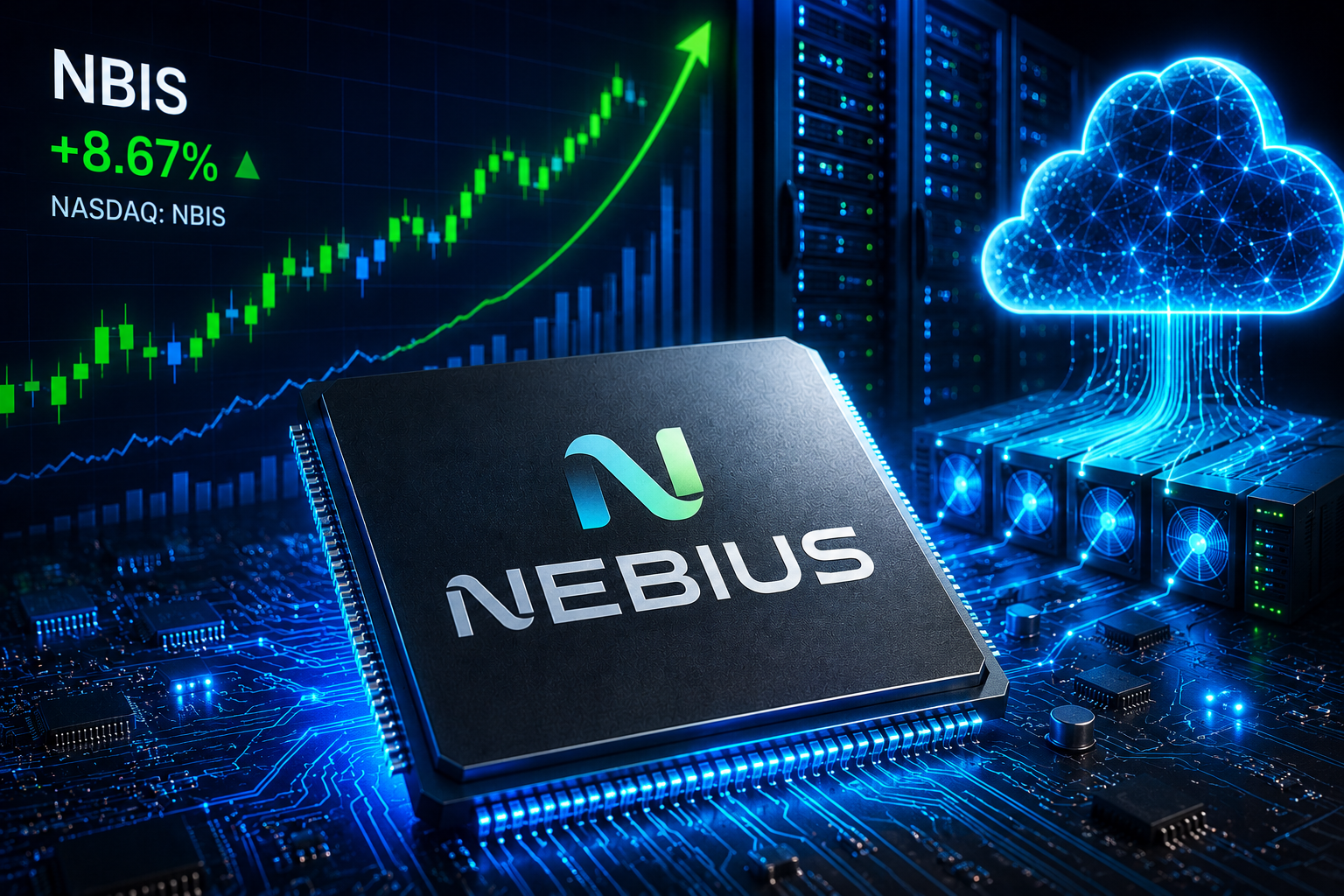
Quick summary: Nebius Group N.V. is an AI infrastructure company, trading under ticker NBIS on the Nasdaq, that builds large scale GPU clusters and cloud computing platforms used to train and run artificial intelligence models. The company is the international successor to Yandex, the Russian internet company once nicknamed Russia’s Google, after a 2024 restructuring separated Yandex’s Russian business from its non Russian assets.
Since re launching as a pure play AI cloud company, Nebius has signed multibillion dollar capacity and compute agreements with Microsoft and Meta, received a two billion dollar strategic investment from Nvidia, joined the Nasdaq 100 index, and posted revenue growth of several hundred percent year over year. The stock has been one of the most volatile large cap AI names on the market, capable of double digit percentage swings in a single trading session.
Below is a full breakdown of Nebius’s history, founders, leadership, business segments, products, revenue mix, financial performance, stock data, dividend policy, competitors, recent news and answers to the questions investors ask most often.
Quick Facts
Item
Detail
Company name
Nebius Group N.V.
Ticker symbol
NBIS (Nasdaq)
Previously known as
Yandex N.V.
Name changed to Nebius Group
August 2024
Resumed Nasdaq trading
October 2024
Headquarters
Amsterdam, Netherlands
Founder and CEO
Arkady Volozh
Industry
AI cloud infrastructure and data centers
Nasdaq 100 member
Yes, since June 22, 2026
Q1 2026 revenue
About $399 million, up roughly 684 percent year over year
Dividend
None currently paid
Main competitors
CoreWeave, Lambda Labs, Amazon Web Services, Microsoft Azure, Google Cloud, Oracle Cloud
What Is Nebius?
Nebius Group N.V. is a technology company that builds full stack infrastructure for artificial intelligence, including large scale GPU clusters, cloud computing platforms, and developer tools used to train and deploy AI models. The company operates data centers and colocated GPU capacity across Europe and the United States, positioning itself as an independent alternative to the large hyperscale cloud providers for AI focused workloads.
Nebius is often described as a neocloud, a term used for a newer generation of cloud providers built specifically around GPU intensive AI workloads rather than general purpose computing. Alongside its core AI cloud business, Nebius also owns or holds stakes in several smaller businesses, including autonomous vehicle technology company Avride, data annotation and AI training data provider Toloka, edtech platform TripleTen, and a stake in the open source database company ClickHouse.
What makes Nebius’s story unusual is its corporate lineage. The company is the direct legal and financial successor to Yandex N.V., the Dutch holding company that once controlled Yandex, Russia’s dominant internet search and technology company. Following Russia’s invasion of Ukraine and a lengthy restructuring process, Yandex N.V. sold its Russian operations and retained its non Russian assets, which were renamed Nebius Group in 2024 and refocused entirely on AI infrastructure.
Company History
Nebius has one of the more unusual corporate histories on the Nasdaq, tracing back through decades of Russian technology history before its 2024 rebirth as an AI infrastructure pure play. Here is the timeline that matters most.
1997: Arkady Volozh and Ilya Segalovich launch Yandex as an internet search engine in Russia, building on search technology work the pair had been developing since the early 1990s.
2007: Yandex N.V. is registered in the Netherlands as the Dutch holding company for the Yandex group.
2011: Yandex completes an initial public offering on the Nasdaq, raising about $1.3 billion in what was, at the time, one of the largest technology IPOs since Google.
2022: Following Russia’s invasion of Ukraine, Yandex N.V. shares are suspended from Nasdaq trading due to international sanctions, and the European Union places sanctions on founder Arkady Volozh, who publicly condemns the invasion.
2024: After a lengthy negotiation, Yandex N.V. completes the sale of its Russian business to a consortium of Russian investors for several billion dollars, while retaining a set of assets located outside Russia, including a Finnish data center, the Nebius AI cloud unit, Toloka, TripleTen and Avride.
August 2024: Yandex N.V. formally changes its name to Nebius Group N.V., with Arkady Volozh installed as founder and CEO of the newly independent company.
October 2024: Nebius resumes trading on the Nasdaq under the ticker NBIS after more than two and a half years of suspension.
December 2024: Nebius raises about $700 million from private investors, including a strategic investment from Nvidia and participation from Accel Partners.
2025 to 2026: Nebius signs multibillion dollar compute agreements with Microsoft and Meta, receives a two billion dollar equity investment from Nvidia, completes the acquisition of inference optimization company Eigen AI, and joins the Nasdaq 100 index in June 2026, cementing its transition from a post Yandex curiosity into a major AI infrastructure company.
Founders
Nebius traces its founding lineage back to Yandex, the Russian internet company that Arkady Volozh built into one of the largest technology businesses in Eastern Europe.
Arkady Volozh: A Kazakhstan born computer scientist and entrepreneur who co founded Yandex in 1997 and served as its CEO for most of its history. Volozh publicly condemned Russia’s invasion of Ukraine, was later removed from the European Union sanctions list, relocated to Israel, and now serves as founder and CEO of Nebius Group.
Ilya Segalovich: Volozh’s longtime business partner and Yandex co founder, who worked with Volozh on early Russian language search technology in the 1990s. Segalovich passed away before the company’s split into Yandex and Nebius.
Because Nebius is legally the surviving entity of what was once Yandex N.V., the company describes Volozh as its founder and CEO, reflecting his role in building the underlying business over nearly three decades, even though the current Nebius Group as a distinct AI infrastructure company only took its present form in 2024.
CEO
Nebius is led by founder and Chief Executive Officer Arkady Volozh, who has described the company’s strategy around a single central constraint, which is supply rather than demand, given how much demand exists for AI computing capacity relative to how quickly new data centers and GPU clusters can be built.
Volozh is supported by a senior leadership team that includes Chief Business Officer Roman Chernin, Chief Product and Infrastructure Officer Andrey Korolenko, and Chief Operating Officer Ophir Nave, many of whom previously worked together at Yandex before the 2024 restructuring. Volozh has consistently emphasized rapid, capital intensive expansion of Nebius’s data center and power capacity as the company’s top strategic priority.
Headquarters
Nebius Group N.V. is headquartered in Amsterdam, Netherlands, where the company opened a dedicated headquarters building in late 2024. Nebius also maintains significant research and development and business operations in Israel and the United States, reflecting both Arkady Volozh’s relocation to Israel and the company’s growing footprint of American data center projects. Nebius operates or is building data center and GPU cluster capacity in locations including Finland, France, and several sites in the United States, including projects in Missouri, New Jersey and Pennsylvania.
Business Segments
Nebius reports results primarily around its core AI cloud business, alongside a set of smaller, non core businesses inherited from its Yandex era.
Segment
What it covers
Approximate share of Q1 2026 revenue
Core AI Cloud
Large scale GPU clusters, cloud infrastructure and platform services sold to AI developers and enterprises
About 98 percent
Other businesses
Toloka (AI training data), TripleTen (edtech), Avride (autonomous driving technology), and a minority stake in ClickHouse
About 2 percent
The overwhelming majority of Nebius’s revenue and growth now comes from its core AI cloud business. The smaller businesses, while strategically interesting and in some cases independently valuable, contribute a very small share of consolidated revenue and are not the primary reason investors follow the stock.
Products and Services
Nebius’s product lineup is built almost entirely around serving the compute needs of AI developers, from individual researchers to large enterprise customers.
Nebius AI Cloud: The company’s core cloud platform, offering large scale GPU clusters, storage and networking infrastructure specifically optimized for training and running AI models.
Managed AI infrastructure: Tools and services that let developers rent dedicated GPU capacity without having to build or manage their own data centers.
Nebius Echo and Aether platform updates: Newer platform features, including natural language infrastructure control and enhanced security, governance and storage capabilities, aimed at making large scale AI infrastructure easier for enterprise teams to manage.
Toloka: A data annotation and AI training data business that helps companies label and prepare data used to train machine learning models.
TripleTen: An edtech platform focused on re skilling individuals for careers in technology.
Avride: A business developing autonomous driving technology for self driving cars and delivery robots.
ClickHouse stake: A minority ownership position in ClickHouse, a widely used open source database company.
Revenue Breakdown
Nebius reported first quarter 2026 revenue of about $399 million, which management described as roughly seven times higher than the same period a year earlier, with the core AI cloud business now representing nearly all consolidated revenue.
Core AI Cloud, 98 percent, about $390MOther businesses, 2 percent
Nebius first quarter 2026 revenue by segment. The core AI cloud business grew 841 percent year over year and now accounts for almost the entire company.
Beyond quarterly revenue, Nebius management has emphasized annualized recurring revenue as a key metric for understanding the business, given how quickly new data center capacity is being brought online. Core AI cloud annualized recurring revenue reached about $1.92 billion exiting the first quarter of 2026, up 54 percent from the prior quarter, reflecting the rapid pace at which new contracted capacity is converting into recognized revenue.
Financial Performance
Nebius’s financial results have gone from a small, recovering post Yandex business to one of the fastest growing companies on the Nasdaq within about eighteen months. First quarter 2026 revenue reached $399 million, up 684 percent year over year, comfortably beating analyst expectations of around $392 million.
Approximate quarterly revenue trend alongside the annualized recurring revenue figure Nebius highlights to investors. Prior period revenue figures are approximate and reconstructed from company disclosures and analyst commentary.
Selected results
Period
Revenue
Net income or adjusted EBITDA
Notes
Q1 2025
About $51 million
Adjusted EBITDA of negative $53.7 million
Early stage of the post Yandex AI cloud ramp
Q1 2026
$399.0 million
Net income of $621.2 million, adjusted EBITDA of $129.5 million
Revenue up 684 percent year over year, AI cloud revenue up 841 percent
Core AI cloud ARR, exiting Q1 2026
$1.92 billion
Up 54 percent quarter over quarter
A key forward looking metric management highlights
2026 capital expenditure guidance
$20 billion to $25 billion
Not applicable
Funding data center and GPU capacity expansion, alongside rising debt levels
Nebius’s large first quarter 2026 net income figure was influenced by non operating items alongside underlying operating performance, and investors have focused closely on adjusted EBITDA and cash flow trends as better indicators of the core business trajectory. The company has been explicit that its near term growth is constrained primarily by how quickly it can build data centers and secure power, rather than by a lack of customer demand.
Stock Information
Nebius trades on the Nasdaq under the ticker NBIS and joined the Nasdaq 100 index on June 22, 2026. The stock has been extraordinarily volatile, rising roughly 175 percent year to date at one point in 2026 while also experiencing sudden double digit percentage declines tied to competitive news from larger technology companies.
Approximate 52 week trading range as of early July 2026. NBIS shares have swung between roughly $44 and $300 over the past year, reflecting both explosive growth and sharp sentiment driven pullbacks.
Metric
Approximate value (early July 2026)
Exchange
Nasdaq
Ticker
NBIS
Recent share price
Around $216
Market capitalization
Roughly $54 billion
Trailing price to earnings ratio
Roughly 64
Index membership
Nasdaq 100, added June 22, 2026
Average analyst rating
Buy, based on coverage from roughly 14 to 16 Wall Street analysts
12 month consensus price target
Roughly $240 to $270
Nebius shares have been especially sensitive to news involving its largest customers. In one notable example, NBIS and fellow neocloud company CoreWeave both fell sharply after a report suggested Meta Platforms, one of Nebius’s own major customers, was exploring building out its own cloud infrastructure business to sell excess AI computing capacity, a development investors worried could eventually turn a customer into a competitor.
Dividends
Nebius does not currently pay a dividend. Given that the company is in the middle of an extremely capital intensive expansion phase, with 2026 capital expenditure guidance in the range of $20 billion to $25 billion to fund new data centers and GPU capacity, Nebius is reinvesting essentially all available capital, and increasingly outside debt and equity financing, into growth rather than shareholder distributions.
Investors seeking income are unlikely to find it in NBIS shares for the foreseeable future. The stock is best understood as a high growth, high volatility bet on continued demand for independent AI cloud infrastructure rather than an income holding.
Competitors
Nebius competes in the fast growing market for AI focused cloud infrastructure, often described as the neocloud sector, alongside the much larger traditional hyperscale cloud providers.
Competitor
What they compete on
CoreWeave
The most closely watched direct competitor in the neocloud sector, also focused on large scale GPU cloud infrastructure for AI workloads
Lambda Labs
A competitor offering GPU cloud computing aimed specifically at AI developers and researchers
Amazon Web Services
The largest general purpose hyperscale cloud provider, competing indirectly across AI infrastructure
Microsoft Azure
A major hyperscale cloud provider and, notably, also one of Nebius’s own large customers under a multibillion dollar compute agreement
Google Cloud
A major hyperscale cloud provider with its own custom AI chip and infrastructure ambitions
Oracle Cloud Infrastructure
A rapidly growing cloud provider that has aggressively pursued large AI infrastructure contracts
One unusual dynamic in Nebius’s competitive picture is that some of its largest customers, including Microsoft and Meta, are themselves capable of building competing infrastructure. This customer and competitor overlap is a key risk factor that investors watch closely, since a shift in strategy by a major partner could affect both demand for Nebius’s services and the broader competitive landscape.
Recent News
Meta cloud expansion report, July 2026: Shares of Nebius and fellow neocloud company CoreWeave fell sharply after Bloomberg reported that Meta Platforms is planning to enter the cloud infrastructure market by selling excess AI computing capacity, raising concerns about future competition from one of Nebius’s own major customers.
Nasdaq 100 inclusion, June 22, 2026: Nebius joined the Nasdaq 100 index, triggering additional buying from passive index funds and broadening its institutional shareholder base.
Eigen AI acquisition closed, June 2026: Nebius completed its acquisition of Eigen AI, adding inference optimization capabilities intended to improve efficiency across its AI cloud platform.
Nvidia partnership expansion: Nvidia invested about $2 billion in Nebius as part of a deepened strategic partnership, securing priority access for Nebius to next generation GPU platforms.
Meta compute agreement: Nebius signed a five year deal with Meta valued at up to $27 billion, including dedicated Nvidia Vera Rubin compute capacity and committed capacity purchases.
Microsoft compute agreement: Nebius signed a multibillion dollar, multiyear agreement with Microsoft reported to be worth up to $19.4 billion, one of the deals that helped transform Nebius from a niche name into a large cap AI infrastructure company.
Record Q1 2026 earnings, May 2026: Nebius reported revenue of $399 million, up 684 percent year over year, alongside net income of $621.2 million and a 45 percent adjusted EBITDA margin, triggering a wave of analyst price target increases.
AI21 Labs acquisition talks: Reports emerged that Nebius was in discussions to acquire Israeli AI company AI21 Labs, though the company has publicly denied an imminent deal.
Frequently Asked Questions
What does Nebius actually do?
Nebius builds and operates large scale GPU clusters and cloud computing infrastructure used by companies to train and run artificial intelligence models, competing as an independent alternative to the major hyperscale cloud providers.
Is Nebius the same company as Yandex?
Nebius Group N.V. is the legal and corporate successor to Yandex N.V., the Dutch holding company that once controlled the Russian internet company Yandex. In 2024, Yandex N.V. sold its Russian business and retained its non Russian assets, which were renamed Nebius Group and refocused entirely on AI infrastructure. The Yandex brand and Russian operations now belong to a separate, unrelated company owned by a consortium of Russian investors.
Who founded Nebius?
Nebius is led by founder and CEO Arkady Volozh, who co founded Yandex in 1997 alongside Ilya Segalovich. Because Nebius is the corporate successor to Yandex N.V., the company credits Volozh as its founder.
Does Nebius pay a dividend?
No. Nebius does not currently pay a dividend. The company is in an extremely capital intensive expansion phase and is reinvesting nearly all available capital into building new data centers and GPU capacity.
Why is NBIS stock so volatile?
Nebius operates in the fast moving AI infrastructure market, where investor sentiment can shift quickly based on customer contract news, competitive announcements from much larger technology companies, and the pace of the company’s own data center buildout. This has led to some of the largest single day price swings of any large cap Nasdaq stock.
Who are Nebius’s main competitors?
Nebius competes with other neocloud providers such as CoreWeave and Lambda Labs, as well as larger hyperscale cloud providers including Amazon Web Services, Microsoft Azure, Google Cloud and Oracle Cloud Infrastructure.
What other businesses does Nebius own besides its AI cloud platform?
Nebius owns or holds stakes in Avride, an autonomous driving technology company, Toloka, a data annotation and AI training data provider, TripleTen, an edtech platform, and a minority stake in the open source database company ClickHouse, though these businesses represent a very small share of total revenue compared to the core AI cloud business.
This article is for informational and educational purposes only and does not constitute financial, investment, tax or legal advice. Stock prices, market capitalization, revenue figures and analyst price targets change frequently, and the figures above reflect publicly available data as of early July 2026. Always verify current numbers with a live market data source and consider speaking with a licensed financial advisor before making investment decisions involving Nebius Group N.V. or any other security.