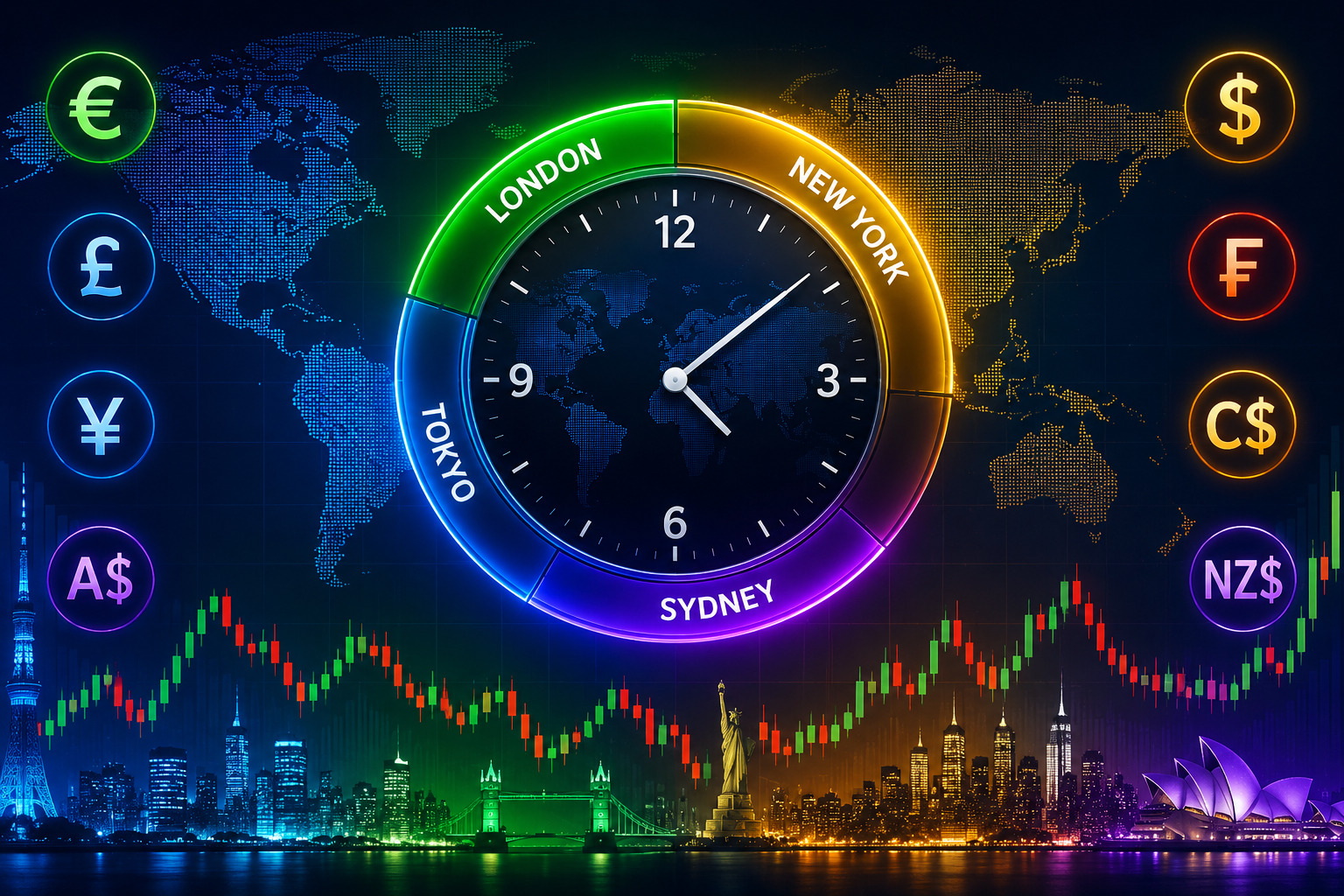
The foreign exchange market never sleeps — it operates 24 hours a day, five days a week, spanning every time zone on the planet. But not every hour is created equal. Knowing when to trade can be just as important as knowing what to trade. Miss the right window and you’re battling thin liquidity, sluggish price action, and wider spreads. Hit it right and you’ll find explosive moves, tight spreads, and far more trading opportunities.
In this guide we break down every major forex trading session, reveal the best times to trade each major currency pair, explain what happens during session overlaps, and give you a practical cheat sheet you can bookmark and use every single trading day.
Unlike the New York Stock Exchange or ASX, forex has no central exchange building. It is an over-the-counter (OTC) market — a global network of banks, institutions, brokers, and retail traders connected electronically. Because major financial centres are spread across the world, there is always at least one market open somewhere.
The trading week opens on Monday morning in Sydney/Wellington (which is Sunday evening in New York) and closes on Friday afternoon in New York. In between, the baton is passed from the Asia-Pacific session to Europe and then to North America.
Here is a simplified overview of when those handoffs happen (all times in UTC/GMT):
Session
Open (UTC)
Close (UTC)
NZT (NZST, UTC+12)
Key Centres
Sydney / Wellington
22:00
07:00
10:00 – 19:00
Sydney, Wellington
Tokyo
00:00
09:00
12:00 – 21:00
Tokyo, Singapore, Hong Kong
London
08:00
17:00
20:00 – 05:00
London, Frankfurt, Zurich
New York
13:00
22:00
01:00 – 10:00
New York, Chicago, Toronto
Note: Times shift by one hour during daylight saving periods. The US, UK, and NZ observe DST on different dates, so always verify your broker’s platform clock.
The Four Major Trading Sessions Explained
The Sydney / Wellington Session (22:00 – 07:00 UTC)
The forex week technically kicks off when Wellington opens on Monday morning. Sydney follows minutes later. This is the quietest of the four sessions in terms of volume and volatility — but that doesn’t mean it should be ignored.
The Sydney/Wellington session is the birthplace of AUD and NZD price action. Central bank communications from the Reserve Bank of Australia (RBA) and the Reserve Bank of New Zealand (RBNZ) during this window can spark significant moves in those pairs. Economic data releases — employment figures, GDP, inflation — from Australia and New Zealand land here too.
Best suited for: AUD/USD, NZD/USD, AUD/NZD, AUD/JPY
Typical daily range: Low (30–50 pips on major AUD/NZD pairs)
Spread environment: Wider than London/New York — factor this into your risk.
The Tokyo (Asian) Session (00:00 – 09:00 UTC)
Tokyo is the largest trading centre in Asia, processing roughly 6% of all global forex turnover. The session begins at midnight UTC and overlaps slightly with Sydney in its early hours, creating a short but meaningful liquidity boost.
Japanese institutional players — banks, exporters, and the Bank of Japan — dominate this window. The JPY pairs are most active here. USD/JPY often sets its daily range during Tokyo hours, particularly around the 00:00–03:00 UTC mark when Japanese institutions are most active.
This session tends to see ranging (sideways) price action on EUR and GBP pairs, as European traders are asleep. Breakout traders sometimes use the Tokyo session range as a reference point for London breakout strategies.
Best suited for: USD/JPY, EUR/JPY, GBP/JPY, AUD/JPY, SGD crosses
Typical daily range: Moderate on JPY pairs (40–80 pips), low on EUR/GBP
Watch for: Bank of Japan policy statements, Japanese GDP, trade balance data
The London Session (08:00 – 17:00 UTC)
London is the undisputed capital of the forex world. At its peak, the London session accounts for roughly 35–40% of all daily forex volume. When London opens at 08:00 UTC, the market wakes up. Volatility surges. Spreads tighten dramatically. Price moves that were impossible during Asian hours happen in minutes.
The first two hours (08:00–10:00 UTC) are particularly powerful — institutional money moves in, stop hunts occur, and the day’s key price levels are established. Many professional traders focus almost entirely on this two-hour window.
Virtually every major currency pair is active during London hours. EUR/USD, GBP/USD, USD/CHF, and EUR/GBP all see their highest liquidity and sharpest moves here. European Central Bank (ECB) decisions and Bank of England (BoE) communications during this session can send pairs flying hundreds of pips.
Best suited for: EUR/USD, GBP/USD, USD/CHF, EUR/GBP, EUR/JPY, GBP/JPY
Typical daily range: High (60–120+ pips on EUR/USD)
New York is the second-largest forex centre globally, processing around 17% of daily volume. The session opens at 13:00 UTC, which coincides with the tail end of London — creating the most important overlap of the trading day (more on this below).
The first four hours of New York (13:00–17:00 UTC) are explosive. US economic data releases — Non-Farm Payrolls, CPI, FOMC statements, retail sales — land during this window and can move markets by 100–200+ pips in seconds. USD pairs obviously react most strongly, but because the dollar is involved in ~88% of all forex transactions, almost every pair is affected.
After 17:00 UTC when London closes, New York-only liquidity drops off significantly. The final hours of the session (19:00–22:00 UTC) are notably quieter, with ranges narrowing and spreads widening again.
Best suited for: EUR/USD, GBP/USD, USD/CAD, USD/JPY, XAU/USD (gold)
Typical daily range: Very high during overlap (80–150+ pips), lower after 17:00
Watch for: FOMC decisions, NFP, US CPI, Fed Chair speeches
Session Overlaps: The Golden Hours
If there is one concept every forex trader must understand, it is session overlaps. When two major sessions are open simultaneously, volume multiplies, spreads tighten, and price action becomes its most dynamic. These are the windows where the most money is made — and lost.
The London–New York Overlap (13:00 – 17:00 UTC) — THE Most Important Window
This four-hour window is the holy grail of forex trading hours. Two of the three largest financial centres in the world are simultaneously open, and combined they account for well over 50% of all global forex volume. The results are:
Tightest spreads of the day (often 0.1–0.3 pips on EUR/USD at major brokers)
Highest volatility and daily pip ranges
Most reliable breakout and trend-following setups
US economic data releases firing into peak liquidity
If you can only trade during one window, this is it. For NZ traders, this falls overnight (01:00–05:00 NZST) — a sacrifice, but one many active traders are willing to make.
The Tokyo–London Overlap (08:00 – 09:00 UTC)
This one-hour window sees Asian liquidity handover to European institutions. It’s shorter and less dramatic than the NY/London overlap but still produces meaningful volatility spikes — particularly on EUR/JPY and GBP/JPY as Japanese money exits and European money enters.
The Sydney–Tokyo Overlap (00:00 – 02:00 UTC)
The mildest of the overlaps but still worth noting for AUD/JPY and NZD/JPY traders. Volume is low relative to other windows, but cross-Pacific institutional flows can produce sharp short-term moves.
Session Overlap Quick Reference
Overlap
UTC Time
Volatility
Best Pairs
London + New York
13:00–17:00
Highest
EUR/USD, GBP/USD, USD/JPY
Tokyo + London
08:00–09:00
Moderate
EUR/JPY, GBP/JPY
Sydney + Tokyo
00:00–02:00
Low-Moderate
AUD/JPY, NZD/JPY
Best Times to Trade Each Currency Pair
Now for the practical meat of this guide. Below we break down the optimal trading windows for every major and popular minor currency pair, along with average daily pip ranges and key considerations.
EUR/USD — Euro / US Dollar
The world’s most traded currency pair, accounting for approximately 23% of all forex volume. EUR/USD is active across both London and New York sessions, but reaches peak performance during their overlap.
Best time to trade: 08:00–17:00 UTC (London session + NY overlap)
Average daily range: 70–120 pips
Avoid: 20:00–07:00 UTC (thin liquidity, choppy action)
Known as “Cable,” GBP/USD is one of the most volatile of the majors. Its swings can be breathtaking — and brutal if you’re on the wrong side. Primarily a London-hours pair.
Best time to trade: 07:00–16:00 UTC
Average daily range: 90–150 pips
Avoid: Asian session — tends to drift aimlessly
Key drivers: BoE decisions, UK CPI, employment, UK PMI, political news
USD/JPY — US Dollar / Japanese Yen
“The Ninja” is driven by two distinct sessions. Tokyo sets the early tone; New York provides the second major volatility window. This pair is also heavily influenced by US Treasury yields.
Best time to trade: 00:00–09:00 UTC (Tokyo) and 13:00–17:00 UTC (NY/London overlap)
Average daily range: 60–100 pips
Avoid: 09:00–12:00 UTC (between sessions, choppy)
Key drivers: Bank of Japan policy, US yields, risk sentiment, NFP
USD/CHF — US Dollar / Swiss Franc
The Swiss Franc is a traditional safe-haven currency. USD/CHF moves inversely to EUR/USD much of the time and is most active during European and early New York hours.
Best time to trade: 07:00–16:00 UTC
Average daily range: 60–90 pips
Avoid: Asian session
Key drivers: SNB policy, risk-off events, US data, EUR/USD correlation
AUD/USD — Australian Dollar / US Dollar
“The Aussie” is a commodity-linked currency with strong ties to Chinese economic performance. It’s most active during the Asian session and around the London/New York overlap.
Best time to trade: 22:00–08:00 UTC (Asian session) and 13:00–16:00 UTC
Average daily range: 60–100 pips
Avoid: Late New York (after 18:00 UTC)
Key drivers: RBA decisions, China PMI/trade data, iron ore prices, US CPI
NZD/USD — New Zealand Dollar / US Dollar
“The Kiwi” behaves similarly to AUD/USD but with smaller average ranges and often amplified moves on RBNZ announcements. Particularly relevant for NZ-based traders.
Best time to trade: 21:00–08:00 UTC (Wellington/Sydney/Tokyo session)
Average daily range: 50–80 pips
Key drivers: RBNZ rate decisions, NZ GDP, dairy prices, Chinese economic data
USD/CAD — US Dollar / Canadian Dollar
“The Loonie” is tightly correlated with crude oil prices. It’s a North American pair at heart — most active when New York is open and Canadian data releases hit.
Best time to trade: 13:00–18:00 UTC
Average daily range: 60–90 pips
Avoid: Asian and early London sessions
Key drivers: Bank of Canada decisions, oil prices, Canadian employment, US data
EUR/JPY — Euro / Japanese Yen
A popular cross pair that combines European and Asian volatility. It gets its biggest moves at the Tokyo–London overlap and during the London session proper.
Best time to trade: 07:00–16:00 UTC
Average daily range: 80–130 pips
Key drivers: ECB/BoJ policy divergence, risk sentiment, European PMI
GBP/JPY — British Pound / Japanese Yen
Called the “Dragon” or “Beast” by traders for a reason — this is one of the most volatile pairs in the market. Massive pip ranges mean massive opportunity and massive risk.
Best time to trade: 08:00–17:00 UTC (London session)
Average daily range: 100–200+ pips
Not for beginners: High volatility demands tight risk management
Key drivers: BoE/BoJ policy divergence, UK data, risk-off flows
EUR/GBP — Euro / British Pound
A relatively slow-moving pair, but critical for understanding intra-European dynamics. It mostly trades in a narrow range but can spike sharply on UK or EU political events.
Best time to trade: 07:00–16:00 UTC
Average daily range: 40–70 pips
Key drivers: UK vs EU economic divergence, Brexit-related news, BoE vs ECB policy
Weekly Volatility Calendar
Beyond the time of day, the day of the week also matters. Here is what to generally expect:
Day
Volatility Level
What to Expect
Monday
Low–Moderate
Market digests weekend news. Slow start, picks up by London open.
Tuesday
Moderate–High
Volume ramps up. Reliable trend days begin.
Wednesday
High
Peak mid-week volume. Strong trend days. FOMC often meets.
Thursday
High
Often the most volatile day — major data releases (NFP preview, jobless claims).
Friday
Moderate, then low
NFP (first Friday of month) = massive volatility. Otherwise, volume tapers as NY afternoon approaches. Avoid holding positions into weekend.
Forex Trading Hours for New Zealand Traders
New Zealand is one of the most geographically unique places to trade forex. Because NZT is UTC+12 (or UTC+13 during NZDT), Kiwi traders face the peculiarity of the most active market hours falling in the middle of the night.
Here is the full session schedule converted to New Zealand Standard Time (NZST, UTC+12):
Session / Event
NZST Time
Recommendation for NZ Traders
Wellington / Sydney Open
10:00 AM
Very accessible — ideal for NZD/USD, AUD/USD
Tokyo Open
12:00 PM
Accessible — JPY pairs come alive
Tokyo Close
9:00 PM
Achievable for evening traders
London Open
8:00 PM
Evening — doable for dedicated traders
London–NY Overlap (PEAK)
1:00 AM – 5:00 AM
Very early morning — requires commitment or algo tools
New York Close
10:00 AM
Aligns with Wellington open — convenient transition
RBNZ Rate Decisions
Varies (often 2:00 PM)
Perfectly timed for NZ traders — watch NZD pairs closely
Strategy for New Zealand traders: Many Kiwi retail traders focus on the Asian session (which aligns with NZ business hours), then pick select London evening trades, and use pending orders or expert advisors (EAs) to capture the London–NY overlap while sleeping.
Pro Tips to Trade the Clock More Effectively
1. Always Know the Market’s “Active Hours” for Your Pair
Don’t try to force a trade when your pair is dead. Check a volatility heatmap tool (ForexFactory, Myfxbook, or your broker’s platform) to visualize when your chosen pair is genuinely moving.
2. Use an Economic Calendar Every Single Day
High-impact news releases — FOMC decisions, NFP, CPI, GDP — can override any technical setup in seconds. Always check the calendar before entering a trade near a data release. ForexFactory’s calendar is the industry standard (and free).
3. Be Cautious on Sundays and Mondays
Gaps can occur between Friday’s New York close and Sunday’s Sydney open. Geopolitical events over the weekend can cause significant gap-opens. Many experienced traders avoid carrying positions over the weekend entirely.
4. Watch for the “Asian Range Breakout” Strategy
Many traders identify the high and low of the Tokyo session, then trade breakouts when London opens at 08:00 UTC. This is one of the simplest and most time-tested session-based strategies in existence.
5. Avoid the “Dead Zone” (20:00 – 22:00 UTC)
This two-hour window between New York’s close and Sydney’s open is the quietest period of the entire trading day. Volume is minimal, spreads are at their widest, and price action is erratic. Most professional traders simply don’t trade during this window.
6. Consider Your Trading Style When Choosing Sessions
Trading Style
Best Session(s)
Why
Scalper (1–5 min charts)
London open, NY/London overlap
Tightest spreads, highest liquidity
Day Trader (15–60 min)
London + NY overlap
Best daily ranges and clean trends
Swing Trader (4hr+ charts)
Any — check entries at London open
Less time-sensitive; focus on daily/weekly setups
Position Trader (daily charts)
Any — focus on NY close (22:00 UTC)
NY close candles are most reliable for daily analysis
7. Account for Daylight Saving Time (DST)
DST changes in the US (second Sunday March / first Sunday November), UK (last Sunday March / last Sunday October), and New Zealand (last Sunday September / first Sunday April) cause session times to shift. Always verify your broker’s server time during DST transitions to avoid nasty surprises.
Frequently Asked Questions
What are the best hours to trade forex overall?
The London–New York overlap (13:00–17:00 UTC) is widely considered the best four-hour window to trade forex. It combines the highest volume, tightest spreads, and largest daily pip ranges for all major pairs.
Can I trade forex 24 hours a day?
Technically yes — the forex market is open from Sunday 22:00 UTC to Friday 22:00 UTC continuously. However, trading during low-liquidity periods (especially 20:00–22:00 UTC) is generally not recommended due to wide spreads and choppy price action.
What is the best time to trade forex for beginners?
Beginners should start with the London session (08:00–17:00 UTC) on EUR/USD. This offers predictable liquidity, tight spreads, and the most educational price action in the market. Avoid high-volatility news events until you’ve built some experience.
What time does the forex market open in New Zealand?
The forex week opens when Wellington/Sydney starts trading at approximately 10:00 AM NZST (Monday). This coincides with 22:00 UTC on Sunday. The market closes at approximately 10:00 AM NZST on Saturday (Friday 22:00 UTC).
Is it safe to trade forex on Fridays?
Friday morning can be excellent if Non-Farm Payrolls are released (first Friday of the month). However, Friday afternoons carry additional risk as institutional traders close positions before the weekend, leading to sudden and unpredictable price moves.
Does the forex market close on weekends?
Yes. The market is closed from approximately 22:00 UTC Friday to 22:00 UTC Sunday (10:00 PM GMT). Some brokers show prices during the weekend but these are non-tradeable quotes. Gaps can occur between Friday’s close and Sunday’s open.
What forex pairs are best to trade during the Asian session?
USD/JPY, EUR/JPY, GBP/JPY, AUD/USD, NZD/USD, and AUD/JPY are all well-suited to the Asian session. EUR/USD and GBP/USD tend to move very little during Asian hours unless there is major surprise news.
Final Thoughts: Trade the Right Hours, Not All Hours
One of the most common mistakes new forex traders make is sitting at their screens all day, trying to trade every little move. The professional approach is the opposite: identify the two or three optimal windows for your chosen pairs, set your entries, manage your risk, and step away.
The London–New York overlap remains the crown jewel of forex trading hours. But for New Zealand traders who can’t always be awake at 1 AM, the Asian session offers perfectly valid opportunities — especially on AUD, NZD, and JPY pairs during Wellington and Tokyo hours.
Master the clock. Trade with the volume. Let liquidity work for you instead of against you.
Key Takeaways
The forex market operates 24/5 across four overlapping global sessions.
The London–New York overlap (13:00–17:00 UTC) is the single most active trading window.
Match your pair to the right session: JPY pairs in Tokyo, EUR/GBP/USD pairs in London.
Avoid the “dead zone” between New York close and Sydney open (20:00–22:00 UTC).
NZ traders can focus on the Wellington/Tokyo session or use pending orders for the London open.
Always check the economic calendar before trading near major data releases.