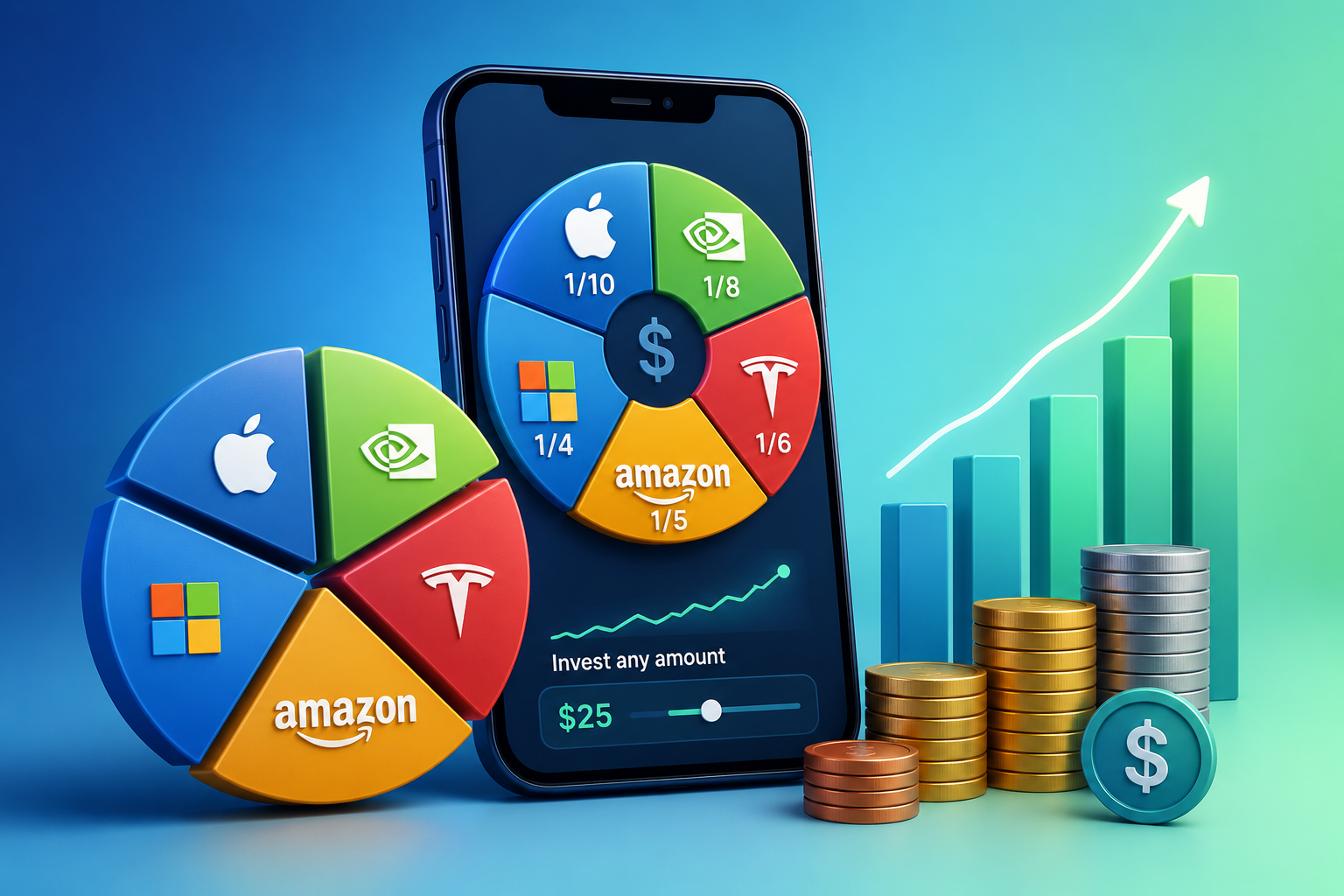
Fractional shares let everyday Americans invest in high-priced stocks like Amazon, Apple, and Tesla with as little as $1. In 2026, the micro-investing market is growing at 17.5% annually and nearly half of all Gen Z investors now own fractional shares. This guide explains exactly how fractional shares work, which brokers offer them, how to get started, the real risks to watch for, and what the latest market data says about this investing revolution.
17.5%Annual growth rate of micro-investing apps in 2026
48%Of Gen Z investors now own fractional shares
95+S&P 500 stocks priced above $300 per share
1. What Are Fractional Shares?
A fractional share is exactly what it sounds like: a piece of a whole stock. Instead of buying one full share of Amazon at over $2,000 or one share of Berkshire Hathaway at roughly $485, you can invest any dollar amount you choose and receive a proportional slice of that company.
Think of it like buying a slice of pizza rather than the whole pie. You get all the same ingredients, the same flavor, and your fair share of any toppings (dividends) that come out of the oven. The only difference is that you paid for what you actually wanted.
This concept transforms how ordinary Americans relate to the stock market. Owning a piece of Apple no longer requires saving up $220 or more for a single share. You can invest $10, $25, or whatever fits your budget and still own a slice of one of the most valuable companies on earth.
Key Definition: A fractional share represents ownership of less than one whole share of a stock or ETF. If a stock trades at $1,000 and you invest $100, you own exactly 0.10 shares. You receive proportional dividends, experience proportional price gains, and carry proportional risk.
A Brief History
Fractional investing is not entirely new. Mutual funds have allowed pooled proportional ownership since the early 20th century. Dividend reinvestment plans (DRIPs) have long allowed shareholders to reinvest dividends into fractional amounts of additional shares. But the modern era of fractional share trading, accessible to any retail investor from their smartphone, is a product of the past decade.
Robinhood helped normalize commission-free trading in 2013. By 2019 and 2020, major platforms including Fidelity, Charles Schwab, and Interactive Brokers had all launched fractional share programs. What was once a niche feature became an industry standard, and the race to attract first-time investors was on.
2. How Fractional Shares Actually Work
Understanding the mechanics behind fractional shares helps you make smarter decisions as an investor. The process is different from buying whole shares on a stock exchange, and those differences matter.
The Pooling Mechanism
When you place a fractional share order, your broker does not send your tiny order directly to the New York Stock Exchange or Nasdaq. Instead, your broker pools your dollars with those of other investors who want the same stock. Once enough demand accumulates, the broker buys whole shares on the open market and internally allocates fractional portions to each investor.
This means you hold a brokerage-level record of your fractional ownership, not a publicly transferable security on an exchange. Your position exists within the broker’s books. This distinction has practical consequences explored in the risks section below.
Dollar-Based Investing
Most platforms now let you invest by dollar amount rather than share quantity. You simply type in “$50” and the platform calculates the exact fraction you will receive based on the current price. Fidelity calls this “dollar-based investing.” Schwab calls its program “Stock Slices.” The name changes but the concept is the same: you set the dollar amount, the platform handles the math.
Dividends and Voting Rights
Fractional shareholders receive dividends proportional to their ownership. If a company pays a $2.00 per share annual dividend and you own 0.25 shares, you receive $0.50. Voting rights, however, are more complicated. Many brokers do not pass through voting rights for fractional shares, or they aggregate votes on your behalf. If shareholder governance matters to you, check your specific broker’s policy before assuming you have a vote.
The numbers behind fractional investing in 2026 are striking. The micro-investing application market is growing from $1.77 billion in 2025 to $2.08 billion in 2026 at a compound annual growth rate of 17.5%. Looking further ahead, the market is expected to reach $3.93 billion by 2030, driven by AI-powered portfolio recommendations, sustainable micro-investment products, and rising adoption of fractional share investing across all demographics.
Perhaps most telling is the sheer scale of the pricing barrier that fractional shares help dissolve. Today, 95 stocks in the S&P 500 are priced at $300 or more per share, meaning that building a truly diversified portfolio of individual U.S. stocks without fractional capabilities would require tens of thousands of dollars just to get started.
Plans to Increase Stock Investments in 2026 (by Generation)
Source: Motley Fool 2026 Generational Investing Survey, n=2,000 U.S. investors
Gen Z
68%
Millennials
64%
Gen X
46%
Baby Boomers
39%
4. Who Benefits Most From Fractional Shares?
The benefits of fractional investing are not limited to people with small budgets. They cut across demographics and portfolio sizes in ways that often surprise people.
First-Time Investors
The most obvious beneficiaries are people just starting out. A recent college graduate, a retail worker, or someone building financial stability from scratch can now begin a portfolio with whatever they have. The psychological benefit of actually owning shares in real companies, even small fractions, is significant. When people actually own stock, even fractional pieces, they start paying attention, follow companies, understand how markets work, and develop genuine interest in wealth building.
Investors Focused on Diversification
Even experienced investors with larger portfolios find fractional shares useful for portfolio precision. Without fractional share access, maintaining a specific target allocation in a small portfolio is nearly impossible. With them, an investor can put exactly 70% in stocks and 30% in bonds regardless of individual share prices, making rebalancing mathematically clean.
Dollar-Cost Averaging Practitioners
Investors who want to invest a fixed amount every week or month, regardless of price swings, benefit enormously. Automated recurring investments using fractional shares remove the friction of “saving up” for whole shares, keeping money working in the market rather than sitting idle in cash.
Dividend Reinvestors
Automatic dividend reinvestment becomes far more powerful with fractional share support. A cash dividend payment is often far less than the price of one full share, so without fractions, that dividend sits in cash. With fractional support, every dollar of dividends goes immediately back to work in the same investment.
5. Gen Z and the New American Investor
No demographic has embraced fractional investing more enthusiastically than Gen Z, and the data in 2026 is unambiguous about this shift.
A 2025 survey by ValueWalk reveals that 48% of Gen Z now invests in fractional shares, with 67% citing low entry costs as a key motivator. This generation is starting earlier than any before it: a World Economic Forum and Boston Consulting Group survey conducted in collaboration with Robinhood shows that 30% of Gen Z begin investing during their university years, which is double the rate observed among Millennials.
Gen Z Investor Behavior Metrics (2026)
Sources: ValueWalk, Motley Fool, Coinlaw.io, World Economic Forum
Own fractional shares
48%
Own AI stocks
67%
Adjust portfolio monthly
64%
Would use AI to manage investments
41%
Started investing in college
30%
The compound interest advantage of starting early is immense. Investing just $100 monthly starting at age 19 with an average annual return of 7% could yield over $270,000 by age 60, whereas starting at age 30 with the same contributions yields just under $140,000. Fractional shares make that early start financially feasible for nearly anyone.
2026 Data: While recession and inflation are top concerns for investors, 68% of Gen Z and 64% of Millennials plan to increase their stock investments this year, compared to only 46% of Gen X and 39% of baby boomers. (Source: Motley Fool 2026 Investor Outlook Report)
6. Top Brokers for Fractional Shares in 2026
Not all fractional share platforms are created equal. Minimum investment amounts, stock availability, ETF support, and execution mechanics vary significantly. Here is how the major platforms compare as of mid-2026.
Broker
Minimum
Fractional ETFs
Commission
Key Feature
Fidelity
$1
Yes
$0
Broadest stock and ETF selection; top research tools
Charles Schwab
$5
S&P 500 only
$0
Up to 30 fractional S&P 500 stocks per transaction
Interactive Brokers
$1
Yes
Low (varies)
Widest securities range; best for advanced investors
Launched fractional trading in Q2 2026; expanding list
Tip: Unlike whole share trading where orders execute in real-time, fractional share orders are typically limited to market orders processed at predetermined times. Most brokers handle fractional trades once per day, often at market close. This matters during volatile sessions, so plan your strategy accordingly.
7. Pros and Cons of Fractional Shares
Fractional shares offer real advantages, but they also come with trade-offs that every investor should understand before diving in.
Advantages
Invest in high-priced stocks with as little as $1
Immediate diversification across many companies
Enables precise dollar-cost averaging
Proportional dividend payments on every fraction
Removes the pressure of “saving up” for a whole share
Full dividend reinvestment without leftover idle cash
Lower emotional barrier for first-time investors
Limitations
Ownership exists at broker level, not on exchange
Cannot transfer fractional positions to another broker
Voting rights often not passed through to investor
Order execution typically delayed until end-of-day
More complex tax lot tracking for capital gains
Not all stocks eligible on every platform
Switching brokers usually triggers a taxable sale
Monthly fee models at some platforms erode small accounts
Why Investors Choose Fractional Shares (2026)
Source: Compiled from ValueWalk, Fidelity, and StockBrokers.com surveys
Low entry cost (35%)
Diversification (28%)
Dollar-cost averaging (18%)
Dividend reinvestment (12%)
Other reasons (7%)
8. How to Get Started With Fractional Shares
Getting started is genuinely straightforward. Here is the step-by-step process for a first-time fractional share investor in 2026.
1
Choose a broker that fits your goals
For most beginners, Fidelity offers the broadest selection and the lowest minimums with zero commissions. M1 Finance works well if you want to build a “pie” portfolio with custom target allocations. Robinhood suits those who want simplicity and a clean mobile experience.
2
Open and fund your brokerage account
Most brokers allow you to open an account online in minutes. You will need your Social Security number, a government-issued ID, and bank account details. Most platforms now support instant ACH transfers so you can start the same day.
3
Decide how much you want to invest
There is no wrong answer. Starting with $25 to $50 is perfectly fine. The real goal early on is to experience how the market moves with your own money on the line, even a small amount, and to build the habit.
4
Search for a stock or ETF by name or ticker symbol
Type in a company name you know and believe in. Apple (AAPL), Microsoft (MSFT), an S&P 500 index ETF like VOO, or any other listed security. On Fidelity, simply enter the ticker and choose to invest by dollar amount rather than share quantity.
5
Enter your dollar amount and confirm the order
Type in $10, $25, or whatever you have decided. The platform shows approximately how many fractional shares you will receive. Your fractional shares appear in your portfolio once the order executes, typically at or shortly after market close.
6
Set up recurring investments for automation
The single most powerful habit any investor can build is automatic recurring contributions. Most platforms let you set up weekly or monthly automatic purchases of any dollar amount. This removes decision fatigue, enforces discipline, and keeps you benefiting from dollar-cost averaging without having to think about market timing.
9. Hidden Risks Most Investors Do Not Discover Until It Is Too Late
Fractional shares are genuinely useful, but several structural limitations catch investors off guard. Understanding these now saves frustration later.
Broker Lock-In
Fractional shares represent a portion of a full share that your brokerage allocates internally. You do not own a transferable security on a public exchange. Changing brokers usually requires selling your fractional positions first, which can trigger taxes. This is fundamentally different from whole shares, which you can transfer between brokers via ACATS transfers without selling.
Delayed Execution
In volatile markets, the inability to execute immediately can be costly. If news breaks mid-day and you want to sell, you might wait hours for execution while the price moves against you. For long-term investors this is usually not a concern, but it is worth understanding before building a strategy that requires precise timing.
Tax Complexity
Fractional shares can complicate tax lot tracking, as each purchase creates a separate tax lot with its own cost basis. If you invest $25 per week in the same stock for a year, you have 52 separate tax lots to account for when you eventually sell. Your brokerage will provide the records, but the complexity of your annual tax return increases noticeably.
Not All Securities Are Eligible
While the major brokers cover most large-cap U.S. stocks and popular ETFs, smaller companies and many international stocks are often not available for fractional trading. If your research points to more obscure companies, you may need to save up for full shares.
Voting Rights Gap
Most fractional share holders do not receive full shareholder voting rights. For investors who care about ESG issues and want to exercise their voice at annual meetings, this is a meaningful limitation worth understanding upfront.
10. Smart Strategies for Fractional Investors in 2026
Knowing you can buy fractional shares is one thing. Knowing how to use them strategically is what separates investors who build real wealth from those who just dabble.
Build Your Own Index Fund
One of the most compelling uses of fractional shares is constructing a personalized index fund. Rather than buying a pre-packaged ETF, you can hand-select 20 to 30 companies across different sectors and assign each a target percentage allocation. Fractional shares let you own proportional pieces of each stock that matters to you, with complete control over your portfolio’s composition.
Automate Dollar-Cost Averaging
Setting up automatic recurring purchases, whether weekly or monthly, is widely regarded as the most effective strategy for retail investors. It removes emotional decision-making from the equation and ensures you buy more shares when prices are low and fewer when prices are high, naturally averaging down your cost basis over time.
Invest Windfalls Immediately
Tax refunds, bonuses, and gifts can be deployed immediately into fractional shares without needing to accumulate enough for a whole share. The moment the money clears your bank, it can be working in the market rather than sitting in a low-yield savings account.
Hypothetical $100/Month Investment Growth: Starting at Age 19 vs. Age 30
Assumes 7% average annual return, measured at age 60. Source: Enterprise World / BCG analysis
Start at Age 19
$270,000+
Start at Age 30
$140,000
Starting 11 years earlier produces $130,000+ more at retirement with identical contributions.
Use Fractional Shares for Sector Exposure
Rather than trying to pick individual winners, fractional shares let you take targeted sector bets. Want exposure to artificial intelligence? Allocate $50 each to Nvidia, Microsoft, Alphabet, and Meta. Want clean energy exposure? Split $200 among solar, wind, and battery storage companies. The fractional share model transforms what used to require thousands into a manageable $200 strategy.
Always Pair With an Emergency Fund
A common mistake among new investors is to invest money they might need soon. Before building a fractional share portfolio, make sure you have 3 to 6 months of living expenses in a high-yield savings account. Fractional shares are for money you do not need for at least 3 to 5 years.
11. Latest Fractional Shares News in 2026
The fractional investing landscape is moving fast. Here are the most significant developments shaping the sector as of mid-2026.
May 2026
E*TRADE Launches Fractional Shares for Retail Accounts
E*TRADE from Morgan Stanley began rolling out fractional share capability in Q2 2026, with phases including an expanding list of stocks and the ability to invest by dollar amount. This makes E*TRADE one of the last major U.S. brokers to adopt the feature as a standard offering.
February 2026
Micro-Investing Market Hits $2.08B Milestone
The micro-investing application market reached $2.08 billion in 2026, growing at a 17.5% compound annual growth rate, driven by smartphone-based financial apps and the increasing participation of first-time investors across all age groups.
March 2026
Gen Z Breaks Investing Age Records
Platforms like Fidelity, Schwab, and Robinhood all report surging youth account openings, many starting with $50 or less. A 16-year-old from San Diego told NBC7 he started with just $50 and added more as he learned, a story now typical of the generation.
June 2026
Tokenized Fractional Trading Gains Ground
Tokenized platforms now enable fractional access to global stocks and ETFs with 24/7 trading and crypto-based funding, blurring the boundary between traditional equity markets and blockchain-based asset infrastructure.
March 2026
Motley Fool Survey: Gen Z Leads on AI Stock Ownership
A Motley Fool survey of 2,000 individual U.S. investors found that 67% of Gen Z and 66% of Millennials own AI-related stocks, compared to 50% of Gen X and 37% of baby boomers. Fractional shares are the primary vehicle enabling this exposure at scale.
2026 Forecast
AI-Powered Portfolio Recommendations Coming to Micro-Investing Apps
Market researchers project that growth through 2030 will be driven by AI-based portfolio recommendations, sustainable micro-investment products, and the expansion of crypto-enabled micro investing as regulatory clarity improves.
12. Frequently Asked Questions
Can you actually make money with fractional shares?
Yes. Fractional shares behave identically to whole shares in terms of price appreciation. If you own 0.1 shares of a stock that doubles in price, your 0.1 shares double in value too. The returns are strictly proportional to your ownership percentage and the stock’s performance.
Do fractional shares pay dividends?
Yes. Dividend payouts are proportionate to the fraction of the share owned. If a company pays $4 per share annually and you own 0.25 shares, you receive $1.00.
What is the minimum amount needed to start?
You can start with as little as $1 at Fidelity. Charles Schwab’s Stock Slices program starts at $5 per position. Most major brokers now have no account minimum to open.
Can I buy fractional shares of ETFs, not just individual stocks?
Yes, at most major brokers. The Vanguard 500 Index Fund ETF (VOO) is priced at approximately $688 as of May 2026, but you can invest any dollar amount into it using fractional shares at Fidelity, Interactive Brokers, M1 Finance, and others.
What happens to my fractional shares if my broker goes bankrupt?
U.S. brokerage accounts are protected by SIPC (Securities Investor Protection Corporation) up to $500,000 in securities. If your broker fails, SIPC works to return your securities and cash. That said, fractional shares that exist only as internal broker records can be more complicated to recover than whole shares, which is one more reason to stick with large, well-regulated platforms.
Are fractional shares right for a Roth IRA?
Yes, and it is one of the best use cases. Buying fractional shares inside a Roth IRA means your capital gains and dividends grow tax-free, and you avoid the tax-lot complexity that comes with taxable accounts. Fidelity and Schwab both support fractional shares in IRA accounts with no minimum.
How are fractional shares taxed?
Fractional share gains are taxed the same as whole share gains. Short-term capital gains (positions held under one year) are taxed as ordinary income. Long-term capital gains (positions held over one year) are taxed at the more favorable 0%, 15%, or 20% rate depending on your income. The added complexity is simply the number of tax lots you accumulate through frequent purchases.
Can I gift fractional shares to someone else?
Yes. You can purchase fractional shares as a gift for a minor by using a custodial account. These accounts allow an adult to manage investments on behalf of a child until they reach adulthood, making them a meaningful alternative to traditional gifts.
Conclusion: The Floor Has Been Removed From Investing
For most of American financial history, meaningful participation in the stock market required capital that tens of millions of households simply did not have. A single share of Berkshire Hathaway, Google, or Amazon represented weeks of wages for the average worker. The market built wealth for those who already had it.
Fractional shares have changed that equation in a fundamental way. By enabling investments in smaller increments, they have democratized access to the stock market, allowing a broader range of investors to participate. Someone working retail and living paycheck to paycheck can now actually participate in wealth building through the market.
The data for 2026 confirms that this is not a passing trend. With the micro-investing market on track to reach $3.93 billion by 2030, with Gen Z starting to invest at record young ages, and with every major U.S. broker now supporting fractional trading, the infrastructure for accessible investing is now permanent.
The risks are real and worth understanding. Tax complexity, broker lock-in, limited voting rights, and delayed execution are genuine trade-offs. But for the vast majority of long-term, buy-and-hold investors, these limitations are manageable compared to the alternative: sitting on the sidelines while inflation erodes the purchasing power of cash savings.
The most powerful move any investor can make is to start. Fractional shares have made that first step available to virtually every American, regardless of income or wealth. The question is no longer whether you can afford to invest. In 2026, the question is simply when you will choose to begin.
Ready to Start Investing With Fractional Shares?
You can open a brokerage account at Fidelity, Charles Schwab, or Robinhood for free, with no minimum balance, and begin buying fractional shares of stocks and ETFs for as little as $1. The best time to start was yesterday. The second-best time is today.
Disclaimer: This article is for educational and informational purposes only and does not constitute financial, investment, or tax advice. All investing involves risk, including the possible loss of principal. Past performance is not indicative of future results. Consult a licensed financial advisor before making investment decisions. Market data and statistics are sourced from publicly available reports as of June 2026 and are subject to change.