Every time a central bank changes its benchmark interest rate, the financial world stops to watch. Stock markets react instantly, mortgage companies adjust their terms, and business leaders re-evaluate their expansion plans.
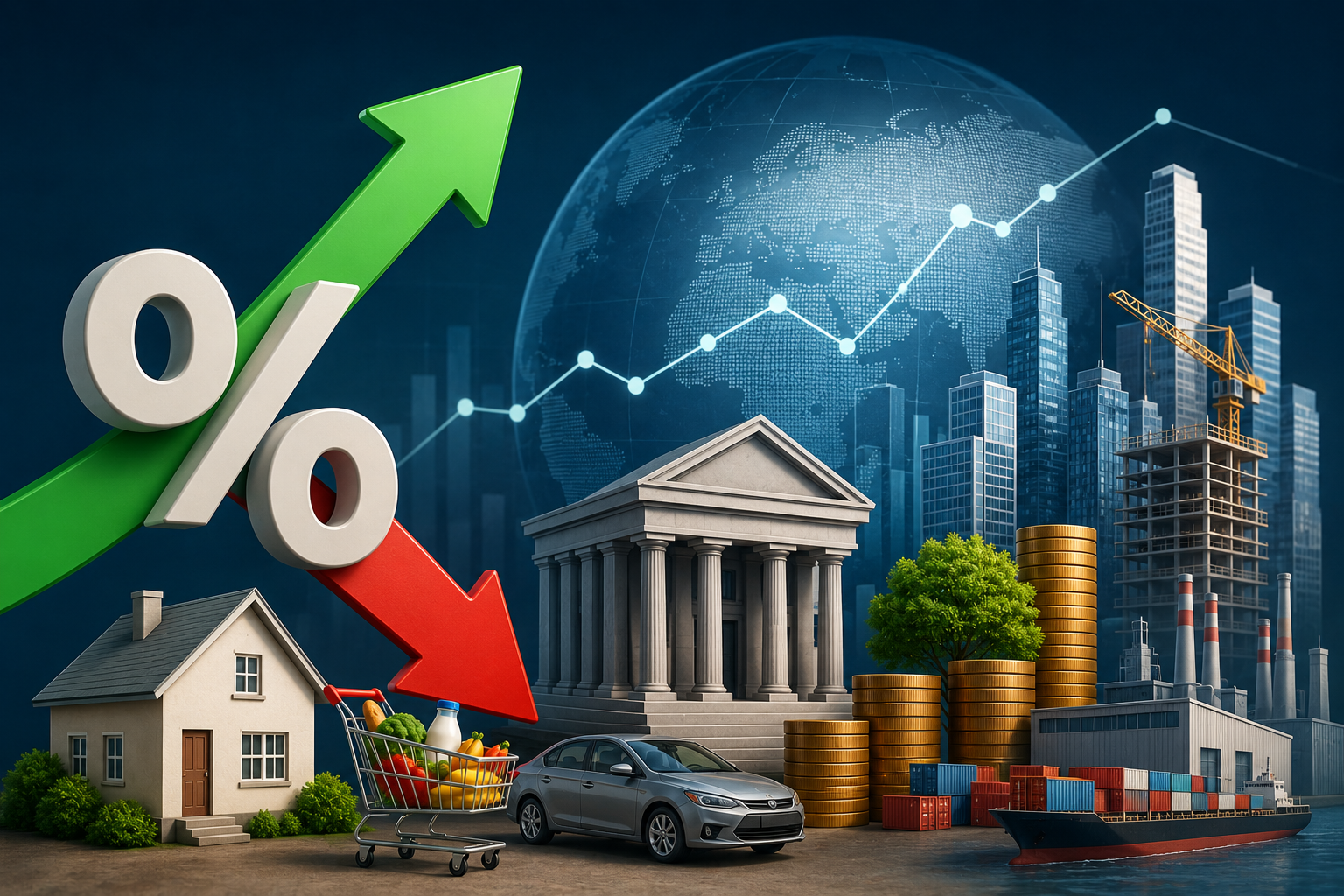
Interest rates represent the cost of borrowing money or the reward for saving it. They serve as the primary steering wheel for modern economies. When the economy runs hot, policymakers use rates as a brake. When growth stalls, they use rates as an accelerator.
This detailed guide explains exactly how interest rates ripple through the financial system, impact your personal wallet, and shape global business cycles.
The Core Mechanism: What Is the Policy Rate?
To understand how interest rates affect the economy, we must start at the source: the central bank. In the United States, this is the Federal Reserve. In the Eurozone, it is the European Central Bank.
Central banks do not directly set the interest rates on your credit cards or auto loans. Instead, they set a benchmark policy rate, known as the federal funds rate in the United States. This is the interest rate at which commercial banks lend money to one another overnight.
When the central bank adjusts this baseline overnight rate, a chain reaction occurs throughout the banking sector. Commercial banks adjust their prime rate, which is the baseline rate they offer to their most creditworthy corporate clients. From there, the shift filters down to consumer loans, variable mortgages, and savings account yields.
Contractionary vs. Expansionary Monetary Policy
Central banks move interest rates up or down based on economic conditions. These movements fall into two distinct strategies.
1. Contractionary Monetary Policy (Raising Rates)
When an economy grows too quickly, consumer demand can outpace supply, causing high inflation. To cool things down, central banks implement contractionary policy by raising interest rates.
By making borrowing more expensive, this policy intentionally slows down consumer spending and corporate investment, reducing the upward pressure on prices.
2. Expansionary Monetary Policy (Lowering Rates)
During an economic downturn or recession, central banks switch to expansionary policy by cutting interest rates. Lower rates make borrowing affordable, encouraging businesses to fund new projects, hire workers, and purchase equipment. For consumers, cheaper financing makes big-ticket items like houses and vehicles more accessible, stimulating overall economic activity.
How Interest Rates Shape Consumer Behavior
Consumer spending accounts for the largest share of economic output in most developed nations. Interest rate fluctuations alter household budgets in three main ways.
The Cost of Credit and Debt
When interest rates rise, the cost of carrying debt increases. If you hold a variable-rate credit card or a personal line of credit, your monthly interest charges move upward. This means a larger portion of your household income goes toward servicing debt, leaving less money for discretionary purchases like dining out, travel, or retail goods.
The Real Estate Market
The housing sector is highly sensitive to interest rate policy. Even a small 1% shift in a 30-year fixed mortgage rate can alter a homebuyer’s monthly payment by hundreds of dollars.
High Rates: Buyers see their purchasing power shrink, housing demand drops, and real estate appreciation slows down or reverses.
Low Rates: Mortgage affordability improves, buyers flood the market, and home prices generally rise due to increased competition.
Saving vs. Spending Incentives
Interest rates determine the reward for keeping cash in the bank. When rates are near zero, high-yield savings accounts and Certificates of Deposit (CDs) offer almost no return, pushing consumers to spend their cash or invest it in riskier assets like stocks. When rates rise, saving becomes an attractive option, drawing cash out of active circulation and into bank deposits.
Economic Variable
Impact of Rising Interest Rates
Impact of Falling Interest Rates
Mortgage Affordability
Decreases; monthly payments climb
Increases; monthly payments drop
Credit Card Fees
Annual Percentage Rates (APRs) increase
Annual Percentage Rates (APRs) decrease
Savings Account Yields
Higher returns on cash deposits
Lower returns on cash deposits
Consumer Spending
Slows down as borrowing costs rise
Accelerates as financing gets cheaper
The Corporate Impact: Business Investment and Employment
Just like households, corporations rely heavily on credit to fund their day-to-day operations and long-term strategic goals.
Capital Expenditures (CapEx)
When a corporation wants to construct a new manufacturing facility or invest in updated software architecture, it often issues corporate bonds or takes out commercial bank loans. Higher interest rates raise the hurdle rate, which is the minimum expected return a project must generate to justify its cost. If borrowing costs climb too high, executives will pause or cancel expansion plans, slowing down overall economic growth.
Employment and Wages
Business activity maps closely to hiring trends. When expansion projects stall due to high borrowing costs, hiring freezes follow. If rates stay elevated for an extended period, companies look to protect their profit margins by cutting operational costs, which can lead to layoffs and wage stagnation.
Conversely, cheaper credit gives businesses the financial flexibility to expand production pipelines and compete for labor, which drives down unemployment and pushes wages up.
Current Financial Context: Where Do Rates Stand Today?
Navigating the modern financial landscape requires tracking the real-time monetary policies of major central banks. Following years of sharp rate hikes designed to curb post-pandemic inflation, global economic policy entered a complex transition phase.
Global growth has shown unexpected resilience, holding steady around 3.3%. However, this stability masks major policy debates inside central banking circles:
The U.S. Dilemma: In the United States, economic policymakers face a clear division. While political figures frequently advocate for lower rates to accelerate growth, the Federal Reserve maintains a cautious stance. The Consumer Price Index (CPI) tracks above the target baseline at 3.8% year-over-year, keeping pressure on long-term Treasury yields.
The AI Productivity Debated Theory: A central debate in current monetary policy focuses on whether rapid technological advances, specifically in artificial intelligence (AI), can boost corporate productivity quickly enough to allow aggressive rate cuts without triggering a fresh wave of inflation.
Global Policy Divergence: While North American and European central banks look for opportunities to gradually ease rates as global headline inflation cools to 3.8%, other nations are moving in different directions. For instance, Japan has steadily raised its policy rate to move away from historical zero-rate environments.
How Interest Rates Direct Financial Markets
Asset classes react differently to changing interest rate environments, making macroeconomic policy a vital consideration for investment portfolio design.
Stocks and Equities
Generally speaking, rising interest rates put downward pressure on stock valuations for two primary reasons:
Lower Discounted Cash Flows: The intrinsic value of a stock is the present value of its future earnings. Higher interest rates increase the discount rate used by analysts, which lowers the calculated value of those future profits today.
Increased Competition for Capital: When corporate bonds and government securities offer reliable 4% or 5% yields, conservative investors shift their money out of volatile equity markets and into fixed-income assets.
Growth sectors, such as technology and biotechnology, are especially sensitive to high interest rates because their valuations rely heavily on projected earnings far out in the future.
Bonds and Fixed Income
The relationship between interest rates and bond prices is a fundamental financial law: they move in opposite directions.
If you hold an older bond paying a fixed 3% interest rate, and the central bank drives market rates up to 5%, your 3% bond becomes less attractive to buyers. To sell that bond on the secondary market, you must lower its price below par value to match current yields.
Bond Price & Interest Rate Relationship Simulator
See the fundamental financial law in action: watch how rising interest rates lower existing bond values.
Trading at a Discount
Estimated Current Market Price$0.00
Original issuance price was $1,000.
Annual Payout$0.00
Capital Gain/Loss$0.00
Input your bond specs and current market terms to see how secondary markets evaluate fixed-rate assets when central bank baselines pivot.
The Global Picture: Currency Values and International Trade
Interest rates also dictate how capital moves across international borders, affecting currency exchange rates and trade balances.
Currency Strength and Capital Flows
Global investors constantly hunt for the highest safe yields available for their capital. If a country raises its interest rates while other nations keep theirs flat, foreign capital moves toward that country to capture the higher returns on government bonds and financial deposits.
To make these investments, foreign buyers must purchase the local currency, driving up its demand and valuation on foreign exchange markets.
International Trade Competition
While a strong domestic currency lowers the cost of importing foreign goods, it introduces challenges for local exporters. A strong currency makes locally manufactured products more expensive for overseas buyers, which can hurt domestic industrial production and widen a nation’s trade deficit over time.
Summary: A Balancing Act
Interest rates are the primary lever used to balance economic growth against price stability. Low interest rates can kick-start a sluggish economy, but leaving them too low for too long can trigger runaway inflation and real estate bubbles. High interest rates are highly effective at suppressing inflation, but prolonged tightening risks stalling business investment and causing unemployment.
For households and business owners alike, tracking central bank statements and recognizing where we stand in the macroeconomic cycle is key to making informed financing, budgeting, and investment choices.
Deepen Your Financial Knowledge
To explore advanced monetary economic models and track live economic datasets, review these official research portals: