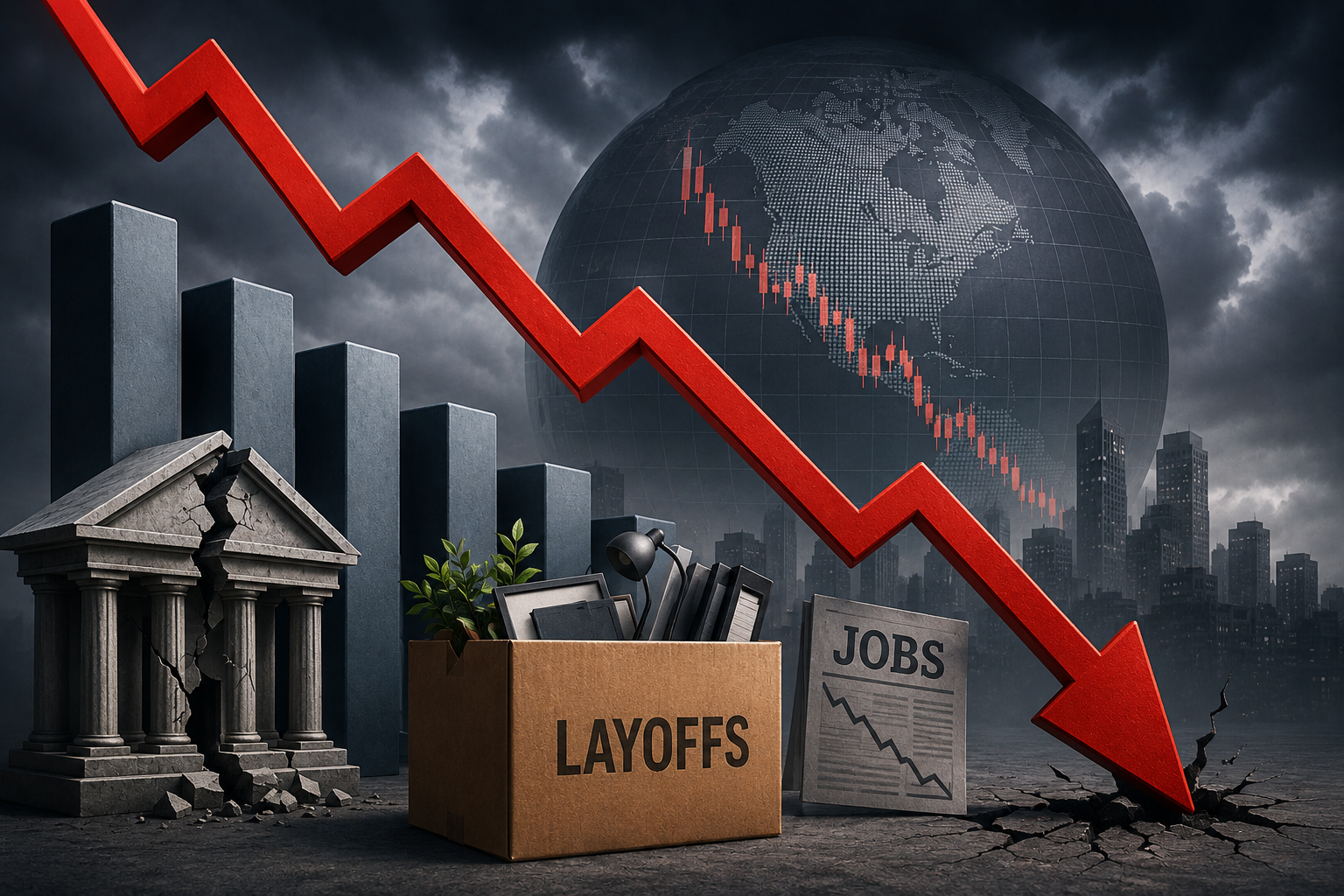
When the economy is booming, businesses hire rapidly, wages grow, and consumer confidence reaches new heights. However, economic expansions do not last forever. Eventually, the cycle pivots, and the economic engine begins to stall. This downward phase of the business cycle is known as a recession.
A recession is more than just a bad month of retail sales or a volatile week on the stock market. It is a systemic, widespread contraction that reshapes employment markets, asset valuations, and corporate survival rates.
Understanding what causes a recession is vital for safeguarding your personal finances, managing a business, and navigating long-term investment portfolios.
What Is a Recession? The Official Criteria
In casual conversation, people often define a recession using a popular rule of thumb: two consecutive quarters of declining Real Gross Domestic Product (GDP). While this technical definition serves as a useful benchmark, official declarations require a much deeper look.
In the United States, the official arbiter of recessions is the National Bureau of Economic Research (NBER). The NBER looks beyond GDP alone, defining a recession as a significant decline in economic activity spread across the economy, lasting more than a few months. They analyze a basket of real-time indicators to assess the depth, diffusion, and duration of a downturn.
Key Indicators Tracked by Economists
Real Personal Income: Tracks household earning power after adjusting for inflation.
Nonfarm Payrolls: Measures the structural health of the labor market and job creation.
Industrial Production: Monitors the output of manufacturing, mining, and utility sectors.
Wholesale-Retail Sales: Evaluates real consumer spending and business-to-business transaction volumes.
The Primary Triggers of a Recession
Recessions rarely stem from a single, isolated event. Instead, they occur when multiple economic pressures converge to break consumer and business confidence. The following factors represent the primary catalysts that historical data identifies as drivers of economic contraction.
1. Sudden Macroeconomic Shocks
An economic shock is an unpredictable, external event that severely disrupts supply chains, production capabilities, or consumer access.
Geopolitical conflicts serve as prime examples of macroeconomic shocks. When international tensions flare, they can shut down critical global shipping corridors or paralyze commodity trade. This immediate disruption cuts off access to raw inputs, driving production costs up while forcing a sharp drop in overall industrial output.
2. Aggressive Monetary Policy Tightening
Central banks hold the responsibility of keeping inflation under control. When consumer prices climb too quickly, policymakers respond by raising interest rates to cool economic activity.
However, over-correcting with interest rates is a delicate risk. If a central bank raises rates too aggressively or leaves them elevated for too long, borrowing costs spike for mortgages, credit cards, and business expansion loans. This contraction intentional or not can pull too much liquidity out of the market, causing corporate investment to drop and consumer spending to freeze.
3. Asset Bubbles Bursting
Asset bubbles occur when irrational exuberance drives the market price of specific investments, like real estate or technology stocks, far beyond their actual intrinsic value.
When the bubble inevitably pops, trillions of dollars in paper wealth vanish in a matter of weeks. This destruction of capital triggers the wealth effect in reverse: consumers feel poorer and instantly cut back on spending, while financial institutions tighten their lending standards to protect their balance sheets, starving the economy of credit.
4. Severe Inflation and Stagflation
While moderate inflation reflects a growing economy, runaway price increases act as a direct drag on growth. When essential goods like food, gasoline, and utilities skyrocket, households must divert money away from discretionary spending just to cover the basics.
If high inflation pairs with slowing economic growth, the economy enters a state of stagflation. This scenario leaves central banks with few good options: raising interest rates to fight inflation harms an already weak jobs market, while lowering rates to boost growth risks pushing consumer prices even higher.
5. Deflationary Spirals
Paradoxically, falling prices can be just as damaging to an economy as inflation. Deflation occurs when widespread prices drop due to a severe collapse in consumer demand.
When consumers see prices falling, they choose to delay major purchases, expecting goods to become even cheaper in the future. This drop in demand forces businesses to lower prices further, cut wages, and lay off workers to stay profitable. The resulting rise in unemployment reduces consumer demand even more, creating a self-reinforcing downward spiral.
Economic Trigger
Core Mechanism
Historical Example
Monetary Tightening
High rates cool down borrowing, investment, and hiring.
The early 1980s Volcker shock.
Asset Bubble Pop
Wealth destruction leads to sudden credit market freezes.
The 2008 Subprime Mortgage Crisis.
Macroeconomic Shock
Unexpected supply chain disruptions halt production lines.
The 1970s OPEC oil embargo.
Deflationary Spiral
Delayed purchasing stalls retail velocities and factory output.
The Great Depression.
Current Global Economic Context: 2026 Breakdown
Evaluating global economic data reveals why top institutional analysts are monitoring recession risk indicators closely. According to comprehensive reports published in the International Monetary Fund World Economic Outlook, the baseline estimate for global growth is slowing to 3.1%, with down-market risks dominating the macro horizon.
Several compounding pressures are currently testing the resilience of the global economy:
Geopolitical Oil and Commodity Shocks: Disruptions in the Middle East, particularly around the critical Strait of Hormuz, have caused energy prices to spike. Analytical worst-case models show that if these trade lanes remain obstructed, global oil prices could trade above $110 a barrel, pushing global inflation past 6% and forcing growth down to a precarious 2%.
Sovereign Debt and Interest Pressures: According to the World Bank Global Economic Prospects, rising public debt levels are driving up borrowing costs across emerging markets and developing economies. This creates a highly sensitive relationship: as debt-to-GDP ratios climb, sovereign credit spreads widen, reducing the fiscal capital governments have available to stimulate domestic growth.
Small Business and Consumer Vulnerabilities: Industrial updates indicate that small-to-medium enterprise (SME) recession anxiety has hit multi-year highs. Widespread energy overhead and supply chain friction are putting heavy pressure on profit margins. This economic strain leaves many firms vulnerable to stagflationary pressures as cost lines rise faster than baseline consumer demand.
How a Recession Spreads: The Domino Effect
An economic downturn rarely stays contained within its starting sector. It flows through a predictable domino effect, transforming an initial drop in demand into a widespread economic contraction.
The Corporate Retrenchment Phase
As sales drop and revenue pipelines shrink, corporate executives shift focus toward cutting costs. They scale back capital investments, cancel software integrations, and reduce inventory orders.
When these measures prove insufficient, companies turn to their largest operational expense: labor. Hiring freezes transition into structural layoffs, which ripples through the broader economy by removing consumer spending power.
The Consumer Credit Squeeze
As job security deteriorates, consumer confidence drops. Households cut discretionary spending, prioritizing debt service and core essentials like housing and food.
Concurrently, commercial banks notice the uptick in loan defaults and move to protect their asset portfolios. They raise credit card score minimums and tighten mortgage approvals, making it difficult for everyday consumers to access capital. This reduction in consumer credit further dampens retail demand.
2026 Global Growth Risk Simulator
Simulate how adjustments in global energy prices and escalating inflation levels pressure real-world global GDP projections based on standard economic modeling criteria.
Projected 2026 Global GDP Growth
3.1%
Target Trajectory
Crude Oil Price (per Barrel)$85
Global Headline Inflation4.4%
Historical Recessions vs. Typical Business Cycles
To keep a balanced perspective, it helps to remember that recessions are a routine component of a standard market economy. The modern economic landscape has survived multiple severe downturns, learning key structural lessons from each.
The 1970s Stagflation Era
Triggered by oil supply shocks, this era proved that inflation and high unemployment could coexist, challenging traditional Keynesian economic assumptions and reshaping modern central banking methods.
The 2008 Global Financial Crisis
Driven by a real estate bubble and complex derivative structures, this downturn highlighted the systemic risks of a highly leveraged banking system and led to the creation of stricter global financial regulations.
The 2020 Pandemic Contraction
An unprecedented health shock that caused the sharpest, fastest drop in economic history. However, it also resulted in a rapid recovery thanks to historic, coordinated fiscal and monetary stimulus programs worldwide.
Summary: Preparing for Changing Economic Tides
Recessions are painful, disruptive events, but they are also a natural phase of economic adjustment. They work to clear out unproductive corporate structures, correct speculative asset pricing, and reset the broader business cycle for its next expansionary run.
While you cannot influence central bank interest rates or prevent global supply chain shocks, you can take practical steps to insulate your personal financial life. Building a liquid cash reserve, paying down high-interest variable debt, and diversifying your income streams will keep your household secure when the macroeconomic climate shifts.
Deepen Your Macroeconomic Knowledge
For readers interested in analyzing raw datasets, historical policy papers, and real-time economic forecasting, visit these official institutional archives: