
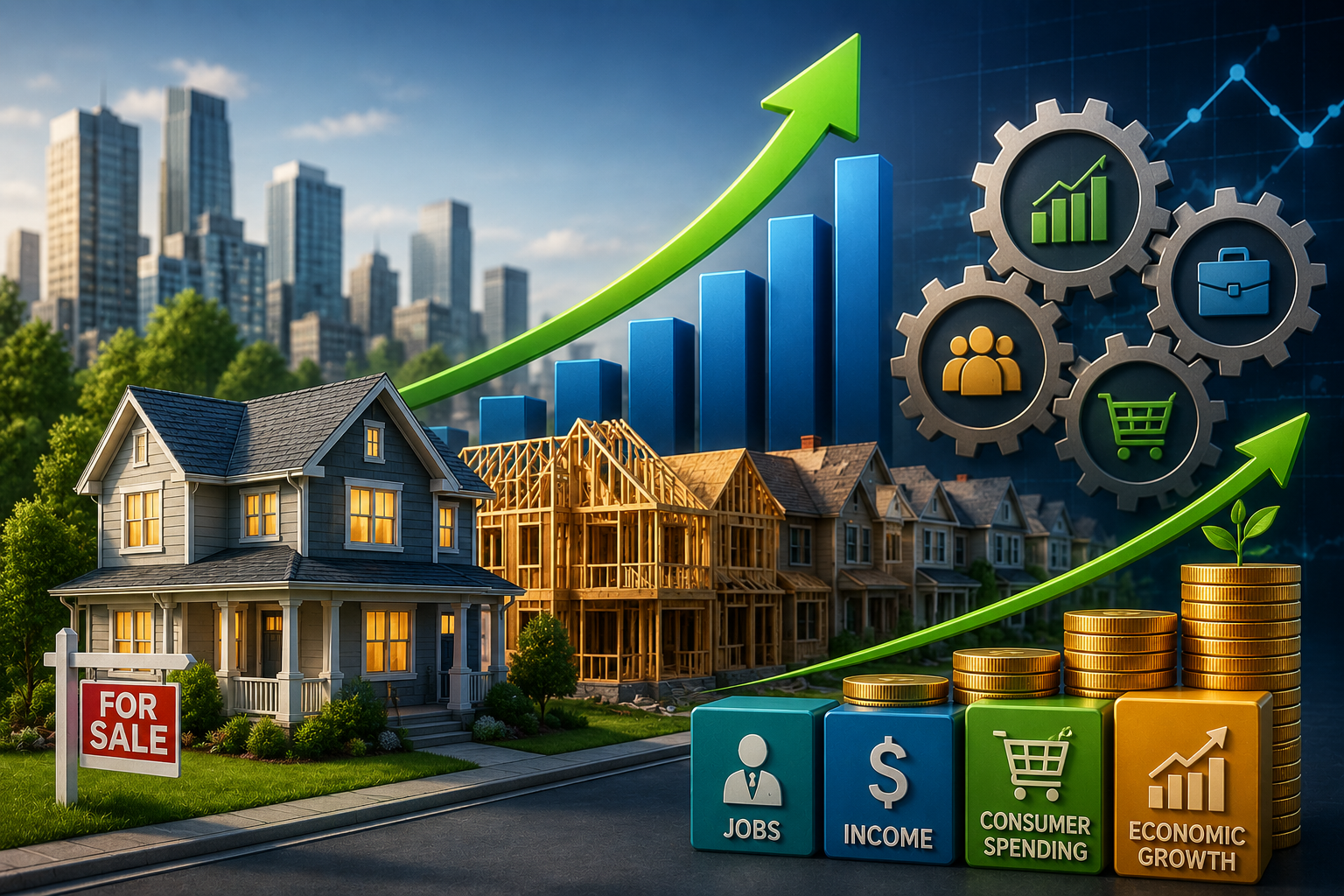
When we talk about the health of an economy, we often focus on gross domestic product (GDP) metrics, employment reports, and stock market movements. Yet, one of the most structural foundations of macroeconomic stability hides in plain sight: the residential real estate sector.
A house is rarely just a place to live. For the vast majority of households, real estate represents their largest single financial asset. Because shelter is a fundamental human need and a highly capital intensive investment, changes in real estate dynamics have a profound effect on the broader economy.
This guide explores the direct transmission lines between the housing market and macroeconomic health, backed by structural data, historical context, and current market shifts.
The Wealth Effect: How Property Valuations Dictate Consumer Behavior
One of the most immediate ways real estate influences broader economic performance is through a psychological and financial mechanism known as the wealth effect.
When home values rise consistently, property owners experience an increase in their perceived and actual net worth. Even if a homeowner does not sell their property or borrow against it, this paper wealth boosts financial security and increases the willingness to spend out of disposable income.
Conversely, when property valuations drop, a reverse wealth effect occurs. As home equity contracts, families become more financially defensive. They pull back on discretionary spending, increase their personal savings rate, and postpone major purchases.
Because consumer spending drives roughly 70% of total economic activity in advanced nations like the United States, even a minor downward turn in property sentiment can slow down wide swathes of the retail, hospitality, and automotive sectors.
Direct and Indirect Contributions to GDP
The real estate footprint impacts gross domestic product through two specific pathways: residential investment (direct contribution) and housing services spending (indirect contribution).
1. Residential Investment
This encompasses all direct building activity within an economy. It covers:
- The construction of new single-family and multi-family housing units.
- Residential structural remodeling and property additions.
- Brokerage commissions and transaction fees generated by property sales.
Every time a developer breaks ground on a new subdivision, it sparks localized demand for civil engineers, contractors, carpenters, and electricians. Simultaneously, it triggers bulk purchasing cycles for raw industrial goods, including lumber, concrete, copper wiring, and steel.
2. Housing Services
This represents an ongoing, massive slice of economic activity. It consists of gross rent paid by tenants, alongside the imputed rent of owner-occupants (the estimated rental value that homeowners would pay to rent their own homes). According to the Bureau of Economic Analysis, combined housing services and residential investment routinely account for 15% to 18% of total US GDP.
| GDP Sector Component | Economic Nature | Primary Business Drivers |
| Residential Investment | Highly Cyclical | Interest rates, land availability, permitting speed |
| Housing Services | Non-Cyclical / Stable | Population growth, demographic trends, urbanization |
| Downstream Retail | Lagging Echo | Home sales volume, furniture outlays, appliance cycles |
The Banking System and Credit Creation Channels
Modern financial structures link the real estate sector directly to the commercial banking sector. Mortgages serve as the primary source of private sector credit creation in most advanced economies.
When a bank approves a residential loan, it doesn’t simply transfer pre-existing money; it extends credit, expanding the aggregate money supply flowing through the real economy. A healthy, liquid property market allows capital to rotate efficiently. Homeowners can use cash-out refinancing or home equity lines of credit (HELOCs) to secure funds for starting new businesses, financing higher education, or paying for medical procedures.
However, this reliance on real estate debt creates a structural vulnerability. If property values drop below the outstanding mortgage debt balance, millions of loans can fall into negative equity. This asset impairment weakens commercial bank balance sheets, causing banks to restrict lending criteria across all business sectors, which can trigger an economic recession.
Current Real-World Context: The Interest Rate Dilemma
Analyzing today’s real estate environment illustrates these systemic trade-offs in real time. Following a historic global tightening cycle by major central banks like the Federal Reserve and the Reserve Bank of Australia, the property market has entered a highly bifurcated phase.
According to reports from the National Association of Realtors (NAR), persistently elevated mortgage rates sitting in the 6.5% to 6.7% zone have structurally altered market momentum. Existing home transaction volumes have cooled as a lack of affordable supply leaves buyers on the sidelines, prompting macro economists to lower their near-term transaction growth forecasts.
This regional variance is heavily tied to local supply constraints. In areas where structural undersupply collides with rapid net migration, prices continue to climb despite high interest costs.
In contrast, markets with less demographic pressure are experiencing flattening or slightly negative returns as consumers struggle to service high mortgage payments. This dynamic forces central bank boards to balance their approach: keeping interest rates elevated enough to cool persistent inflation while avoiding a sharp real estate downturn that could destabilize broader household consumption.