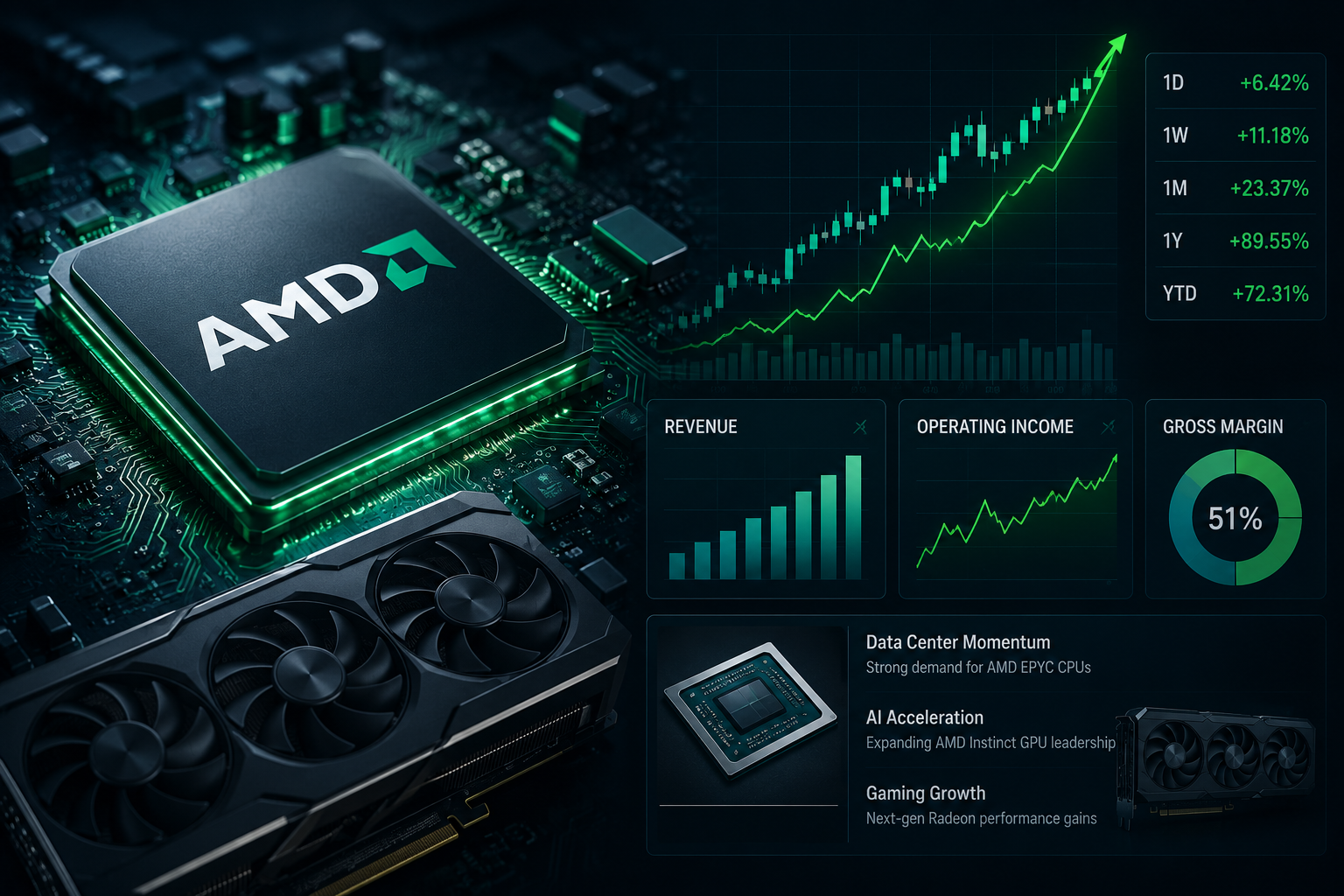
Advanced Micro Devices, Inc. (NASDAQ: AMD) is an American semiconductor company that designs central processing units (CPUs), graphics processing units (GPUs), and adaptive computing chips used in personal computers, gaming consoles, data centers, and AI infrastructure. Founded in 1969 by Jerry Sanders and a group of engineers from Fairchild Semiconductor, AMD spent decades as Intel’s smaller rival before reinventing itself under CEO Lisa Su, who took over in 2014.
Today AMD is one of the most closely watched stocks in the artificial intelligence buildout. Its Data Center segment, powered by EPYC server processors and Instinct AI accelerators, has become the company’s primary growth engine, with multi year GPU supply deals now in place with OpenAI and Meta. AMD does not pay a dividend and instead reinvests cash flow into research and development and share buybacks. Below you will find AMD’s business segments, revenue breakdown, financial performance, stock data, dividend policy, competitors, and the most recent company news, along with answers to common investor questions.
AMD Quick Facts
Full legal name
Advanced Micro Devices, Inc.
Ticker symbol
AMD on the Nasdaq Global Select Market
Founded
May 1, 1969, in Sunnyvale, California
Founder
Jerry Sanders, with seven colleagues from Fairchild Semiconductor
CEO
Dr. Lisa Su (Chair and Chief Executive Officer since October 2014)
Headquarters
2485 Augustine Drive, Santa Clara, California
Industry
Semiconductors, computer hardware
Main products
Ryzen and Threadripper CPUs, EPYC server processors, Radeon and Instinct GPUs, Xilinx FPGAs, Pensando data processing units
Advanced Micro Devices, known almost everywhere by its initials, is one of the two dominant designers of x86 computer processors, alongside Intel, and one of the leading suppliers of graphics chips, alongside NVIDIA. AMD does not usually manufacture its own chips. Like most modern semiconductor companies, it is fabless, meaning it designs the chips and then contracts factories such as Taiwan Semiconductor Manufacturing Company (TSMC) to physically produce them.
The company’s products sit inside an unusually wide range of devices for a single chipmaker: everyday laptops and desktop PCs, gaming consoles including the PlayStation and Xbox families, corporate data center servers, supercomputers, and now the AI accelerator clusters that large technology companies are building to train and run artificial intelligence models. That last category, AI focused data center hardware, has become the single biggest driver of AMD’s growth and investor interest since 2023.
AMD was incorporated on May 1, 1969, and began operations that September from a small facility in Sunnyvale, California. Its first product was the Am9300, a basic 4 bit shift register, launched in 1970. For much of the 1970s and 1980s, AMD operated as a second source manufacturer, producing chips designed by other companies, including Fairchild and National Semiconductor, under strict military grade quality standards.
A pivotal moment came in 1982, when AMD signed a technology exchange agreement with Intel that allowed it to produce processors compatible with Intel’s x86 architecture. That relationship soured into a lengthy legal dispute during the late 1980s, but AMD eventually secured the right to keep building x86 compatible chips, a decision that shaped the entire personal computer industry by keeping two major suppliers in the market instead of one.
The 1999 launch of the Athlon processor marked AMD’s first real technical lead over Intel in raw performance. The company built on that momentum through the early 2000s before running into difficult years during the late 2000s and early 2010s, a period marked by heavy losses, the 2009 spinoff of its manufacturing arm into a separate company called GlobalFoundries, and repeated struggles to keep pace with Intel.
The turnaround began in 2014 with the appointment of Lisa Su as CEO. Her strategy focused on disciplined product roadmaps, the 2017 launch of the Ryzen CPU line, and the 2022 acquisition of FPGA maker Xilinx in a deal valued at roughly 35 billion dollars. That acquisition gave AMD adaptive computing chips used in aerospace, telecommunications, and industrial equipment, broadening the company well beyond PCs and gaming. Since 2023, AMD has leaned heavily into artificial intelligence hardware, culminating in large scale, multi year GPU supply agreements with OpenAI and Meta announced in late 2025 and early 2026.
AMD was founded by Walter Jeremiah Sanders III, known professionally as Jerry Sanders, together with seven colleagues who left Fairchild Semiconductor with him in 1969. The founding group is generally listed as Jerry Sanders, Ed Turney, John Carey, Sven Simonsen, Jack Gifford, Frank Botte, Jim Giles, and Larry Stenger. Their initial capital was reported at around 100,000 dollars.
Sanders, a former marketing executive at Fairchild, served as AMD’s president and chief executive officer from its founding until 2002, then remained chairman of the board until 2004, a run of 35 years with the company he helped start. He was known for an unusually people focused management style for the era, introducing profit sharing and broad employee stock ownership at a time when neither was common in Silicon Valley, and for refusing to conduct layoffs during the recessions of the 1970s. AMD went public on September 27, 1972, at 15.50 dollars per share, raising 7.5 million dollars in its initial public offering.
Dr. Lisa Su has served as president and chief executive officer of AMD since October 2014 and currently also holds the title of chair of the board. Born in Taiwan and raised in the United States, Su holds three degrees from the Massachusetts Institute of Technology, including a doctorate in electrical engineering. Before joining AMD in 2012, she held engineering and management roles at Texas Instruments, IBM, and Freescale Semiconductor.
Su became AMD’s first female CEO and is widely credited with engineering one of the more notable turnarounds in the semiconductor industry, taking a company that was near financial distress in the early 2010s and rebuilding it into a leading supplier of PC, server, and AI accelerator chips. She is known among colleagues for a demanding, detail oriented management style and for personally driving AMD’s product roadmap decisions, including the bet on chiplet based CPU designs that underpins the modern Ryzen and EPYC product lines.
We have strong and increasing confidence in reaching tens of billions of dollars in annual Data Center AI revenue, with a long term growth target exceeding 80 percent per year.
Dr. Lisa Su, AMD Chair and CEO, Q1 2026 earnings call
AMD’s corporate headquarters is located at 2485 Augustine Drive in Santa Clara, California, in the heart of Silicon Valley, a short distance from rivals Intel and NVIDIA. The company originally began operations in Sunnyvale, California in 1969 before later relocating its main campus to Santa Clara. AMD also operates major design and engineering centers in Austin and Markham, Texas; Boise, Idaho; Markham, Ontario in Canada; and significant international offices in Hyderabad and Bangalore, India, Penang, Malaysia, and Shanghai and Beijing in China.
AMD reports its results across four business segments. Each targets a different type of customer, from everyday PC buyers to the world’s largest cloud computing companies.
Data Center
EPYC server CPUs and Instinct AI accelerators sold to cloud providers, enterprises, and government customers. Currently AMD’s largest and fastest growing segment.
Client
Ryzen and Threadripper processors for consumer and commercial desktops and laptops, sold through PC makers such as Dell, HP, and Lenovo.
Gaming
Radeon graphics cards for PC gamers plus semi custom chips that power game consoles, including long running supply agreements with Sony and Microsoft.
Embedded
Adaptive and embedded chips, largely from the 2022 Xilinx acquisition, used in aerospace, defense, industrial automation, automotive, and telecommunications equipment.
Ryzen: mainstream CPUs for laptops and desktops, AMD’s highest volume consumer product line.
Threadripper: high core count CPUs aimed at content creators and workstation users.
EPYC: server grade CPUs used in data centers, sold under code names such as Genoa, Turin, and the upcoming sixth generation platform known as Venice.
Instinct: data center GPUs and AI accelerators, including the MI300, MI350, and the newly launched MI450 series built to compete directly with NVIDIA’s data center GPUs.
Radeon: graphics cards for PC gaming and content creation.
Xilinx FPGA and adaptive SoC lines: including the Versal, Virtex, Kintex, Artix, and Spartan families acquired with Xilinx in 2022.
Pensando: data processing units (DPUs) used to accelerate and secure networking inside data centers.
Helios: AMD’s rack scale AI system architecture, combining Instinct GPUs, EPYC CPUs, and Pensando networking into a single deployable unit for large AI customers.
ROCm: AMD’s open source software platform for programming its GPUs for AI and high performance computing workloads, positioned as an alternative to NVIDIA’s CUDA.
In its most recently reported quarter, AMD generated 10.3 billion dollars in total revenue, up 38 percent from the same quarter a year earlier. Data Center has grown into the clear centerpiece of the business, now accounting for more than half of company revenue.
Revenue by Segment, Q1 Fiscal 2026
Total revenue: approximately 10.3 billion dollars
Data Center$5.8B
Client$2.9B
Gaming$0.72B
Embedded$0.87B
Source: AMD Q1 fiscal 2026 financial results, reported May 5, 2026. Bar widths are scaled to segment share of total revenue.
Segment growth trends
Data Center revenue rose 57 percent year over year, driven by EPYC server CPU demand tied to agentic AI workloads and early Instinct MI350 shipments.
Client revenue rose 26 percent year over year on strong Ryzen sell through, with commercial PC shipments up more than 50 percent as Dell, HP, and Lenovo expanded their AMD lineups.
Gaming revenue rose 11 percent year over year, helped by Radeon GPU demand, partly offset by lower semi custom console chip revenue.
Embedded revenue rose 6 percent year over year, returning to growth after several quarters of decline, led by test and measurement, aerospace and defense, and communications customers.
AMD’s financial results have accelerated sharply since 2023 as AI related data center demand ramped up. The table and chart below summarize the most recently reported quarter alongside guidance for the following quarter.
$10.3BQ1 2026 revenue
+38%Revenue growth, YoY
55%Non GAAP gross margin
$1.37Non GAAP diluted EPS
Quarterly Revenue Trend
In billions of U.S. dollars, non GAAP figures where applicable
Reported quarterMost recent quarter
Figures rounded to the nearest 100 million dollars based on AMD quarterly earnings reports. Fiscal quarters shown roughly align with calendar quarters.
Balance sheet and cash flow
Cash, cash equivalents, and short term investments stood at 12.3 billion dollars at the end of the most recent quarter.
Free cash flow reached a record 2.6 billion dollars for the quarter, about 25 percent of revenue.
AMD generated 3.0 billion dollars of operating cash flow during the quarter.
The company guided second quarter 2026 revenue to approximately 11.2 billion dollars, plus or minus 300 million dollars, which would represent roughly 46 percent year over year growth, with non GAAP gross margin guided near 56 percent.
AMD trades on the Nasdaq Global Select Market under the ticker AMD. The stock has been one of the strongest performers among large cap technology names in 2026, driven largely by optimism around the company’s AI accelerator roadmap and its new supply agreements with OpenAI and Meta.
~$518Recent share price
~$844BMarket capitalization
$133.5052 week low
$584.7352 week high
Key Stock Statistics
Exchange
Nasdaq Global Select Market
Trailing P/E ratio
Roughly 170 to 190, well above the semiconductor sector average, reflecting high growth expectations
Forward P/E ratio
Roughly 75 to 80
Revenue (trailing twelve months)
Approximately 37.5 billion dollars
Profit margin
Approximately 13 percent
2026 year to date performance
Up more than 150 percent as of early July 2026
Shares outstanding
Approximately 1.6 billion
Note that share price, market capitalization, and valuation ratios change constantly during trading hours. The figures above are a snapshot from early July 2026 and should be checked against a live quote source such as Nasdaq, Yahoo Finance, or your brokerage before making any investment decision.
AMD does not currently pay a dividend and has never paid one in its history as a public company. Management has consistently chosen to reinvest cash flow into research and development, manufacturing capacity commitments with partners such as TSMC, and strategic acquisitions, rather than returning cash to shareholders through dividends.
Instead of dividends, AMD returns some capital to shareholders through share buybacks. The company repurchased 221 million dollars of stock during the most recently reported quarter and had roughly 9.2 billion dollars remaining under its active buyback authorization. Investors looking for dividend income from the semiconductor sector typically look toward more mature chip companies rather than AMD, which remains firmly positioned as a growth stock.
AMD competes across several distinct markets at once, which means its competitive set changes depending on the product line.
Competitor
Primary overlap with AMD
NVIDIA
Dominant rival in data center GPUs and AI accelerators, the single most important competitive relationship for AMD’s growth story
Intel
Long time rival in x86 CPUs for both consumer PCs and data center servers
Qualcomm
Competes in laptop processors through ARM based chips and in some embedded and mobile markets
Broadcom
Competes in custom AI chips and networking silicon for hyperscale data centers
Marvell Technology
Competes in custom silicon and data infrastructure chips for cloud customers
NVIDIA remains AMD’s most consequential competitor by far. NVIDIA holds a commanding lead in AI accelerator market share and benefits from its CUDA software ecosystem, which is deeply embedded in AI research and development. AMD’s ROCm software platform has closed much of that gap but is still viewed by many industry analysts as less mature than CUDA. Intel remains the more direct comparison in traditional PC and server CPUs, where AMD has steadily gained market share over the past decade under Lisa Su’s leadership.
Stock pulls back from record high amid broader chip sector volatility
After touching an all time high above 580 dollars per share in the second half of June 2026, AMD stock fell sharply in the following days along with other AI linked semiconductor names, as some investors began questioning how quickly the AI capital spending cycle can continue at its current pace. Despite the pullback, AMD remains up more than 150 percent year to date.
May 2026
AMD reports blowout first quarter, guides for accelerating growth
AMD posted first quarter fiscal 2026 revenue of 10.3 billion dollars, up 38 percent year over year and above the high end of its own guidance range, driven by Data Center strength. The company guided second quarter revenue to about 11.2 billion dollars, implying roughly 46 percent annual growth, ahead of what analysts had expected.
February 2026
Meta signs six gigawatt, multi year AMD GPU supply deal
AMD and Meta announced an expanded partnership covering up to six gigawatts of AMD Instinct GPU capacity across multiple future chip generations, with the first shipments of a custom MI450 based GPU expected in the second half of 2026. The agreement includes performance based stock warrants for Meta tied to delivery and technical milestones, mirroring a similar structure AMD used in its earlier OpenAI agreement.
October 2025
OpenAI commits to six gigawatts of AMD Instinct GPUs
AMD and OpenAI announced a multi year, multi generation agreement covering six gigawatts of AMD GPU capacity, with the first one gigawatt deployment of MI450 series chips scheduled to begin in the second half of 2026. The deal positioned AMD as a core compute partner for one of the world’s largest AI companies and was a major catalyst behind the stock’s rally over the following months.
News section reflects publicly reported developments as of early July 2026. For the very latest headlines, check AMD’s official newsroom at amd.com or a live financial news source.
AMD stands for Advanced Micro Devices, Inc. The company was founded in 1969 and is headquartered in Santa Clara, California.
Who is the CEO of AMD?
Dr. Lisa Su has been AMD’s president and chief executive officer since October 2014. She also serves as chair of the board of directors.
Does AMD pay a dividend?
No. AMD has never paid a cash dividend in its history as a public company. It returns capital to shareholders through share buybacks instead, and reinvests the majority of its cash flow into research, development, and growth.
Who founded AMD?
AMD was founded on May 1, 1969, by Jerry Sanders along with seven colleagues who left Fairchild Semiconductor together: Ed Turney, John Carey, Sven Simonsen, Jack Gifford, Frank Botte, Jim Giles, and Larry Stenger.
What is AMD’s biggest competitor?
NVIDIA is AMD’s most important competitor in data center GPUs and AI accelerators, the fastest growing part of AMD’s business. Intel remains AMD’s longtime rival in traditional CPUs for PCs and servers.
Is AMD stock a good buy right now?
This is not investment advice. AMD trades at a high valuation relative to most of the semiconductor sector, reflecting strong expected growth from AI data center demand, its OpenAI and Meta supply agreements, and market share gains in server CPUs. At the same time, the stock carries meaningful risk from its dependence on continued AI capital spending by a small number of large customers, competition from NVIDIA, and its reliance on TSMC for manufacturing. Anyone considering an investment should review AMD’s official filings with the U.S. Securities and Exchange Commission and speak with a licensed financial advisor.
Where is AMD headquartered?
AMD’s corporate headquarters is located at 2485 Augustine Drive, Santa Clara, California, in Silicon Valley.
What are AMD’s main products?
AMD’s main product lines are Ryzen and Threadripper CPUs for PCs, EPYC CPUs for servers, Instinct GPUs for AI and data centers, Radeon GPUs for gaming, and adaptive FPGA chips inherited from its 2022 acquisition of Xilinx.
Disclaimer: This article is for informational and educational purposes only and does not constitute financial, investment, or legal advice. Stock prices, market capitalization, valuation ratios, and other financial figures change continuously and the values presented here reflect a snapshot from early July 2026 based on publicly available sources. Always verify current figures directly with AMD’s investor relations site, official SEC filings, or a live market data provider before making any investment decision. Past performance does not guarantee future results.
Sources referenced: AMD Q1 fiscal 2026 earnings release and earnings call transcript (May 5, 2026); AMD and OpenAI strategic partnership announcement (October 2025); AMD and Meta strategic partnership announcement (February 24, 2026); Yahoo Finance and Robinhood AMD stock data (July 2026); Wikipedia entries for AMD and Jerry Sanders; AMD corporate newsroom at amd.com.